Álvaro M. Sampaio, Carina Lopes, Adriana Santos, André Lima, António J. Pontes (2023). Design for the combination of additive manufacturing parts with products already developed – An hybrid design approach. In: Human Aspects of Advanced Manufacturing. AHFE Open Access, vol. 80, pp. 218–227. https://doi.org/10.54941/ahfe1003524
The geometric freedom allowed by additive manufacturing (AM) has driven the development of products based on human-centric design through functional and aesthetic customization. The combination of personalised AM parts with products already developed is a disruptive and flexible approach that may create optimized product-user interactions. For this, critical comprehension on the manufacturing process is required to ensure appropriate mechanical connection between the new and existing components of the product. This paper addresses a method for product optimization based on this hybrid design approach. A specific case of a musical instrument that was redesigned for greater ergonomic compatibility with users was considered to describe the sequential development steps.
Additive manufacturing (AM) comprises a set of versatile manufacturing technologies that enable the design, development and production of parts with highly complex geometries that could not otherwise be obtained (Hajare and Gajbhiye, 2022). This flexibility is propelling its use in the production of daily consumer goods and technical functional parts for a variety of industries (e.g., automotive, aerospace) (Hajare and Gajbhiye, 2022). Additionally, the potential of AM for mass product customization has led engineers and desi- gners to overcome technological obstacles and therefore reach innovative developments which enable new interactions. These new interactions were somewhat achieved by different strategies that created the possibility to per- sonalized products that, therefore, enhanced the performance of the user. These strategies where centered in: (i) the development of new products that were design from the evaluation of the problems and needs of the user, in their relationship with the product; (ii) by the development of add-ons that
Design for the Combination of Additive Manufacturing Parts 219
could be enclosed in the existent product, overcoming the major issues in the interactions; (iii) and, by resorting to the development of parts of the pro- duct that could be replaced by new optimized ones. All of these strategies prescribed AM as the manufacturing process to achieve the required goal, mainly since AM enables design freedom, fast manufacturing and the pro- duct/part personalization. This paper focus on main topics of an ongoing research with the overall aim of describing a method for non-conventional design and manufacturing processes for the development of hybrid products. It is centered in the design and manufacturing of individual parts of the pro- duct, that could support enhanced interactions by product personalization and the production through AM technologies. Therefore, in this paper it is discussed and presented the definition of the concept of hybrid products, the main issues involved in the concept and the production by AM. It is also pre- sented the specific case of a musical instrument, with the main requirements for the development and, the method that was employed to overcome the challenges imposed by the AM process characteristics.
HYBRID PRODUCTS CONCEPT Hybrid products was defined as products composed by two or more mate- rials produced in a single process or by embedding inserts, by means of AM (Lima et al. 2017, Sampaio et al. 2019). In general, this concept was dedicated to the strategy of embedding external components in an AM build process that involved, (i) the design of a part with a specifically designed cavity to accept the external component, (ii) pausing the print in the “middle”of manu- facturing process, (iii) inserting the external component into the designed cavity, and (iv) restarting the manufacturing over the inserted component. Past examples can be seen in the work of Meisel, et al. (2014), Willis, et al. (2012), Lima et al. (2017) and Sampaio et al. (2019).
More recently it was introduced the concept of hybrid products as a result of the combination of a hybrid manufacturing process based on the com- bination of AM processes with conventional injection moulding through overmoulding steps (Sampaio et al. 2022). This concept is related to the innovative aspects of AM processes which, when explored, can increase and augment conventional manufacturing an facilitate the next generation of customized products. The combination of processing technologies or hybrid manufacturing is a solution to overcome obstacles by combining processes advantages and overcoming product limitations (Sampaio et al. 2022).
The possibility of combining AM parts with products already developed also emerged on a hybrid approach. It supposes the redesign and produ- ction of individual parts of the product, taking advantage of the geometric freedom of the additive fabrication, for effective integration into existing products. This concept is a modern solution for the production of spare parts needed for repair and maintenance operations. Through this method, a more flexible and efficient supply chain is guaranteed avoiding logistical constraints of physical inventories. The integration of AM parts into conven- tional products also enables personalization and, therefore, the adaptation
and optimization of the product to specific users, which is particularly impor- tant for tangible interactions, where multiple pushing, grabbing, and holding movements are implicit. This personalization gives added-value to products, which is considered a differentiating factor for most companies (Torn and Waneker, 2019).
One particular characteristic of all these concepts is that the need to think on design for assembly is presented. These non-conventional proce- dures require in-depth understanding on the mechanical connections and fittings existing between the AM parts and the product already developed to ensure aesthetics and functionality in the end. Comprehend the geometric and dimensional accuracy enabled by AM, which is dependent on the techno- logy, equipment and manufacturing parameters is, therefore, a fundamental topic addressing the hybrid method (Roth et al. 2022). Of all AM techno- logies, Selective Laser Sintering (SLS) was elected for this study due to the higher geometric flexibility it allows (Ben et al. 2017).
SELECTIVE LASER SINTERING Based on the Powder Bed Fusion concept, SLS was one of the first AM tech- nologies available on the market (Gibson et al. 2010; ASTM, 2012). In SLS, a laser source is used to fuse powder particles that are successively deposi- ted over a building platform to create parts from a digital CAD file (ASTM, 2012; Lopes et al. 2021). In regions of the powder bed where no sintering or fusion is programmed, the powder particles remain loose to support the parts being produced, which gives SLS high design flexibility and consistent surface quality comparing to other fabrication processes (Ben et al. 2017). To enable designers to take full advantage of such inherent geometric freedom within the process capabilities and constraints, several design guidelines for SLS are being established and updated over the years (Allison et al. 2019). For laser-sintering of conventional polymeric materials, such as polyamides, standard guidelines suggest the design of parts with minimum wall thickness of 0.7 mm, minimum holes diameter of 1.5 mm, minimum features size of 0.8 mm and minimum clearance of 0.3 mm for moving parts (Ben et al. 2017; Minetola et al. 2020). In turn, as this technology resorts to powder mate- rial that is exposed to successive heating-cooling cycles and complex energy phenomena, the manufactured parts are prone to shrinkage and warpage and, consequently, they depict dimensional inaccuracies in most cases (Singh et al. 2019). Studies in this field have shown that there is a series of printing characteristics in SLS which prevents the production of parts with desired dimensional and geometric characteristics, being necessary to in practice adjust theoretical design guidelines (Allison et al. 2019; Minetola et al. 2020). Trial runs using test artifacts with various features with different sizes are often necessary to ultimately fabricate parts with a tolerance suited to their application, depending on the settings defined for each building job (Weiss et al. 2018; Singh et al. 2019). The geometry of the part is a critical issue in SLS with well-known impact in the manufacturing process. The geometry of the part defines the cross-sectional area in each layer which influences the duration and number of times that the laser beam acts on the surface of the
Design for the Combination of Additive Manufacturing Parts 221
powder bed, and, therefore, the thermal gradient created during the manu- facturing. Undesired dimensional deviations are mostly observed in thicker parts, i.e., with larger cross-section, as they retain more energy during the manufacturing process, as opposed to thinner parts that guarantee greater energy dissipation (Ben et al. 2017). For instance, the clearance needed to design moving parts is dependent on their geometry, as the value needs to be gradually increased with the increasing of the wall thickness due to the phenomenon of secondary sintering observed in surrounding powder parti- cles (Ben et al. 2017). Owing to the complex dependence of the dimensional accuracy on a variety of factors, more research to understand the tolerances enabled by the manufacturing process in each building job is necessary as it is of key importance to produce near-net shaped parts by SLS (Minetola et al. 2020). Based on exploratory research, methodologies describing funda- mental development stages may be established with the objective of helping engineers and designers to conceive products with dimensional and geome- tric accuracy suited to the application purpose. As aforementioned, this is essential condition to create hybrid solutions by combining AM parts with others produced with different fabrication processes.
METHOD FOR PRODUCT OPTIMIZATION This section presents the method involved in the design, development and production of hybrid products obtained through the combination of opti- mized AM parts with products already developed. The method consists of six main steps, from preliminary product and user needs understanding until prototyping, testing and final assembling (Figure 1). A specific case-study was used to in detail describe the development steps, highlighting the sequence of activities embracing each one.
Figure 1: Steps of the product optimization method.
Figure available in the original PDF paper.
Case-Study – Background Musical instruments are products in which additive manufacturing has a major field of applications. Although some developments have already been done, optimized solutions to overcome interaction difficulties have not yet been fully researched and achieved. Interaction difficulties are ergonomic incompatibilities that increase users’ efforts to push, grab, hold, and there- fore play the instrument. This is the case of optimizations, or customizations, to instruments to be used by people with non-conventional usage (e.g., disa- bilities), thus this case-study is centered on the design and development of a trumpet that can be played differently from the conventional use (i.e., with a different hand or with just one hand). A trumpet is an instrument of force,
whose air pressure and speed, embouchure force, and tube length are funda- mental pillars of its personality. The instrument is played with both hands, where the right hand is responsible for the musical notes and the left is used to support the instrument. In terms of design, although the major advances in terms of manufacturing processes, very little evolution has been made to the instrument. A trumpet is a musical instrument of wind, generally produced in brass, with a pipe of 1 to 2 meters, being the smallest instrument in the metal family, but the one that has the most acute and penetrating register of all instruments. The instrument is a cylindrical metal tube three-quarters of its length, becoming conical along the length and ending in a bell.
In the next sections the main issues and objectives concerning the design of an optimized trumpet based in the concept of hybrid products and produced by SLS is presented and discussed.
First Step – Product Understanding The first step of the method is focused on a complete understanding of the product, both in terms of form and function. Comprehension on these topics can be achieved by resorting to physical or digital models of existing pro- ducts and by collecting information from users’ perspective and experience. In the specific case of the musical instrument, main targets included under- standing the functionality of the trumpet, typical interaction with the users, main components and its function (e.g., mouthpiece, pistons, tunning slide, valves), and requirements for sound production. Through a comprehensive analysis and critical observation and interaction with the instrument, some potentialities for product optimization were identified. In this regard, it was found that standard geometric configurations are ergonomic for players who press pistons for the musical notes with the right hand and hold the instru- ment with the left hand. For left-handed players, holding the trumpet with the right hand is a difficult task as the second valve restricts a comfortable interaction with the instrument. This interaction may also be hindered by a more difficult access to the pistons. The development of a new design concept enabling the use of the trumpet with just one hand, either right or left, would therefore overcome such typical limitations of players, through the genera- tion of novel inclusive design solutions. In this initial step of development, a commercial trumpet was measured (main body and accessories) and a digital model was created using CAD software, accordingly.
Second Step – Product Decomposition The second step comprises the definition of the architecture of the product, through its decomposition in various functional components (Ulrich and Eppinger, 2015). This enables to, in detail, understand the individual compo- nents and their relative contribution to the functionality of the product, and also allows for the possibility of a modular, multifunctional or multi-material production, minimizing common manufacturing constraints. In this activity, all components composing the trumpet were identified and analyzed sepa- rately and as part of an assembled product. Some mandatory conditions for the proper functioning of the instrument were identified, namely (i) critical
Design for the Combination of Additive Manufacturing Parts 223
dimensions of functional constituents and (ii) the need to use metallic mate- rials in the mouthpiece and pistons. The decomposition of the production in several parts demonstrated that the optimization of the product would invo- lve redesigning the central region of the pistons with which the user directly interacts.
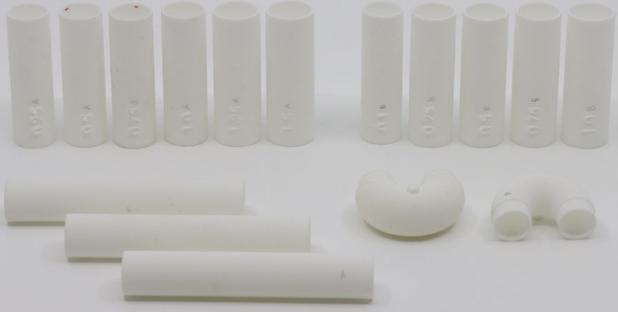
Third Step – Components Detail Design The design of various geometric solutions with different tolerances is perfor- med in the third step of development. The main purpose of this analysis is to identify adequate tolerancing for the mechanical connections established between the new and existing components of the product and the capacity of the manufacturing process for accurate reproducibility, depending on the processing settings (i.e., part orientation, process parameters, material, etc). Considering that the main goal of the work is to redesign the central region of the trumpet maintaining the existing metal pistons, it was necessary to identify the tolerances allowed by the AM process in order to ensure proper sliding between the components while ensuring acoustic insulation. Thus, real-scale tubes with clearance varying between 0.25 - 1.25 mm were desi- gned and produced by SLS with Polyamide 12 in an EOS P 396 equipment (Figure 2).
Figure 2: Real-Scale tubes with different tolerances.
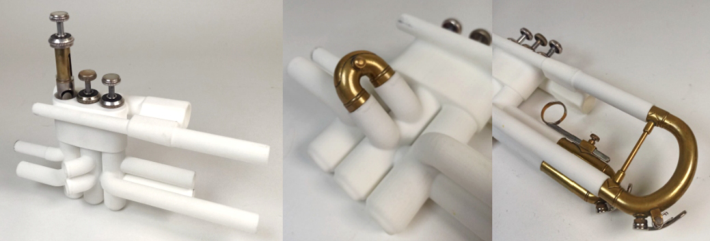
Fourth Step – Geometric Solutions Refinement This activity involves the testing of various geometric solutions of the pro- duct, in order to infer reliability and identify necessary changes and new design iterations. Assembled components of the trumpet were evaluated and the most appropriate geometric solutions were identified, resorting to draft versions of the instrument manufactured by AM. The fitting between the polymeric prototypes and the existing metallic parts was evaluated by testing the trumpet in real conditions (Figure 3). The sound produced by the trumpet, conditioned by the clearance of the sliding components, was also evaluated in this stage.
Figure 3: Hybrid product test assembly.
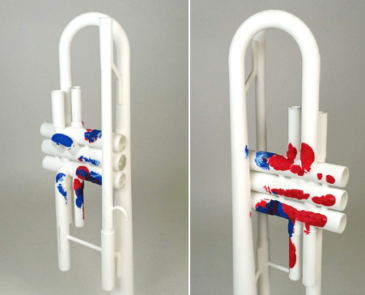
Fifth Step – Product Development This activity consists in the development of the 3D model of the product to be produced. The model should contemplate data acquired from the previous activity with regard to clearance and tolerancing of mechanical connections and standard design rules for the specific AM technology. Thus, once esta- blished the tolerances between sliding elements and functional connections, new design versions of the product were developed focusing on the identified optimization purpose, viz., the adaptability of the trumpet for disable people and for both left and right-handed players. With a draft version of the main body of the instrument manufactured by AM, usability tests were performed to identify ergonomic problems in the interaction with the user (Figure 4).
Figure 4: Usability tests (blue: right hand; red: left hand).
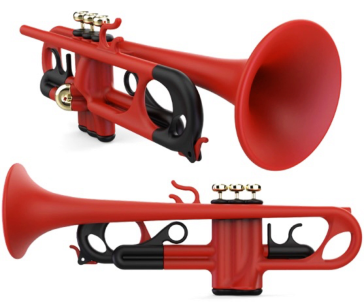
Based on the results obtained from the usability tests, there was develo- ped a product with a support surface for holding the trumpet avoiding the direct contact of the palm of hand with the second valve and a smoother tubes profile providing greater fingers grip and enhanced handling comfort (Figure 5). The trumpet finger hook was also redesigned aiming to ensure greater adaptability to different users. By implementing these modifications, it was possible to reduce the mechanism from four individual parts to just one functional unit.
Design for the Combination of Additive Manufacturing Parts 225
Figure 5: Details of the developed hybrid trumpet (3D CAD render).
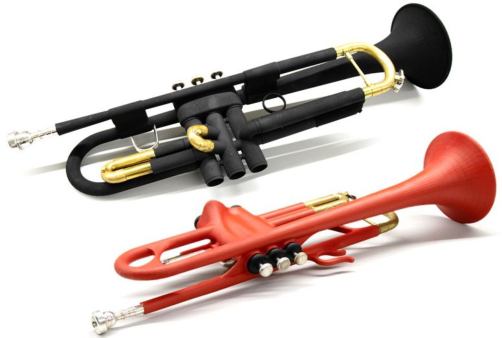
Sixth Step – Product Assembly and Assessment The assembly of the product by combining optimized AM parts with the existing components is the final step of the hybrid method. The assembly pro- cess allows to validate the previous development activities with the obtention of a functional product in its complete form. In this stage, the final ver- sion of the hybrid trumpet was assembled and compared with intermediate design solutions (Figure 6). The developed musical instrument was produ- ced by SLS and integrates several original parts (e.g., mouthpiece, pistons, etc.) to ensure mechanical functionality and quality sound production. By including an optimized hand support structure and an adapted trumpet fin- ger hook, it was created the possibility to hold the instrument with just one hand, contradicting ergonomic incompatibilities of conventional solutions.
Figure 6: Intermediate (black) and final (red) versions of the developed hybrid trumpet.
CONCLUSION
The implementation of a hybrid design approach as a means of adding value to existing products was demonstrated in this work by combining AM parts
with conventional trumpet components, with the aim of ensuring an optimi- sed instrument user experience. The methodology employed to understand the problem and user needs, identify solutions and develop new concepts follows six sequential steps that have been described in detail. Fundamental activities are the product decomposition and designing of mechanical con- nections with appropriate tolerancing, which depends on the manufacturing process and part geometry. Once defined an appropriate clearance between the casing and pistons, the main body of the trumpet was redesigned in order to create a comfortable area for handling and playing the product with just one hand, either left or right, and a more ergonomic trumpet finger hook. The novel hybrid trumpet that was developed and produced evidences higher ada- ptability to different users, even people with disabilities, while minimize the hands tension that is felt by players after long periods of use.
ACKNOWLEDGMENT
This work was funded by the European Regional Development Fund (ERDF) through the Operational Competitiveness and Internationalization Programme (COMPETE 2020) of the Portugal 2020 Program [Project No. 47108, “SIFA”; Funding Reference: POCI-01-0247-FEDER-047108].
REFERENCES
Allison, J., Sharpe, C., Seepersad, C. C. (2019). Powder bed fusion metrology for additive manufacturing design guidance, Additive Manufacturing, 25, pp. 239–251. ASTM (2012) ASTM F2792 12a - Standard Terminology for Additive Manufactu-
ring Technologies. Ben, R., Schoffer, F., Garret, B. (2017). The 3D printing handbook: technologies, design and applications. 3D Hubs. Czelusniak, T., Amorim, F. L. (2020). Influence of energy density on selective laser
sintering of carbon fiber-reinforced PA12, International Journal of Advanced Manufacturing Technology, 111, pp. 2361–2376. Gibson, I., Rosen, D. and Stucker, B. (2010) Powder Bed Fusion Processes, in Additive Manufacturing Technologies - Rapid Prototyping to Direct Digital Manufacturing. Springer International Publishing, pp. 103–142. Hajare, D. M. and Gajbhiye, T. S. (2022) Additive manufacturing (3D printing):
Recent progress on advancement of materials and challenges, Materials Today: Proceedings, 58, pp. 736–743. Lima, A., Silva, C., Sampaio, A. M., Pontes, A. J. (2017) Development of a methodology for hybrid products during the Additive Manufacturing process. In: 4D – designing, development, developing, design, International Conference. Kaunas University of Technology, Lithuania. Lopes, A. C., Sampaio, A. M., Cátia, S., Pontes, A. J. (2021) Prediction of SLS
parts properties using reprocessing powder, Rapid Prototyping Journal, 27(3), pp. 496–506. doi: 10.1108/RPJ-04-2020-0076. Lopes, A. C., Sampaio, A. M., Pontes, A. J. (2022) The influence of the energy density on dimensional, geometric, mechanical and morphological properties of SLS parts produced with single and multiple exposure types, Progress in Additive Manufacturing.
Design for the Combination of Additive Manufacturing Parts 227
Meisel, N., Elliott, A., Williams, C. (2014). A procedure for creating actuated joints via embedding shape memory alloys in Polyjet 3D printing. Journal of Intelligent Material Systems and Structures., 26(12), pp. 1498–1512. Minetola, P., Calignano, F., Galati, M. (2020) Comparing geometric tolerance capa-
bilities of additive manufacturing systems for polymers, Additive Manufacturing, 32, p. 101103. Sampaio, A. M., Gonçalves, R., Lima, A., Cruz, J. S. C., Figueiredo, B., Carvalho, S., Pontes, A. J. (2019). Design for Additive Manufacturing of Mechanical Connections Toward Hybrid Products, in: Advances in Additive Manufacturing, Modeling Systems and 3D Prototyping, Di Nicolantonio, M., et al. (Ed.). Springer International Publishing, pp. 418–427 Sampaio, A. M., Lima, A., Silva C., Miranda, A., Pontes, A. J. (2022). Design and Pro-
duction of Hybrid Products. In Emilio R. & Di Nicolantonio, M. (eds). Additive Manufacturing, Modeling Systems and 3D Prototyping. AHFE 2022 International Conference. AHFE Open Access, vol. 34 pp. 1–8 AHFE International, USA. Singh, S., Sharma, V. S., Sachdeva, A. (2019) Application of response surface methodology to analyze the effect of selective laser sintering parameters on dimensional accuracy’, Progress in Additive Manufacturing, 4(1), pp. 3–12. Tong, Q. et al. (2020) Laser sintering and invalidating composite scan for improving
tensile strength and accuracy of SLS parts, Journal of Manufacturing Processes, 56, pp. 1–11. Torn, I. A. R., Vaneker T. H. J. (2019). Mass Personalization with Industry 4.0 by SMEs: a concept for collaborative networks. Procedia Manufacturing, 28, 135–141. Ulrich, K. T. and Eppinger, S. D. (2015). Product design and development (6th edition)
McGraw-Hill Education. Willis, K., Brockmeyer, E., Hudson, S. (2012). Printed optics: 3D printing of embedded optical elements for interactive devices. Proceedings of the 25th Annual symposium on user interface software and technology, 589–598.
LISTED IN THE AHFE DIGITAL BOOKSTORE CATALOGUE
Explore the complete digital volume
Human Aspects of Advanced Manufacturing
Read this individual research paper free through the original publisher, or explore the full digital proceedings book.
ISBN 978-1-958651-56-8
Explore this ISBN in the AHFE Bookstore ↗Listed in the July 2026 bookstore catalogue; search by ISBN to confirm current availability · Digital book purchase optional