Shiyi Zhou, Jiajun Wei, Zhijuan Zhu (2023). Improvement Design of Household Medical Nebulizer for Children Based on Ergonomics. In: Ergonomics In Design. AHFE Open Access, vol. 77, pp. 450–457. https://doi.org/10.54941/ahfe1003403
The purpose of this paper is to study the user needs of household children’s nebulizers from the perspective of Ergonomics, and to provide a basis for the improved design of products, so as to help children carry out nebulization treatment more efficiently and safely. The user research method was used to analyze the pain points and needs of users in the use of children's home nebulizers. Through the literature research, this paper studied the relevant human-machine size and psychological characteristics of children were, and discussed the demand-orientation of children's nebulizer shape, color and material were. Through the above research, this study analyzed the needs of children's nebulizers in terms of the experience of use and man-machine dimensions, and improved the product. The improved design of household children’s nebulizers could not only soothe children's anxiety in the treatment to a certain extent, but also promote children’s healthy growth and help improve the system of children's household medical products.
Respiratory diseases are one of the most prevalent diseases affecting children around the world and an important cause of rising child mortality (M. Saleh and M. Çev˙ik, 2022). Nebulization therapy is the most common treatment for children with respiratory illnesses (X. W. Liu et al., 2022). Compared to drug and injection delivery methods, nebulized therapy has the advantages of smaller doses, fewer side effects and simple operation. Through literature research, this paper found that most children’s nebulizers were not signifi- cantly different from adult nebulizers (Y. X. Zhao, 2021), which do not meet the physical and psychological needs of children.
For the innovation and improvement of children’s nebulizers, Jia Anmin and Sun Wei (2020) have analyzed the current situation of nebulizer products and children’s psychological characteristics. Shi Yaojun (2018) has explored the integration of bionics into the emotional design of medical products. Xu Xiaowang (2020) has proposed two design principles of product Ergonomics and interactivity. Based on narratology and narrative design theories, Zhang Kai and Gao Zhenyu (2018) have investigated how to enhance children’s
Improvement Design of Household Medical Nebulizer for Children Based on Ergonomics 451
emotional experiences in the course of therapy. Cao et al. (2022) have poin- ted out that common nebulizer designs ignore children’s psychological needs and user experience. They proposed a design scheme that integrates cartoon images and music into products.
In general, most of the research focuses on user experience and tech- nical optimization of children’s nebulizers, with less practice in improving the human-machine dimensions and interactions for children’s household nebulizers. This study adopted the user survey to analyze the pain points and demands of users in the use of nebulizers. Took Ergonomics as the main entry point, the nebulizer was more compatible with the physiologi- cal and psychological needs of children, and optimized the existing children’s nebulizers.
RESEARCH PROCESS Nebulizers for children are usually used with the assistance or supervision of parents. Therefore, the main subjects of this study were children and parents who used nebulizers. There are two parts of user research: an online questionnaire was used to analyze the potential needs of users and collect users’ expectations for the improvement of household children’s nebulizers. Another method was offline user interviews to explore the problems exi- sting in the use of atomizers, and to provide references for the subsequent improvement of product Ergonomics.
Questionnaire Research The respondents were parents of children aged 12 and under, the valid sam- ple was 23. This questionnaire provided information about the problems
Table 1. Questionnaire results.
Table available in the original PDF paper.
Dimensions Questionnaire results Design conclusions User information The majority of children using nebulizers were 0 to 6 years old.
1) The size of children’s nebulizers should conform to Ergonomics for children. 2) The structure of children’s nebuli- zers needs to be simplified. 3) Focus on emotional design in the appearance of children’s nebulizers. Usage rate Over 70% of parents had used children’s nebulizers. Usage process More than 75% of children showed uncooperative behavior during nebulized treatment. When the child was 0 to 3 years old, over 60% of parents helped children to hold the nebulizer; by the age of 4 to 6 years, this fraction dropped to 7.69%. Product preference
60.87% of parents chose handheld nebulizers. Expectation Lightweight, easy-to-use and child-friendly.
Table 2. User interview results.
Table available in the original PDF paper.
Basic information
Children’s age Children using nebulizers were mostly between 1 and 4 years old. Treatment site Most parents purchased household nebulizers and reflected that home treatment was more convenient than hospitals. Nebulization type Most parents chose the compression mask type. Accompaniment Most children needed to be accompanied by their parents. Some parents reflected that children could complete independently. Highlighted issues
Children’s emotion Most children had resistance to the first use of nebulizers. Man-machine size Most parents did not have a clear understanding of the size of the mask, and usually used masks uniformly distributed by hospitals or ordinary nebulizer masks on the market. But the size of these masks was mostly based on adults, which was inconsistent with the face of children. Product appearance Most of the children’s nebulizers were medical styles, and the design does not conform to the psychological characteristics of children.
with children’s home nebulizers in five areas: user Information, usage rate, usage process, product preference and user expectation. Table 1 shows the summary of the questionnaire.
User Interviews The user interviews were conducted in the primary school and kindergarten affiliated with Huazhong University of Science and Technology. Ten parents (7 mothers and 3 fathers) and five children (3 females and 2 males) were randomly selected as interviewees.
Based on the above analysis, five requirements are summarized (Table 3).
Table 3. Requirements for household children’s nebulizers.
Table available in the original PDF paper.
Project Demand 1 Visual Experience Meet the emotional needs of children 2 Man-machine size Fit the physiological characteristics of children 3 Interaction Add interest to human-machine interaction 4 Functional use Enhance visibility of use and treatment progress 5 Product structure Appropriate simplification
Improvement Design of Household Medical Nebulizer for Children Based on Ergonomics 453
ANALYSIS OF THE PHYSICAL AND PSYCHOLOGICAL CHARACTERISTICS OF CHILDREN Physiological Characteristics Analysis
Based on the previous research, this study identified the analysis object of human-machine size as 4 ∼6 years old children. The gripping method of nebulizers was forceful grasp. The larger the contact area between the handle and the palm, the lower the compressive stress (Z. Y. Lv and Y. Qu, 2013). The related hand size was taken from the 95th percentile of males aged 4 to 6 years. According to the analysis, the functional correction of hand width is 27 mm, and the functional correction of hand length is 45 mm. Following the formula in Table 4, the thumb width and the fingertip distance in the tiger mouth were calculated in Table 5. (The dimensions were based on the Chinese National Minor’s Hand Size Typology.) Combined with the Head and face dimensions of children in Table 6, the relevant dimensions for the nebulizer were calculated and collated to give Table 7.
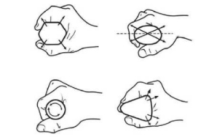
In terms of grasping shape, the near-elliptical or polygonal handle was more suitable for the human hand, which could reduce the pressure on the palm, and the grasping state is the most ideal (Z. Y. Guo, 2021). For this reason, the nebulizer handle could adopt a near-elliptical shape, which is more conducive to children.
Table 4. Calculation formula of hand control part (GB/T 26159-2010).
Table available in the original PDF paper.
Control parts Male Female Regression equation Regression equation
Equation reproduced from the original PDF.
Ring finger length Y=−1.42+0.413X1 Y = 1.25+0.399X1 Pinky length Y=−1.64+0.328X1 Y=−0.72+0.321X1 Hukou middle finger fingertip distance Y = 2.79+0.199X2 Y = 2.40+0.203X2 Proximal width of the index finger
Distal width of the index finger Y = 3.05+0.168X2 Y = 2.72+0.173X2 Wide knuckles of the thumb Y = 4.14+0.200X2 Y = 3.10+0.209X2 Note: X1 is the hand length, X2 is the hand width, and Y is the size of other parts of the hand.
Table 5. Hand size of children (in mm) (GB/T 26158-2010).
Table available in the original PDF paper.
Parameter Male (4∼6 years old) Female (4∼6 years old)
5 50 95 5 50 95
78.9 90.4 97.8 79 89.6 96.4
Hand width 49.6 58.1 63.5 48.4 56.6 61.8 Hand length 105.4 123.2 134.6 104.7 122 133 Thumb width 14 15.8 16.8 13.2 14.9 16 Hukou middle finger fingertip distance
Table 6. Head and face dimensions of children (in mm) (G. Y. Zhang, 2020).
Table available in the original PDF paper.
Project Average value (mm) Standard deviation (mm) Head full height 203.8 12.2 Head length 174.7 7.2 Head width 151.8 6.0 Head circumference 512.5 19.5 Morphological length 94.9 6.2
Table 7. Sizing reference for children’s household nebulizers.
Table available in the original PDF paper.
Parameter Size 1 Body size (handheld part) Length<=90mm, Diameter<=57mm 2 Button size Diameter: 16∼18mm 3 Mask size (G. Y. Zhang, 2020) Mask midpoint to bridge of the nose: 60mm Midpoint to chin: 36mm Midpoint to side cheek: 50mm Delivery port diameter: 18mm, vent diameter: 9mm
Figure 1: Different handle cross-sectional for gripping (Z. Y. Guo, 2021).
Psychological Characteristics Analysis Children’s Perception of Color Vision plays an important role in children’s cognition. Children after the age of four can produce emotional changes according to the different colors of things. Brilliant colors will arouse children’s strong interest. According to research, children’s favorite color groups in early childhood are orange, yel- low, red and green (Z. X. Zhu, 2000). With the increase of age, children’s aesthetic of color is gradually established. Therefore, choosing the right color in the process of designing products can make children higher accepted.
Children’s Perception of Form Children’s shape perception develops rapidly. At this stage, children can distinguish basic geometric shapes such as circles, squares and triangles, and gradually form self-aesthetic evaluation (J. H. Liu, 2013). Furthermore, chil- dren often associate geometric shapes with figurative objects. For the images of animals and plants, Children are more receptive and friendly (B. J. He, 2019). Therefore, the appearance of children’s medical products should be
Improvement Design of Household Medical Nebulizer for Children Based on Ergonomics 455
lively and close to the specific form of nature, so as to reduce children’s resistance.
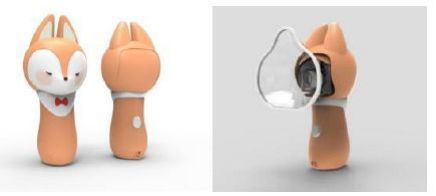
DESIGN PRACTICE This study chose the cartoon fox that often appears in fairy tales as the main body of the product, because the fox could make children think of nature and lovely, and easy to be accepted by children. In terms of shape, rounded surfaces were mostly used, which could give people a close and soft feeling, and also prevent children from being hurt during the use of the product. In terms of color, bright orange and warm white were used as the main colors of the original product, which could convey a warm feeling. In terms of material, this design was mainly made of ABS plastic and silicone, with a skin-friendly and flexible frosted texture.
Combined with literature research, this study found that mask nebulizers were more effective than nebulizers such as oral inhalers and nasal cannulas (G. Y. Zhang, 2020). Therefore, this solution adopted a mask whose scale was standardized according to the child’s human dimensions to ensure the efficiency of the nebulized treatment. In addition, the contour of the mask fitted the child’s face, which could reduce discomfort during the use of the nebulizer.
Figure 2: Nebulizer body (left), Nebulizer masks (right).
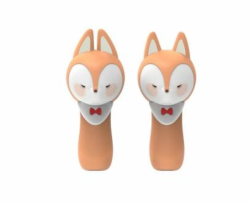
This study improved the reminder function of the nebulization treatment time. As the nebulization time progressed, the fox’s ears closed slowly from the initial opening (Fig. 3). When the nebulization treatment was finished, the
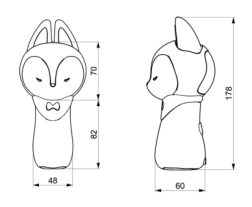
Figure 3: Ear position while nebulization is in progress (left), ear position at the end of nebulization (right).Figure 4: Nebulizer size (in mm).
ears closed completely and a short beep sounded. This design could not only increase children’s interest in the treatment process, but also reduce the anxi- ety caused by children’s inability to visually understand the process. Figure 4 shows the size of the children’s handheld nebulizer.
CONCLUSION AND LIMITATION According to the questionnaire survey, user interview and literature analy- sis, the pain points and users’ needs were explored, and later a new kind of children’s household nebulizer was designed based on Ergonomics. The new design product was helpful to alleviate children’s anxiety, and greatly improved the treatment efficiency which promoted the children’s health. This study had achieved certain research results, but there are many shortcomings, below:
1) The scope of user research around the school was limited and the sample was not sufficient. This study needed to broaden the scope of the user research and increase the sample in subsequent refinement. 2) The design was not physically modeled to observe problems in actual use, and further model testing needed to be refined in the future. 3) The problems raised in this paper were limited, and the relationship between appearance and function needed to be further studied in the future to summarize the problems more comprehensively.
REFERENCES
B. J. He. (2019). Research on Emotional Design of Children’s Medical Devices.
Unpublished master’s thesis, North China University of Technology, Beijing. M. Jia, W. Sun. (2020). Research on the innovative design of children’s nebulization machines. Industrial Design (03), 63–64. GB/T 26158-2010, Human dimensions of Chinese minors. GB/T 26159-2010, Hand sizing system of Chinese minors. G. Y. Zhang. (2020). Flow field characteristics of drug distribution in children’s
nebulizing mask and mask optimization. Master’s thesis, Xi’an University of Architecture and Technology, Shanxi. J. H. Liu. (2013). Psychology of Child Development. Shanghai, China: East China Normal University Press.
Improvement Design of Household Medical Nebulizer for Children Based on Ergonomics 457
K. Zhang, Z. Y. Gao. (2018). Research on children’s medical product design based on narrative design. Decoration (01), 111–113. M. Saleh and M. ÇEV˙IK. (2022). Diagnosis of respiratory diseases for children using
machine learning. 2022 International Symposium on Multidisciplinary Studies and Innovative Technologies (ISMSI), 369–374. X. G. Cao, W. L. Tang and C. W. Zou. (2022). The innovative design of children’s cartoon nebulizer. Wireless Internet Technology (01), 70–72. X. W. Liu, Y. H. Wei and S. H. Yu. (2022). Research on the design of medical products
for preschool children based on cognitive behavioral therapy-Taking children’s nebulizer design as an example. Decoration (04), 133–135. X. X. Xu, Y. X. Han and X. P. Han. (2020). The application of the humanized concept in children’s medical product design. Industrial Design (10), 59–60. Y. J. Shi, H. Yu, J. Yao. (2018). Research on the application of bionics in the emotional
design of children’s medical products. Design (03), 34–35. Y. X. Zhao. (2021). Research on the design of children’s medical nebulizers based on user experience. Master’s thesis, Hubei University of Technology, Hubei. Z. Y. Guo. (2021). Research on the design of hand-held tools for school-age children
under feature quantification. Master’s thesis, Hubei University of Technology, Hubei. Z. Y. Lv, Y. Qu. (2013). Design of bus handle based on Ergonomics. Journal of Graphics (06), 69–73. Z. X. Zhu. (2000). Child Psychology. Beijing, China: People’s Education Press.
LISTED IN THE AHFE DIGITAL BOOKSTORE CATALOGUE
Explore the complete digital volume
Ergonomics In Design
Read this individual research paper free through the original publisher, or explore the full digital proceedings book.
ISBN 978-1-958651-53-7
Explore this ISBN in the AHFE Bookstore ↗Listed in the July 2026 bookstore catalogue; search by ISBN to confirm current availability · Digital book purchase optional