Zixuan Huang, Shuwen Qiu, Zhijuan Zhu (2023). Improvement Design of Metro Access Control System Based on Ergonomics. In: Ergonomics In Design. AHFE Open Access, vol. 77, pp. 159–166. https://doi.org/10.54941/ahfe1003373
The purpose of this paper is to explore a new mode of metro security check based on ergonomics. Before China’s epidemic policy had been adjusted at the end of 2022, the metro security inspection had faced the problem of balancing epidemic prevention and control and travel efficiency. To deal with different situations flexibly, the improved methods of the metro security system and proposed feasible countermeasures were explored in this study. Questionnaire interview and field observation methods were adopted in this study. Based on the research of literature and competing products, the forms of security check in different cities were compared and the existing problems of metro security check were summarized. The impact of different security inspection links in the metro access control system on passengers' travel efficiency was explored. Then, the design positioning and scheme design were proposed from the perspectives of man-machine size, process integration, information feedback, and product appearance. To improve the metro passengers’ travel efficiency, physiology and psychology knowledge in ergonomics were used in this metro entrance guard system integration design, which could make vulnerable groups go through the security check easily and improve the passengers’ efficiency to enter the metro station.
Existing Situation of Metro Access Control System With the continuous development of China’s metro, the issue of traffic travel efficiency has attracted more and more attention. During the period of epide- mic prevention and control, the metro was not only faced with the problem of balancing epidemic prevention and control and passenger travel efficiency but also the situation of imperfect epidemic emergency response mechanisms of various departments (Wei’an Li et al 2020). After the adjustment of China’s epidemic policy at the end of 2022, passengers do not need to scan the code to measure the temperature. However, there are still many problems that need to be solved in the metro access control system. On one hand, processes in China’s access control system are not convenient enough, and the travel effi- ciency of passengers is low, resulting in long queues from time to time. On the other hand, the epidemic situation is changing rapidly, and the response mechanism of the metro access control system still needs to be improved.
Relative Work At present, many scholars have conducted research on improving the effi- ciency of security checks. On the optimization of the metro security check process, Zheng Xun et al. extracted the most important factors affecting the security check service time through the method of stepwise regression (Xun Zheng et al., 2018), but it was limited to the three processes of bag relea- sing, walking and bag picking, and the part of passing through the security gate and ticket gate was missing. Some scholars improved the efficiency of passenger security checks by optimizing the location and layout of the access control system. Antonova et al. used AnyLogic simulation software to find typical congestion points according to the passenger flow of metro stations and optimized the facility layout for locations prone to congestion (Anto- nova et al., 2020). Due to the impact of the space environment, the layout of the access control system is usually inconvenient to change. Some scholars consider the direction of passenger flow to improve travel efficiency. Hong- jiao Xue et al. jointly optimize the train schedule and passenger flow control method to greatly reduce the total waiting time of passengers and reduce congestion (Hongjiao Xue et al., 2022). However, there are many subway lines in big cities and the needs of passengers are changeable and flexible, so it cannot be effectively promoted in big cities. At present, China’s metro access control system still has some problems such as complex processes and inflexible response mechanisms. In the next section, after the questionnaire interview and field observation, the processes that can be integrated into the metro access control system are investigated; then, the size of each part is calculated; lastly, its appearance is considered.
Therefore, the objective of this study is, (1) To improve the travel efficiency of passengers, the processes of the metro access control system were integra- ted; (2) The size of the main products in the metro access control system was adjusted to meet different groups of people’s needs; (3) In this study, we redesigned the color and form of the automatic fare gate and security gate in the original metro, to make it and the location environment could be more integrated and have local characteristics; (4) The metro QR code and the pas- senger health code can be identified through the same scanning window to deal with different epidemic situations was proposed in this study.
RESEARCH PROCESS Questionnaire Survey and Field Observation
How people feel when they pass through the metro access control during the period of epidemic prevention and control is described in the questionnaire survey while field observation describes the action flow of passengers ente- ring the metro access control system after epidemic policy adjustment. To make the research more targeted, this article takes the Wuhan metro entra- nce guard system in China as an example. A total of 50 questionnaires were issued, of which 47 were valid (questionnaires that had not taken the metro in Wuhan or experienced the temperature measurement and security check of
Improvement Design of Metro Access Control System Based on Ergonomics 161
Table 1. The questionnaire.
Table available in the original PDF paper.
Question Option
Yes, no.
Q1.Your gender? Male, female. Q2.Your age? <=17, 18-24, >=25. Q3.Have you ever taken the metro in Wuhan city? Yes, no. Q4.Have you ever experienced the temperature measurement and security check of the metro?
Q5.How do you feel during code checks, temperature checks, and security checks on the metro?
Impressive, a little impression, no impression. Q6.How does the metro access control system make you feel? (How long it takes?)
Very long, long, no feeling, short, very short.
the metro were regarded as invalid). The age of the subjects was concentrated from 18 to 24 years old, and the male-to-female ratio was close to 1:1.
According to the questionnaire survey results, 61.7% of the subjects only had a little impression of the code checking, temperature measurement, and security check in the metro that was found in the questionnaire survey results. It shows that the appearance of the existing metro access control system’s parts is difficult to be noticed. 53.19% of the subjects considered that the metro access control system costs much time, which shows that the metro access control system affects passenger travel efficiency.
Different metros’ security check process has different distance. Therefore, we take Exit D of Metro Line 2 of Huazhong University of Science and Tech- nology as an example to analyze the movement process of passengers entering the station during non-peak passenger flow (see Table 2) There are some pro- blems from the passenger security check action process. The process of taking luggage from the security door to leaving the automatic fare gate affects the travel efficiency most in all the processes. Thus, the way of combining the security door and the automatic fare gate to improve the efficiency of metro passengers was explored. In the next section, the specific size range of each part of the redesigned metro access control system is given.
Product Appearance Analysis Color is one of the most expressive design elements in public facility design. The metro access control system design principles are summarized as fol- lows, (1) The overall coordination principle: in the comparison of competing products of the security gate, the metro security gate is mostly gray, which coordinates with the environment; (2) Regional cultural elements: the design object of the metro access control system is the Wuhan metro, which should reflect the local characteristics; (3) People’s psychological feelings: the color of the security door should not be eye-catching, to avoid users staying for a long time.
Table 2. Analysis of passenger security check action process in Wuhan metro.
Table available in the original PDF paper.
Figure Description Problem
Number Action flow
Passengers pass through the security door without stopping.
1 Checking through the security door
When passengers have a large suitcase, they will push the suitcase forward, but the security door is not wide enough, resulting in low traffic efficiency. 2 Placing luggage
Passengers place larger luggage such as luggage or satchel on the conveyor belt for baggage security.
The conveyor belt is at a certain height from the ground, so it is difficult to take the security conveyor belt when the luggage is heavy, resulting in low efficiency. 3 Manual security check
Using security bars to check passengers. If you bring a drink, take the drink on-site.
When the passenger carries the cross-body bag on the side far away from the security inspector, resulting in low efficiency. 4 Taking the luggage
Passengers take their luggage from the baggage security conveyor belt.
Passengers buy the ticket, swipe the metro card, or scan Metro QR Code to leave.
Sometimes it’s difficult to take the luggage off the security conveyor belt when it’s heavy, resulting in low efficiency. 5 Leaving the auto- matic fare gate
Some can only open the software to scan the QR code before entering the gate, resulting in low efficiency.
Human-Machine Size Analysis There are five steps to set the functional size of the product according to the ergonomic principle, including determining the type of the designed product, selecting the human body percentage, determining the functional
Improvement Design of Metro Access Control System Based on Ergonomics 163
Table 3. Relevant date of male, aged 18–60 (adapted from ergonomics (5th ed.), 2017).
correction amount, determining the psychological correction amount, and finally figuring out the functional size of the product. This metro entrance guard system integration design mainly includes two parts: a security door and an automatic fare gate.
The size of the security door mainly includes door width and door height. The height of the door is higher than most passengers, so the height of P95 adult men should be taken. The revised amount of the heel is 25∼38mm, and due to the impact of passengers wearing hats and walking during security inspection, the security’s height should be increased to 90mm.
The security door’s lowest height = P95 adult male’s height+heel correction+other correction = 1775mm + 25∼38mm + 90mm = 1890∼ 1903mm. Then, with the psychological correction height of 115mm, the security door’s best height = 1890∼1903mm + 15mm = 2005∼ 2018mm. The wheelchair’s width of 600mm and the width size of the pregnant abdo- men is 318.5mm, they are all in the channel space size. Finally, the dynamic size of the passenger is 1020mm as the design basis for the width.
For the automatic fare gate, the user needs to raise the arm to scan the metro QR code and wait for the gate to open and pass. It is necessary to determine the height and width of the gate, the height of the baffle, and the length of the channel. The maximum height of the baffle is supposed to be higher than the crotch height of the passenger from the ground, which is 0.480 times the height of the person (Ergonomics (5th ed.), 2017). The highest baffle’s height = 0.480×P95 adult male’s height + heel correction = 0.480×1775mm + 25∼38mm = 877∼890mm.
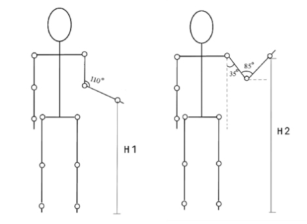
The process of scanning the metro QR code is related to the movement of the shoulder, elbow, and wrist. When the user is a normal adult, the height of the gate should meet the lowest height within the comfort range of P95 adult men to the highest height within the comfort range of the arm of P5 adult women. With the shoulder as the center, the comfort range of the upper
Figure 1: The diagrammatic sketch of the height of H1 and H2.
arm is +15
∼+35
; with the elbow as the center, the comfort range of the forearm is +85
∼+110
.
According to the data analysis, the gate’s lowest height is the height of the wrist from the ground when the male upper arm of P95 does not swing and the arm bending and extension angle is 110
; its highest height is the height of the wrist from the ground when the female upper arm of P5 swing to 35
, and the arm bending and extension angle is 85
. The human shoulder-to- ground height is 0.818 times the human height (Ergonomics (5th ed.), 2017).
When the passenger is a normal adult, the minimum height of the gate is H1 and the highest height is H2.
H1 = P95 adult male’s shoulder height from the ground - P95 adult male’s upper arm length - P95 adult male’s forearm length × cos(180
-110
) = 0.818 × 1775mm - 338mm - 258mm × cos70
≈1025.71mm. H2 = P5 adult female’s shoulder height from the ground - P5 adult female’s upper arm length × cos35
+ P5 adult female’s forearm length × sin(180
- 110
- 55
)= 0.818 × 1484mm - 262mm × cos35
+ 193mm × sin15
≈ 1049.25mm When the passenger is a disabled adult, the minimum height of the gate is H3 and the highest height is H4. The P95 adult male sitting shoulder height is 641mm, P5 adult female sitting shoulder height is 518mm. The seat height of the wheelchair and electric wheelchair is generally 480mm ∼550mm, and the trouser thickness’s correction is 3mm.
+ 193mm × sin15 + 480mm + 3mm ≈ 836.33mm. In the next section, the final size of each part is given.
DESIGN SCHEME Dimension of Metro Access Control System
Based on the action process analysis of passengers entering the metro access control system and related calculations, the main size data of the redesigned
Improvement Design of Metro Access Control System Based on Ergonomics 165
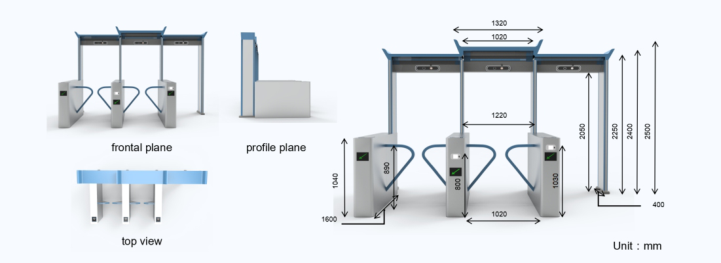
access control system is obtained. The height, width, and length of the inside security door are 2005mm, 1020mm, and 400mm respectively. The auto- matic fare gate’s height is 1040mm, the baffle’s height is 890mm, and the length and width of its channel are 1600mm and 1030mm respectively. Gene- rally, the height of the scanning screen and barrier-free scanning screen is 1030mm and 800mm respectively. Other dimensions unrelated to ergono- mics are determined by comparing the data of the existing products on the market (see Figure 2).
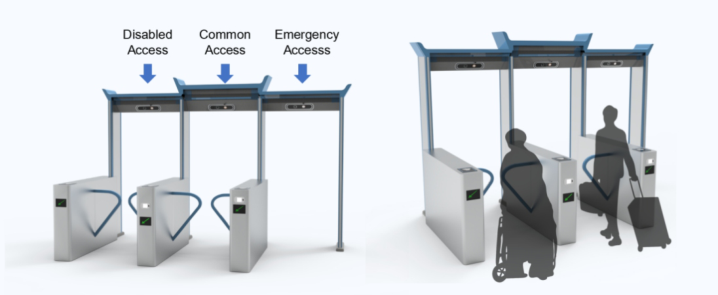
Display of Product Appearance In appearance, the top of the security gate uses the element of the cornices in the famous building “Yellow Crane Tower” in Wuhan; Regarding color, blue white, and gray colors are used to make passengers feel comfortable; In terms of travel efficiency, the distance between the automatic fare gate and the security door is greatly reduced, which saves passengers’ security time. During the epidemic period, the code-scanning part can simultaneously identify the health code and metro QR code. For different populations, three corresponding channels are set up for diversion. The left channel is equipped with a low card scanning area for wheelchair passengers to pass. The middle passage is widened for normal passengers to pass easily with a lot of luggage.
Figure 2: Three views and dimensions of the metro access control system design.Figure 3: Rendering and scenario of the metro access control system design.
On the right is the emergency passage, which is guarded by security personnel to enhance the fault tolerance of the metro access control system. In detail, the security door is equipped with an anti-skid foot cover, and the gate door is made of translucent and opaque plastic material to prevent passengers from hitting by accident.
CONCLUSION
To improve passenger travel efficiency, we redesigned the metro access con- trol system. The time between passengers entering the security door and leaving the automatic fare gate could be greatly reduced. And the scanning area of the automatic fare gate can not only identify the Metro QR Code but also identify the health code at the same time to flexibly respond to dif- ferent epidemic situations. Considering the needs of special groups in this design, the man-machine size of the original metro access control system was improved.
This study focuses on the design of a single microscopic security inspe- ction process on Wuhan Metro Line 2, without considering the influence of the layout of the subway station and passenger flow, and there are still some limitations. In future research, the adaptability to the subway environment and the method of cost reduction and promotion can also be considered. The related technologies of integrating gates and security gates need further rese- arch. Due to the different specific requirements of the metro access control system in different periods, this study can be continuously improved, hoping to provide a reference for the design of related products.
ACKNOWLEDGMENT
This study is our initial attempt to improve the metro access control system based on ergonomics. We sincerely thank the School of Mechanical Science and Engineering of Huazhong University of Science and Technology for their financial support and all the friends who participated in the questionnaire and helped us in the research.
REFERENCES
Antonova, V. M., Grechishkina, N. A. & Kuznetsov, N. A. Analysis of the modeling results for passenger traffic at an underground station using anylogic[J]. Journal of Communications Technology and Electronics, 2020, 65(6): 712–715. Wei’an Li, Yaowei Zhang, Qiankun Meng. (2020) Urgent problems of emerge-
ncy management under epidemic emergencies and their countermeasures [J]. Proceedings of the Chinese Academy of Sciences, 35 (3): 235–239. Xue, H., Jia, L., Li, J., & Guo, J. (2022). Jointly optimized demand-oriented train timetable and passenger flow control strategy for a congested subway line under a short-turning operation pattern. Physica A: Statistical Mechanics and its Applications, 593, 126957. Yulan Ding. (2017) Ergonomics (5th ed.) [M]. Beijing: Beijing Institute of Technology
Press. Zheng Xun, Li Haiying, Chen Xu & Luo Yongji. (2018). Analysis of subway security inspection service time and its influencing factors. Journal of Beijing Jiaotong University (03), 53–58.
LISTED IN THE AHFE DIGITAL BOOKSTORE CATALOGUE
Explore the complete digital volume
Ergonomics In Design
Read this individual research paper free through the original publisher, or explore the full digital proceedings book.
ISBN 978-1-958651-53-7
Explore this ISBN in the AHFE Bookstore ↗Listed in the July 2026 bookstore catalogue; search by ISBN to confirm current availability · Digital book purchase optional