Rui Jiang, Yujia Du, Haining Wang (2023). Ergonomic evaluation of a new handle for laparoscopic dissector based on upper extremity posture. In: Ergonomics In Design. AHFE Open Access, vol. 77, pp. 717–726. https://doi.org/10.54941/ahfe1003432
Extreme motions of upper extremity during laparoscopic surgery have been one of the most important risk factors that cause work-related musculoskeletal disorders among surgeons. This study presents a new pistol-type handle (NPT) for laparoscopic dissector. The new handle provides ergonomic support for the thumb and purlicue to make it more flexibly and steadily to open and close end-effector. Other two commercial handles, including a pistol-type (PT) and a ring-type (RT), were compared together using objective and subjective studies. Twenty surgical students with clinical experience performed simulation tasks of dissection and precision handling. Subjects’ motions (wrist, forearm and upper arm) and performance were measured by inertial measurement unit (IMU) and video analysis, with opinions and perceptions evaluated by questionnaires. The outstanding goniometry results reveal that completing dissection task using NPT reduces the mean angle deviations relative to comfortable upper extremity position. The performance shows no difference between NPT and PT, however, NPT and PT perform less task errors and less task time than RT. The subjective results show that NPT significantly obtains preferences and reduces the degree of task difficulty. For performance on task completion, pistol-type handles show better usability than ring-type. For comfortable upper extremity posture, NPT has been demonstrated goniometry and ergonomic advantages during operations. The handle with thumb and purlicue support can protect surgeons’ musculoskeletal health by means of reducing awkward wrist postures and exaggerated arm arcing movements.
Relying on the properties of laparoscopic instruments that allow for smal- ler incisions, laparoscopic surgery has shown significant advantages over conventional open surgery. These advantages include faster recovery time, less pain and smaller scars (Olivier 2009, Wilfong 2020). While beneficial to patients, surgeons are at risk for work-related musculoskeletal disorders. Poor posture has been demonstrated to be the most important factor of the disorders (Aghilinejad 2016), which are caused by extreme posture of the wri- sts, arms and shoulders and prolonged immobility of neck, back and lower body. Obvious and common symptoms were reported as post-traumatic pain
and numbness (Berguer 1999, Catanzarite 2018). These problems are attribu- ted to the unconsidered ergonomic layout of the operating room. Improper operating table height, monitor position and trocar placements lead to the surgeon’s awkward upper extremity posture when using the instrument (Supe 2010). Several studies conduct ergonomics interventions directly at physi- cal level by presenting different designs of the handle (González 2020, Sancibrian 2013, Sancibrian 2020, Shimomura 2015, Tung 2014). In con- sideration of ergonomics principles, small zones of contacts and a more neutral position of the wrist, the new handles show a preference for pistol- type design. Correspondingly, ring-type handles are also commonly used by surgeons for the advantages of economical cost, reusable structure and easy disinfection (Matern and Waller 1999). However, in terms of controlling the end-effector of the aforementioned handles, a single-finger activation mode is used to manipulate the only button or both exerting ends of the lever structure. Repetitive finger flexion during the prolonged procedure is also a factor for several syndromes of musculoskeletal disorders (Catanzarite 2018). It is necessary to consider ergonomics solution of controlling the end-effector.
During usability test, task settings are typically about precision hand- ling, power grip or integral operation (González 2020, Sancibrian 2013, Sancibrian 2020, Shimomura 2015, Tung 2014). Blunt dissection as a non- dominant hand operation is commonly overlooked because studies focus more on the dominant hand. Maintaining a state of power separation in an immobilized laparoscopic environment through forceful wrist flexion or pro- nation is a risk of pronator teres syndrome and wrist tendonitis (Catanzarite 2017). To evaluate the effect of the improved handle on relieving extreme upper extremity postures, goniometry was used to measure angles including wrist, forearm and shoulder (Sancibrian 2020, Yu 2016). IMUs are sugge- sted as goniometry sensors to effectively assess on-site ergonomic hazards (Yan 2017). In surgery, surgeons worn IMU sensors to record upper extre- mity postures, and the accuracy has been demonstrated to be comparable to that of an optical motion capture system (Davila 2021).
This study assumed that the wrist stability during handle-to-tip force tran- smission could be increased by optimizing the mode in which force is applied to the handle. The optimization in turn reduced the incidence and trial time of extreme upper extremity postures to reduce the risk of musculoskeletal disor- ders. Therefore, the aim of this study was to present a new ergonomic handle for laparoscopic dissector and to evaluate the usability compared to two additional commercially available handles based on upper extremity posture. Objective evaluation included the task errors, task times and angular devi- ations of the upper extremities during the execution of the task. Subjective evaluations included satisfaction and task difficulty.
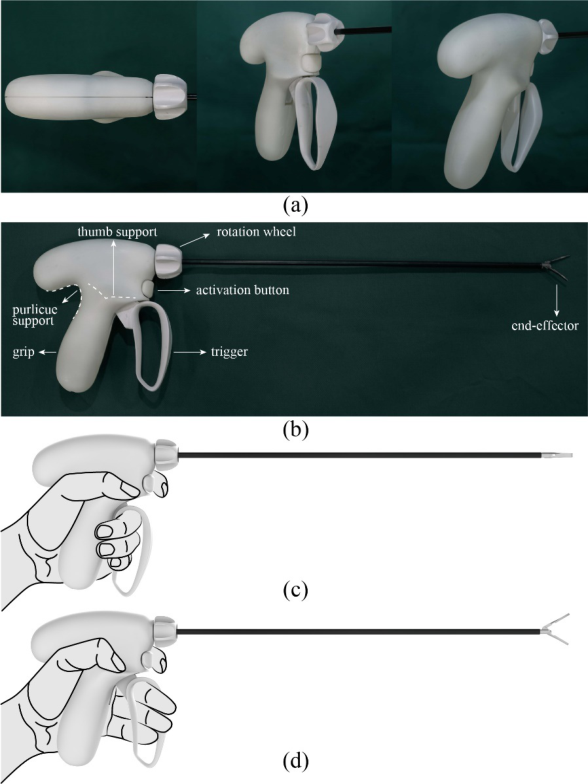
THE NEW HANDLE DESCRIPTIONS The NPT prototype (see Figure 1 (a)) is an auxiliary type of laparoscopic dissector designed for non-dominant hands. The innovative trigger, purli- cue support and thumb support (see Figure 1 (b)) allow surgeons to grasp
Ergonomic Evaluation of a New Handle for Laparoscopic Dissector 719
Figure 1: (a) NPT prototype; (b) The functional zones of NPT; (c) The state of the hand at the time of the grasping tissue; (d) The state of the hand at the time of the blunt dissection.
tissue and operate blunt dissection in a neutral hand position during prolon- ged surgery, which makes it more intent for the dominant hand to perform precise operations. When the middle finger, ring finger and little fingers pull the trigger close to the grip and the thumb naturally rests on thumb sup- port, the end-effector closes for grasping tissue (see Figure 1 (c)). When the middle finger, ring finger and little finger pull the trigger away from grip, the purlicue pushes up against the purlicue support and the thumb pushes back against the thumb support, then the end-effector opens for blunt dissection (see Figure 1 (d)). The index finger adjusts the direction of the end-effector by rotating the rotation wheel and presses the activation button to seal ves- sels when the end-effector is closing. As many of the functional zones of the hand as possible are involved in the end-effector control process for avoiding small zones of contacts and reducing the range of upper extremity motion.
METHODS
Twenty surgical students (10 male and 10 female) participated in the present study. All subjects selected have clinical experience of laparoscopic surgery between one and two years. Exclusion criteria of subjects included any inju- ries and musculoskeletal disorders on upper extremity and left-handedness. Surgical students are chosen because surgeons are the target users for NPT while they are not excessively influenced by previous use of laparoscopic instruments. Subjects were informed about the experiment procedure before signing the informed consent. In the meantime, a questionnaire about demo- graphic variables and anthropometric characteristics was completed (see Table 1).
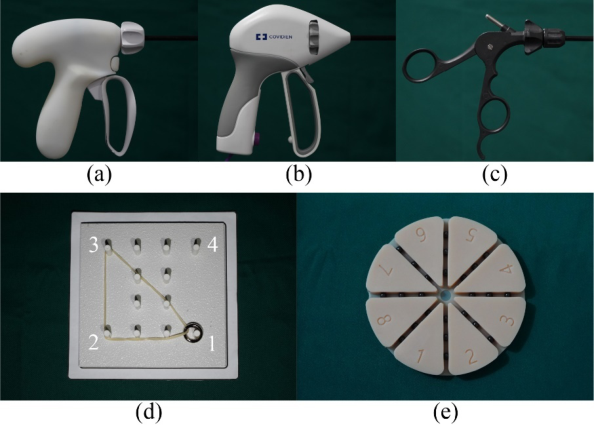
The NPT prototype (see Figure 2 (a)) and other two commercial instru- ments were used together to conduct the experiment. The instruments were PT (see Figure 2 (b)) made by Medtronic Covidien (Minneapolis, MN, USA) and RT (see Figure 2 (c)) made by Lap Game (Hongkong, China).
Subjects performed simulation precision handling (T1) and tasks of dis- section (T2) in the training boxes which are frequently used by surgeons to simulate laparoscopic operations. In T1, a pegboard was fixed in the training box (see Figure 2 (d)). Two ends of a rubber band were placed on pillar 2 and 3 and another end was placed on pillar 4 with the steel ring. The subjects had to work with both hands and move the three vertices of the triangle from pil- lar 3,2,1 to pillar 4,3,2 in turn. Following the same logic, the subjects were required to rotate the position of the initial triangle widdershins 8 times. In other words, it takes 24 times to pull the rubber band or steel ring off the pegboard and round the interfering pillar to stretch it to another pillar. In T2, a multi-wound suture model with 24 ceramic chickpeas was fixed in the training box (see Figure 2 (e)). The subjects had to use their non-dominant hand for blunt separation while the dominant hand had to stretch a chickpea out and put it in the nearby storage box. The subjects had to take out all 24 chickpeas one by one. Then, subjects had to return the chickpeas to their approximate positions with the same operation.
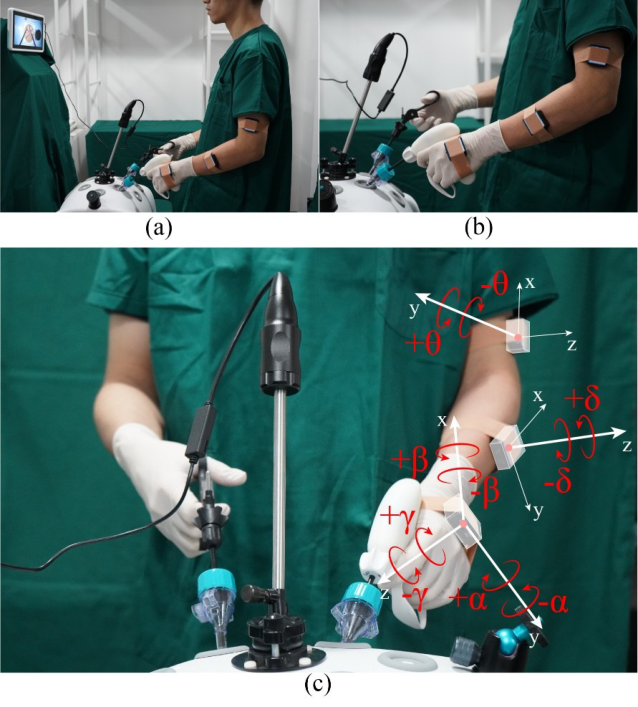
In tasks, the subject was positioned directly in front of the training box. The training box and the monitor were adjusted to the subject’s customary height (see Figure 3 (a)). In order to adapt to the non-dominant hand and find a comfortable upper limb position, trainings were performed to become
Table 1. Mean and SD of the demographic variables and anthropometric characteristics.
Table available in the original PDF paper.
Variables Male (10) Female (10) Whole Group (20) Mean SD Mean SD Mean SD
Ergonomic Evaluation of a New Handle for Laparoscopic Dissector 721
Figure 2: Instruments and material: (a) NPT prototype; (b) PT (Ligasure Maryland pistol- type forcep); (c) RT (Laparoscopic ring-type dissector); (d) The pegboard with rubber band and steel ring in T1; (e) The multi-wound suture model with 24 ceramic chickpeas.
familiar with and comfortable with the operation before formal procedures. Each subject had to perform T1 and T2 with all three handles. The order of the handles was random. Subjects were required to rest for at least 2 minutes between tasks.
Objective goniometric data was measured by IMUs. 3 IMUs were respecti- vely fixed on the hand, forearm and upper arm of the subject through muscle stickers. The subject’s most comfortable operating position was recorded as the initial position of the IMUs (see Figure 3 (b)). The IMU performs Z-axis zeroing and addition calibration based on the initial position before each task. The goniometric data was recorded as the angular deviations from the initial position. The angular deviations included hand flexion (D1) and extension (D2), hand protonation (D3) and supination (D4), hand radial deviation (D5) and ulnar deviation (D6), forearm flexion (D7) and extension (D8), shoulder abduction (D9) and adduction (D10) (see Figure 3 (c)). Task performance was recorded as trial time and the number of errors. 3 cameras were placed on the front, left side and the position facing the monitor to record the whole experiment.
Subjective data was collected through questionnaires, including difficulty in completing each task (Q1) and satisfaction with the handle (Q2). After each task, the subjects rated Q1 on a visual analogue scale (VAS) from not difficult at all (0) to extremely difficult (10). The subjects rated Q2 on a same form of scale after using each handle. Meanwhile, the subjects were allo- wed to freely express the handles based on either the experiment or previous experience.
For subjective and objective data, Shapiro-Wilks test was used to assess whether the samples fit the normal distribution. The goniometric data was
Figure 3: (a) Subject performing T2; (b) Initial location of the IMUs; (c) Angular devi- ations: +α: hand flexion (D1); -α: hand extension (D2); +β: hand protonation (D3); -β: hand supination (D4); +γ : hand radial deviation (D5); -γ : hand ulnar deviation (D6); +δ: forearm flexion (D7); -δ: forearm extension (D8); +θ: shoulder abduction (D9); -θ: shoulder adduction (D10).
described by means of one-way analysis of variance by mean and standard deviation. Kruskal-Wallis test as a nonparametric test method was used to assess variables that do not conform to a normal distribution. Median and interquartile range (IQR) were used to describe them. Significance values have been adjusted by the Bonferroni correction.
RESULTS AND DISCUSSION
There are significant differences in angular deviation between different hand- les in both tasks, except for D8 in T1 (see Table 2). For D8 in T1, the mean values of NPT (-3.54±2.22), PT (-3.46±2.55), and RT (-3.58±2.47) are sli- ghtly different. The reason for this insignificant difference may be that the movement of the forearm required in task operation is more inclined to lift the rubber band up rather than hold it down. In T1, NPT shows significantly less
Ergonomic Evaluation of a New Handle for Laparoscopic Dissector 723
Table 2. Statistical results from the goniometric angles.
Table available in the original PDF paper.
Task Angles NPT PT RT F p-value Mean SD Mean SD Mean SD
angular deviations than PT in D1 (p = 0.033), D2 (p<0.001), D3 (p<0.001), D4 (p<0.001), D5 (p<0.001), D6 (p = 0.004), D7 (p<0.001), D9 (p<0.001) and D10 (p<0.001) and RT in D1 (p<0.001), D3 (p<0.001), D4 (p = 0.001), D5 (p<0.001), D7 (p<0.001), D9 (p<0.001) and D10 (p = 0.018). In T2, NPT shows significantly less angular deviations than PT in D1 (p<0.001), D3 (p<0.001), D4 (p<0.001), D5 (p<0.001), D7 (p<0.001), D8 (p<0.001), D9 (p<0.001) and D10 (p<0.001) and RT in D1 (p<0.001), D2 (p<0.001), D4 (p<0.001), D5 (p = 0.018), D6 (p<0.001), D7 (p<0.001), D8 (p<0.001), D9 (p<0.001) and D10 (p<0.001). For T1 and T2, NPT has suggested advantage over PT and RT in goniometry. Since there is little difference in the operation mode and lever structure of the instruments while using different handles, the reduction of deviations can probably be attributed to the fact that the support structures provide higher stability in operations. Namely, using NPT redu- ces the angular deviations relative to comfortable upper extremity position and NPT provides a stable way of force transmission. According to the con- tent of the tasks, NPT can be used to partly reduce awkward wrist postures and exaggerated arm arcing movements for power grip and blunt dissection operations.
What is noteworthy is that D3 (p<0.001) of RT outperforms NPT on a significant level. Similarly, PT performs better on several variables when com- paring RT with PT. In T1, PT shows significantly less angular deviations than RT in D1 (p<0.001), D3 (p<0.001) and D9 (p<0.001) while PT shows signifi- cantly more angular deviations than RT in D2 (p = 0.004), D7 (p<0.001) and D10 (p = 0.025). In T2, PT shows significantly less angular deviations than
RT in D2 (p<0.001), D4 (p = 0.001), D6 (p<0.001), D7 (p<0.001) and D9 (p<0.001) while PT shows significantly more angular deviations than RT in D1 (p<0.001), D3 (p<0.001) and D5 (p<0.001). The less angular deviations in variables of RT above-mentioned does not mean that RT has an obvious ergonomic advantage, but rather that the non-neutral initial hyperflexion of the ring-type handle limits the room for wrist movement. This uncomfor- table initial position has been directly in line with the study of Tung et al. (Tung 2014). In this study, subjects also reported wrist stiffness and discom- fort after the task from prolonged use of the RT handle. As a consequence, the pistol-type handle has the advantage of goniometry over the ring-type handle.
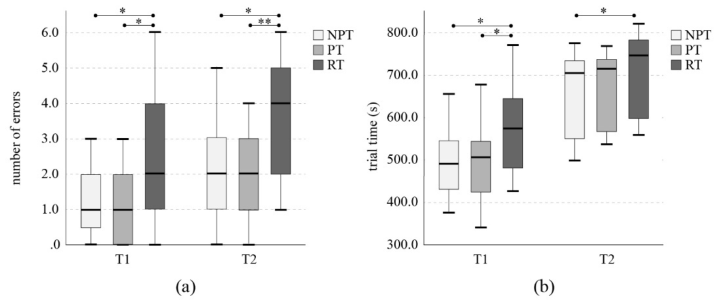
SD = standard deviation. **p ≤0.01. There are significant differences in the number of errors in both tasks (see Figure 4 (a)). RT shows significantly more errors than NPT and PT in T1 (NPT: p = 0.035; PT: p = 0.023) and T2 (NPT: p = 0.021; PT: p = 0.010). There is no significant difference between NPT and PT in both tasks. There are significant differences in trial time in both tasks (see Figure 4 (b)). NPT significantly shows a positive effect on trial time compared with RT in T1 (p = 0.039) and T2 (p = 0.037). PT shows significantly shorter trial time than RT in T1 (p = 0.042). Significant differences in task performance were not observed between NPT and PT in both tasks. This is sufficient to prove that the performance of NPT has not been negatively affected by this innovative design.
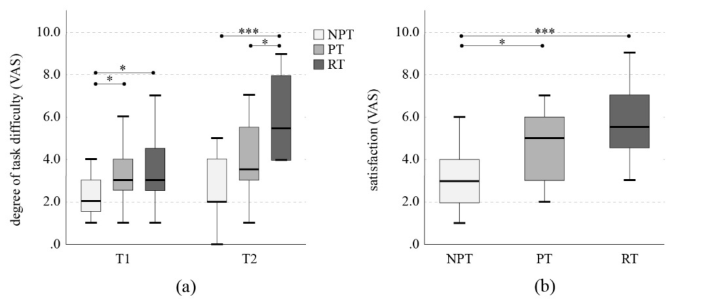
For degree of task difficulty, the results show statistically significant dif- ferences between both tasks (see Figure 5 (a)). In task 1, NPT was observed to be significantly less difficult than PT (p = 0.035) and RT (p = 0.031), possibly because the pistol-type handles provide greater flexibility. In task 2, pistol-type handles (NPT: p<0.001; PT: p = 0.025) show significantly lower degree of task difficulty. The subjects also expressed the separation operation of RT in T2 usually caused pain on their thumbs and little fingers. According to video analysis, subjects often had to switch their finger position
Figure 4: (a) Box plot diagrams about number of errors of each task, *p ≤0.05, **p ≤0.01; (b) Box plot diagrams about trial time of each task, *p ≤0.05.
Ergonomic Evaluation of a New Handle for Laparoscopic Dissector 725
Figure 5: (a) Box plot diagrams about degree of difficulty of each task, *p ≤0.05, ***p ≤0.001; (b) Box plot diagrams about satisfaction of each handle, *p ≤0.05, ***p ≤0.001.
repeatedly when using RT in T2, and indentations could also be observed. Notably, subjects expressed a statistically significant preference for subje- ctive satisfaction with NPT compared with PT (p = 0.048) and RT (p<0.001) (see Figure 5 (b)).
CONCLUSION
This study presents a new ergonomic handle design for laparoscopic disse- ctor. The innovative trigger, purlicue support and thumb support optimize the mode in which force is applied during handle-to-tip force transmission. Frequent tissue grasping and blunt dissection of the non-dominant hand are considered as two crucial tasks during prolonged surgery. Compared with additional two commercial handles, one is pistol-type and another is ring- type, operating with the new handle significantly reduces angular deviations from neutral positions on wrist, forearm, and shoulder. In particular, results suggest that the new handle reduces the degree of task difficulty and gets more satisfaction from surgical students without compromising task performance. Results might be sufficient in the advantages that the improved handle could reduce the risk of work-related musculoskeletal disorders.
ACKNOWLEDGMENT
The authors would like to express sincere thanks to the helpful related staff in the Anthropometry and Wearables Design Lab at Hunan University.
REFERENCES
Aghilinejad, M., Ehsani, A., Koohpayehzadeh, J. and Dehghan, N. (2016). Ergonomic risk factors and musculoskeletal symptoms in surgeons with three types of surgery: Open, laparoscopic, and microsurgery, Medical Journal of the Islamic Republic of Iran Volume 30.
Berguer, R., Forkey, D. and Smith, W. (1999). Ergonomic problems associated with laparoscopic surgery, Surgical endoscopy Volume 13 pp. 466–8. Catanzarite, T., Tan-Kim, J. and Menefee, S. A. (2018). Ergonomics in gynecologic
surgery, Current Opinion in Obstetrics and Gynecology Volume 30 No. 6. Catanzarite, T., Tan-Kim, J., Whitcomb, E. L. and Menefee, S. A. (2017). Ergonomics in Surgery: A Review, Female Pelvic Medicine & Reconstructive Surgery Volume 24 pp. 1–12. Davila, V. J., Meltzer, A. J., Fortune, E., Morrow, M. M. B., Lowndes, B. R., Linden,
A. R., Hallbeck, M. S. and Money, S. R. (2021). Intraprocedural ergonomics of vascular surgeons, Journal of Vascular Surgery Volume 73 No. 1. pp. 301–308. González, A. G., Barrios Muriel, J., Romero-Sánchez, F., Salgado, D. and Alonso, F.
(2020). Ergonomic assessment of a new hand tool design for laparoscopic surgery based on surgeons’ muscular activity, Applied Ergonomics Volume 88 p. 103161. Matern, U. and Waller, P. (1999). Instruments for minimally invasive surgery, Surgical Endoscopy Volume 13 No. 2. pp. 174–182. Olivier, R., Van ‘T Hullenaar, C., Ruurda, J. and Broeders, I.a. M. J. (2009). Ergono-
mic, user comfort, and performance in standard and robot-assisted laparoscopic surgery, Surgical Endoscopy Volume 23 pp. 1365–1371. Sancibrian, R., Gutierrez-Diez, M., Torre-Ferrero, C., Benito-Gonzalez, M., Redondo-Figuero, C. and Palazuelos, J. C. (2013). Design and evalua- tion of a new ergonomic handle for instruments in minimally invasive surgery, The Journal of surgical research Volume 188. Sancibrian, R., Redondo-Figuero, C., Gutierrez-Diez, M., Gonzalez-Sarabia, E. and Palazuelos, J. C. (2020). Ergonomic evaluation and performance of a new handle for laparoscopic tools in surgery, Applied Ergonomics Volume 89 pp. 103210. Shimomura, Y., Minowa, K., Kawahira, H. and Katsuura, T. (2015). Ergonomic
design and evaluation of the handle for an endoscopic dissector, Ergonomics Volume 59 pp. 1–18. Supe, A., Kulkarni, G. V. and Supe, P. A. (2010). Ergonomics in laparoscopic surgery, Journal of Minimal Access Surgery Volume 6 pp. 31–36. Tung, K., Shorti, R., Downey, E., Bloswick, D. and Merryweather, A. (2014). The
effect of ergonomic laparoscopic tool handle design on performance and efficiency, Surgical endoscopy Volume 29. Wilfong, C., Ross, S., Musumeci, M., Spence, J., Gravetz, A., Sucandy, I. and Rosemurgy, A. (2020). Doing more with less: our decade of experience with laparo-endoscopic single site Heller myotomy supports its application, Surgical endoscopy Volume 34 No. 10. pp. 4481–4485. Yan, X., Li, H., Li, A. R. and Zhang, H. (2017). Wearable IMU-based real-
time motion warning system for construction workers’ musculoskeletal disorders prevention, Automation in Construction Volume 74 pp. 2–11. Yu, D., Lowndes, B. R., Morrow, M. M. B., Kaufman, K. R., Bingener, J. and Hallbeck, S. (2016). Impact of novel shift handle laparoscopic tool on wrist ergo- nomics and task performance, Surgical Endoscopy Volume 30 pp. 3480–3490.
LISTED IN THE AHFE DIGITAL BOOKSTORE CATALOGUE
Explore the complete digital volume
Ergonomics In Design
Read this individual research paper free through the original publisher, or explore the full digital proceedings book.
ISBN 978-1-958651-53-7
Explore this ISBN in the AHFE Bookstore ↗Listed in the July 2026 bookstore catalogue; search by ISBN to confirm current availability · Digital book purchase optional