Junyao Wu, Liya Hu, Zhijuan Zhu (2024). Improvement Design of Age-friendly Supermarket Shopping Carts Based on Ergonomics. In: Ergonomics In Design. AHFE Open Access, vol. 129, pp. 203–211. https://doi.org/10.54941/ahfe1004825
This paper aims to study the users’ needs of supermarket shopping carts for the elderly from the perspective of Ergonomics and provide a guideline for product improvement, so as to enhance the shopping experience of elderly users in supermarkets. Shopping carts from different supermarkets were compared and the existing problems of supermarket shopping processes and shopping carts were summarized based on the literature review and competing products analysis. Through field interviews and KANO model questionnaire surveys, the demand-orientation of form, color, material and function of age-friendly supermarket shopping carts were explored. Then the needs of age-friendly supermarket shopping carts from the aspects of user experience and human dimensions were analyzed and the product was improved. In this study, the physiological and psychological knowledge in Ergonomics were applied, which not only improved the comfort and convenience of the elderly’ s shopping experience in the supermarket to a certain extent, but also provided new ideas for the research of age-friendly design in public service facilities.
The aging of the population is a common problem facing the world today. The quality of life of the elderly has been paid more and more attention by soci- ety and supermarket shopping is one of the important activities of the elderly life. In the field of supermarket shopping, targeted services have not been fully provided according to the physiological and psychological needs of the elderly, and the consumption experience of the elderly is poor. In the process of supermarket shopping, the elderly face many inconveniences. However, there are still many problems to be solved in the design of supermarket shop- ping carts. On the one hand, with the decline in the sports level of the elderly, they need more convenience and support in their daily life, which requires all sectors of society to provide more appropriate products and services to meet their special needs. On the other hand, because the elderly have higher requirements for the safety and comfort of the shopping experience, it is particularly important to provide shopping carts that meet the physiological
characteristics, psychological characteristics, and usage habits of the elderly, so that they can enjoy a more relaxed and pleasant shopping experience.
At present, many scholars have studied the humanised and intelligent design of supermarket shopping carts and the supermarket shopping process. Guo et al. (2017) have conducted a study on the braking device and layered design of supermarket shopping carts. Zhijuan Xiang (2014) has improved the design of shopping carts for CR Vanguard supermarkets in terms of mate- rial, structure, size, and color. Wenxin Zhou and Shidong Chen (2023) have structured a supermarket shopping cart and mounted an intelligent terminal on it. BingYao (2019) has studied the design of supermarket service systems under the development trend of new retail and proposed an innovative design strategy for consumer scene reconstruction. Tulin Tang (2019) has used the service design approach to study the safety problems encountered by the elderly during supermarket shopping and obtained five categories of safety needs for older people’s supermarket shopping safety experience. Ming Ni (2011) has summarised the principles of supermarket service systems in detail and three types of supermarket service systems from the point of view of con- sumers’ shopping needs, using new information technology as a realization tool.
In general, most studies have focused on service design research and humanised intelligent design of supermarket shopping processes, while there is less practice in improving the human-machine dimensions and interaction of supermarket shopping carts. This study adopts user research to analyze the pain points and needs of the elderly in the process of using supermar- ket shopping carts. The supermarket shopping cart takes Ergonomics as the main entry point, which is more suitable for the physiological and psycholog- ical needs of elderly users, and makes an age-friendly design for the existing supermarket shopping devices.
According to the World Health Organization’s criteria for classifying the age of the elderly, the subject of the study was young elderly people between the ages of 60 and 74 years old.
Therefore, the objective of this study is, (1) In order to improve the shop- ping experience of the elderly, the use process of supermarket shopping experience is integrated; (2) The dimensions of the supermarket shopping carts were adapted to meet the needs of older people in their use; (3) In this study, the appearance color and shape of the supermarket shopping cart were improved to make it more integrated with the supermarket environment; (4) Foldable rest seats, power-assisted wheels and smart screens are added to the supermarket shopping carts to meet the needs of elderly users.
RESEARCH PROCESS Questionnaire Research
The respondents were aged between 60 and 74 years old and were capable of taking care of themselves, and the valid sample was 20. This questionnaire provides relevant information (Table 1).
Improvement Design of Age-Friendly Supermarket Shopping Carts Based on Ergonomics 205
User Interviews Interviewee: The elderly in the Yuyuan community. User Interview Results: User interview results are in Table 2.
Table 1. Questionnaire research results.
Table available in the original PDF paper.
Dimensions Questionnaire Results Design Conclusion Shopping time 50% of the elderly spend about an hour shopping, and 40% spend more than an hour shopping.
2) Shopping carts need smoother, more stable wheels.
1) Shopping carts need to be comfortable, convenient, and have a rest function. The inadequacies of existing products
75% of the elderly thought that shopping carts are large and inconvenient to promote; 60% of the elderly thought that the cartwheel is not flexible, and the direction of turning is not easy to control; 45% of the elderly think that fragile, oversized items are not easy to place.
Inconveniences during the shopping process
3) Shopping cart with supermarket navigation, partition placement, self-checkout, and memo system.
65% of the elderly thought waiting in line was too long; 40% said it was difficult to find goods; 35% thought queuing for weighing was long; And 20% thought the price of goods was unclear.
85% of the elderly spend more time finding products.
4) Shopping carts should be redesigned on traditional styling.
The shopping process can find the goods you need Expectations for the appearance of the product Most of the elderly want the product to have a more rounded appearance.
5) The appearance of the shopping cart should be more rounded, and the color scheme should echo the supermarket.
Table 2. User interview results.
Table available in the original PDF paper.
Shopping cart
The inconvenience encountered
Appearance A modern and more rounded look.
The supermarket shopping carts are rusty and the small wheels are difficult to push. Supermarket Can’t find the goods they need in unfamiliar supermarkets and the waiting time for payment in most supermarkets is too long. Individual Forget to purchase needed goods. Expectations for the product Features Navigation, self-billing, memoranda, and the addition of folding seats.
206 Wu
Questionnaire Research Based on KANO Model This paper divides the questionnaire into two dimensions: the satisfaction degree when providing and the satisfaction degree when not providing. Sat- isfaction is divided into 5 levels (very satisfied, satisfied, general, dissatisfied, and very dissatisfied) because people’s satisfaction is often gradual, rather than sudden, and the copy of satisfaction can be flexibly modified according to actual problems (see Table 3).
Human-Machine Size Analysis for the Elderly There are five steps to set the functional size of the product according to the ergonomic principle, including determining the type of the designed product, selecting the human body percentage, determining the functional correc- tion amount, determining the psychological correction amount, and finally figuring out the functional size of the product.
According to the World Health Organization’s criteria for classifying the age of the elderly, the subject of the study was young elderly people between the ages of 60 and 74 years old, who are capable of taking care of themselves. As the physical state of older persons changes with age, the scale of space used by older persons also changes. At the age of 70, the height of older persons generally decreases by 2∼3% compared with that of their younger counter- parts, and the proportion of female older persons sometimes shrinks by as much as 6%. Therefore, Ergonomics for the elderly should be introduced into age-friendly design, which should be based on the scale of the living models of male and female older people and designed concerning relevant norms.
This improvement design of the age-friendly supermarket shopping carts based on Ergonomics mainly includes two parts: the shopping cart handle and basket.
Supermarket shopping cart handle dimensions include height, width, and diameter.
The design of handlebar height should be a universal product size design problem, and shoulder height and upper arm length of P50 adult man should be chosen as the basis of product design, and the heel height and psycho- logical correction amount should be taken into account. According to the distribution of force when bending the arm in a standing position, it can be seen that the maximum value can be reached at 70
(Ergonomics (5th ed.), 2017). The supermarket shopping cart handle height = (P50 adult male’s shoul- der height - P50 adult male’s upper arm length x sin70
+ P50 adult female’s shoulder height - P50 adult female’s upper arm length x sin70
According to the survey, most users like to put their elbows on the handle of the supermarket shopping cart.
The width of the supermarket shopping cart handle should be wider than the shoulder width of the majority of passengers to allow as many people as possible to rest their elbows on the handle rail.
Improvement Design of Age-Friendly Supermarket Shopping Carts Based on Ergonomics 207
It should meet the minimum shoulder width within the comfort range of P95 adult man.
Table 3. Questionnaire results based on KANO model.
Table available in the original PDF paper.
Dimensions Questionnaire Results I (no difference feature) Light and easy-to-use shopping cart, and install shopping wheels
Partition to place items I (no difference feature) Partition for fragile and damaged items I (no difference feature) Partition large items I (no difference feature) A tall and comfortable handle I (no difference feature) Self-weighing device A (charm feature) Self-billing device A (charm feature) Foldable seat I (no difference feature) Memorandum A (charm feature) Promotion push R (reverse feature) Price accounting O (Expected features)
Table 4. Relevant data of male, aged 18–60 (adapted from Ergonomics (5th ed.), 2017).
Then, with a correction for clothing thickness of 13mm and a correction for range of motion of 50mm.
The width of the supermarket shopping cart handle = P95 adult male’s maximum shoulder width + functional corrections (clothing thickness, range of motion) + psychological corrections = 469mm + 13mm + 50mm + 30mm ≈562mm.
For the handle, its operation mode is palm surface and finger circumfer- ential grip, its design factors include handle diameter, length, shape, etc. As
208 Wu
the gripping action of the supermarket shopping cart handle belongs to force grip, the more suitable diameter is 30∼40mm. For forceful grip, the larger the contact area between the handle and the hand palms, the lower the pres- sure. Therefore, the round cross-section of the handle is better (Ergonomics (5th ed.), 2017).
Based on the above principles, a handle of a nearly cylindrical cross-section with a diameter of 35mm was selected for this design.
The dimensions of a supermarket shopping cart basket include the depth and the distance of the bottom of the basket from the ground.
The basket depth needs to be sized to allow as many users as possible to easily reach and place items in the basket. It is necessary to calculate its maximum depth.
The depth should meet the maximum length within the comfort range of the arm length of P10 adult women.
The height of the shopping basket from the ground is a crucial aspect of universal product size design. This ensures that users can push the cart comfortably without their knees touching it while walking.
It should be selected P50 adult male and female knee height as a reference basis, the amount of correction of the heel of the shoe is 30mm.
The height of the bottom of the basket = (P50 adult male’s knee height + P50 adult female’s knee height)/2 + functional correction (heel height) + psychological correction = (493mm + 458mm)/2 + 30mm + 20mm ≈525.5mm.
DESIGN SCHEME Dimension of Age-Friendly Supermarket Carts
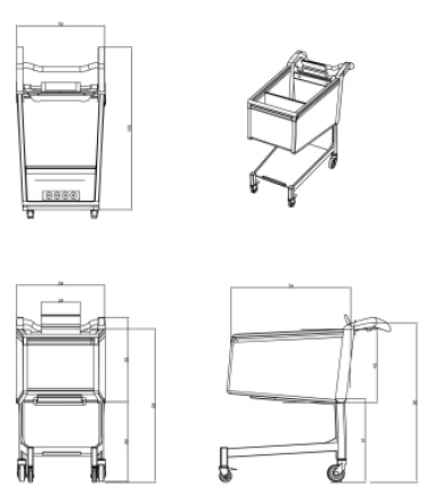
Based on the observation and analysis of the movement processes of elderly people using supermarket shopping carts and the related dimensional cal- culations, the relevant dimensions were redesigned. The height, width and diameter of the handles of the supermarket shopping cart are 916mm, 562mm, and 350mm respectively; the depth and height of the basket of the supermarket shopping cart are 510mm and 526mm respectively. Other dimensions that are not related to the human machine are based on the data and research criteria of the products available on the market.
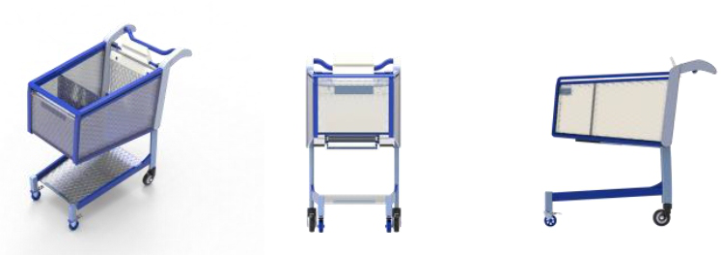
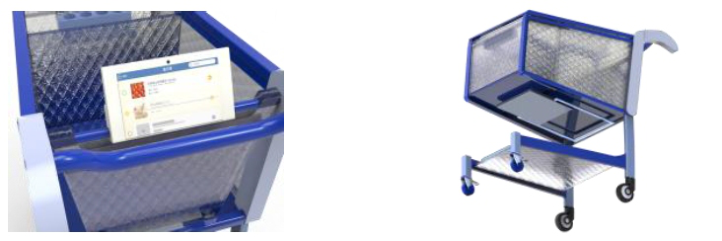
Display of Product Appearance In appearance, perceptual imagery based on user research was used to design the appearance; Regarding color, blue, white and grey are used to match the supermarket environment researched; Adding removable card slots for each class and fragile glass bottles in the basket of the supermarket shopping cart, setting up a large item placement area for better zoning and plan- ning of placement; Incorporating a pull-out resting seat underneath the cart basket; Replacing traditional wheels with power-assisted wheels; A smart
Improvement Design of Age-Friendly Supermarket Shopping Carts Based on Ergonomics 209
screen has been added to the shopping cart, based on the use of RFID, Bluetooth and other technologies in indoor navigation, self-service weigh- ing, self-service settlement and other functions, adding shopping list function and price accounting function, integrating the shopping process, and inte- grating the navigation, weighing, settlement and booking of delivery in the supermarket shopping cart to shorten the time of searching for the goods and queuing time, and to improve the efficiency by integrating the process links.
In detail, the basket is made of polycarbonate material, which is impact- resistant and recyclable. The bottom plate of the basket is designed with a backward tilt, which is easy to clean; the back plate is split and movable, which can be stacked together to increase storage space.
Figure 1: Rendering of improvement design of age-friendly supermarket shopping carts based on Ergonomics.Figure 2: Three views and dimensions of improvement design of age-friendly super- market shopping carts based on Ergonomics.
210 Wu
Figure 3: Rendering of smart screens and pull-out lounge chairs.
CONCLUSION
According to the questionnaire survey, user interview, and literature analy- sis, the pain points and users’ needs were explored, and later a new kind of supermarket shopping cart was designed based on Ergonomics. This study focuses on improving the design of shopping carts in Wal-Mart and Sam’s Club, which still has some limitations. This study needs to broaden the scope of field research and user studies to increase the sample.
Due to the continuous development of technology research related to supermarket shopping carts. As a design student, one limitation of the present study is that the author’s understanding of the field is still evolving, which may have influenced the depth and breadth of the analysis. This study can be continuously improved, hoping to provide a reference for the relevant product design.
The design was not physically modeled to observe problems in actual use, and further model testing needed to be refined in the future.
ACKNOWLEDGMENT
This study is our initial attempt to improve the age-friendly supermarket shopping carts based on Ergonomics. We sincerely thank the School of Mechanical Science and Engineering of Huazhong University of Science and Technology for their financial support and all the friends who participated in the questionnaire and helped us in the research.
REFERENCES
Bing Yao. (2020) Research on the design of supermarket service systems in the new retail era [D]. Shenyang University of Aeronautics and Astronautics. GUO, et al. (2017) Design of new shopping cart for supermarket [J]. Modern
Manufacturing Technology and Equipment, (05): 158–160. Ming Ni. (2011) Research on Supermarket Service Design under the Background of New Information Technology [D]. Jiangnan University. N. Wang. (2019) Research on the design of elderly mobility scooters based on Kano
model [J]. Industrial Design, (01): 155–156.
Improvement Design of Age-Friendly Supermarket Shopping Carts Based on Ergonomics 211
Tulin Tang. (2019) Research on the design of supermarket shopping safety experience for the elderly in China under the perspective of service design [D]. Zhejiang University of Technology. Wenxin Zhou, Shidong Chen. (2017) Shopping cart redesign based on enhancing
shopping experience [J]. Industrial Design Research, (00): 235–239. Yulan Ding. (2017) Ergonomics (5th ed.) [M]. Beijing: Beijing Institute of Technology Press. Zijuan Xiang. (2015) The Research on improved design of trolley [D]. Central South
Forestry University of Science and Technology.
LISTED IN THE AHFE DIGITAL BOOKSTORE CATALOGUE
Explore the complete digital volume
Ergonomics In Design
Read this individual research paper free through the original publisher, or explore the full digital proceedings book.
ISBN 978-1-964867-05-2
Explore this ISBN in the AHFE Bookstore ↗Listed in the July 2026 bookstore catalogue; search by ISBN to confirm current availability · Digital book purchase optional