Zixuan Huang, Shuwen Qiu, Ren Long (2023). Design of Intelligent Home Planting Robot Based on MR Technology. In: Affective and Pleasurable Design. AHFE Open Access, vol. 71, pp. 252–260. https://doi.org/10.54941/ahfe1003265
The purpose of this paper is to explore the interactive mode of intelligent home planting robot based on MR technology. In recent years, China's green plant industry market is expanding, the residential economy is developing rapidly under the epidemic prevention and control, and the smart planting machines used at home have attracted much attention. The design of intelligent home planting robot was explored in this study, which could provide reference for the design of related home intelligent products. Market research, literature research, user interview and user collaborative design methods to analyze the current design trend and user needs of home intelligent robots were adopted in the research. The results show that the development of labor courses in urban primary and secondary schools was affected by the epidemic, and there were some problems of children with less exposure to outdoor activities and a low understanding of vegetables. In order to meet the needs of children for home planting and understanding of green vegetables, our research team completed the design and output from the directions of human-computer interaction, appearance and modeling, sustainable development and plant demand visualization. The intelligent home planting robot is designed to grow green vegetables at home, which can compost degradable waste as raw materials. Based on MR technology, the real-time feedback of plants through operation interface and cartoon expression, which is of great research value and reference significance.
In terms of education, from September 2022, China’s Ministry of Education requires primary and middle school students to learn how to cook. Therefore, it has become necessary ability for children to know vegetables, grow vege- tables, and understand the taste and characteristics of vegetables. Vegetable cultivation is inseparable from fertilizers, and composting is one of the most effective and suitable technical means to deal with organic waste. A large amount of degradable garbage is produced in our life. The fertilizer uses the metabolism of microorganisms that exist widely in nature to reproduce itself under suitable conditions, thereby converting biodegradable organic matter into stable humus. (Yingmin Zhang et al. 2011).
Coupled with the fact that the Chinese government has attached great importance to environmental protection in recent years, the environmental awareness of primary and secondary school students needs to be strengthe- ned. In terms of policies, various localities in China have issued local policies on the green plant industry to increase the penetration rate of the industry. In 2020, the green plant industry has become a market for policy dividends. The government work report of the State Council of China pointed out that the green plant industry will help improve the quality of life of the people. In recent years, with the advancement of Industry 4.0, the Internet of Things technology has penetrated various high-end smart green products that have been introduced to the market, but they focus more on how to make plants grow better and are limited to physical space.
Relative Research of Intelligent Home Robot Compared with developed countries in Europe and the United States, China’s robot research started relatively late, which has led to a low utilization rate of home robots in people’s lives. As China increases investment in robot rese- arch and development, the types of home robots are gradually increasing. And due to the advantages of technological competition, the manufactu- ring cost of robots has been greatly reduced, which will greatly increase the proportion of robot consumption (Liqun Niu et al. 2020). From the perspective of the interaction form of home robots, natural interaction is a research hotspot of human-computer interaction, which is based on the user’s natural operation methods, such as voice, gesture, etc., and is deve- loping towards a multi-channel, multi-sensory, multidimensional intelligent interaction method (Shuyu Ren, 2016).
Mixed Reality Technology Mixed Reality (MR for short) is a kind of digital perception technology, which uses digital means to capture, reproduce or synthesize various sensory inputs from the external world, to achieve an immersive sense of immersion. Establish an interactive relationship between them, that is, form a mixed world of virtual and real interaction (Yinghao Hao, 2016). With the wide application of MR,the technology is becoming more and more mature. Magic Leap, which has been committed to promoting MR technology, uses a small computer as the computing core and displays it with a retinal projection technology that is currently unimaginable. Such research will undoubtedly enhance the human experience of receiving images. At present, MR techno- logy is being researched and applied in the fields of education, medical care, games, and sports (Li Peng et al. 2016). Through MR technology, the audie- nce is completely immersed in the virtual space, and the virtual space triggers some real feelings. These experiences are real to people’s sensory experience, but these objects are indeed fictitious objects, thus blurring the boundary between virtuality and reality (Jiao Lin, 2021).
Therefore, the objective of this study is, (1) To enhance users’ awareness of environmental protection by combining intelligent home planting robots with
compost bins; (2) To propose the combination of MR technology and intel- ligent home planting robots, which can interact with children and generate experiences, which has a better educational effect; (3) Adopt a humanized interactive interface to visualize and present the needs of plants in real-time, increasing the interest of the product.
RESEARCH PROCESS Market Research
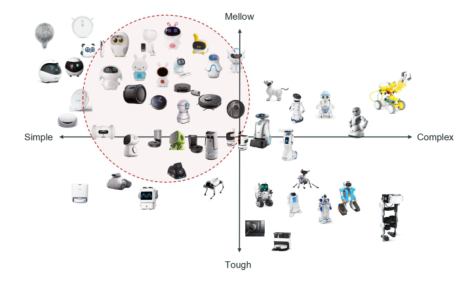
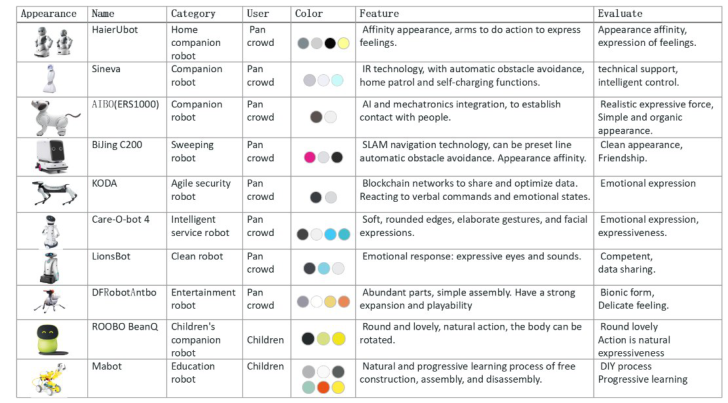
This article collects the existing intelligent robots and divides them accor- ding to two groups of antonyms: mellow-tough, and simple-complex (see Figure 1). In the research, it is found that there are more simple and mellow intelligent robots. Then selected 10 representative products, were compared from the four dimensions of category, user, color, and feature, and conducted a generalized evaluation respectively to explore possible reference factors (see Figure 2).
Among related intelligent robot products, keywords such as companion- ship and cleaning appear frequently. From the distribution of their colors, it can be seen that there are more intelligent robots in black, white, and gray colors. In addition to the choice of achromatic color, cleaning robots are mostly in cool colors, and Children’s educational robots and entertainment robots are mostly in warm colors. Relevant studies have shown that white home robots have a strong reflective ability and visually give people a clean feeling. In a small space, it can soothe people’s emotions and calm the irrita- ble emotions of hypertensive patients. The achromatic color scheme is more conservative, and there will not be too much color conflict in home life (Jie Zou et al. 2019). Most smart home robots have a friendly appearance, roun- ded edges, and rich expressions, which can easily establish contact with users and give people a friendly feeling.
User Research After market research, various situations involving the home life of primary and middle school students are investigated: first, We found some pain points
Figure 1: The appearance distribution trend of the existing intelligent home robot.
Example for Preparation of Your Own Paper 255
Figure 2: The comparison of Intelligent Robots.
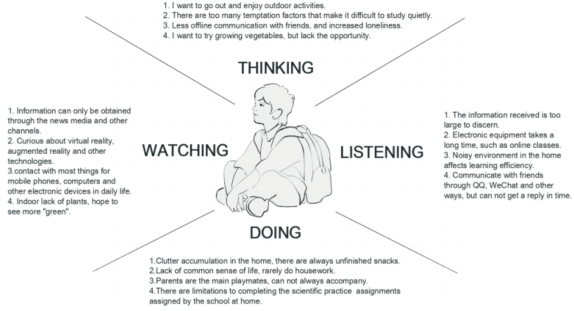
through online interviews with families of primary and middle school stu- dents; then the research team conducted collaborative design and drew an empathy map from the four directions of watching, listening, thinking, and doing (see Figure 3); lastly, the selected points are voted to summarize the design direction. Details on intelligent home planting robot are discussed in later sections.
Feasibility and Necessity of MR Technology Virtual reality (VR for short) is a new type of human-computer interaction developed in recent years, which allows people to immerse themselves in a computer-generated virtual world. Ting Qiu and others proposed to apply VR technology to planting design and integrate it into virtual simulation expe- rimental teaching, breaking the limitations of design teaching, and applying
Figure 3: Empathy map of primary and middle school students living at home.
virtual simulation technology to solve traditional teaching problems (Ting Qiu, 2022). And MR is not a technology based on imagination, it is a fur- ther development of VR and AR technology, and it can also be integrated into experimental teaching. Since its key point is to interact with the real world, the home implant robot provides a suitable real-world platform for MR technology.
Based on the virtual experiment system of MR technology, Zixi Jia et al. realized the control of the inverted pendulum and the robotic arm system in the virtual environment (Zixi Jia et al. 2020). The control of other virtual objects through MR technology provides practical experience for the appli- cation of intelligent home planting robot MR. To satisfy users’ immersive home planting experience, it is feasible to apply MR technology to intelligent home planting robots
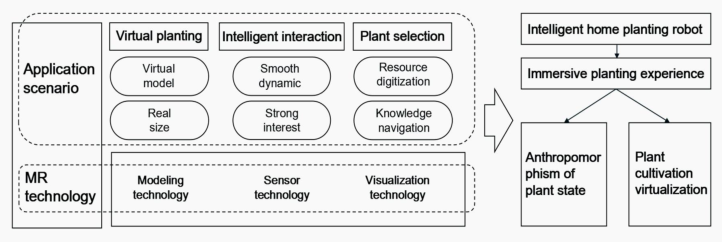
MR technology has a certain development potential in the field of the home intelligent robot. The integration of MR technology into the intelligent home planting robot is an important means to realize interesting interactions with users. Three application directions of MR in the intelligent home planting robot were explored, (1) Virtual planting: using the hole chamber of the plan- ting robot as a platform, the plants are presented in the virtual scene; (2) Plant selection: intelligently recommend vegetables suitable for planting to users by integrating relevant digital resources related to indoor vegetable cultivation, according to the local climate and environment conditions and the difficulty of planting (3) Intelligent interaction: The dynamic plant elf can feedback on the present state of plants to create an immersive planting experience. This direction is the main design point of the intelligent home planting robot in this research, Details on specific interaction methods are discussed in later sections (see Figure 4).
Figure 4: Application of MR in intelligent household planting robot.
DESIGN OUTPUT Design Illustration
To meet the needs of children and family members, this is a home-intelligent planting robot that can grow green vegetables, use degradable domestic waste
Example for Preparation of Your Own Paper 257
as compost raw materials, and interact with people through MR technology to realize the visualization of plant needs.
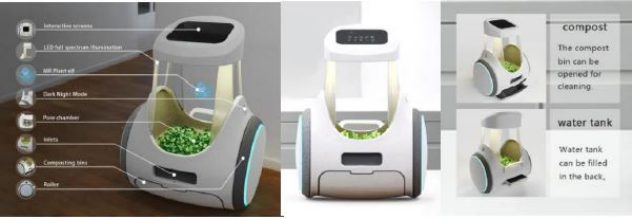
The top of the robot is a 7-inch LCD screen, which is used to display the needs of plants. By wearing MR equipment, you can observe the MR elves above the plants, and the MR elves will reflect the state of the plants. Users can have fun interactions with the MR elves, increasing the user’s interactive experience. There is a compost bin in the front belly of the robot, which can put kitchen waste, express boxes, etc. into compost, and the compost bin can be taken out for cleaning. There is a child lock on the first-level interface to prevent children from accidentally opening the compost bin.
In addition, the robot uses artificial lighting, and the lights on both sides provide faint light for the dark environment. The four-hole chambers pro- vided can plant four different plants at the same time, and the open space around them allows the plants to grow freely. In terms of product appeara- nce, the simple and modern shape, smooth lines, and integrated appearance plus slender blue light bands are in line with the future sense of technology of the home; in terms of color matching, it adopts achromatic matching of black, white and gray, suitable for various home furnishing The environment gives people a clean and tidy feeling; in terms of material, the white main body is made of flame-retardant ABS material, and the composting and watering parts are made of two-color injection molding. The blue part is the LED ambi- ent light strip. Four frosted glass covers are connected in the middle of the product to ensure that the plants grow naturally while reducing the impact of light on the user’s eyes to a certain extent.
User Interface Design To reflect the needs of plants in real time, cute expressions are designed in the interface to interact with children (see Figure 6). The first-level interface displays three expressions: normal state (smiling), abnormal state (crying), and feedback state (blinking) under different conditions, reflecting the vege- tative state. When the expression is in an abnormal state, click to enter the secondary interface, and the cause of the plant abnormality (including water, humidity, temperature, air, minerals, etc.) can be displayed. Select
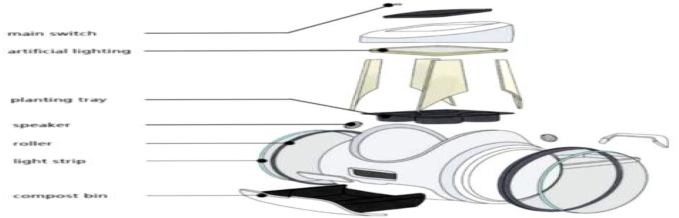
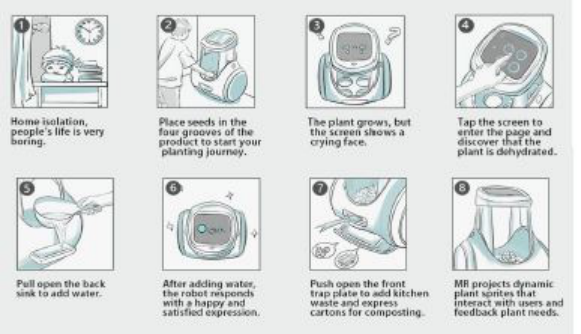
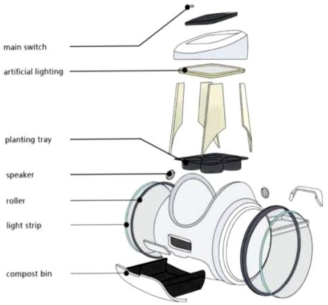
Figure 5: Product rendering and details.Figure 6: Display of some user-interface.Figure 7: Use process.Figure 8: Exploded views.
the abnormal item and click to enter the third-level interface, and the rele- vant information about the four-hole chambers will be displayed, which is convenient for users to make precise adjustments.
Example for Preparation of Your Own Paper 259
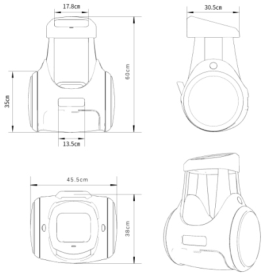
Figure 9: Three views.
Use Process Similar to the use process of planting machines on the market, first put sponge blocks and seeds into the four-hole chambers of the smart home planting robot and cover them with an absorbent cloth. After the seeds germinate and remove the absorbent cloth, we can wait for harvesting. The box in front of the robot is used for composting, which provides nutrients to the plants. If there are abnormal conditions such as lack of water during the growth of plants, the interface will show a crying expression. After opening the water storage box at the back of the robot to add water, the interface will turn into a smiling face. If you use MR equipment to observe the plants before and after watering, it is easy to find that the MR plant elf has changed from listless to full of vitality. During use, you can also use your fingers to interact with the MR plant elf, making life full of fun.
CONCLUSION
The intelligent home planting robot based on MR technology designed in this paper uses degradable household waste as composting raw material to improve users’ awareness of environmental protection in the process of fertili- zation. The user interface responds to the needs of plants through expressions The combination of MR technology and intelligent home planting robots was explored, by interacting with the MR plant elf, enhancing user engagement. It could effectively solve the defects of competing products in the market that are limited to observing plants and cannot interact with them. However, there are still some limitations. We prefer to provide a direction and design scheme combined with MR. The product structure and technical implementation still need to be developed and improved. It is hoped that users can experience the fun of home planting and provide a reference for the design of related robots.
ACKNOWLEDGMENT
Affected by the epidemic, we mainly conduct research in the form of desktop research. Thanks to all interviewees and those who contributed to this research.
REFERENCES
Jiao Lin (2021). Application of MR technology in fine art design. New technologies and new products in China (21), 36–38. Jie Zou, Cuiyu Li, Yanqing Dong, and Liu Ding. (2019) Analysis of the application
of color emotion in the home intelligent service robot for the elderly [J]. Popular Art, (03): 84–85. Li Peng, Peng Luo. (2016). New media technology is changing and enhancing news media —— based on VR technology, AR technology, and MR technology investi- gation. Journal of Southwest University for Nationalities (Humanities and Social Science edition) (10), 153–157. Liqun Niu, Xiaopu Sun. (2020). The technical development trend and current
situation of the household cleaning robot. Technology and Innovation (12), 74–75. Shuyu Ren. (2016) Design of natural interaction interface based on situational perception [D]. Nanjing: Southeast University. Ting Qiu, Zujian Chen (2022). Research on the application of VR technology in
planting design —— Take the virtual simulation experiment teaching seasonal phase change of plant landscape as an example. Forestry Science and Technology Information (04), 1–6. Yinghao Hao. (2016). A new mode of human-computer interaction, VR / AR /MR industry began to form. New Industrialization (08), 65–70. Yingmin Zhang, Xiaobo Shang, Kaiming Li, Zhongsheng Zhang, Kefang Zhangand
Rong Hongwei. (2011). Current status and management counter measures of municipal solid waste treatment technology. Journal of Ecology and Environment (02), 389–396. Zixi Jia, Shuai Wang, Yida Hao and Yihe Wu. (2020). The Application of MR Technology in the Practical Teaching of Robot Engineering Specialty. Experimental Technology and Management (09), 139–142.
LISTED IN THE AHFE DIGITAL BOOKSTORE CATALOGUE
Explore the complete digital volume
Affective and Pleasurable Design
Read this individual research paper free through the original publisher, or explore the full digital proceedings book.
ISBN 978-1-958651-47-6
Explore this ISBN in the AHFE Bookstore ↗Listed in the July 2026 bookstore catalogue; search by ISBN to confirm current availability · Digital book purchase optional