Ren Long, Wenyi Han, Xin Zeng, Yiming Wang, Mei Ming Xiong (2022). Color Analysis and Application of Luo Fabric Based on Clustering Algorithm. In: Human Factors for Apparel and Textile Engineering. AHFE Open Access, vol. 32, pp. 145–152. https://doi.org/10.54941/ahfe1001549
Luo, a traditional Chinese silk fabric, is famous for its lightness and softness. Due to its difficulty in weaving and the lack of development in line with contemporary trends, it gradually disappeared from people's vision. Therefore, in order to clarify the color matching rules of traditional woven fabrics and complete the redesign of the intangible cultural heritage of woven fabrics, this paper introduces the K-means clustering algorithm to extract the main colors of the sorted images of woven fabrics and similar fabrics, and build a standard color card. The model with color network. Taking the design of Luo and silk products produced in Wuluo—ancient Wu land as a practical case, it is verified that Luo fabric standard color card and color network model can provide a theoretical basis for the redesign of Luo products, and provide inspiration and inspiration for Luo's color design. Decision-making suggestions to promote the inheritance and development of Wuluo intangible cultural heritage.
Compared with shape, texture, size and other factors, color is more intuitive and visually impactful (Duan, 2006). The clever collocation of colors is an important way to improve product effects and achieve product innovation.
Chinese traditional Luo fabrics have evolved unique characteristics and weaving techniques in the long history. The rope uses the intertwining of the warp yarns and the repeated alternation of the hank and the plain weave, which makes the warp and weft yarns not easy to slip, the structure is stable, and the air-permeable strip holes are presented (Wang, 2021). Due to vari- ous factors, in modern times, Luo fabrics began to fade out of people’s field of vision. Fortunately, the technique of weaving has been preserved due to the protection of intangible cultural heritage. Even so, it does not have the potency of sustainable development. The existing research on Luo is mainly focused on the restoration of techniques and the reproduction of cultural relics. The objective and systematic analysis of the color matching rules of Luo fabrics in the referenced literature is still blank. Therefore, this paper hopes to clarify the color matching rules of Luo, taking Wu Luo—the color matching design of Luo and silk products produced in ancient Wu land as a practical case, to provide color matching reference and theoretical basis for Wu Luo product design, and to enhance the vision of Wu Luo silk scarves The
expressive power helps the protection and inheritance of Wu Luo’s intangible cultural heritage.
COLOR EXTRACTION METHODS The main color system of a picture represents the distribution of the main colors in the picture, which can affect people’s overall sensory impression of a picture. Therefore, the extraction of the main color of a picture is helpful for analyzing the use and matching of colors (Zhang et al., 2017). Since the appearance of the color histogram in 1991, scholars have continued to study, improve and optimize the color extraction method. Among them, Zhu Mia- oliang et al. (Xu et al., 1998) proposed a dominant color extraction method based on cluster analysis, which weighed the color resolution and color cha- racteristics at the same time. dimension. In his research, Chen Tianyun (Chen et al., 2007) accurately locates the center of the color block, and through the analysis method of quantitative clustering, the color in the picture is reaso- nably grouped into the color that is as similar as possible to the color of the pattern. Xu and Wan (2008) used an octree to cluster the pixels of the graph according to the color space of color values, and derived a series of chara- cteristic colors such as dominant color and average color as the index of the image content. Among them, the method of color extraction using K-means clustering algorithm is widely used in the field of color extraction and analy- sis due to its strong operability and better extraction effect. In this paper, K-means clustering algorithm is used to analyze and extract the main color of the material picture library of Luo fabrics and other fabrics, and explore the color matching rules of fabrics.
Basic Concepts of K-Means Clustering Algorithm There are many kinds of clustering algorithms, among which K-means cluste- ring algorithm is a representative clustering algorithm. It has simple principle, fast convergence speed, few adjustment parameters, and has significant advantages in color extraction.
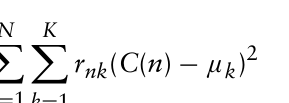
The basic idea of using the K-means clustering algorithm to extract the dominant color is: when selecting the initial cluster center, the principle of “each cluster itself should be as compact as possible, and each cluster should be separated as much as possible”should be followed. First randomly select a pixel in the image as the first initial cluster center, then calculate the distance between the remaining pixels and the first initial cluster center, and the pixel with the largest distance is the second initial cluster center, The pixels with the largest distance from the first and second cluster centers are taken as the third initial cluster center, so as to obtain all the initial cluster centers by analogy. distance sum of squares formula:
N X
Equation reproduced from the original PDF.
In the above formula, n is the coordinates of the pixels in the image, K refers to the final clustering into several main colors, C(n) is the color value
Color Analysis and Application of Luo Fabric Based on Clustering Algorithm 147
corresponding to each pixel, and µk represents the color value of the cluster center to which the pixel belongs. In addition, rnk is a two-component, used to indicate whether the current pixel color belongs to the k-class: if it does not belong to the kth class, it is 0, otherwise it is 1.
Color Extraction Scheme and Desired Goals Before completing color extraction, it is necessary to construct a material set containing a certain number of pictures, and extract the overall main color of the picture material set (Chen et al., 2007). Since other dynasties have a long time, it is difficult to verify the color. Therefore, in order to ensure the authenticity of the fabric color, the pictures in the material collection are mainly from the Ming and Qing dynasties. The author searched for fabric pictures in major museum websites and literature, and obtained a total of 60 valid material pictures.
Write the program of the K-means clustering algorithm in the Matlab envi- ronment, input the address of the material picture and the K value (that is, cluster into several main colors), run the algorithm program, and obtain the proportion of the color card of the main color of a single image. Integrate the main color ratio color card of each material image into a total color ratio map containing 60 images each with 6 main colors, a total of 360 colors, and use the K-means clustering algorithm again to perform secondary clustering to get The color card of the main color ratio of the fabric color library cle- arly shows the use of colors in the fabric material library and quantitatively displays the color ratio.
COLOR ANALYSIS OF LUO AND SIMILAR FABRICS The color analysis of Luo and similar fabrics mainly includes the construction of the standard color card of Luo fabrics and the construction of the color network model of Luo and similar fabrics.
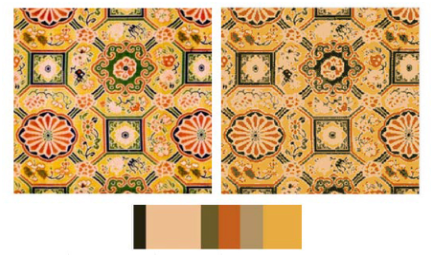
Construction of Color Card It has been verified by experiments that when a picture is grouped into 6 main colors, the color card can basically display the color of the picture. Take a picture as an example to show the main color extraction effect in the material picture library.
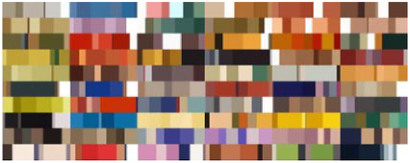
After extracting the main colors of the material pictures respectively, the proportion color cards of the respective 6 main colors are obtained. The Matlab image cropping program is used to ensure that the color cards of each picture are of equal size, and all the obtained color cards are filled in one image. The main color diagram is as follows.
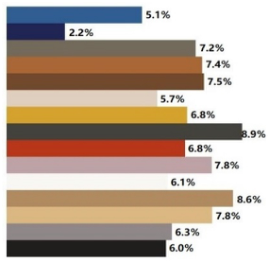
Secondary clustering was performed using K-means clustering algorithm, and 15 initial cluster centers were selected. According to the accuracy requi- rements set in the program, the final clustering result can be obtained in 111 rounds of iterative clustering. The clustering result is made into a color card, which is the standard color card of Luo and other fabrics, as shown in Figure 4.
Figure 1: Material pictures, clustering pictures and their proportion color card.Figure 2: The main color diagram of the material.Figure 3: The color chart of the total proportion of the material pictures.
The standard color card shows the 15 main colors and their proportions corresponding to the material library pictures. When Wu Luo’s color match- ing design is carried out later, the colors with a larger proportion are extracted from the color card as the main colors, and the smaller ones are used as auxiliary colors.
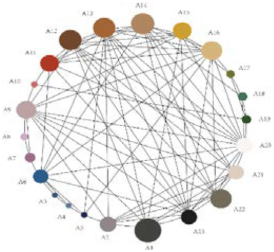
Construction of Color Network Model In order to better show the collocation and relationship between the extracted colors, based on the above color extraction results, this paper introduces a color network model. The drawn color network model is shown in Figure 5. In the figure, each main color corresponds to three kinds of main information: color information, the size of the point, and the number of corresponding
Color Analysis and Application of Luo Fabric Based on Clustering Algorithm 149
Figure 4: Overall color network model of Luo and other fabrics.Figure 5: Color scale extension.
lines on the point. The color and size of the main color dots correspond one-to-one with the proportion color card obtained before, and the more lines are connected to the main color dots, the higher the frequency of the cor- responding main color appears in Luo and other fabric materials, indicating that the color is more frequent. Commonly used. In addition, it can be found that the frequency of the color with a large proportion is not necessarily high (Zhang et al., 2017). As shown in the figure, the main color point of A12 is larger, but there are only 10 corresponding lines on it, and the area of the main color point of A20 is smaller than that of A12, there are 14 corresponding connections.
The color network model can simultaneously display all kinds of infor- mation of the extracted colors and color matching, and provide an effective reference for the design selection of Wuluo color matching.
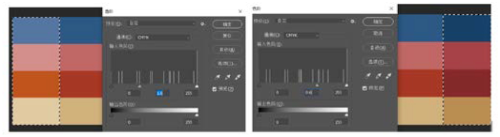
Color Card Extension Design extension of color swatches by using color gradation changes. The level of a color is used to represent the brightness intensity of an image. In Photoshop software, the color scale map refers to the distribution map of different brightness in the image, and the standard scale from left to right is 0-255 (Xiao et al., 2012). In order to complete the three-dimensional color scale of black, white and gray in the color matching color card, this topic uses the color scale tool in Photoshop to adjust the brightness of the color card (as shown in Figure 6).
Figure 6: Vertical axisymmetric composition.
DESIGN PROJECT This design practice selected Tao Yuanming’s representative work “Peach Blossom Spring” as the theme story concept. In the practice of silk scarf composition, it was subdivided into 6 major sections of imagery to complete the product line draft.
Main Image Concept and Composition Frame The narrative structure of “Peach Blossom Spring”can be briefly summarized as a cyclic story line of entering-exploring-leaving-seeking style. Using the clue of the whereabouts of the fishermen in Wuling, it connects the ideal and the real state, and describes the tranquility, harmony, freedom and equality of the Peach Blossom Spring of a scene.
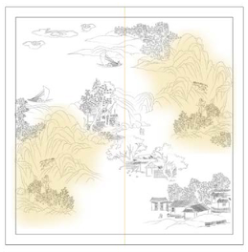
Excellent silk scarf composition can make the picture balanced, coordina- ted and beautiful. Part of the vertical axis-symmetrical composition is selected during the creation of the line draft composition of this subject. An Axisym- metric pattern is a commensurate combination of the same or similar parts of the pattern, it is a special form of balance, and it is also the structural pat- tern that most easily obtains a sense of pattern decoration (Sun, 2019). As shown in Figure 7, echoing the repeated scenes of the entry and exit links of “From the mouth” and “Exit” in “Peach Blossom Spring”, the two plates are symmetrically set on the left and right in the composition of the line draft, so as to obtain visual stability, balance and order of beauty.
Color Design In the color matching of silk scarves, following the color matching principle of “clear main colors, harmonious auxiliary colors, and in-place decorative colors”, the gold color matching of “6 main colors: 3 auxiliary colors: 1 embellishment color” was adopted in the specific color matching application ratio. law.
Through the previously drawn color network model of Luo and other fabrics, the colors required for different color schemes are selected and the color scale is extended to complete the color card. From the established color network model, six related styles of A14, A18, A20, A23 (style 1), A6, A10, A11, A16 (style 2) are selected as color schemes, and these four styles are
Color Analysis and Application of Luo Fabric Based on Clustering Algorithm 151
Figure 7: Self-made color card.
Figure available in the original PDF paper.
Figure 8: Color assignment of the line draft of the self-made color card.
respectively used. According to the size of the color ratio, choose different numbers of transition colors with different shades of light and shade, and make corresponding 12 color cards, as shown in Figure 8.
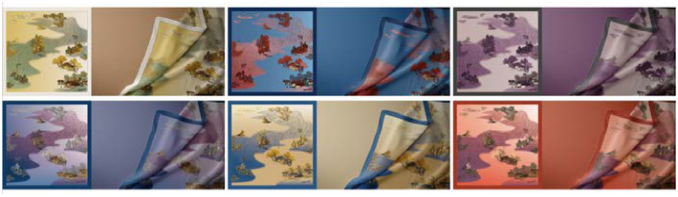
Based on 6 sets of color swatches made by Luo and similar fabric color network models, the line drafts were assigned colors respectively, and the obtained renderings are shown in Figure 9.
To sum up, the standard color card and color network model of Luo fabrics based on the clustering algorithm have a good application effect in the design of Wu Luo silk scarves, which can effectively help designers to complete the color scheme of silk scarf design and improve the design efficiency.
CONCLUSION
In this paper, K-means clustering algorithm is used to extract the main color of Luo and similar fabrics, and a color network model is constructed to achi- eve a more in-depth analysis of the color and color matching rules of Luo and similar fabrics. The application practice of Wu Luo silk scarf line draft color matching shows that the color network model and the standard matching color card have good operability and application effect, and can effectively improve the design efficiency.
Since there are few color choices for Luo and similar fabric samples at present, the color scheme needs to be further extended in future research, the material library will be supplemented and updated continuously, and a more comprehensive design scheme that meets user needs will be designed according to users’ perceived preferences.
ACKNOWLEDGMENT
This paper is funded by the University-level Educational Reform Project of Huazhong University of Science and Technology, Project No.: 2020003.
REFERENCES
Chen, T.Y. Yu, J. Zhao, D.F. Lin, J. (2007) A Method of Characteristic Color Extraction and System Design. Journal of Yunan University. 29(S1), 80–84. Duan, S. (2006) Color Psychology and Art Design. Southeast University. Sun, J.J. (2019) Research on the Design Method and Application of Hermes Silk
Scarves. Suzhou University. Wang, Z.Q. (2021) Study on the Structure, Technology and Culture of Warp Twisted Fabrics in Ancient China. Donghua University. Xiao, Z.T. Yan, H.S. Xiong, W. You, K. (2012) Comparison and Analysis of Levels
and Curve Tools in Photoshop. Computer Era. 02, 37–40. Xu, F.Q. Wan, X.X. (2008) Color Image Segmentation Algorithm Based on Dominant Color Graph. Application Research of Computers. 25(1), 313–315. Xu, X. Zhu, M.L. Liang, Q.H. (1998) “Image Color Feature Extraction Method
Based on Clustering Algorithm”, The 5th Chinese Joint Conference on Artificial Intelligence, Xi’an, S-SX. Zhang, M.S., et al. (2017) Color Extraction and Application Based on Humming birds’ Feathers. Journal of Silk. Volume 54 No. 12.
LISTED IN THE AHFE DIGITAL BOOKSTORE CATALOGUE
Explore the complete digital volume
Human Factors for Apparel and Textile Engineering
Read this individual research paper free through the original publisher, or explore the full digital proceedings book.
ISBN 978-1-958651-08-7
Explore this ISBN in the AHFE Bookstore ↗Listed in the July 2026 bookstore catalogue; search by ISBN to confirm current availability · Digital book purchase optional