Lars Arnemann, Benjamin Schleich (2023). Integrating Views of Digital Twins in the Strategic Planning of Cyber-Physical Products. In: Creativity, Innovation and Entrepreneurship. AHFE Open Access, vol. 74, pp. 60–69. https://doi.org/10.54941/ahfe1003306
The digital twin is the virtual representation of the real product and provides the basis for cyber-physical products. Information about states as well as commands are stored in the digital twin. A multitude and variety of stakeholders can retrieve the states and execute the commands. Howev-er, the digital twin is not made available to these stakeholders in its entirety, but rather application- and user-specific rights are distributed to them. These application- and user-specific rights are un-derstood to be the views of digital twins. Taking these views into account in the early stages of product development has the potential to reduce costs, open up new markets and adapt end products to individual customer requirements with less effort. The concept developed in this paper integrates the views of digital twins into the early stages of development of cyber-physical products. A model for strategic product planning is implemented that fully takes into account the criteria of Industry 4.0 and the views of digital twins. In this phase of the product life cycle, the views of digital twins are defined and integrated. A newly developed persona model can be used to analyze and formalize both users, in this case stakeholders, and ap-plications, in this case smart services. The stakeholder model considers both the assignment of a group and a role, as well as the identification of tasks, problems and benefits, and PESTEL influenc-ing factors. The smart service model addresses on the one hand the tasks, problems and benefits of the stakeholders; on the other hand, states and commands can be recorded as well as hardware, software and infrastructure can be analyzed. A comparison of these two models with each other promises an optimal fit. It is thus possible to fulfill customer-specific wishes. The developed concept is validated with the help of a practical use case. In particular, the integra-tion of the views of digital twins is investigated. As a result of the investigation, the applicability and viability of the concept are demonstrated on the basis of a vacuum cleaning robot. In the outlook, future research potentials are identified and possible new solution approaches are presented.
Industry 4.0 and digitalization approaches can increase the flexibility of pro- duction, productivity, and the efficient use of resources. However, increasing demand for customized products with cross-product services simultane- ously confronts companies with challenges. Adapting business models at the
Integrating Views of Digital Twins in the Strategic Planning of Cyber-Physical Products 61
beginning of the strategic product planning phase offers the opportunity to maintain or increase competitiveness (Wolfenstetter et al. 2015). Consequen- tly, selling product-service systems and using Digital Twins as the basis for services results in a competitive advantage for many companies.
Digital Twins are the digital representation of physical components and link the real and virtual worlds by twinning (Schleich et al. 2017). A diverse range of applications and use across all lifecycle phases are characteristic fea- tures of Digital Twins (Schleich et al. 2019). This Digital Twin comprises a digital master and a digital shadow and, through sensors and actuators, can store information about the states of the physical component and commands. Various actors can access and execute this information and commands via smart services, such as condition monitoring, remote access, predictive main- tenance, etc. Since a fully comprehensive provision of Digital Twins is impractical, application- and user-specific rights are distributed, understood as views of Digital Twins. In the early phases of product development, con- sidering the views of Digital Twins offers the potential for reducing costs, opening up new markets, and adapting end products to individual customer requirements with less effort of end products to individual customer requi- rements. Motivated by this potential, this paper focuses on the views of the Digital Twin into the development of cyber-physical products.
The is divided into five chapters. After the introduction, chapter two exa- mines the state of the art in technology and research. Then, fundamentals are explained from areas of product development as well as Industry 4.0 and Digital Twins. In addition, a conclusion is drawn at the end of this chapter. The core of this thesis is chapter three. Based on the requirements profile, a concept for integrating views of Digital Twins into the development of cyber- physical products is created. The core component includes strategic product planning. This is presented in detail and integrated into an overall concept through end-to-end product development. Chapter four validates and discus- ses the developed concept. A use case serves as the basis for the review. Finally, chapter five presents a summary and an outlook on future development and research potential based on this paper’s results.
STATE OF THE ART The transformation from mass production in Industry 2.0 to customized mass production is made possible by product service systems (PSS). The business model provides the basis for this. It is decided whether an existing business model is adapted or a new business model is implemented (Barquet et al. 2013). A model that has been used in many industries since 2010 is the Busi- ness Model Canvas. The current situation can be presented using a table created by Osterwalder and Pigneur in a standard format (Osterwalder and Pigneur 2013). Nine building blocks with topics such as customers, benefits, and infrastructure provide transparency for all those involved in strategic planning.
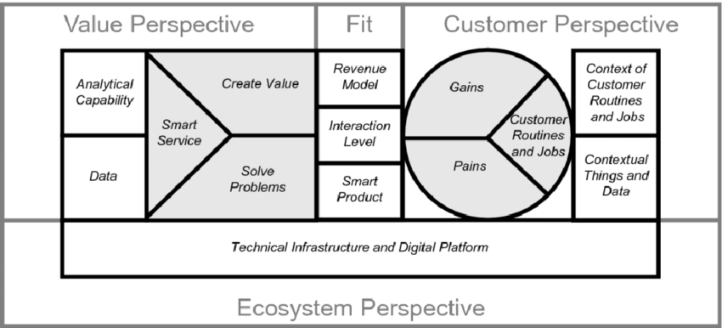
The importance of (smart) services is increasing in the business world, lea- ding to a variant of Canvas. The Smart Service Canvas is a model used to describe, analyze and develop business models for smart services. The four
62 Arnemann and Schleich
Figure 1: Smart Service Canvas model (Richter and Anke 2021).
areas of customer view, value view, ecosystem view, and fit of views are included in this canvas model, according to Figure 1 (Poeppelbuss and Durst 2019). The customer view includes the customer tasks and resulting problems to be solved by a smart service. If the customer needs are served, then a customer benefit results. Context things and data serve here as a source for context analysis of customer tasks. This data is accessible via a common technical infrastructure and digital platform that relevant actors can use through cloud computing services.
The available data and analytical capabilities define the value creation view. First, data is generated and collected in the usage phase, e.g., loca- tion data. Subsequently, these are converted into information with the help of analytical capabilities. Thus, the core of a service concept of a smart service is defined, and, in addition, it describes in detail which customer problems can be solved in concrete terms. Finally, the value creation view describes how the smart service leads to positive effects and results, i.e., provides an advantage.
The optimum fit of customer benefit and service offering is a prerequisite for a successful smart service. In addition, the customer desires an attractive and sustainable revenue model and a suitable level of interaction. A disti- nction is made between self-services, machine-to-machine services, provider active services, and interactive services, depending on the interaction between provider and customer. Lastly, choosing a suitable smart product is crucial, as this forms the technical basis for services and depends heavily on the skills and competencies of the target group (Durst 2018).
This chapter examined the topic of digital business transformation in more detail. The transformation from mass production to customized mass pro- duction is driven by applying the Smart Service Canvas model. However, it can be stated that current research approaches are insufficient to present an end-to-end strategic product planning with integration of future potentials through the views of Digital Twins and considering the criteria of Industry
Integrating Views of Digital Twins in the Strategic Planning of Cyber-Physical Products 63
4.0. Furthermore, there is a lack of a supporting, scalable, cross-sectoral, or cross-industry concept for product developers to generate customer-centric ecosystems for the development of product-service systems.
REQUIREMENTS The structure of this chapter is based on methods and procedures for require- ments analysis and system modeling (Kern 2020). First, the scientific need for action for integrating viewpoints of Digital Twins into the strategic product planning of cyber-physical products is given. Then, from this need for action follows a goal definition of this work, for which requirements are defined and explained in order to be able to fulfill them. Finally, these requirements are summarized in an overview.
Digitalization is driving the development and introduction of new busi- ness models. These business models increasingly target customized product configurations, which are the key to successful value creation. One possible implementation is the addition of digital services to products. This builds long-term customer relationships. Digital Twins have high potential and benefits here because they are the virtual representation of a product instance and record information. This information, especially within the usage phase, supports the development and introduction of new service-oriented business models.
This shows that a distribution of application-specific and user-specific rights and the integration of these into strategic product planning does not yet exist. This is because there is currently no concept that fully considers the criteria of Industry 4.0 and the views of Digital Twins or integrates them into a model.
This work aims to develop an end-to-end strategic product planning system that integrates the future potential offered by the views of Digital Twins to reduce costs, open up new markets and adapt end products to individual customer requirements.
The requirements profile serves as the basis for concept development, as shown in Table 1. In addition, it serves as the basis for concept validation and verification, in which properties of the concept solution are compared with previously defined requirements.
Table 1. Requirements to the concept.
Table available in the original PDF paper.
R1 The model must integrate the development of services. R2 The model must integrate the development of cyber-physical products. R3 The model must integrate business model development. R4 The model should be as scalable as possible. R5 The model should be as supportive as possible for developers. R6 The model must be cross-sector and cross-industry. R7 The model must support the multitude and diversity of stakeholders. R8 The model must be sufficiently powerful to map fully.
64 Arnemann and Schleich
CONCEPT Successful implementation of the target definition from requirements analysis presupposes an end-to-end model. This model or concept focuses on inte- grating the views of Digital Twins. Therefore, the approach described in this chapter focuses on the multiplicity and diversity of the views of Digital Twins, taking into account the criteria of Industry 4.0. The goal is to integrate the views of Digital Twins in the strategic planning of cyber-physical products.
Therefore, in a first step, stakeholders are abstracted. For this purpose, they are first assigned to a group, then to a role, and finally to a user. This assignment serves as a better overview and structure and is used to develop secure digital usage management. A stakeholder is first assigned to a group by dividing it into internal and external. External stakeholders, in turn, are divided into market, financial, and public.
In summary, this results in five groups: Internal, Market, Financial, Public, and Other. The assignment of a stakeholder to a role follows the assign- ment to a group. In total, there are ten roles, each assigned to a group: Investor (Finance); Government and Society (Public); Employee, Supervisory Board and Works Council (Internal); End Customer, Supplier, Partner, and Competitor (Market). As a result, many users understood as stakeholders are successfully assigned to a group and a role and thus have an extended identity.
In the second step, the abstracted stakeholders are analyzed. The persona model provides a classic method for analyzing stakeholders. Personas are models that describe idealized stakeholders and characterize them with the help of features. The needs and goals of inhomogeneous target groups become clear through this model and make it possible for a developer to put himself as a potential stakeholder. If the quantity and quality of existing data are insufficient, appropriate methods for obtaining data, such as online surveys or interviews, are needed (Personas - Definition | Onlinemarketing-Praxis).
Now, the third step is to identify a stakeholder’s tasks. By performing a task, a stakeholder expects to achieve certain goals. Tasks can be divided into both major and minor tasks. These, in turn, can be structured into subtasks to obtain a fully comprehensive overview of the tasks and identify the entire spectrum of tasks.
The fourth step is to identify the problems a stakeholder faces when tasks are implemented. The task is to identify an ACTUAL-TARGET deviation. This becomes apparent through a deviation in the degree of fulfillment of the tasks. In addition, it must be examined whether the problems are open or clo- sed. This is possible by classifying the problems. An open problem has neither a defined initial nor final state. A closed problem, on the other hand, has a well-defined initial and final state. Only the solution path is unknown. Ano- ther consideration for identifying problems is whether they are past, present, or future problems. Future problems, in particular, hold great innovation potential.
The fifth and final step is identifying a stakeholder’s benefits and gains. The better the tasks are performed, and the problems are solved, the greater the benefit and profit for a stakeholder. Maximizing these two factors is thus the
Integrating Views of Digital Twins in the Strategic Planning of Cyber-Physical Products 65
primary focus and is always considered in the stakeholder analysis. In other words: Benefit and profit are proportional to the advantage that motivates a stakeholder to buy and use a product-service system.
Generally, benefit and profit can be divided into time, cost, and quality. The three parameters have a reciprocal relationship, which means that a change in one parameter immediately affects the other two factors.
Table 2 presents the developed persona model, to which the PESTEL (Poli- tical, Economic, Social, Technological, Environmental, Legal) influencing factors were added in the last step. In addition, the group and the role of a stakeholder were also added. The result is a fully comprehensive persona model for stakeholder analysis and formalization.
The value proposition comprises products and services that can be com- bined as a product-service system. Through sensors in the product, data is generated by consumers and devices at every stage of the product’s life, which is processed and analyzed to generate information and, ultimately, know- ledge. This can be used to create intelligent services or services, so-called smart services. At the same time, the transparent and secure handling of sen- sitive, personal data is particularly important and is always at the forefront (Bundesministerium für Wirtschaft und Energie). As a digital technology, the development of smart services holds great potential, particularly the esta- blishment of new business models, the development of new business areas, performance optimization, and customer focus. Thus, added value is offered to both companies and stakeholders. Furthermore, smart services are offe- red to solve stakeholders’ problems, accomplish tasks, and thus create an advantage. These comprise information or states that can be retrieved and operations or commands that can be executed.
First, smart services are analyzed. For this purpose, they are divided into information or state and operation or command. This can be product-related, customer-related, or environment-related information. Operations can affect a product’s behavior, function, or movement.
A persona model is also developed for the value proposition or smart servi- ces and presented in this paper. The goal is to compare the persona model for stakeholders and the persona model for smart services and to adapt them to each other to address the stakeholders’ needs successfully.
Table 2. Persona for stakeholder.
Table available in the original PDF paper.
Stakeholder Group Role
1. Task 2. Problem 3. Benefit Main Task Actual-Target Deviation Time Side Task Open / Closed Costs Sub Task Past / Present / Future Quality
PESTEL Influencing Factors
66 Arnemann and Schleich
The persona model for smart services is similar to the persona model for stakeholders. However, the model is divided into task fulfiller, problem solver, and benefit provider/win producer. The task fulfiller must answer the que- stions: how and which tasks are fulfilled, the problem solver must answer the questions: how and which problems are solved, and the benefit provide- r/win producer must answer the questions: how and which benefits/profits are generated. In addition, it is helpful to analyze current hardware, software, and infrastructure, as these significantly impact smart services.
Table 3 describes the persona model developed for smart services. This model is a methodological tool for abstracting smart services and then efficiently analyzing and formalizing them. The final step in successfully integrating the views of Digital Twins into strategic product planning is the matching of analyzed stakeholders and analyzed smart services. An optimal fit of both developed persona models promises an attractive and sustainable revenue model, a desired and valued interaction level, and the right choice of a smart product.
Table 3. Persona for smart services.
Table available in the original PDF paper.
Smart Service Information Sub Information
Operation Sub Operation
1. Task Fulfiller 2. Problem Solver 3. Benefit Provider Which task is fulfilled, and how Which problem is solved, and how Which benefit is provided, and how
HIS Influencing Factors
The conceptual approach thus consists of analyzing and formalizing the multitude and diversity of views of Digital Twins. This includes both the players who have an interest in the Digital Twin and smart services. The goal was to define the views of Digital Twins and integrate them into strategic product planning.
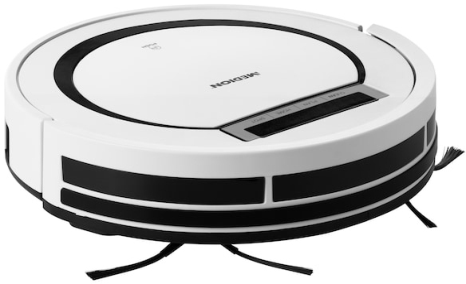
VALIDATION The use case for the validation must be a cyber-physical product or system. These include sensors and actuators and a local and global connection to use digital data and services. In addition, a human-machine interface is avai- lable. The selected product is a robotic vacuum cleaner that autonomously navigates and controls rooms while cleaning floors.
The next step is to analyze stakeholders for the product-related services of a robot vacuum cleaner that can use smart services to create value. First, a pre-selection of possible users is made for each group and each role. This results in the following user, who is used for the validation: Public, State, Authorities (police, fire department).
Integrating Views of Digital Twins in the Strategic Planning of Cyber-Physical Products 67
The role of the police is to guarantee public safety and order. The fire department is responsible for fires, accidents, and natural disasters. Problems can arise in the continuous monitoring of people and the environment and in the establishment of preventive measures. Consequently, a smart service could reduce the arrival time at the scene and costs through preventive measures. External influencing factors can be data protection rights, and fun- damental rights since consumers’ privacy is encroached upon for end-to-end monitoring. However, these rights are defined differently depending on the country.
Based on this persona model for the police and fire departments, the persona model for smart services is created to fulfill the tasks, solve the pro- blems, and benefit or generate a profit. The goal is to compare and adjust (if necessary) the created persona models.
In order to ensure safety and order, the police/fire department needs access to visual and auditory data. In addition, it can be beneficial to return visual and auditory data. Knowing how the ambient temperature, carbon monoxide content, and humidity behave to prevent fires is also helpful.
The validation demonstrates the applicability and viability of the concept for integrating the views of Digital Twins into the development of cyber- physical products. All requirements for the model integrating future potenti- als through the views of Digital Twins are completely fulfilled.
CONCLUSION
The Digital Twin is the virtual representation of the real product and pro- vides the basis for cyber-physical products. Information about states as well as commands are stored in the Digital Twin. A multitude and variety of sta- keholders can retrieve the states and execute the commands. However, the Digital Twin is not fully available to these stakeholders; instead, application- and user-specific rights are distributed to them. These rights are understood to be the viewpoints of Digital Twins. Considering these views in the early pha- ses of product development holds the potential for reducing costs, opening up
68 Arnemann and Schleich
new markets, and adapting end products to individual customer requirements with less effort.
Strategic product planning is the most important part of the concept. In this phase of the product life cycle, the views of Digital Twins are defined and integrated. Using a newly developed persona model, users, in this case stakeholders, and the applications, in this case smart services, can be analyzed and formalized. A comparison of these two models with each other promises an optimal fit. It is thus possible to fulfill customer-specific wishes.
A smart home product was selected as an application example as part of the validation. It is necessary to check whether the concept of this work can also be applied to other smart products, systems, or systems of systems. In particular, product-service systems characterized by a high service content should be tested for applicability and viability of the developed concept.
Concerning the concept, a prototype implementation should be done to facilitate and digitize the implementation or further validations. One possi- bility is to program an application that guides and supports a developer step by step to integrate the views of Digital Twins in the development of cyber- physical products. It is conceivable to integrate this application into current Product Lifecycle Management (PLM) programs.
REFERENCES
Barquet, Ana Paula Bezerra/Oliveira, Maicon Gouvea de/Amigo, Carolina Román/Cunha, Vitor Pinheiro/Rozenfeld, Henrique (2013). Employing the busi- ness model concept to support the adoption of product-service systems (PSS). Industrial Marketing Management 42 (5), 693–704 https://doi.org/10.1016/j.in dmarman.2013.05.003. Bundesministerium für Wirtschaft und Energie. Smart Service Welten. Available online at https://www.bmwi.de/Redaktion/DE/Artikel/Digitale-Welt/smart-ser vice-welt.html (accessed 5/22/2021). Durst, C. (2018). Smart Service Canvas - Entwicklung von Smart Services | ITONICS
Blog 2018. Available online at https://www.itonics-innovation.de/blog/smart-ser vice-canvas (accessed 5/14/2021). Kern, A. (2020). Nutzungsmanagement für sichere digitale Wertschöp- fungsnetze. Forschungsberichte aus dem Fachgebiet Datenverarbeitung in der Konstruktion (69). notebooksbilliger.de (2021). MEDION Saugroboter MD 18600 [für Hart- böden, Tierhaar optimiert, 90 Min. Laufzeit, Rückkehr zur Ladesta- tion, Programmierfunktion] bei notebooksbilliger.de 2021. Available online at https://www.notebooksbilliger.de/medion+saugroboter+md+18600+653596 (accessed 5/14/2021). Osterwalder, Alexander/Pigneur, Yves (2013). Business model generation: A handbook for visionaries, game changers, and challengers. New York, Wiley&Sons. Personas - Definition | Onlinemarketing-Praxis. Available online at https://www.on
linemarketing-praxis.de/glossar/personas (accessed 5/22/2021). Poeppelbuss, Jens/Durst, Carolin (2019). Smart Service Canvas - A tool for analyzing and designing smart product-service systems. Procedia CIRP 83, 324–329. https://doi.org/10.1016/j.procir.2019.04.077 Richter, Fabian/Anke, Jürgen (2021). Combining Methods for the Design of Digital
Services in Practice: Experiences from a Predictive Costing Service. In: 185–202.
Integrating Views of Digital Twins in the Strategic Planning of Cyber-Physical Products 69
Schleich, Benjamin/Anwer, Nabil/Mathieu, Luc/Wartzack, Sandro (2017). Shaping the digital twin for design and production engineering. CIRP Annals 66 (1), 141–144. https://doi.org/10.1016/j.cirp.2017.04.040 Schleich, Benjamin/Dittrich, Marc-André/Clausmeyer, Till/Damgrave, Roy/Erkoyu-
ncu, John Ahmet/Haefne, Benjaminr/Lange, Jos de/Plakhotnik, Denys/Scheidel, Wieben/Wuest, Thorsten (2019). Shifting value stream patterns along the product lifecycle with digital twins. Procedia CIRP 86, 3–11. https://doi.org/10.1016/j.pr ocir.2020.01.049 Wolfenstetter, Thomas/Bohm, Markus/Krcmar, Helmut/Brundl, Simon (2015). Why product service systems development is special. In: 2015 International Conference on Industrial Engineering and Systems Management (IESM). IEEE.
LISTED IN THE AHFE DIGITAL BOOKSTORE CATALOGUE
Explore the complete digital volume
Creativity, Innovation and Entrepreneurship
Read this individual research paper free through the original publisher, or explore the full digital proceedings book.
ISBN 978-1-958651-50-6
Explore this ISBN in the AHFE Bookstore ↗Listed in the July 2026 bookstore catalogue; search by ISBN to confirm current availability · Digital book purchase optional