Jean Paul Sebastian Piest, Maria Eugenia Iacob, Marcel Wouterse (2022). Designing intelligence amplification: a design canvas for practitioners. In: Human Interaction & Emerging Technologies (IHIET 2022): Artificial Intelligence & Future Applications. AHFE Open Access, vol. 68, pp. 68–76. https://doi.org/10.54941/ahfe1002714
Designing, developing, and implementing applications based on the concepts of Intelligence Amplification (IA) is a complex process. Although some design theories are present in literature, to our best knowledge, no comprehensive IA design approach exists for practitioners. Based on action design research, an IA design canvas is developed and guiding design principles are derived in two iterations. The main contribution of this research is a comprehensive IA design approach, consisting of an IA design canvas and four guiding design principles. Evaluation of the IA design canvas in three concurrent design workshops with 25 participants representing, 14 organizations, provides empirical support that the proposed IA design approach can ease the design processes, especially during the emphasize, ideate, and conceptualize stages of design thinking. Generalization is however not possible. Future research can explore the broader use of the IA canvas for explanation, analysis, prediction, and quantification, and formalize the IA design approach in a design theory.
The term Intelligence Amplification (hereafter IA) was first introduced by William Ross Ashby in his Introduction to Cybernetics (Ashby, 1956). In the last chapters of this work Ashby relates the concept of power-amplification to the amplification of sound, regulation, the human brain, and intelligence. Ashby concludes his work by stating that “problem solving is largely, perh- aps entirely, a matter of appropriate selection” (Ashby, 1956). Based on this pioneering work, widely varying definitions of IA have emerged over time. The term IA embodies a multitude of concepts and is used in different disci- plines. Therefore, the term IA is difficult to define precisely. As a result, there is little consensus what the term IA actually means. IA is on the one hand contrasting Artificial Intelligence (AI), but on the other hand using AI conce- pts and related technologies. AI can be defined as “intelligent entities that mimic cognitive functions” (Russell and Norvig, 2002). This way, AI implies replacement of human intelligence by machine intelligence and/or execution of formerly manual tasks using automation or robots without human inte- rvention. As a result, the human is kept out of the loop. Contrasting AI, IA emphasizes the enhancement of human intelligence and keeping the human
Designing Intelligence Amplification: a Design Canvas for Practitioners 69
in the loop. Since the definition of IA varies among researchers and disci- plines, it is important to clarify how the term is defined in this research. In this research IA is defined as “the effective use of information technology to enhance human intelligence in a given context”. This definition is sele- cted, because 1) it relates to the discipline of information systems research, in which the use of information technology is studied in context as part of a broader socio-technological environment, 2) it emphasizes the enhancement of human intelligence, which clearly sets IA apart from AI, 3) it can easily be incorporated in design science research methodologies, which is the main focus of this research, and 4) it is short and comprehensive, which makes it suitable for practitioners to use.
Designing IA applications is a complex process, which requires expertise from different disciplines, involvement of various stakeholders, and has a very wide application domain and solution space. Most practitioners lack knowledge regarding IA and are not capable to emphasize, ideate, and conce- ptualize IA applications without involvement of experts. Because IA is hard to define and measure, it is difficult to emphasize the expected benefits of an IA application during the initial design phase. Current literature contains little validated empirical research regarding IA,indicating a gap between avai- lable knowledge regarding IA and the actual use of IA. Therefore, in this research we aim to develop a comprehensive IA design approach for practiti- oners. Inspired by the widely used business model canvas of Osterwalder and Pigneur (2010), an IA design canvas is developed to support practitioners to emphasize, ideate, and conceptualize IA applications with involved stakeh- olders. The main goal of the IA design canvas is to ease the design processes related to IA applications, especially during the first stages of design thinking, and improve communication with experts and involved stakeholders. Based on the Action Design Research (ADR) method of Sein et al. (2011), the IA design canvas is iteratively developed and tested with practitioners in design workshops.
This chapter is structured as follows. First, an overview of related work is given regarding the design, development, and implementation of IA. Next, the use of the ADR is described. Then, the IA design canvas and derived design principles are presented and described. After that, the results and findings from design workshops are summarized. Lastly, conclusions are drawn and future work is positioned.
RELATED WORK
In this section related work regarding the design and application of IA are discussed.
Designing IA Next to introducing the term of IA, Ashby published the design for an intelligence amplifier ([1956] 2016). Dough Engelbart (1962) developed a conceptual framework to augment the human intellect. Xia and Maes (2013) revisited the conceptual framework of Engelbart. More recently, Cristina and Garcia (2010) propose a model of IA, called AGUIA, which can be
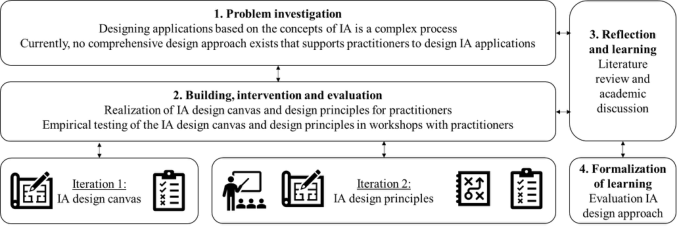
Figure 1: Application of the ADR method (image adapted from Sein et al., 2011).
used for knowledge use and acquisition. Based on the initial work of Liu (2016), Dobrkovic et al. (2016) propose a generic IA method that supports the initial design steps for IA-driven decision making by means of task- and decision decomposition and appropriate selection of tasks- and decisions for the design and implementation of IA applications. The use of the IA method is illustrated for enhancing decision making in scheduling processes.
Applying IA The experimental use and potential impact of IA in the logistics is demonstra- ted using the serious game Synchromania by Dobrkovic et al. (2016) and to support the process of literature reviewing (Dobrkovic et al., 2018). The work done in SynchromodalIT is extended by actually implementing IA in opera- tional environments. Single-case mechanism experiments are conducted at a large international retailer for two cases based on IA: master data validation and slotting (Kloppenburg, 2019; Gemmink, 2019). Recently, relevant IA approaches, models and case studies are presented in the special issue Smart Data, Information, and Knowledge Processing for IA by Szczerbicki et al. (2020). In earlier work, IA is applied for schema matching (Buis, 2019; Piest et al. 2020; Boerrigter, 2021). In current research, an industry platform is realized to develop IA applications for the logistics industry (Piest, 2019).
ACTION DESIGN RESEARCH The ADR method of Sein et al. (2011) is used to develop the IA design appro- ach for practitioners using its four stages, as shown in Figure 1. The ADR method is used to generate prescriptive design knowledge by developing and evaluating artefacts in an organizational setting (Sein et al., 2011).
The problem is investigated during the first stage of the ADR method. Practice-inspired research combined with a literature review led us to the idea of a design canvas. The IA design canvas and design principles are developed as theory-ingrained artefacts during the second stage of the ADR method. The first iteration addressed the problem in a specific organization. The second iteration addressed a class of problems in multiple organizations which results in a generalization of the proposed design principles. Refle- ction and learning are applied during the third stage of the ADR method to guide the emergence of the IA design canvas and design principles based on
Designing Intelligence Amplification: a Design Canvas for Practitioners 71
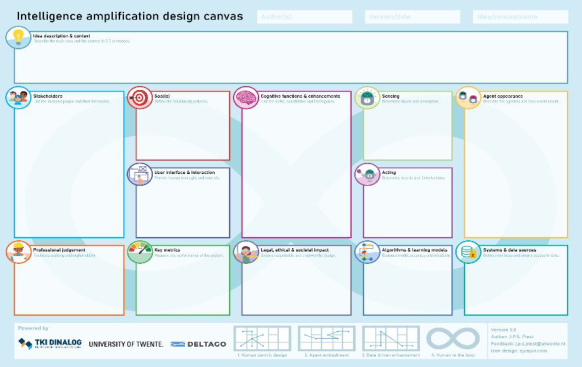
Figure 2: IA design canvas (adapted from Osterwalder and Pigneur, 2010).
the perspectives of practitioners, the workshop outcomes, and authentic and concurrent evaluation. The fourth stage of the ADR method focused on eva- luating the IA design canvas as a solution instance for the problem at hand and as approach for deriving design principles for practitioners.
IA DESIGN APPROACH FOR PRACTITIONERS In this section we present the IA design canvas, which is developed based on the ADR method as explained in the previous section, and the design princi- ples, which are derived based evaluation of the design workshops, reflection, and learning.
IA Design Canvas The IA design canvas, shown in Figure 2, contains three layers: a conceptual, foundational, and supporting layer. The conceptual layer supports emphasi- zing the initial idea(s) for an IA application and its context. This is the starting point for ideation. The foundational layer contains the main IA concepts. Practitioners can involve stakeholders to collaboratively conceptualize the IA application. The supporting layer incorporates enabling IA concepts. The IA design canvas encapsulates 13 elements as presented in Table 1.
Design Principles Four design principles are derived based on the design workshops: human centric design, agent embodiment, data driven enhancement, and human in the loop. These design principles provide practitioners guidance to conceptu- alize the 13 elements. The principle human centric design aims to achieve responsible and trustworthy AI. First, the stakeholders and their goals are identified. Next, the user interface and interaction with AI is explored. Fol- lowing, cognitive functions are made explicit from a human centric design perspective. Then, legal, ethical, and societal aspects are assessed. Finally,
Table 1. Design canvas elements, instructions, and guiding questions.
Table available in the original PDF paper.
Element Instruction Guiding Questions Idea description & context
Describe the idea and context in 2-3 sentences
What is the idea for an intelligent agent? How are the concepts of IA incorporated? Stakeholders List the involved people and their interest(s)
Who are the main stakeholders involved? What is their role? Goal(s) Define the solution objective(s)
What is the main goal of the IA application? User interface & interaction
Provide human oversight and controls
How do end-users interact with the intelligent agent? Cognitive functions & enhancements
List the skills, capabilities, and intelligence
Which cognitive functions are assigned to the end-user? Which to the intelligent agent? Sensors Determine inputs and perception
How does the intelligent agent perceive its environment? Actuators Determine intents and (inter)actions
Which actions/decisions does the intelligent agent need to take? Agent appearance Describe the agent(s) and task environment
Which type of intelligent agent is suitable? Professional judgment
Facilitate auditing and explainability
How can practitioners assess and interpret the outcomes? Key metrics Measure the performance of the system
Which metrics can measure and monitor performance? Legal, ethical & societal impact
Ensure responsible and trustworthy design
Which rules and regulations are applicable? What is the (uninten- ded) impact? Algorithms & learning models
Evaluate model accuracy and reliability
What are candidate algorithms? How can each model be trained and assessed? Systems & data sources
Define interfaces and secure access to data
Which system integrations are required to access data sources?
professional judgement is incorporated for auditing and to ensure explaina- bility. The principle agent embodiment makes the larger technology concept explicit. First, the physical and/or virtual appearance is described in terms of task environment, sensing-, and acting capabilities. Next, cognitive functions are made explicit from a machine intelligence perspective. The third principle makes the data driven enhancement explicit. First, the data sources are iden- tified and system integrations are defined to access the data. Next, candidate algorithms and learning models are selected and connected to stakeholder goals. Subsequently, key metrics are incorporated to measure the perfor- mance of the IA application and related to professional judgement by the end-users. The principle human in the loop evaluates the interaction between the end-users and intelligent agent. Following the infinite loop, the complete- ness and consistency of the 13 elements of the IA application can be assessed. Involving multiple stakeholders contributes to the design outcomes.
Designing Intelligence Amplification: a Design Canvas for Practitioners 73
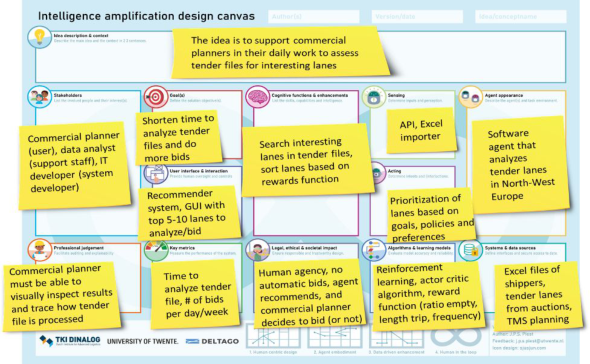
Figure 3: Illustrative example of IA design canvas.
DESIGN WORKSHOPS In this section, the results and findings from testing and refinement of the IA design canvas with practitioners during design workshops are presented.
In-Company Design Workshop During a one-day workshop with 4 practitioners, a total of 49 ideas for IA applications were ideated during a brainstorming session. Each workshop participant used the IA design canvas to conceptualize an IA application. Figure 3 illustrates the use of the IA design canvas to design a smart tende- ring agent. Based on the design workshop, a pilot project is initiated for the experimental development of the smart tendering agent and evaluated in Piest et al. (2021).
At the end of the day, the use of the IA design canvas and the design workshop are evaluated by the workshop participants. Table 1 depicts the evaluation results.
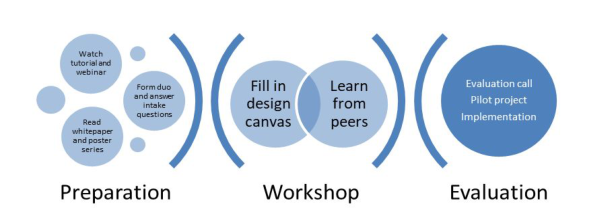
Design Workshops With Mixed Groups Together with Deltago and Breda University of Applied Sciences (BUAS), three concurrent design workshops were organized for members of the Logi- stics Community Brabant (LCB) as part of the Data science for Logistics Innovation (DALI) program. The design canvas workshop was prepared, delivered, and evaluated in three steps as shown in Figure 4.
The design workshop was published in the event calendar of LCB and invitations were sent to DALI participants. After verification, participants received practical information about the design canvas workshop, inclu- ding reading materials and links to webinars and supporting resources. An intake was conducted online via MS Teams and participants received a short questionnaire. Four questions were asked individually to learn about the background, current position, prior knowledge, and experience. In addi- tion, participants were asked to form a duo and provide a brief summary
Table 2. Design canvas and design workshop evaluation.
Table available in the original PDF paper.
EvaluationCriteria Score Feedback Eases requirements gathering process
5 Forces thinking in multiple dimensions 5 Thinking in building blocks, add examples 5 Add more logic in blocks and design patterns 4-5 KPI examples, when are you done?
IA design canvas
Facilitates communication
4 Create mutual understanding, IA is complex 4 Efforts and feasibility check can be added 5 Supports better understanding, no action 5 Good discussion instrument, many aspects
Stimulates taking action
2 Supports first step, not implementation 2 Creates overview, no action 1 Business case elements are missing 2 Stimulates thinking, no next steps
Supports ideation process
4 Supports brainstorming, also unrealistic ideas 4 Contributes to understanding 4 Position flow awareness-alignment-action 4 Supports brainstorm-ideas-concept
Design work- shop
3-4 Cluster ideas/functions, check existing tools 4 Dependent on group dynamics 4 Keep in mind the backgrounds 4 Add first check on process and data maturity
Supports conceptualization and design process
Figure 4: Design workshop preparation, delivery, and evaluation.
of the idea and expectations or questions for the design workshop. During the intake, the answers and input were discussed, additional resources were shared, and the design workshop agenda was discussed in more detail to align expectations.
The first workshop was organized for 6 companies with 11 participants. The first workshop was planned in the morning and was assessed with a score of 7.3 out of 10. The main improvement, mentioned by multiple participants, was to increase the duration to a full day instead of a morning so that there is more room to discuss all contents, present plenary the results to learn from each other, and to run multiple iterations. The second workshop was orga- nized for 5 companies with 8 participants. Based on the evaluation of the
Designing Intelligence Amplification: a Design Canvas for Practitioners 75
first workshop, a full day was planned. This turned out very well and gave more time to complete the IA design canvas in three iterations and let parti- cipants present their ideas. The second design workshop was assessed with a score of 8.4 out of 10. The third workshop was organized for 3 companies with 6 participants. The third workshop was assessed with a score of 7.6 out of 10. Building on second workshop, a full day was planned and the num- ber of slides was reduced to focus on discussion and interaction. Although we provided various examples and reading materials prior to the workshop, par- ticipants kept emphasizing that more practical examples would contribute to better understanding. Providing beforehand tangible examples, such as the smart tendering agent, can contribute to better preparation and improve the outcome of the design workshop.
CONCLUSIONS AND FUTURE WORK The proposed IA design approach enables practitioners to emphasize, ide- ate, and conceptualize IA applications by means of a practical IA design canvas. The IA design approach is empirically tested and 4 design princi- ples were derived based on the in-company workshop with 4 practitioners and 3 design workshops involving 25 practitioners representing 14 organi- zations. This constitutes evidence that design processes can be eased with the IA design canvas. The design workshops however have stressed that the design of IA applications still requires both domain- and expert knowledge. The focus in this study lies on the design of IA applications using ADR. The use of the IA design canvas for explanation, analysis, prediction, and quan- tification is not evaluated. Furthermore, the research is based on single-case mechanism experiments. Generalization at this time was not possible due to the situational and contextual nature of design science. Future research can explore broader use of the IA canvas and formalize the IA design approach in a design theory.
ACKNOWLEDGMENT
This research is supported by TKI DINALOG as part of the ICCOS project (grant no. 2018-2-169TKI). The authors thank Bas Groot for organizing the design workshops.
REFERENCES
Ashby, W.R. (1961). An introduction to cybernetics. Chapman & Hall Ltd. Ashby, W. Ross. ([1956] 2016) “Design for an Intelligence-Amplifier”. Automata Studies. (AM-34), Volume 34, Princeton University Press, 2016, pp. 215–234. https://doi.org/10.1515/9781400882618-011. Buis, J.T.P. (2017) Applying intelligence amplification to the problem of schema
matching (Master’s thesis, UT). https://essay.utwente.nl/73499/. Cristina, A., & Garcia, B. (2010). AGUIA: Agents guidance for intelligence amplification in goal oriented tasks. In 2010 International Conference on P2P (pp. 338–344). IEEE. DOI: https://doi.org/10.1109/3PGCIC.2010.56.
Dobrkovic, A., Döppner, D.A., Iacob, ME., van Hillegersberg, J. (2018). Collaborative Literature Search System: An Intelligence Amplification Method for Systematic Literature Search. In: Designing for a Digital and Globalized World. DESRIST 2018. LNCS, vol 10844. Springer, Cham. https://doi.org/10.1007/978- 3-319-91800-6_12. Dobrkovic, A., Liu, L., Iacob, ME., van Hillegersberg, J. (2016). Intelligence Amplifi-
cation Framework for Enhancing Scheduling Processes. In: Advances in Artificial Intelligence - IBERAMIA 2016. LNCS, vol 10022. Springer, Cham. DOI: https: //doi.org/10.1007/978-3-319-47955-2_8. Engelbart, D. C. (1962). Augmenting human intellect: A conceptual framework.
Menlo Park, CA, 21. Gemmink, M. W. T. (2019). The adoption of reinforcement learning in the logistics industry: a case study at a large international retailer (Master’s thesis, UT). https: //essay.utwente.nl/80122/. Kloppenburg, G. W. (2019). The adoption of intelligence amplification in the slot-
ting process: a case study in the data validation automation of a Dutch Retailer (Master’s thesis, UT). https://essay.utwente.nl/77611/. Liu, Luyao (2016) Applying intelligence amplification in decision making (Master’s thesis, University of Twente). https://essay.utwente.nl/69712/. Osterwalder, A., & Pigneur, Y. (2010). Business model generation: a handbook for
visionaries, game changers, and challengers (Vol. 1). John Wiley & Sons. Piest, J.P.S. (2019). “A Platform Architecture for Industry 4.0 Driven Intelligence Amplification in Logistics,” 2019 IEEE 23rd International EDOCW, 2019, pp. 174–178, doi: https://doi.org/10.1109/EDOCW.2019.00038. Piest, J.P.S., Iacob, M.E., van Sinderen, M.J., Gemmink, M. and Goossens, B.
“A Reinforcement Learning Platform for Small and Medium-sized Enterprises in Logistics,” 2021 IEEE 25th International EDOCW, 2021, pp. 289–298, doi: https://doi.org/10.1109/EDOCW52865.2021.00060. Piest, J. P. S., Meertens, L. O., Buis, J., Iacob, M. E., & van Sinderen, M. J. (2021).
Smarter interoperability based on automatic schema matching and intelligence amplification. In 10th I-ESA: Tarbes, France, November 17-19, 2020 (CEUR Workshop Proceedings; Vol. 2900). CEUR. http://ceur-ws.org/Vol-2900/. Russell, S., & Norvig, P. (2002). Artificial intelligence: a modern approach. Sein, M. K., Henfridsson, O., Purao, S., Rossi, M., & Lindgren, R. (2011). Action design research. MIS quarterly, 37–56. DOI: https://doi.org/10.2307/23043488. Szczerbicki, E., Nguyen, N.T., & Zanni-Merk, C. (2020) Smart Data, Information,
and Knowledge Processing for Intelligence Amplification: Approaches, Models and Case Studies, Cybernetics and Systems, 51:2, 81-83, DOI: https://doi.org/10. 1080/01969722.2020.1716524. Xia, C., & Maes, P. (2013). The design of artifacts for augmenting intellect. In: Proceedings of the 4th Augmented Human International Conference (pp. 154–161). ACM. DOI: https://doi.org/10.1145/2459236.2459263.
Read this individual research paper free through the original publisher, or explore the full digital proceedings book.
ISBN 978-1-958651-44-5
Explore this ISBN in the AHFE Bookstore ↗Listed in the July 2026 bookstore catalogue; search by ISBN to confirm current availability · Digital book purchase optional