Jean Paul Sebastian Piest, Maria Eugenia Iacob, Marcel Wouterse (2022). Designing intelligence amplification: organizing a design canvas workshop. In: Human Interaction & Emerging Technologies (IHIET 2022): Artificial Intelligence & Future Applications. AHFE Open Access, vol. 68, pp. 247–251. https://doi.org/10.54941/ahfe1002739
Based on the related paper about the design of intelligence amplification, in which a design canvas and design principles are introduced, this poster provides researchers, practitioners, and trainers practical guidance to organize a design canvas workshop using the intelligence amplification design canvas. Building on the experience and evaluations from design canvas workshops with practitioners, this poster presents a step-by-step approach with practical guidelines to prepare, deliver, and evaluate a design canvas workshop. The poster complements the paper with a blended workshop design and links to supplementary materials.
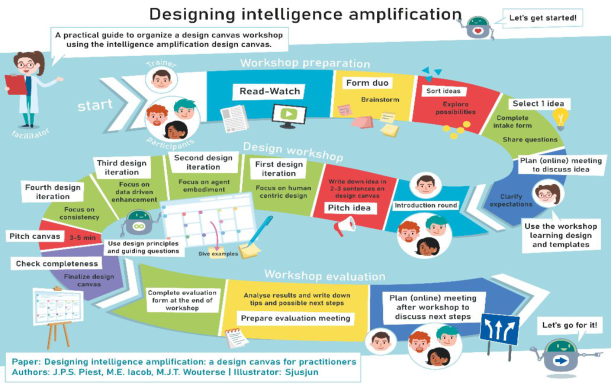
POSTER: ORGANIZING A DESIGN WORKSHOP This section contains the poster, as shown in Figure 1, that visualizes the process to organize a design workshop using the intelligence amplification canvas.
STEP-BY-STEP APPROACH This section describes the step-by-step approach to organize an online blen- ded design workshop using the IA design canvas and design principles as described in the related chapter of Piest, J.P.S. Iacob, M.E., Wouterse, M.J.T. (2022).
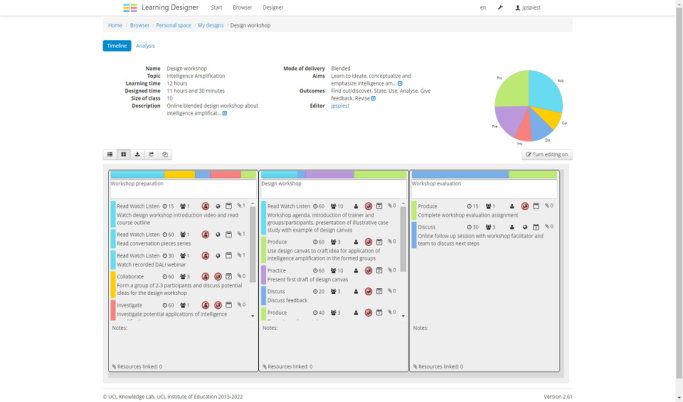
Learning Design The online application Learning Designer of the UCL Knowledge Lab (UCL Institute of Education, 2022) is used design an online blended workshop of approximately 12 hours of learning time for participants, as shown in Figure 2. Ideally the design workshop is organized by a facilitator, that focu- ses on the learning process, and a trainer, that focuses on the contents of the workshop. Both roles can also be fulfilled by one person when working in smaller groups. The size of the group is set to 10 people and workshop participation in pairs. Pairs are ideally formed by someone with a business role (e.g. CEO or business manager) and someone with a technical back- ground (e.g. IT or data). This ensures incorporation of multiple perspectives
Figure 1: Poster with practical guidance to organize a design workshop.Figure 2: Screenshot of online blended workshop design in Learning Designer.
and learning from peers while maintaining sufficient time and attention for the facilitator and/or trainer to complete multiple design iterations using the IA design canvas.
The main aim of the design workshop is to learn how to ideate, conceptu- alize, and emphasize ideas for applications based on the concepts of IA using the IA design canvas and design principles. The intended outcomes are:
Find out/discover: potential applications of IA;
State: (at least) one idea that utilizes IA using the intake form;
Use: the IA design canvas to craft the idea using the 12 building blocks;
Analyse: the IA design canvas using the 4 design principles;
Give feedback: regarding IA design canvases of fellow participants;
Revise: the IA design canvas based on feedback received.
Designing Intelligence Amplification: Organizing a Design Canvas Workshop 249
Table 1. Activities during the workshop preparation stage.
Table available in the original PDF paper.
Activity Duration Mode Who 15 min. Online Participants Watch workshop introduction video and read syllabus
1 hour Online Participants
Read supplied papers and/or illustrative case studies
1 hour Meeting Participants
Form a pair of 2 participants and discuss potential ideas for the design workshop
Participants
Investigate potential applications of IA
1 hour Meeting and/or individually 30 min. Meeting Participants
Craft (at least) 1 idea and complete intake form Online intake with workshop facilitator and participants
30 min. Online meeting Participants, facilitator and trainer
The process of organizing a design workshop comprises three stages: work- shop preparation, design workshop, and workshop evaluation. Next, each stage will be briefly discussed.
Stage 1: Workshop Preparation During the workshop preparation stage the trainer and facilitator create an online learning environment and make learning materials available for par- ticipants. Table 1 provides an overview of the learning activities that are covered during the workshop preparation stage.
Ideally the participants are provided access to the learning environment 2-3 weeks prior the design workshop. The intake can take place 1 week before the design workshop. This activates the learning process and provides the trainer and/or facilitator flexibility to tailor the design workshop to expectations of participants.
Stage 2: Design Workshop Based on the experience and evaluations of multiple design workshops, a design workshop can best be delivered as a one-day event. Table 2 provi- des an overview of the learning activities that are covered during the design workshop stage.
Organizing the design workshop requires a meeting room for 12 people and supporting facilities (e.g. TV or presentation screen, catering, prin- ted IA design canvases, pens). Depending on the preferences of the trainer and/or facilitator, a U-shape or informal set-up can be selected for the design workshop.
Stage 3: Workshop Evaluation
Table 3 provides an overview of the learning activities that are covered during the design workshop stage.
Table 2. Activities during the design workshop preparation stage.
Table available in the original PDF paper.
Activity Duration Mode Who
All
Highlight workshop agenda 15 min. Presentation Trainer Introduction of trainer, facilitator and participants
30 min. Introduction round 15 min. Presentation Trainer
Presentation of illustrative case study with example of IA design canvas
15 min. Assignment Pairs
Use IA design canvas to craft idea for application of IA
60 min. Pitches Pairs
Short break 10 min. - All Present first draft of IA design canvas (5-10 min.)
30 min. Assignment Pairs
Discuss feedback and revise IA design canvas 15 min. Assignment Pairs Apply design principle human centric design 30 min. Assignment Pairs Apply design principle data driven enhancement
60 min. Pitches Pairs
Lunch 60 min. - All Apply design principle human in the loop 30 min. Assignment Pairs Prepare pitch 30 min. Assignment Pairs Short break 10 min. - All Present final version of the IA design canvas (5-10 min.)
Finalize IA design canvas based on feedback 15 min. Assignment Pairs Conclude design workshop 10 min. Presentation Trainer
Table 3. Activities during the workshop evaluation stage.
Table available in the original PDF paper.
Activity Duration Mode Who Complete evaluation form 15 min. Individual work Participants Analyze evaluation forms 1 hour Meeting Trainer and/or facilitator Discuss next steps 30 min. Online or meeting Pairs, trainer and/or faci-
litator
The trainer and/or facilitator can decide whether (not) to make the design workshop evaluation anonymous. It is recommended to plan a follow-up ses- sion online or a physical meeting within 1-2 weeks after the design workshop. This allows participants to reflect on the design workshop and evaluate the outcomes.
PRACTICAL SUPPLEMENTS This section contains practical supplements to support the process of organi- zing a design workshop.
Learning Design and Syllabus The learning design created in Learning Designer is made available for re-use via the following short link: https://v.gd/rv5lac. The learning design contains links to: (1) an introduction video, (2) the conversation pieces blog series with
Designing Intelligence Amplification: Organizing a Design Canvas Workshop 251
8 research posters and illustrative case studies, and (3) a recorded webinar with examples from the DALI learning community, (4) an intake form, (5) the IA design canvas, (6) a slide deck to guide the design workshop, and (7) an evaluation form. The learning design can be customized in Learning Designer and exported as a syllabus as a Microsoft Word file or for the Moodle LMS.
Intake Form and Questions In order to support the workshop preparation stage, the intake form, avai- lable for download in Learning Designer, can be re-used and/or customized. The facilitator and/or trainer can use the intake form to obtain information about the participant’s educational background, working experience, and prior knowledge. The intake form mainly focuses on the following main que- stion: Which idea(s) for IA application(s) do you want to bring to the design workshop? Additionally, it is recommended to ask participants about their expectations for the design workshop, clarify the learning goal if needs, and offer the possibility to ask questions prior the design workshop. The trainer can use the information to incorporate illustrative case studies and additional learning materials to tailor the design workshop to the needs of participants.
Evaluation Form Additionally, an evaluation form, which is also available for download in Learning Designer, can be re-used and/or customized. Based on preferences of the trainer and/or facilitator, the participants can complete the design workshop evaluation form at the end of the design workshop or afterwards.
CONCLUSION
The poster provides trainers, facilitators, and practitioners guidance to orga- nize a design workshop using the IA design canvas. This chapter complements the related chapter regarding the design of IA applications with a practical step-by-step approach to prepare, deliver, and evaluate the design workshop using the IA design canvas. The blended learning design digitally enhances the one-day design workshop with approximately 4 hours of online learning activities and supplementary materials.
ACKNOWLEDGMENT
This research is supported by TKI DINALOG as part of the ICCOS project (grant no. 2018-2-169TKI). The authors thank Bas Groot for organizing the design workshops. Special thanks to Sjusjun for creating illustrations and visualizing the process.
REFERENCES
Piest, J.P.S., Iacob, M.E. and Wouterse, M.J.T. Designing intelligence amplification: a design canvas for practitioners. In review for 8th International Conference on Human Interaction and Emerging Technologies (IHIET 2022). UCL Institute of Education. (2022). Learning Designer [online]. Available from: ht
tps://www.ucl.ac.uk/learning-designer/index.php [accessed 24 June 2022].
Read this individual research paper free through the original publisher, or explore the full digital proceedings book.
ISBN 978-1-958651-44-5
Explore this ISBN in the AHFE Bookstore ↗Listed in the July 2026 bookstore catalogue; search by ISBN to confirm current availability · Digital book purchase optional