Yuan Yuchen, Ren-Ke He, Chaomin Ma (2022). A Bibliometric and Visual Analysis of Affordance-Based-Design. In: Applied Human Factors Research. AHFE Open Access, vol. 67, pp. 541–547. https://doi.org/10.54941/ahfe1002697
In order to analyze the research progress, research hotspots and theoretical basis of Affordance-Based-Design, and explore new trends in the future, this paper systematically reviews the research progress of Affordance-Based-Design with the help of the WOS literature database, combining with literature clustering, literature metrology, and other methods. A total of 534 papers belonging to 61 countries, 670 research institutes, and comprising 2822 keywords, are retrieved from the Web of Science Core Collection for network construction and analysis. The results show that the number of literature within the scope of retrieval is on the rise, and the process has experienced three stages. The United States, the United Kingdom and China are leading in this direction, while South Korea's influence on Affordance-Based-Design has increased rapidly in the past five years. The research hotspots mainly focus on user experience in products and interfaces, innovative design methods and practices, real and virtual environments, Social media and communications, Mechanism of user behavior and so on. It can be seen from the co-citations of references that the evolution of affordance theory has mainly experienced two aspects, that is, the transformation of the nature of affordance and the expansion of design objects under the guidance of affordance. Based on affordance theory, it is possible to design products, interfaces, and environments that are both practical and easy to be perceived by expected users, thereby reducing user learning costs and improving user experience. Especially in the context of the rise of the metaverse concept, designing a more immersive virtual environment based on affordance theory is the research frontier of Affordance-Based-Design.
Affordance theory was first observed by James J. Gibson, who proposed that affordances were the properties of an object that allow it to function (Gibson, 1977). American cognitive psychologist Donald Norman first introduced the term affordance to the field of human-computer interaction (Norman, 1988) in his book The Psychology of Everyday Things. Based on afforda- nce theory, it is possible to design objects that are both practical and easy to be perceived by expected users, thereby reducing user learning costs and improving user experience. In recent years, Affordance-Based-Design has developed rapidly, and a large number of research literature have emerged, but there is a lack of papers using bibliometrics to analyze the development and cutting-edge trends of Affordance-Based-Design. In order to analyze the research progress, this paper systematically reviews the research progress of Affordance-Based-Design with the help of the WOS literature database, combining with literature clustering, literature metrology, and other methods.
Research Design The data used in this study came from the Web of Science database. The Web of Science core set was used for retrieval, and the keywords ‘Affordance’ and
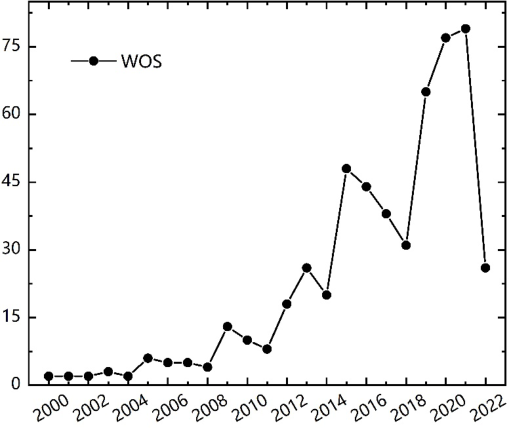
Figure 1: Distribution of literature annual distribution.
‘Design’ were used for topic retrieval, and the keywords were connected by ‘AND’. A total of 955 papers were obtained by selecting the SCI-Expanded and Social Science Citation Index database. In combination with the Louvain literature clustering algorithm and expert discussion method (Dzikowski, 2018), literature that did not belong to any cluster module, peripheral litera- ture and invalid literature (missing key information such as time, keywords and authors) were eliminated, and 534 pieces of literature were finally retained.
Scientific bibliometrics and knowledge structure visualization are adopted in this paper. Visual software such as VOSviewer and CiteSpace were used for co-word analysis. VOSviewer is a Java-based bibliometric software deve- loped by Van Eck and Waltman from The Centre for Science and Technology Studies (CWTS) in The Netherlands (Van and Waltman, 2010), and Cite- Space was developed by Professor Chen Chaomei from Drexel University in The United States (Chen, 2006).
BIBLIOMETRIC RESULTS AND ANALYSIS Basic Characteristics of Affordance-Based-Design
The 534 literatures screened in this paper was mainly published after 2000. Figure 1 was obtained through the statistics of literature in the WOS core database (2022 is incomplete statistics). On the whole, the number of litera- tures of Affordance-Based-Design within the scope of retrieval is on the rise, indicating that this research has been continuously paid attention and valued by scholars.
The process of Affordance-Based-Design has roughly gone through three periods: The embryonic period of Affordance-Based-Design was 2000-2003.
A Bibliometric and Visual Analysis of Affordance-Based-Design 543
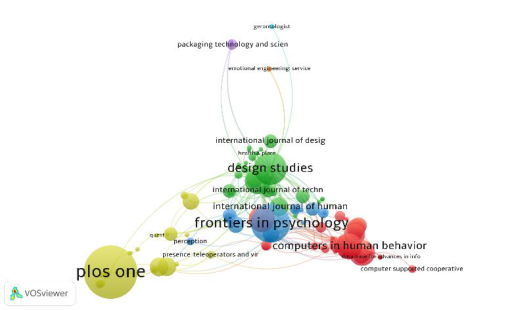
Figure 2: Journal co-citation network.
In 1999, American cognitive psychologist Donald Norman published Affor- dance, conventions, and design, which promoted the research of affordance theory in the field of design (Norman, 1999). After that, related research papers began to appear. However, there are problems such as ambiguous understanding of affordance and misuse of terminology at this stage. The gro- wth period of Affordance-Based-Design was 2004–2011. In 2003, Hartson standardized the terms of affordance and proposed four complementary types of affordances: cognitive affordance, physical affordance, sensory affordance and functional affordance (Hartson, 2003). His views affirmed the importa- nce of affordance theory in interaction design and evaluation, thus attracting a large number of researchers to further invest in Affordance-Based-Design. During this period, the number of related papers increased steadily, and innovative design methods based on affordance theory gradually received attention. The outbreak period of Affordance-Based-Design is from 2012 to the present. During this period, the number of Affordance-Based-Design studies exploded. Affordance theory is used in many product, interface, envi- ronment or user experience design practices, and more innovative design methods based on affordance theory have been proposed.
The Journal with the Highest Literature Output In terms of literature output, a total of 310 journals published research arti- cles related to “Affordance-Based-Design” during the retrieval period, as shown in Figure 2. PLOS ONE published the largest number of articles, 22 articles in total, with 579 citations. Next came Frontiers in Psychology, which published 15 articles and were cited for 224 times, and Design Stu- dies, which published 12 articles and was cited for 356 times. Among them, PLOS ONE ranked first in terms of literature output and total citations. In addition, Design Studies has the most citations in the field of design.
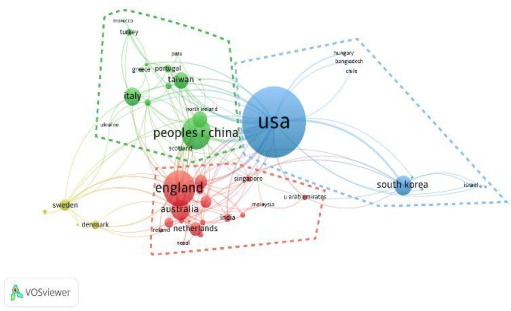
The Distribution of Literature in Countries and Research Institutions In terms of national or regional output, a total of 61 countries/regions in the world contribute to this field of research, as shown in Figure 3. It can be
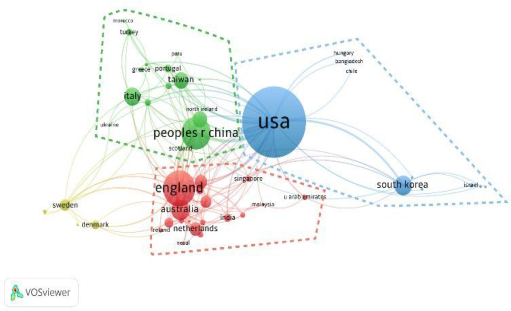
Figure 3: Cooperation and co-occurrence of countries/regions.Figure 4: Cooperation and co-occurrence of institutions.
seen that the United States ranked first with 166 articles, accounting for one- fifth of the total (31.086%). They were followed by the United Kingdom (71), China (63), Australia (35), South Korea (34). From the distribution of partnership intensity (cooperation times), the international cooperation in Affordance-Based-Design is not close. The United States, the United Kingdom and China have relatively frequent cross-border cooperation.
Under the influence of Norman, a large number of American scholars engaged in the research of Affordance-Based-Design and made outstanding contributions in basic theories, design methods and design practices. In addi- tion, the National Science Foundation and Office of Naval Research funded a number of studies in virtual environments, which greatly expanded the appli- cation scenarios of affordance theory. Therefore, the number of research in the United States ranks first among countries, close to one-third of the total literature, and the number of citations far exceeds that of other countries and regions. Although South Korea ranks fifth in the number of documents, its influence in Affordance-Based-Design has grown significantly in the past five years due to its extensive research in the field of mixed reality.
A total of 670 research institutions around the world have conducted rese- arch on Affordance-Based-Design. The network of institutional outputs and collaborations is shown in Figure 4. In the search range, Clemson University ranked first with 9 articles published. Subsequently, Pennsylvania State Uni- versity published 8 articles, SungKyunKwan University published 7 articles, City University of Hong Kong 7 published articles, and Lancaster University published 7 articles. From the distribution of partnership intensity (coope- ration times), the cooperation between institutions is not close. In addition, although City University of Hong Kong ranks third in the number of docu- ments, its influence in Affordance-Based-Design has grown significantly due
A Bibliometric and Visual Analysis of Affordance-Based-Design 545
to its outstanding contributions in motivational affordance and collaboration system design (Jung et al., 2010, Suh and Wagner, 2017, Chen et al., 2019).
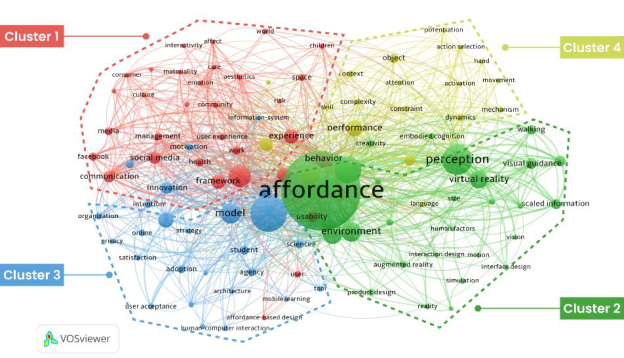
Research Hot Spots The research hotspot is usually considered to be the scientific problems join- tly studied by the closely related and numerous pieces of literature in a certain period of time. The keywords of the literature are the author’s highly refined research, and the high-frequency co-occurrence of keywords reflect the rese- arch hotspots in this field. Select the co-occurrence frequency of more than 6 times to obtain the cluster graph formed by 105 keywords (see Figure 5). The keyword in the same color in the figure is a cluster with 4 clusters.
Cluster #1 – communication and management system design contains 32 cluster members, mainly including technology, impact, facebook, mana- gement, community, world, materiality, engagement and other keywords. Imagined affordances emerge between users’ perceptions, attitudes, and expe- ctations; between the materiality and functionality of technologies; and between the intentions and perceptions of designers. people shape their media environments, perceive them, and have agency within them because of imagi- ned affordances (Nagy and Neff, 2015). In addition, perceptions of constraint lead people to change their technologies while perceptions of affordance lead people to change their routines (Leonardi, 2011).
Cluster #2 – interactive design in real or virtual environments contains 27 cluster members, mainly including environment, virtual reality, visual gui- dance, scaled information, interaction design, augmented reality, embodied cognition and other keywords. Based on affordance theory, it is possible to design products, interfaces, and environments that are both practical and easy to be perceived by expected users (Shin, 2017), thereby reducing user learning costs and improving user experience.
Table 1. The keyword burst of Affordance-Based-Design.
Table available in the original PDF paper.
Keyword Burst Strength Year Education 2.1 2019-2022 Health 2.1 2019-2022 Social Media 1.97 2019-2022 Innovation 3.58 2020-2022 Management 1.91 2020-2022
acceptance, mobile learning and other keywords. As design of interactive pro- ducts started to address the whole user experience, User Experience became an established field of research (Pucillo and Cascini, 2014). Affordance- Based-Design can increase usability while giving users the experience they expect.
Cluster #4 – usability of design contains 20 cluster members, mainly inclu- ding performance, constrain, presentation, complexity, object, dynamics, hand, potentiation, mechanism and other keywords. Affordances in design can be understood as the action possibilities of a user interacting with a designed object (Gero and Kannengiesser, 2012). Affordance-Based-Design allows users to enhance the detection of the possibility of action, thereby improving the usability of a product or interface.
The Research Frontier of Affordance-Based-Design In order to explore the research frontier of Affordance-Based-Design, keyw- ord burst of Citespace are used for detection. Table 1 shows the keyword burst of Affordance-Based-Design. It can be seen from the keyword burst that education, health, and social media exploded from 2019 to 2022, and inno- vation and management exploded from 2020. It can be seen that research on social media, communication and service design is the research frontier of Affordance-Based-Design. In addition, in the context of the rise of the metaverse concept, designing a more immersive virtual environment based on affordance theory is another research trend.
CONCLUSION
Affordance-Based-Design presents an increasing trend in terms of the out- put of time series papers, but the growth trend is slow. In the development process of more than 20 years, there are not many productive countri- es/regions, institutions and scholars, and research cooperation is mainly intra-institutional cooperation, which is relatively scattered and needs to be further strengthened. Through keyword clustering, it can be seen that Affordance-Based-Design is comprehensively diversified in terms of resea- rch contents, which can be divided into four categories: #1 communication and management system design, #2 interactive design in real or virtual envi- ronments, #3 user experience, and #4 usability of design. These clusters constitute the hot research areas and topics of Affordance-Based-Design. The research on social media, communication and service design is the research
A Bibliometric and Visual Analysis of Affordance-Based-Design 547
frontier of Affordance-Based-Design. In addition, in the context of the rise of the metaverse concept, designing a more immersive virtual environment based on affordance theory is another research trend.
REFERENCES
Chen, C., 2006. CiteSpace II: Detecting and visualizing emerging trends and transient patterns in scientific literature. Journal of the American Society for information Science and Technology, 57(3), pp. 359–377. Chen, X., Wei, S., Davison, R.M. and Rice, R.E., 2019. How do enterprise social
media affordances affect social network ties and job performance?. Information Technology & People. Dzikowski, P., 2018. A bibliometric analysis of born global firms. Journal of business research, 85, pp. 281–294. Gero, J.S. and Kannengiesser, U., 2012. Representational affordances in design, with
examples from analogy making and optimization. Research in Engineering Design, 23(3), pp. 235–249. Gibson, J.J., 1977. The theory of affordances. Hilldale, USA, 1(2), pp. 67–82. Hartson, R., 2003. Cognitive, physical, sensory, and functional affordances in interaction design. Behaviour & information technology, 22(5), pp. 315–338. Jung, J.H., Schneider, C. and Valacich, J., 2010. Enhancing the motivational affor-
dance of information systems: The effects of real-time performance feedback and goal setting in group collaboration environments. Management science, 56(4), pp. 724–742. Leonardi, P.M., 2011. When flexible routines meet flexible technologies: Affordance, constraint, and the imbrication of human and material agencies. MIS quarterly, pp. 147–167. Nagy, P. and Neff, G., 2015. Imagined affordance: Reconstructing a keyword for
communication theory. Social Media+ Society, 1(2), p. 2056305115603385. Norman, D.A., 1988. The psychology of everyday things. Basic books. Norman, D.A., 1999. Affordance, conventions, and design. interactions, 6(3), pp. 38–43. Pucillo, F. and Cascini, G., 2014. A framework for user experience, needs and
affordances. Design Studies, 35(2), pp. 160–179. Shin, D.H., 2017. The role of affordance in the experience of virtual reality learning: Technological and affective affordances in virtual reality. Telematics and Informatics, 34(8), pp. 1826–1836. Suh, A. and Wagner, C., 2017. How gamification of an enterprise collaboration
system increases knowledge contribution: an affordance approach. Journal of Knowledge Management. Van Eck, N. and Waltman, L., 2010. Software survey: VOSviewer, a computer program for bibliometric mapping. scientometrics, 84(2), pp. 523–538.
LISTED IN THE AHFE DIGITAL BOOKSTORE CATALOGUE
Explore the complete digital volume
Applied Human Factors Research
Read this individual research paper free through the original publisher, or explore the full digital proceedings book.
ISBN 978-1-958651-43-8
Explore this ISBN in the AHFE Bookstore ↗Listed in the July 2026 bookstore catalogue; search by ISBN to confirm current availability · Digital book purchase optional