Wei Dai, Hu Zhiqian, Biwen He (2022). How petrochemical industry survive in post-COVID-19: A STAMP-based system science research & recommendations for large-scale sociotechnical systems. In: Applied Human Factors Research. AHFE Open Access, vol. 67, pp. 237–245. https://doi.org/10.54941/ahfe1002700
The COVID-19 profoundly impacts petrochemical manufacturing, and different organizations have specific response measures to such major public health incidents. Notably, As a representative interdisciplinary subject in systems science & systematics, work system and safety in Human Factors and Ergonomics (HFE) research can play an essential role in investigating the humans and organizations of the petrochemical industry. Although the global outbreak has gradually stabilized, this industry has experienced a challenging period in 2020. How does they survive this struggle? Is there a predicament with their responses? How can HFE researchers apply the knowledge of system safety to the future development of petrochemical manufacturing? Therefore, This research conducts Accimap and System Theoretic Accident Modeling Process (STAMP) analysis for one representative oil refinery in China. This procedure is a qualitative data analysis in the system security discipline. The researchers investigate the relationship between human and organizations in the context of the epidemic from the systematic perspective, discover related problems, thereby consider the future of petrochemical manufacturing.The highlights of this research are: the application of STAMP to COVID-19 research, which is a knowledge innovation of practice in system security; Using the comprehensive wisdom of safety science from the systematic perspective; Applying qualitative data, and exporting highly visual information diagram to interface with readers in a wider range of expertise, creating in more potential possibilities.The researchers use Accimap to process the qualitative data in large-scale socio-technical systems and build a complete and transparent organization diagram; Also, The researchers use STAMP to locate deficiencies in its system control process. Consequently, this research uses the data results, combine with the current situation of international petrochemical industry, to put forward guiding recommendations for its development in the post-pandemic era.
The global outbreak caused by the new corona-virus (COVID-19) has a con- tinued and far-reaching impact on humans. As of July 2020, the confirmed epidemic cases have exceeded 14 million (Sarkodie & Owusu, 2021). The outbreak of COVID-19 is considered the greatest crisis facing humanity since the Second World War (Wang et al., 2021). Meanwhile, researchers predict that the surveillance of the coronavirus would continue until 2024 to deal with its recurrence yet more scientifically control it (Kissier et al., 2020). Therefore, the coronavirus epidemic is making all countries’ public health systems face complex and continuous challenges.
Notably, Stern & Schachter (2021) points out that researchers’ interest in ergonomics continues to increase. Additionally, organizational design and management is a new branch of human factor & ergonomics (HFE) esta- blished by the Human Factors Society in 1978. The study for work system safety can create positive performance impacts in academia, industry, and government (Kleiner, 2008). Moreover, the researcher affirms the applica- tion of HFE in work system, would affect the health and safety of personnel and system performance (Nickel et al., 2021). Consequently, under the global epidemic, consolidating the study of work system safety with public health knowledge is a significant research trend.
Significantly, an extensive petrochemical manufactory in mainland China, blocked the spread of the COVID-19 within two months. Thanks to the positive response of the Chinese government, people resumed work and production in the second quarter of 2020. However, in research object’s COVID-19 prevention and control records, employees have certain doubts about factory management. Such discordant factors require researchers to extract more profound information. Although China’s chemical industry seems to have passed the most challenging period, there are many countries whose chemical industries are still in crisis from a globally perspective. The- refore, as a broad discipline with the fundamental goal of ensuring workers’ physical and mental health in the working environment, the study of COVID- 19 surveillance in large-scale sociotechnical systems has high research value for HFE researchers in the post-pandemic era.
Therefore, this study investigates in system safety, corporate strategies, and design application in the pandemic context. The researcher applies the epidemic news report of this refinery as the information source and descri- bes the factory’s outbreak through Accimap accident representation method. Correspondingly, the researcher adopts the systems theoretic accident model processes (STAMP), to examine the epidemic control structure of this refi- nery, including discovers a series of systemic problems and user requirements. Finally, To manage safe production & recovery in the post-epidemic era, this study puts forward a conceptual design theory corresponding to the require- ments. Besides, the researcher discuss the development of heavy industry and proposes guiding recommendations.
METHODOLOGY
The research object of this study is a oil refinery in mainland China. This soci- otechnical system is a fundamental national petrochemical industry base in
How Petrochemical Industry Survive in Post-COVID-19 239
this area, and the petrochemical business is also an important pillar industry in this city. Given the importance of the sociotechnical system in the economy and production, this study plans an investigation into the work system of this refinery.
The refinery runs its own media organization. This agency is used to disclose information about the company’s operating conditions, production profits, losses, organization and mobilization, remarkable events, rewards, and punishments. From January 27 to March 27, 2020, this organization announced a total of 10 pieces of the news report about epidemic control. It contains critical information such as interviews with employees, the imple- mentation of policies of the group company, and the structure of the epidemic control team.
PROCEDURE This study firstly retrieves many official reports and social media data on this refinery. Next, after the researcher extracts information from the before- mentioned source, this study summarized the epidemic journal, government documents, and other related raw materials. the researcher adopts AcciMap to gain insights into the causes and links of the spread of COVID-19 in the factory and found the key influencing factors that caused the outbreak; through STAMP, the researcher investigated the backward connections in the epidemic controller and found that this refinery is responding to major public health weaknesses & deficiencies during the occurrence.
AcciMap can confirm the distance between the accident consequences, and also can highlight the events, decisions, actions, and controls that lead to the failure of sociotechnical systems (Branford et. al., 2009). This study applies Rasmussen and Svedung’s (2000) guidelines for the establishment of AcciMap. In Accimap, participants’ decisions at diverse levels generate the influencing factors (decisions, actions, events) in the accident process. The associated factors are modeled as interconnected rectangles. The researcher additionally adjusts the position of the rectangle according to the priority and context.
This study applies STAMP analysis, and the process follows Leveson’s STAMP research & guidance literature (Leveson, 2011). According to Leve- son’s CAST (Causal Analysis Based on STAMP) method definition (Leveson, 2016),this method can locate and analyze risks by detecting the success of control actions in the system. The researcher builds the public health event control architectures of this refinery based on all acquired qualitative data.
RESULT
According to the result of AcciMap analysis (Appendix 1), the researcher finds the following problems with the research object.
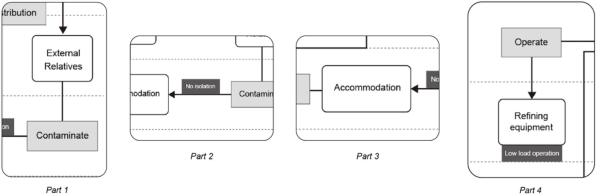
Problem A: Insufficient information to the family members of employees. The reason for problem A is that in AcciMap, This refinery does not have any influencing factors connected to external relatives, and the overall con- trol system of this system is entirely internal (Appendix 1). Besides, even
Figure 1: Problem area in the AcciMap for a refinery outbreak in January 2020, China.
if the factory has an isolation policy, family members cannot be controlled (Figure 1, Part 2). Moreover, most employees and relatives are in the same residence, which dramatically increases the risk of transmission (Figure 1, part 3). Therefore, this study believes that the family members received insuf- ficient information radiation during the outbreak, thus forming the omission of the refinery infection defense.
Problem B: Insufficient monitoring of imported cases. This refinery does not implement strict control over employees who live with their families, implementing the same management model as regular workers (Figure 1, Part 1). This circumstance means that internal control may be safe yet ignores external factors. This setting would lead to an incomplete control system.
Problem C: Abnormal capacity arrangement. Reducing equipment capa- city is an abnormal production pattern. This research supposes that high workload & psychological stress brought by low-load production may incre- ase the risk of transmission (Figure 1, Part 4). Also, psychological counselling would give employees the correct guidance there by avoid dereliction of duty caused by panic.
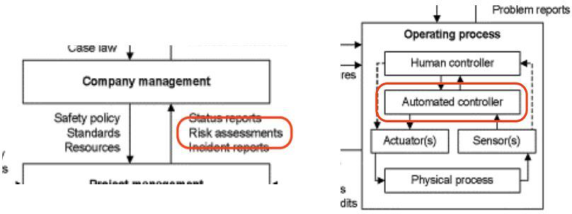
According to the results of the STAMP analysis (Appendix 1), the resea- rchers found the following problems with the research object: Problem A: Lack of risk assessment. According to Leveson’s definition, assessing security & risk in the sociotechnical system is essential (Figure 2, left). There are constant controllers for risk assessment in STAMP. Howe- ver, In 10 report of the official media, those records does not document the public health risk assessment department in this refinery. All guidance comes from the top-level control system (blue). This evidence means that this refi- nery does not have an independent department to deal with such incidents. Even if there is an emergency response team (Appendix 1), it is only tempora- rily established. Consequently, this study believes that such an organizational design is unsuccessful in infection defense.
Problem B: Lack of automated controllers. According to Leveson’s defini- tion, the bottom controller in STAMP: The operation process usually involves humans & automation (Figure 2, right). Notably, Automated controllers, including temperature detection equipment, thermal imaging displays, and digital epidemic maps, may play an essential role in preventing the COVID- 19. However, the automated controller in the control architecture is missing. All control measures are managed & executed by humans. This study assumes that the lack of automation may increase the risk of transmission.
How Petrochemical Industry Survive in Post-COVID-19 241
Figure 2: General socio-technical system hierarchical safety control structure (excerpt), adapted from Leveson (2011).
Problem C: Lack of health & hygiene tutoring for employees.The SPAC control system does not include tutoring on infection control measures for employees. The researcher assumes that this may be one of the causes for the “insufficient information radiation to family members” in AcciMap.
Problem D: Lack of specific physical control documents. Most official reports are organizational-level control measures, and individual measures records are vacant, which may cause discordance in the implementation of decision-making and distrust between organizations.
To sum up, the researcher believes there are several loopholes in this refi- nery epidemic control systems. Notably, all the evidence of missing statements in AcciMap or STAMP above comes from the official report. However, the fact that the official media has not documented does not mean that this refi- nery has not implemented such measures. Given the confidentiality of the information and its strict restrictions, it is not easy to conduct more in-depth interviews with it. Nevertheless, this is not satisfactorily convincing resea- rchers that they has not implemented such measures. Still, it is assumed that this refinery has those mentioned above “automated controller,”“psychologi- cal guidance,” “employee tutoring,” and other more advanced public Health services & measures, why does it not report on its official media? Therefore, this study has reason to suppose that many of the deficiencies mentioned above exist in the research object.
DISCUSSION
The outbreak of COVID-19 has made public health management more cri- tical in many complexes, large-scale sociotechnical systems. The process of COVID-19 transmission frequently involves every factor in the sociotechni- cal systems (Miguel et. al., 2021). In a broad sense, The achievements of the Chinese government in fighting the epidemic are derived from the control in every industrial system like this refinery; in a narrow sense, every individual contributes to preventing the spread of the epidemic, even if the system in which they exist holds a defect.
The AcciMap demonstrates that the research object has a severe lack of experience in facing significant public health incidents. While restricting employees, they do not recognize the influence of family members, which
led to the outbreak of family’s infectious cases; During the high-risk period, production is still carried out, and individual psychological counseling is not arranged, which caused panic among the employees; Meanwhile, STAMP shows that the public health incidents control hardware and software in this refinery are backward. Notably, Chassery et al. (2021) believe that a health observation organization is effective. This institution is responsible for sea- rching all relevant scientific publications to adjust the procedures for medical interventions. Such monitoring would provide health personnel with relia- ble, up-to-date knowledge to apply the most appropriate management. This study believes that such institutions are foreseeable. Moreover, Ceesay (2021) claims that during the epidemic, the education & training of employees in developing countries can positively affect pandemic control. Consequently, The above evidence fully corresponds to the three deficiencies aspects of its control system: an automated epidemic monitoring & control hardware, a complete risk prediction and assessment system, a systematic employee health & hygiene education system. Correspondingly, The system security analysis successfully identified problem areas in the sociotechnical system. However, Improving the above three factors in such problem areas are still issues that necessitate being considered.
The researcher believes that in response to insufficient experience in hand- ling health incidents, according to Accenture’s “flexible policy,” it is not advisable to put all resources into production and ignore the summary of experience when the epidemic is gradually recovering. Accenture suggests that Today’s O&G industry needs to rethink fundamentally and reduce its structural costs in non-traditional ways (Accenture, 2020). Correspondingly, The first solution is that the executor should carry out a “structural reorga- nization” of the research object, which is more traditional in management and technology. The researcher suggests setting up a specific system secu- rity researcher and maintaining a high degree of communication and contact with existing refineries in areas with severe epidemics. This transit aims to build a “forward-looking” public health defense system in the post-epidemic era, thereby avoiding the problem of insufficient experience with sufficient preparation. The second solution is to consolidate McKinsey’s O&G indu- stry transformation design strategy. McKinsey claims that excellent engineers, digital technology, and business talents are necessary to promote the tran- sformation of business models (McKinsey, 2020). Notably, digital positions such as human-computer interaction (HCI) and automation can create a great demand for talents (Janssen et. al., 2019). Therefore, The researcher recom- mends that prototype an automated epidemic prevention & control system to achieve structural reorganization. Such schemes include infection moni- toring & sensing terminals (Zivelonghi & Lai, 2021); Health information visualization equipment (Zyl, 2021); Accident & safety databases (Chassery et al., 2021). This type of design development is the fundamental factor in the composition of the automation system.
In summary, whether it is a comparison of the level of system safety meth- ods or thinking about the expectation of the petrochemical industry, the public safety and the development of civilization is constantly the funda- mental goal. Meanwhile, the development of production technology and
How Petrochemical Industry Survive in Post-COVID-19 243
increased productivity would generate a safer & environmentally friendly way of resource utilization. Moreover, as a non-renewable resource, the indu- stry’s demand for petroleum resources will undoubtedly tend to decline in the distant future. However, human safety requirements are constant and per- sistent. Therefore, researchers need to study thoughtfully: applying limited system security knowledge and systems to infinite emerging industries and assisting traditional industries’ smooth transformation.
CONCLUSION
This study used Accimap and STAMP to investigate a refinery outbreak in January 2020. The researcher uses system safety analysis methods to uncover many problems its public health incidents response and summarizes them into three deficiencies: automated hardware, risk assessment system, and health & hygiene education system. Based on the above deficiencies, this study pro- vides application discussions and instructive analysis for the petrochemical industry in the post-epidemic era.
As we look forward to the future, new energy can be discovered, and recent technologies may be developed, yet corresponding new risks would also be born. Such development is going to be a continuing challenge for HFE researchers. However, this would also generate new requirements and new opportunities for system safety science. In the post-epidemic era, the bounda- ries between disciplines are going to be hazier. Public health, human factors, and system security may have more significant intersections, and more disci- plines would also contribute to public security. HFE researchers need to look at upgrading this intersection with a forward-looking perspective to occupy a stable advantage area in future development.
REFERENCES
Accenture. (2020, March 20). How oil and gas companies can build resilience in uncertain times. Retrieved July 12, 2021, from https://www.accenture.com/cn-en/ insights/energy/coronavirus-oil-gas-companies-build-resilience-uncertain-times Branford, K., Hopkins, A., & Naikar, N. (2009). Guidelines for AcciMap analysis.
In Learning from high reliability organisations. CCH Australia Ltd. Ceesay, E. K. (2021). Potential impact of COVID-19 outbreak on education, staff development and training in Africa. Research in Globalization, 3, 100049. Janssen, C. P., Donker, S. F., Brumby, D. P., & Kun, A. L. (2019). History and future
of human-automation interaction. International Journal of Human-Computer Studies, 131, 99–107. Kissler, S. M., Tedijanto, C., Goldstein, E., Grad, Y. H., & Lipsitch, M. (2020).
Projecting the transmission dynamics of SARS-CoV-2 through the post pandemic period. Science, 368(6493), 860–868. Kleiner, B. M. (2008). Macroergonomics: work system analysis and design. Human factors, 50(3), 461–467. Leveson, N. G. (2011). Applying systems thinking to analyze and learn from events.
Safety science, 49(1), 55–64. Leveson, N. G. (2016). Engineering a safer world: Systems thinking applied to safety (p. 560). The MIT Press.
Liu, J., Hao, J., Sun, Y., & Shi, Z. (2021). Network analysis of population flow among major cities and its influence on COVID-19 transmission in China. Cities, 112, 103138. Mckinsey. (2020, May 15). Oil and gas after COVID-19: The day of reckoning or a new age of opportunity?. Retrieved July 12, 2021, from https://www.mckinsey.com/industries/oil-and-gas/our-insights/oil-and-gas-after -covid-19-the-day-of-reckoning-or-a-new-age-of-opportunity Miguel, J. C. H., Taddei, R. R., & Figueiredo, F. S. (2021). Coronavirus, infra-
structures and the sociotechnical (dis) entanglements in Brazil. Social Sciences & Humanities Open, 4(1), 100146. Nickel, P., Bärenz, P., Bischoff, H. J., Monica, L., Kaufmann, U., Wichtl, M., ... & Radandt, S. (2021, June). Work system design in machine and system safety with a focus on human-system interaction. In Congress of the International Ergonomics Association (pp. 154–160). Springer, Cham. Rasmussen, J., & Suedung, I. (2000). Proactive risk management in a dynamic
society. Swedish Rescue Services Agency. Sarkodie, S. A., & Owusu, P. A. (2021). Global effect of city-to-city air pollution, health conditions, climatic & socio- economic factors on COVID-19 pandemic. Science of The Total Environment, 146394. Stern, B., & Schachter, C. (2021). Public Interest in Distal Upper Extremity Pain
and Workstation Ergonomics in the Context of COVID-19. Archives of Physical Medicine and Rehabilitation, 102(4), e14. van Zyl, G. U. (2021). New technological developments in identification and monitoring of new and emerging infections. Reference Module in Biomedical Sciences. Wang, X., Wu, F., Zhao, X., Zhang, X., Wang, J., Niu, L., ... & Giesy, J. P. (2021).
Enlightenment from the COVID-19 Pandemic: The Roles of Environmental Factors in Future Public Health Emergency Response. Engineering. Zivelonghi, A., & Lai, M. (2021). Mitigating aerosol infection risk in school buildings: the role of natural ventilation, volume, occupancy, and CO2 monitoring. Building and Environment, 204, 108139.
How Petrochemical Industry Survive in Post-COVID-19 245
APPENDICES
Appendix 1: AcciMap of a refinery outbreak in January 2020, China.
Appendix 2: STAMP model for the COVID-19 control system in a refinery, 2020, China.
LISTED IN THE AHFE DIGITAL BOOKSTORE CATALOGUE
Explore the complete digital volume
Applied Human Factors Research
Read this individual research paper free through the original publisher, or explore the full digital proceedings book.
ISBN 978-1-958651-43-8
Explore this ISBN in the AHFE Bookstore ↗Listed in the July 2026 bookstore catalogue; search by ISBN to confirm current availability · Digital book purchase optional