Chaomin Ma, Wanjia Zhang (2023). A Bibliometric and Visual Analysis of autonomous vehicles-pedestrians interaction. In: Human Factors in Robots, Drones and Unmanned Systems. AHFE Open Access, vol. 93, pp. 37–42. https://doi.org/10.54941/ahfe1003745
In order to clarify the relevant concepts and research development process of the interaction between pedestrians and autonomous vehicles, this paper is based on the literature on the topic of "Interaction between pedestrians and autonomous vehicles" in the Web of Science database, with the help of visual knowledge graph analysis tools CiteSpace and VOSviewer. A knowledge map with keywords, countries and journals as nodes, and a knowledge map for interactive research between pedestrians and autonomous vehicles were built. This paper clarifies the research progress, research hotspots and development trends in the field of human-computer interaction between pedestrians and autonomous vehicles, and reveals the key research directions of human-machine interface (eHMI) outside the vehicle. Combining traditional literature review and bibliometric research methods, it provides Researchers and practitioners provide more detailed information on research progress in the field of human-vehicle interaction.
As society becomes more intelligent, our relationship with artificial intelli- gence (AI) in the digital world is growing closer. This relationship has the potential to greatly benefit our lives, with technological advancements expan- ding the ways we interact with AI, such as intelligent vehicles (Hao Tan et al. 2019). The design of future intelligent vehicles is evolving towards a seamless cross-vehicle travel system that includes humans, vehicles, infrastructure, and urban environments.
The human-machine interface (HMI) of intelligent vehicles is a research topic in the field of transportation that involves psychology, human factors engineering, social science, and more. The HMI of intelligent vehicles refers to the interactive interfaces both inside and outside the vehicle, including the information transmission and operation methods between the driver and passengers and the vehicle. The HMI of intelligent vehicles is a complex system that needs to consider many factors such as human cognitive cha- racteristics, ergonomics, interaction modes, and safety. While drivers need to pay more attention to driving information and status while driving, pas- sengers are more concerned with entertainment, comfort, and other aspects.
For pedestrians, the external HMI of intelligent vehicles can help them better understand the driving status of the vehicle to avoid traffic accidents.
Previous researchers have extensively explored the literature on human- vehicle interaction in automobiles, most of which were followed up after the early 21st century (Kun, 2018). Kun reviewed and predicted the main fin- dings in this research field and recommended areas for future work. With the introduction of more automated functions and the transfer of control from the driver to the vehicle, pedestrians no longer rely on nonverbal cues. In order to study what the interaction between pedestrians and autonomous vehicles (AVs) might look like in the future and how AVs convey intent to pedestrians (Habibovic et al. 2018), they designed an external vehicle inter- face called the Autonomous Vehicle Interaction Principles (AVIP). (Li et al. 2020) provided a new perspective for conceptualizing trust in automation, which can be used to help guide future research and design processes to enh- ance the collaboration between drivers and autonomous vehicles. (Pappas et al. 2021) explored the interaction between pedestrians and autonomous vehicles in a safe virtual environment.
METHODS
The Web of Science Core Collection is a valuable database that provides access to academic information from around the globe. It contains over 12,400 high-impact academic journals covering a variety of fields, including natural sciences, engineering, biomedical research, social sciences, arts, and humanities. To achieve our research objectives, we used the following sea- rch query in the Web of Science Core database: TS=("pedestrian") AND ("automated" OR "autonomous" OR "self-driving" OR "driverless" OR "auto-pilot") AND ("vehicle" OR "car" OR "automobile") AND ("intera- ction" OR "communication"). We selected the five major citation indexes commonly used in the WOS database, which are SSCI, SCI-Expanded, A&HCI, CPCI-S, and CPCI-SSH, as our search sources. To collect all rele- vant articles, we set the search time span from January 2002 to September 2022. We exported the resulting literature in the format of "full records and cited references" as a TXT file, and eliminated irrelevant articles that deviated from the research topic or lacked critical information such as time, keywords, author information, or duplicate data. In the end, we obtained 679 relevant articles, which will be used for further knowledge graph analysis and research review (see Table 1).
Table 1. Leliterature data source search information.
A Bibliometric and Visual Analysis of Autonomous Vehicles-Pedestrians Interaction 39
RESULTS
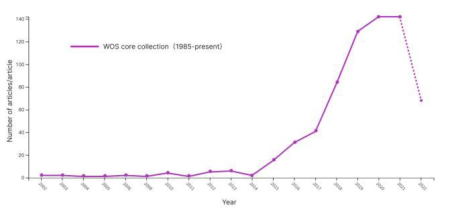
Study on the Annual Variation of Literature Quantity and Research Hotspots The amount of published research is an indicator of the sustainability and level of attention a particular research area has received. The higher the num- ber of publications and the longer the duration, the more attention and faster development that field has experienced. This study analyzed data from the Web of Science core collection database using "pedestrian and autonomous vehicle" and "interaction communication" as research topics. The figure shows the analysis of the number of publications over time, indicating an increasing trend in the literature on pedestrian interaction design with auto- nomous vehicles since 2014 (see Figure 1). Notably, the field has experienced rapid growth from 2017 to 2019 and reached its peak in 2020 and 2021 with a total of 142 publications per year. These findings suggest sustained atten- tion to research on pedestrian interaction with autonomous vehicles over the past nine years.
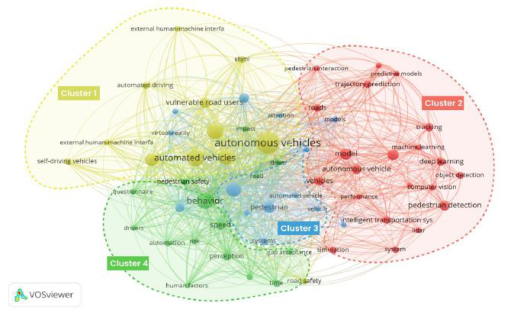
Keyword Co-Occurrence Clustering Network Map The keywords in the literature are highly refined in our research, and high-frequency co-occurring keywords reflect the long-term research hot- spots in pedestrian interaction with autonomous vehicles. In this study, 2,120 keywords were identified from the 697 articles in the search scope. To conduct the keyword co-occurrence analysis, VOSviewer was used on the 697 Web of Science core collection database articles. A total of 62 keywords were selected based on a minimum of 10 occurrences for each keyword. A keyword co-occurrence clustering view of pedestrian interaction with auto- nomous vehicles was created, as shown in Figure 2. The clusters in the figure are based on analysis results, with keywords of the same color being part of the same cluster. The research hotspots in pedestrian interaction with autonomous vehicles can be divided into four main clusters.
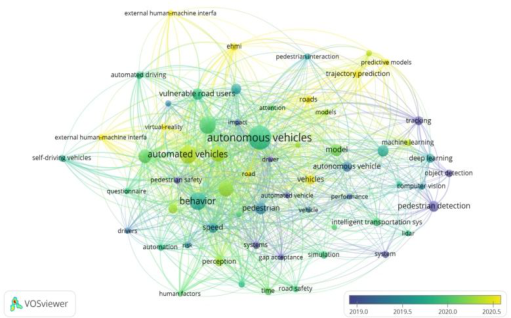
Cluster #1 (yellow) focuses on the external human-machine interface, communication, and design aspects of the interaction. Research in this cluster now emphasizes safety and trust aspects, shifting from internal human-machine interaction to the external interface with pedestrians (see Figure 3).
Figure 1: Annual trends in the number of articles related to pedestrian interaction with autonomous vehicles.
Cluster #2 (red) concentrates on the technical aspects of the interaction, including pedestrian detection, machine learning, and computer vision. This cluster highlights the importance of developing models and predictive systems for pedestrian safety.
Cluster #3 (blue) focuses on the general attitudes and perceptions of pede- strians towards autonomous vehicles, including acceptance, trust, and safety. It also examines the impact of the interaction on pedestrian perception of safety and willingness to cross the street.
Cluster #4 (green) investigates the decision-making process of pedestri- ans when interacting with autonomous vehicles, including factors such as behavior, perception, speed, time, and human factors. Research in this clu- ster aims to identify effective communication strategies and understand the various factors that influence pedestrian decision-making.
Overall, these clusters represent different aspects of research related to the complex interaction between pedestrians and autonomous vehicles, with a focus on safety, trust, and effective communication.
A Bibliometric and Visual Analysis of Autonomous Vehicles-Pedestrians Interaction 41
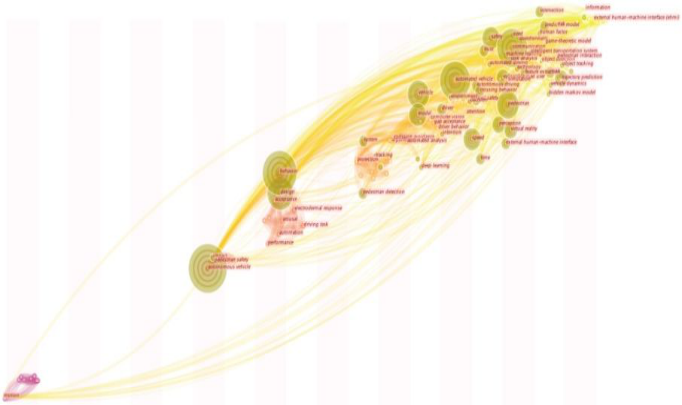
Figure 4: Keyword co-occurrence tag view.
Analysis of Periodic Research Hotspots and Frontiers Trends The timeline chart featuring the keyword, drawn using CiteSpace (see Figure 4), includes a clearer time axis as the horizontal axis. This allows for a more intuitive understanding of research hotspots and trends during a certain time period. It also highlights the importance of understanding the commu- nication of pedestrians’ intentions with autonomous vehicles as the control of autonomous driving technology gradually shifts to the vehicles. Li et al. (2020) offer a new perspective on trust in automated driving technology, pro- viding a guide for future research and design programs aimed at enhancing cooperation between drivers and autonomous vehicles.
CONCLUSION
This article provides an overview of research on the relationship between pedestrians and autonomous vehicles over the past two decades, using bibli- ometric analysis and knowledge mapping to identify trends and hotspots. Future research will focus on the design of human-machine interactions with autonomous vehicles and the factors influencing pedestrians’ attitudes and decisions towards them. The article highlights the importance of develo- ping a human-machine interaction design that can enhance driving efficiency and safety, which will have significant implications for the future of the automotive industry.
REFERENCES
Bazilinskyy, P., Dodou, D. and de Winter, J. (2019) ‘Survey on eHMI concepts: The effect of text, color, and perspective’. Transportation Research Part F: Traffic Psychology and Behaviour, 67 175–194.
42 Ma and Zhang
Chen, C. M. (2006) ‘CiteSpace II: Detecting and visualizing emerging trends and transient patterns in scientific literature’. Journal of the American Society for Information Science and Technology, 57 (3), pp. 359–377. Clark, J. R., Stanton, N. A. and Revell, K. (2021) Human-automation interaction
design: developing a vehicle automation assistant. CRC Press. Dey, D. et al. (2019) ‘Pedestrian road-crossing willingness as a function of vehicle automation, external appearance, and driving behaviour’. Transportation Research Part F: Traffic Psychology and Behaviour, 65 191–205. Ezzati Amini, R., Katrakazas, C. and Antoniou, C. (2019) ‘Negotiation and Decision-
Making for a Pedestrian Roadway Crossing: A Literature Review’. Sustainability, 11 (23), pp. 6713. Fridman, L. et al. (2017) ‘To walk or not to walk: Crowdsourced assessment of external vehicle-to-pedestrian displays’. arXiv preprint arXiv:1707.02698. Gandhi, T. and Trivedi, M. M. (2008) ‘Computer vision and machine learning for
enhancing pedestrian safety’. Computational intelligence in automotive applicati- ons, 59–77. Habibovic, A. et al. (2018) ‘Communicating intent of automated vehicles to pedestrians’. Frontiers in psychology, 9 1336. Kooijman, L., Happee, R. and de Winter, J. C. (2019) ‘How do eHMIs affect pede-
strians’ crossing behavior? A study using a head-mounted display combined with a motion suit’. Information, 10 (12), pp. 386. Kun, A. L. (2018) ‘Human-machine interaction for vehicles: Review and outlook’.
Foundations and Trends® in Human–Computer Interaction, 11 (4), pp. 201–293. Li, J., Meng, C. and Liu, L. (2021) ‘Verifying Automation Trust in Automated Driving System from Potential Users’ Perspective’. Advances in Human Factors in Robots, Drones and Unmanned Systems: Proceedings of the AHFE 2020 Virtual Conference on Human Factors in Robots, Drones and Unmanned Systems, July 16-20, 2020, USA, 2021. Springer, pp. 31–38. Pappas, G. et al. (2022) ‘Game-Based Simulation and Study of Pedestrian-Automated
Vehicle Interactions’. Automation, 3 (3), pp. 315–336. Robert, L. P. (2019) ‘The future of pedestrian-automated vehicle interactions’. XRDS, 25 (3), pp. 30–33. She, J., Islam, M. and Zhou, F. (2021) ‘The effect of dynamic speed information
and timing of displaying EHMI on automated vehicle and pedestrian interacti- ons’. International Design Engineering Technical Conferences and Computers and Information in Engineering Conference, 2021. American Society of Mechanical Engineers, pp. V006T006A053. Tan Hao et al. (2019) ‘Research on the development trend of human-computer interaction in smart cars’. Packaging Engineering, 40 (20), pp. 32–42. Van Eck, N. J. and Waltman, L. (2010) ‘Software survey: VOSviewer, a computer
program for bibliometric mapping’. Scientometrics, 84 (2), pp. 523–538.
LISTED IN THE AHFE DIGITAL BOOKSTORE CATALOGUE
Explore the complete digital volume
Human Factors in Robots, Drones and Unmanned Systems
Read this individual research paper free through the original publisher, or explore the full digital proceedings book.
ISBN 978-1-958651-69-8
Explore this ISBN in the AHFE Bookstore ↗Listed in the July 2026 bookstore catalogue; search by ISBN to confirm current availability · Digital book purchase optional