Joanna Orysiak, Magdalena Młynarczyk, Piotr Prus (2022). Types of consumed drinks at work during summer and winter seasons among foresters: A pilot study. In: Social and Occupational Ergonomics. AHFE Open Access, vol. 65, pp. 228–232. https://doi.org/10.54941/ahfe1002680
Dehydration is very common among workers both at the beginning and end of work. Persistent or even worsening dehydration after work indicates insufficient fluid intake at work. The aim of the study was to determine the differences in the type of consumed drinks during work between summer and winter periods in foresters. The study was carried out in summer (n = 10) and in winter (n = 10) among male foresters. Subjects completed a questionnaire regarding the amount of drinks consumed during 1 working day. It was observed that in summer the most consumed drink was water. Similarly, in the winter period, the volunteers drank water the most, but its consumption was almost twice lower than in the summer (p>0.05). On the other hand, tea consumption was 2/3 higher in winter compared to summer (p>0.05). There were also observed large, but nonsignificant, variations in volume of fluid intake between workers.In conclusion, the season of the year may affect workers’ choice of drink type. ACKNOWLEDGEMENTS:This paper is published and based on the results of a research task no. IV-38 carried out within the scope of the statutory activity, financed in the years 2021-2022 from the funds of the Ministry of Science and Higher Education.
Hypohydration is defined as a deficit of body water, which is caused by acute or chronic dehydration (the process of losing the body water) (McDermott et al. 2017). Dehydration can be associated with working in both hot and cold environments (Kenefick and Sawka, 2007; Montain et al. 2010). It should be noted, that drinking insufficient volume of fluids may negatively affect human health and work performance (Kenefick and Sawka, 2007; Montain et al. 2010; Bates et al. 2010). Previous studies shown that dehydration is common among workers both before and after work (Bates et al. 2010; Biggs et al. 2011; Mears and Shirreffs, 2015). Biggs et al. (2011) observed that 43% in autumn and 47% in winter before work, as well as, 64% in autumn and 63% in winter were dehydrated. Persistent or even worsening dehydration after work indicates insufficient fluid intake at work. As recommended by Occupational Safety and Health Administration (OSHA) (OSHA 1; OSHA 2) and the National Institute for Occupational Safety and Health (NIOSH) (NIOSH 1; NIOSH 2) workers should frequently (before the feeling of thirst occurs) drink small amounts of cool water (in hot environments) or warm beverages (especially in cold environments) to stay well hydrated.
Types of Consumed Drinks at Work During Summer and Winter Seasons 229
Table 1. Percentage of workers who consume certain types of drinks at work.
Table available in the original PDF paper.
Season of Water Juices Dairy Sodas Coffee Infusions Other the year products drinks Summer 80% 20% 0% 40% 50% 20% 0% Winter 60% 20% 10% 20% 50% 70% 10%
The aim of the study was to determine the differences in the type of con- sumed drinks during work between summer and winter periods in foresters.
MATERIALS AND METHOD Two cross-sectional observational studies were performed among forestry workers. First observation carried out in the summer (air temperature 20.5 °C, relative humidity 57.7%) and the second in the winter (air tem- perature 4.3 °C, relative humidity 68.5%).
The study was conducted among male foresters, who spend most of their work outdoors. Ten participants in summer (age 31±10 years, body mass 86±15 kg, height 179±7 cm, body mass index 27±5 kg/m2) and ten parti- cipants in winter (age 37±5 years, body mass 99±13 kg, height 179±8 cm, body mass index 31±4 kg/m2) took part in the study. Each one was measured over one shift.
Immediately after shift, participants completed a questionnaire regarding fluid intake during 1 working day. The questionnaire asked about amount and type of fluid intake at work, and including the questions about: water, juices, dairy products, sodas, coffee, infusions, alcoholic beverages, alco- hol free beer, energy drinks, sports drinks, plant-based beverages, meal replacement drinks, protein shakes, supplements and others.
The study was approved by a local Ethics Committee, and writ- ten informed consent was obtained from all participants in this study (KEBN-21-63-JO).
Statistical Analysis The nonparametric Mann–Whitney test was used to examine differences in the amount of consumed specific types of drinks between workers in the summer and in the winter. The level of statistical significance was set at p<0.05.
RESULTS AND DISCUSSION
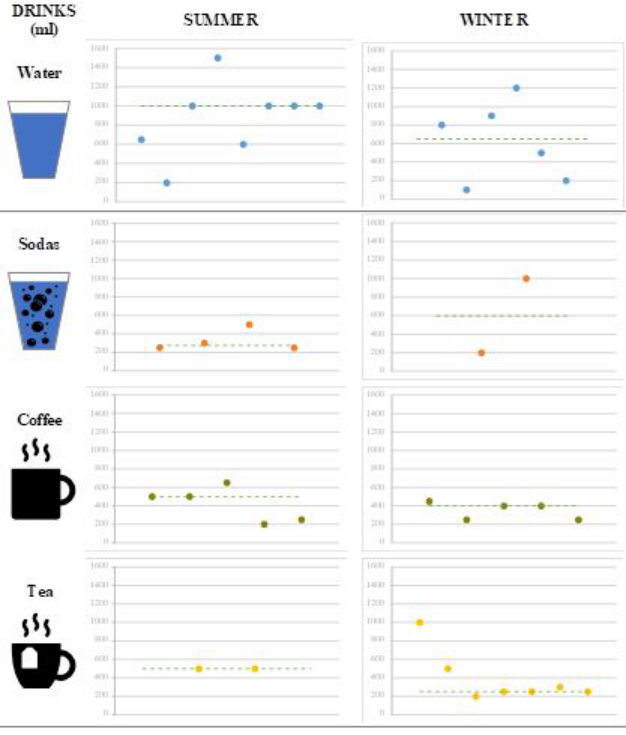
The statistical analysis showed that there was no statistical difference in the amount of consumed specific types of drinks between workers in the sum- mer and in the winter. But, despite the lack of statistical significance, it was observed that the type and amount of fluid intake varies depending on the season and individual preferences (see Table 1, see Figure 1).
Both in the summer and the winter, it was reported that water was consu- med in the greatest amount among the various types of drinks (total amount
Figure 1: Median and individual consumption (ml) of some drinks by foresters at work.
in the summer 6950 ml, in the winter 3700 ml) (p>0.05). In both periods, cof- fee was consumed in a similar amount (total amount: in the summer 2100 ml, in the winter 1750 ml). In turn, the total amount of tea drunk in the sum- mer was 1000 ml, and in the winter 2740 ml (p>0.05). The amount of soft drinks consumed was similar (total amount in the summer 1300 ml, in the winter 1200 ml) (p>0.05), but this was due to the consumption of 1 liter of soft drinks by one volunteer in the winter. In the summer, 80% of foresters chose water to drink, while in the winter, 70% of participants consumed tea and 60% water. In the case of soft drinks, a higher percentage of participants consumed them in the summer than in the winter (see Table 1, see Figure 1).
So far research on drinking patterns and fluid intake among workers was not often conducted. As in our study, previous studies also shown that water was consumed the most during work, but workers also often drank coffee and soft drinks (Walden et al. 2018). Bethel et al. (2017) observed, that large percentage of American farmers in Oregon, apart from water, consumed at work soft drinks, sports drinks and juice. It should be noted, that the type of
Types of Consumed Drinks at Work During Summer and Winter Seasons 231
Table 2. Percentage of workers who consume different amount of drinks at work.
Table available in the original PDF paper.
Season of the year Amount of fluids <1000 ml 1000-2000 ml >2000 ml
Summer 40% 40% 20% Winter 30% 70% -
drinks selected by workers may depend on among others: age, gender, time of day, type of work, climatic condition, availability of fluids, culture and tradition (Elmadfa and Meyer, 2015; Guelinckx et al. 2015; Walden et al. 2018; Vieux et al. 2019). In our study, large, but nonsignificant, discrepancies in the amount of fluid consumed between individual foresters were observed, which is consistent with the results of other authors (Biggs et al. 2011; Mears and Shirreffs, 2015) (see Table 2). In the summer, the amount of fluids consumed by foresters ranged from 600 ml to 2150 ml, and in the winter from 350 to 1800 ml. During the winter, none of the workers consumed more than 2000 ml of fluid per shift (see Table 2).
CONCLUSION
In our study, the season of the year may affect workers’ choice of drink type. In the summer, most of the workers chose to drink water during their shift, while in winter, more than half of the workers reported drinking tea. On the other hand, coffee was eagerly consumed both in the summer and the winter. Some authors recommend avoid consuming drinks containing caffeine during work, however, any type of fluid intake affect hydration status (Maughan et al. 2016; McCubbin et al. 2020). Therefore recommendations to limit the consumption of certain fluids (e.g. coffee) may result in lower total fluid intake, especially if these drinks are preferred by workers (Maughan et al. 2016; McCubbin et al. 2020).
ACKNOWLEDGMENT
This paper is published and based on the results of a research task no. IV-38 carried out within the scope of the statutory activity, financed in the years 2021–2022 from the funds of the Ministry of Science and Higher Education.
REFERENCES
Bates, G.P., Miller, V.S. and Joubert, D.M. (2010), “Hydration status of expatriate manual workers during summer in the middle East.” The Annals of Occupational Hygiene, 54, 137–143. Doi: 10.1093/annhyg/mep076. Bethel, J.W., Spector, J.T. and Krenz, J. (2017), “Hydration and Cooling Practices
Among Farmworkers in Oregon and Washington.” Journal of Agromedicine, 22, 222–228. Doi: 10.1080/1059924X.2017.1318100. Biggs, C., Paterson, M. and Maunder, E. (2011), “Hydration status of South African forestry workers harvesting trees in autumn and winter.” The Annals of Occupational Hygiene, 55, 6–15. Doi: 10.1093/annhyg/meq068.
Elmadfa, I. and Meyer, A.L. (2015), “Patterns of drinking and eating across the European Union: implications for hydration status.” Nutrition Reviews, 73(Suppl. 2), 141–147. Doi: 10.1093/nutrit/nuv034. Guelinckx, I., et al. (2015), “Intake of water and different beverages in adults
across 13 countries.” European Journal of Nutrition, 54(Suppl. 2), 45–55. doi: 10.1007/s00394-015-0952-8. Kenefick, R.W. and Sawka, M.N. (2007),“Hydration at the work site.” Journal of the American College of Nutrition, 26(5 Suppl), 597S-603S. doi: 10.1080/07315724.2007.10719665. Maughan, R.J., et al. (2016), “A randomized trial to assess the potential of dif-
ferent beverages to affect hydration status: development of a beverage hydra- tion index.” The American Journal of Clinical Nutrition, 103, 717–723. doi: 10.3945/ajcn.115.114769. McCubbin, A.J., et al. (2020), “Sports Dietitians Australia Position Statement: Nutrition for Exercise in Hot Environments”. International journal of sport nutrition and exercise metabolism, 30(1), 83–98.doi: 10.1123/ijsnem. 2019–0300. McDermott, B.P., et al.(2017), “National Athletic Trainers’ Association Position Sta-
tement: Fluid Replacement for the Physically Active.” Journal of Athletic Training, 52(9), 877–895. doi: 10.4085/1062-6050-52.9.02. Mears, S.A. and Shirreffs, S.M. (2015), “Assessing hydration status and reported beverage intake in the workplace.” American Journal of Lifestyle Medicine, 9, 157–168. Doi.org/10.1177/1559827614523706. Montain, S., et al. (2010), “Water Requirements and Soldier Hydration.” Borden
Institute, Website: https://ke.army.mil/bordeninstitute/other_pub/HydrationPDF .pdf National Institute for Occupational Safety and Health (NIOSH 1). (May 2021) Preventing cold-related illness, injury, and Death among workers. Web- site: https://www.cdc.gov/niosh/docs/wp-solutions/2019-113/pdfs/2019-113.pd f?id=10.26616/NIOSHPUB2019113 National Institute for Occupational Safety and Health (NIOSH 2). (May 2021) Heat
stress – recommendations. Website: https://www.cdc.gov/niosh/topics/heatstress/ recommendations.html Occupational Safety and Health Administration (OSHA 1). (May 2021) Cold Stress Guide. Website: https://www.osha.gov/SLTC/emergencypreparedness/guides/col d.html Occupational Safety and Health Administration (OSHA 2). (May 2021) Prote-
cting workers from heat illness. Website: https://www.osha.gov/Publications/osha- niosh-heat-illness-infosheet.pdf Vieux, F., et al. (2019), “The Timing of Water and Beverage Consumption During the Day Among Children and Adults in the United States: Analyses of NHANES 2011-2016 Data.” Nutrients,11, 2707. doi: 10.3390/nu11112707. Walden, M., Mayländer, S. and Kaeding, T.S. (2018), “Drinking Patterns and Fluid
Intake in the Settings Workplace and University: A Systematic Review.” Journal of Nutrition and Health Sciences, 5, 410.
LISTED IN THE AHFE DIGITAL BOOKSTORE CATALOGUE
Explore the complete digital volume
Social and Occupational Ergonomics
Read this individual research paper free through the original publisher, or explore the full digital proceedings book.
ISBN 978-1-958651-41-4
Explore this ISBN in the AHFE Bookstore ↗Listed in the July 2026 bookstore catalogue; search by ISBN to confirm current availability · Digital book purchase optional