Lidilia Cruz-Rivero, Alejandro Del Angel-Dominguez, Maria Leonor Mendez-Hernandez, Ilse Alejandra Estevez-Gutierrez, Carlos Eusebio Mar-Orozco (2022). RULA and TRIZ methods for ergonomic analysis in the redesign of artisanal wine bottle filling workstation. In: Social and Occupational Ergonomics. AHFE Open Access, vol. 65, pp. 145–151. https://doi.org/10.54941/ahfe1002669
In the north of Veracruz, Mexico, there are nano-SMEs or family businesses that carry out their processes in an artisanal way; being an area whose population is 60% of indigenous origin, their traditions in the elaboration of products are preserved. In this case study, the analysis of the bottle filling workstation of the honey wine-producing company is proposed. This work aims to carry out an ergonomic research based on an anthropometric study, the RULA method (rapid upper limb assessment) and TRIZ method (Theory of Inventive Problem Solving); to evaluate the postures that put the integrity of the craftsman at risk and based on the find the appropriate design parameters to propose an ergonomic redesign in the honey wine bottle filling station. As a result, it is expected to develop a proposal that meets the needs of users who carry out their filling process manually reducing discomfort in the extremities and Musculoskeletal Disorders (MSDs).
In a globalized world, competition means everything to companies because it imparts economic growth and, therefore, jobs and improves the company and the population. Companies in their need to improve their competitive- ness must do their best to rethink and redesign their production systems to face the challenges of current markets. One of the ways to achieve this pur- pose is by employing practical techniques that support the redesign of these production systems. Currently, there are registered data of workers exposed to dangerous risks in their work areas; these risks eventually lead to disea- ses and musculoskeletal disorders (MSDs) that affect workers’ performance (Caparas, 2020). Ergonomics is a scientific discipline that focuses mainly on analyzing the relationships between human elements and the structure of the work area to optimize the well-being of workers and the productivity of systems (Salvendy, 2012). There are several ergonomic evaluation methods
to determine the risk factor in work areas, such as the RULA method, which was developed to evaluate the exposure of people to postures, applied forces, repetitive movements, and muscular activity that contribute to the appeara- nce of muscle disorders – skeletal of the upper extremity. The RULA method was developed in 1993 to evaluate workers’ exposure to risk factors that cause a high postural load, and that can cause disorders in the upper limbs of the body (McAtamney & Corlett,1993). For risk assessment, the posture adopted, its duration and frequency, and the forces exerted when it is main- tained are considered in the method (Diego-Mas, 2015). In work focused on designing and evaluating a wheelchair-mounted assistive device, an evalua- tion and conceptual design were carried out with innovative tools such as TRIZ (Theory of Inventive problem-Solving) (Altshuller, 1999); in addition to adopting digital human modeling to evaluate human-machine interference and an adjustment; An ergonomic evaluation was carried out with RULA (Rapid Upper Limb Assessment) based on posture analysis, achieving as a result of a design according to the needs of the user population (Seid & Das, 2021). This ergonomic assessment tool focuses on the position of the upper extremities rather than the lower extremities and does not apply well to the agricultural, manufacturing, or construction sectors; therefore, this tool is unable to address the continuous increase in skeletal disease, particularly in artisanal activities (Kong et al., 2017). TRIZ (Theory of Inventive Problem Solving) is a methodology that gives an approach on how to solve problems within a way of evolution of a technical system. TRIZ principles are based on thousands of patents where repeating patterns were discovered. There is a limited number of general problems and there is a limited number of solu- tions for these problems. These problems and their solutions are constantly repeating in time. Based on this knowledge, TRIZ can help us to achieve a better solution to problems in the redesign (Prabaswari et al., 2020). This paper deals with how TRIZ has been used to redesign artisanal wine bottle filling workstation and propose an improvement of production processes.
BEEKEEPING INDUSTRY IN MEXICO Mexico is one of the main producing and exporting countries of bees (Apis Mellifera) in the world and beekeeping is an important activity for the coun- try. About 45,000 producers are dedicated to it, who work around 1.9 million colonies (Magaña et al., 2016), (Tapia-González et al., 2021) . In Veracruz, about 1,400 families participate directly in beekeeping and report an inven- tory of 130,000 hives. The main regions where this activity takes place are the Huasteca Baja, Totonacapan, Altas Montañas and the Sotavento. Accor- ding to the Department of Rural Agricultural Development and Fisheries (SEDARPA), the entity is fifth in the generation of honey, with its contri- bution to the national and international market of approximately 4,772 tons of butter, mangrove, orange blossom, pine-oak, coffee, and mountain varie- ties, depending on the type of flowering (SEDARPA, 2020). The company of artisanal origin APITAN, is a microenterprise located in the north of Vera- cruz, Mexico, in the municipality of Tantoyuca in the Huasteca region, this SME is dedicated to the packaging of beekeeping products, specifically honey,
RULA and TRIZ Methods for Ergonomic Analysis in the Redesign 147
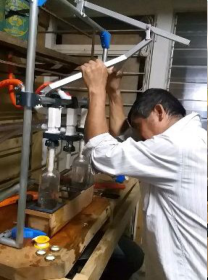
Figure 1: Current Workstation for filling honey wine bottles.
pollen, and honey wine, these processes are carried out by artisanal methods, however, derived from the demand, the needs of the production area have been greater, which generates an increase in the work carried out in the area of filling honey wine, in which important physical work is generated that is carried out repetitively, thus generating musculoskeletal disorders. The way in which the worker operates is from the efforts of the hand-arm, forearm, and shoulder, since being an artisanal process, the filling of the bottles is done by pulling a lever above his height and pressing down, keeping it while the bottles are filled, this process is carried out repetitively, will be studied to determine possible injuries, as well as find an alternative for the operator to work without having damage in the future, through the use of different existing ergonomic evaluation methods. Later from a series of repetitions, during the day, it is observed that the shoulders begin to tighten and feel pain from the effort. At the passage of the working day the operator tends to decrease with notoriety the force to exert pressure and its low productivity, this is also harmful to the company, this is because the workstation is not ergonomically designed nor the movements of the operator, over time you can have a musculoskeletal disorder (MSDs).
TOOLS FOR PROCESS IMPROVEMENT Based on an anthropometric analysis, application of the RULA method, and the TRIZ Method, an evaluation and design proposal is made to improve the working environment of the honey wine bottle filling area, thereby improving the operator’s postures and reducing the risk of MSDs. An anthropometric study was carried out on a group of artisans who work the process of filling honey bottles in the manual workstation designed for this activity. The age of people in the population between 25 and 60 years, all of them were males and their level of education are among elementary and middle school. The anthropometric data considered in the study are:
Maximum vertical reach with grip
Maximum vertical reach without grip Arm length
Eye height
Forearm length
Shoulder height
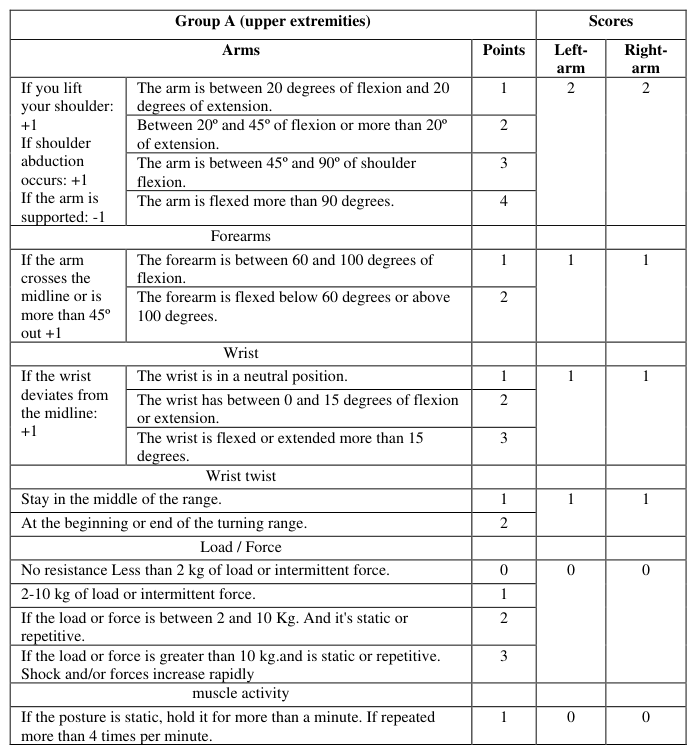
Table 1. Repetitive movements valuation with RULA.
Table available in the original PDF paper.
Company: APITAN Workstation: Filling bottles Description: Bottle filling by using a lever actuation
Arm Forearm Wrist Wrist Group Group Trunk Neck Leg Group Group twist A C Trunk Neck points B D points Left Arm 6 3 4 2 9 11 2 2 1 2 4 Right Arm 5 3 4 2 8 10 2 2 1 2 4
Table 2. Final RULA score Risk level.
Table available in the original PDF paper.
Final RULA score Risk level Risk level Left Arm 7 Very High Right Arm 7 Very High
Table 3. Risk level.
Table available in the original PDF paper.
Score Risk Level Action 1-2 Low Level 1: Ergonomically acceptable work situations. 3 - 4 Moderate Level 2: Situations that can be improved, it is not necessary to intervene in the short term. 5-6 High Level 3: Modifications to the design or task requirements should be made in the short term. > = 7 Very High Level 4: Priority of ergonomic intervention
McAtamney & Corlett (1993)
Table 4. Repetitive movements valuation with RULA (Proposed Workstation).
Table available in the original PDF paper.
Company: APITAN Workstation: Filling bottles Description: New postures on the workstation are evaluated using a simulation of the proposed area.
ERgoSoft PRO software is used for detailed evaluation minimizing measurement errors.
Arm Forearm Wrist Wrist Group Group Trunk Neck Leg Group Group twist A C points B D points Left arm 2 1 1 1 2 2 1 1 1 1 1 Right arm 2 1 1 1 2 2 1 1 1 1 1
RULA and TRIZ Methods for Ergonomic Analysis in the Redesign 149
Table 5. Evaluation for: Both arms (Proposed Workstation).
RULA method Postures and physical load were evaluated during the working day with the RULA, to determine ergonomic risk indexes.
After the evaluation with RULA, an analysis is carried out with TRIZ, to obtain the necessary design parameters for the workstation proposal. TRIZ is used for the enhancement of manufacturing processes in many studies, in
Table 6. Final RULA score Risk level (Proposed Workstation).
Table available in the original PDF paper.
Final RULA score Risk level Risk level Left Arm 2 Low Right Arm 2 Low
RULA points Level of risk Action 1 - 2 Low Performance level 1: Ergonomically acceptable work situations.
this case, TRIZ has been used for the redesign of artisanal wine bottle filling workstation.
Altshuller Parameters from TRIZ matrix The parameters in conflict that are observed below, are the improvements that are desired but that at the same time worsen when improving certain aspects. According to the parameters in conflict, the principles of inven- tiveness are observed; these refer to the possible solutions to previous cases.
Parameter A 33 Improvement (Convenience of use)
Parameter B 39 Gets worse (productivity) The inventive principles of TRIZ used are:
15 dynamics,
1 segmentation,
28 substitution of mechanical systems As a result of applying the inventive principles of the contradictions matrix, a workstation prototype was developed, proposed to prevent the worker from overexerting himself and adopting a bad posture.
With the proposed design based on the principles of the inventiveness of TRIZ, the worker will perform the bottles fill more quickly with less effort since doing it manually as it is done today. Without the help of an ergonomic workstation causes physical injuries and illnesses, as shown by the evaluation with the RULA. The change in actuation about the previous work station and the proposal consists in that in the current station; the filling is carried out by pulling the lever, raising the shoulders above the head, and later exerting downward pressure. This situation generated overexertion and poor posture. In the proposed workstation, arms are no longer raised, nor is there any excess effort, work is carried out at the required height, as well as with this change, the MSDs will be reduced, according to the results of the RULA evaluation. Based on the inventive principles of TRIZ,the filling mechanism is changed. In the previous mechanism, the bottle filling valve had to be lowered by the operator’s effort. Now valve is fixed, and what goes up is a container of the bottle up to engage the fill valve. As mentioned by Sojka and Lepšík (2020), the use of TRIZ for process improvement was described by many authors, and many approaches were tried.
RULA and TRIZ Methods for Ergonomic Analysis in the Redesign 151
ACKNOWLEDGMENT
The authors would like to acknowledge APITAN, Mr. Héctor Williams, owner of the company, and Joaquín Antonio-Martínez, Eng. for the facilities granted to carry out this work.
REFERENCES
Altshuller, G.: The Innovation Algorithm: TRIZ, systematic innovation, and technical creativity. Technical Innovation Center, Worcester, MA (1999). Caparas, H. (2020). Environmental Ergonomics and Postural Job Analysis on
Handcrafting Process of a Small-Scale Jewelry Enterprise. Journal of Industrial Engineering and Management Science Journal, 17–32. Diego-Mas, Jose Antonio. Postural evaluation using the RULA method. Ergonauts, Polytechnic University of Valencia, 2015. [consult 02-12-2022]. Available online: http://www.ergonautas.upv.es/metodos/rula/rula-ayuda.php ErgoSoftPRo Software (2021). ERgoSoft PRO software for evaluation. https://next
prevencion.com/metodos/ergonomia/metodo-rula/ Kong, Y.K., Lee, S.Y., Lee, K.S., Kim, D.M.: Comparisons of ergonomic evaluation tools (ALLA, RULA, REBA and OWAS) for farm work. Int. J. Occup. Saf. Ergon. 24,1–6 (2017) Magaña-Magaña M, Tavera-Cortés M, Salazar-Barrientos L, Sanginés-García J.
(2016). Beekeeping productivity in Mexico and its impact on profitability. Mexican Journal of Agricultural Sciences 7: 1103–1115. ISSN: 2007–0934. https://doi.org/10.29312/remexca.v7i5.235 McAtamney, L., & Corlett, E. N. (1993). RULA: a survey method for the investigation of work-related upper limb disorders. Applied Ergonomics, 24(2), 91–99. Prabaswari, A. D., Fernanda, M. A., Jati, N. P., Indrawati, S., & Aldhiza, R. A.
(2020). Redesign of wudhu facility for disabilities using integrated kansei method. In IOP Conference Series: Materials Science and Engineering (Vol. 722, No. 1, p. 012016). IOP Publishing. Salvendy G., (2012). Handbook of Human Factors and Ergonomics fourth edition, Hoboken, New Jersey: Wiley & Sons, Inc., 2012. SEDARPA (2020). http://www.veracruz.gob.mx/2020/09/10/con-2-5-mdp-equipa-s
edarpa-a-apicultores-de-la-huastecabaja/#:~{}:text=En%20Veracruz%2C%20c erca%20de%20mil,Altas%20Monta%C3%B1as%20y%20el%20Sotavento. Seid K., Das A.K. (2021) Design and Evaluation of Wheelchair-Mounted Self- Transfer Assistive Device for Elderly and Patients. In: Muzammil M., Khan A.A., Hasan F. (eds) Ergonomics for Improved Productivity. Design Science and Innovation. Springer, Singapore. https://doi.org/10.1007/978-981-15-9054-2_61 Sojka, V., & Lepšík, P. (2020). Use of TRIZ, and TRIZ with Other Tools for Process
Improvement: A Literature Review. Emerging Science Journal, 4(5), 319–335. Tapia-González, José, León-Mantecón, Talit, Contreras-Escareño, Francisca, Macias-Macias, José, Tapia-Rivera, José, & Guzmán-Novoa, Ernesto. (2021). Climatic, regional, and bee brood quantity influences on the hygienic beha- vior of Apis mellifera. Abanico veterinario, 11, e115. Epub 11 de octubre de 2021.https://doi.org/10.21929/abavet2021.20
LISTED IN THE AHFE DIGITAL BOOKSTORE CATALOGUE
Explore the complete digital volume
Social and Occupational Ergonomics
Read this individual research paper free through the original publisher, or explore the full digital proceedings book.
ISBN 978-1-958651-41-4
Explore this ISBN in the AHFE Bookstore ↗Listed in the July 2026 bookstore catalogue; search by ISBN to confirm current availability · Digital book purchase optional