Xintong Wu, Tianren Luo, Shuping Xiong, Yuanyuan Liu, Meng Li (2022). Introduction of Distractions in Immersive Virtual Reality Laparoscopic Surgery Training – a Pilot Study. In: Physical Ergonomics and Human Factors. AHFE Open Access, vol. 63, pp. 141–149. https://doi.org/10.54941/ahfe1002607
Reducing human errors by surgeons is of great importance to patient safety. The main drawback of current VR laparoscopic surgery training is that it only focuses on improving the proficiency of basic surgical skills while lacking the true representation of the busy and chaotic OR surroundings. Multiple distractions were introduced into this study to explore the influence on the laparoscopic surgery training process. A VR headset displayed a video of a laparoscopy procedure recorded by a 360° camera in a real OR, which contains various distractions occurring during the surgery. Ten surgical trainees performed a standardized training task in the virtual OR under both non-distractive and distractive conditions. Questionnaires, videos and semi-structured interviews were used to collect data. The results showed that the introduction of distractions significantly reduced participants' task performance (p<0.001) and increased their mental workload (p=0.001). Participants also showed different degrees of sensitivity to various distractions. In addition, most participants raised the need for system personalization. This VR-based immersive virtual OR demonstrated its potential to enhance surgeons' ability to deal with distractions in laparoscopic training. Future work will focus on improving the personalization and interactivity of the system, thereby increasing the training efficiency.Keywords: Immersive virtual reality; Surgical training; Distractions; Human error; Cognitive Workload
Laparoscopic surgery, also known as minimally invasive surgery (MIS), is a new trend in the field of surgical treatment. Laparoscopic surgery com- bines medical visualization and electronic technology, and possesses many advantages over traditional open surgery, as patients experience less pain and bleeding, and faster recovery (Miao, 2018). Despite laparoscopic sur- gery is becoming the standard of care in many surgical therapies (van Dijk et al., 2014), however, it requires more rigorous skill training than open
surgery. Due to the limitations of its workspace and the distortion of endo- scopic images, surgeons have to cope with problems such as a limited visual field, constrained movements, demanding hand-eye coordination, and ever- changing instruments and equipment (Eyal, & Tendick, 2001; Lazeroms, Jongkind, & Honderd, 1997). As a result, the great complexity and long learning curve during laparoscopic surgery training has been shown to signi- ficantly increase both the physical and cognitive workload of trainees, and negatively impact training budgets and time costs (Li et al., 2021).
Over the last two decades, the introduction of virtual reality (VR) tech- nology has accelerated the acquisition of proficiency by providing basic laparoscopic skill training in a repetitive and highly controlled simulation environment (Dawe et al., 2014; Munz et al., 2004; Seymour et al., 2002). VR-based laparoscopic training also avoids unnecessary pains or risks to pati- ents during the learning process (Schijven et al., 2005). Nevertheless, it rarely performs an actual “immersive training” for laparoscopic surgery due to the deficiency of truthfully representing a real operating room (OR) (Ganni et al., 2020; Jakimowicz, & Buzink, 2015). The real OR is fraught with complexity and variability, with a variety of persistent distractions that raise the task demands and stress levels of sur- geons, drain out their physiological and mental resources, increase human errors and ultimately compromise the long-term safety of patients (Pluyter et al., 2010). Training in the surroundings that contain distractions is cru- cial for surgeons to adapt faster to the busy and chaotic realities of OR and to reduce human errors (Pluyter et al., 2010). In addition to meeting profi- ciency requirements, trainees should also achieve self-management from the distractions that occur in a real OR environment (Mentis et al., 2016).
A challenge of current VR laparoscopic surgery training is simulating vari- ous distractions in a real operation, as it only presents surgical tasks through a 2D visualization, rather than replicating the hustle and bustle of a real OR environment (McCreery, El-Beheiry, & Schlachta, 2017; van Dongen et al., 2008). The distractions that occurred in a surgical environment are highly divergent, which can be classified as environmental factors, social factors, equipment factors, and organizational factors (Persoon et al., 2011). With the rapid development of VR technology since 2016, regenerating a virtual OR for a fully immersive training has now become economically and techni- cally within reach (Ganni et al., 2020; Li et al., 2020). We thus developed a pilot study to analyze the influences of distractions on a basic laparoscopic surgery training task from the perspective of cognitive workload in an immer- sive virtual OR, aiming to explore how to integrate distractions in surgical training with the help of VR-based simulation.
METHODS
Participants Ten surgical trainees enrolled as participants from Health Science Centre, Xi’an Jiaotong University, Shaanxi, P.R. China from June to July 2021. There were six males and four females at the average age of 24.6 (SD = 6.3). All participants had prior experience in the box laparoscopic trainer. Five
Introduction of Distractions in Immersive Virtual Reality Laparoscopic Surgery Training 143
participants had a short prior exposure to a VR headset, and no participant used them frequently. Besides, each participant volunteered to participate in the study and signed informed consent.
Setup The virtual OR system we applied comprised three components: a VR head- set, a box surgical trainer, and a virtual OR environment. The VR headset was an HTC Vive, providing stereoscopic images (1080×1200 pixels per eye, 110° field of view), integrated 3D audio and six-degrees-of-freedom head- tracking. Besides, a pair of handheld controllers were also included in the kit. The box surgical trainer (Endoskill™, Hangzhou YISI Medical Techno- logy Co., LTD, P.R. China) contained an operation table that simulates the patient’s abdomen, two instruments, a camera (1920×1080 pixels, with LED lighting). The virtual environment was represented by a panoramic video of a laparoscopy procedure recorded via a 360° camera in a real OR, inclu- ding an audio recording. A laptop PC (HP; OMEN Laptop 15-ek0xxx) was used for real-time rendering and transferring the fused environment to the VR headset.
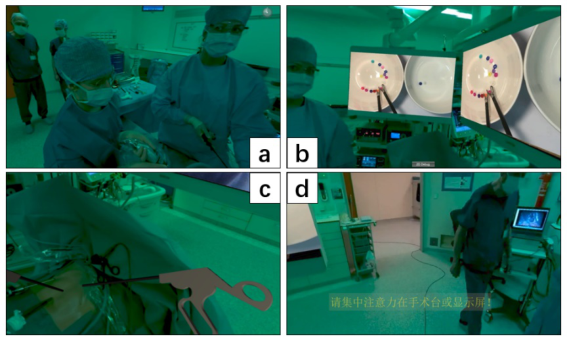
To reproduce a realistic setup of a real OR, we developed the following features: 1) the virtual environment contained a surgical team and multi- ple distractions which covered various typical distractive events observed in real surgical procedures, such as phone calls, alarms, door openings, communication, as well as background noise (Mentis et al., 2016; van Houwelingen et al., 2020) (see Figure 1a). 2) In this virtual OR, the two virtual displays suspended above the operating table were rendered as the real-time video from the camera of the box trainer (see Figure 1b). 3) The two controllers of the VR headset were rendered as two virtual surgical instruments in this virtual OR. These controllers were attached to the sur- gical instruments from box trainer so the trainees can recognize their hand motions while wearing the headset (see Figure 1c). 4) Distractions were dete- cted by head-tracking. When trainees’ eyes deviated from the surgical area (i.e., the operating table and virtual displays), they would receive a flo- ating message in the center of their field of view until they turned gazes back (see Figure 1d). 5) The virtual OR could be simultaneously seen in the VR headset and on the external monitor from the same perspective (Ganni et al., 2020).
Task Before the task began, a standardized introduction and informed consent were given to each participant. Participants would have up to five minutes to familiarize themselves with the system and control the symptoms of cyber- sickness (Li et al., 2021). The task “bead transfer” was adopted in the study, as it’s one of the standardized tasks to reflects participants’ general laparo- scopy skills (Paschold et al., 2014; Zheng, 2009). The task was performed twice in random order for each participant, once under the non-distractive condition (with the box trainer), and the other with distractive condition (the virtual OR). In each round, ten successful bead transfers were considered as
Figure 1: The setup of the VR laparoscopic surgery training system. a) The surgical team in the virtual OR. b) The virtual displays showing real-time video from the exter- nal camera. c) The rendered surgical instruments. d) A floating message appears when distractions were detected, “please concentrate on the operating table or displays”.
task completed. After completing the task, participants were asked to fill out a questionnaire, then watch a playback to review the distracted moments to make relevant comments and suggestions.
Assessment Methods First, the task duration was recorded to assess participants’ task performa- nce. Second, the number of times (i.e., frequency) participants were distracted during the task was counted. Furthermore, the NASA-TLX was introduced to measure participants’ workload when performing the task in the virtual OR (Hart, 2006). The Raw Task Load Index (RTLX) and six subscales (demands of mental, physical and temporal, and the effort, performance and frustra- tion) were calculated as scores between 0 and 100 (Hart, 2006). In the final step, semi-structured interviews were conducted in which participants freely commented on how realistic the training system was, and how satisfied they were with the virtual experience (Ganni et al., 2020).
Statistical Analysis The data were calculated with SPSS v.26, including mean and standard devi- ation (SD). Normality tests were conducted using the Shapiro-Wilk test. To compare the differences between distractive and non-distractive condi- tions, paired-samples t-test (normally distributed) or Wilcoxon signed-rank test (non-normally distributed) was then used. Moreover, Pearson Corre- lation Coefficient was applied where appropriate. A p-value of <0.05 was considered as statistically significant (*).
Introduction of Distractions in Immersive Virtual Reality Laparoscopic Surgery Training 145
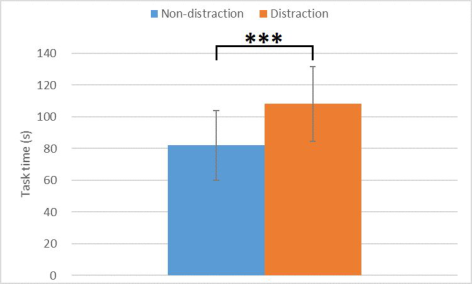
Figure 2: Task duration in non-distractive and distractive conditions. ***indicates the significance at the 0.001 level.
RESULTS
Task Duration The result of the paired-samples t-test revealed a significant longer task dura- tion under the distractive condition (mean = 108.10, SD = 23.48) than that in the non-distractive condition (mean = 82.10, SD = 21.99) (see Figure 2).
Mental Workload In short, the mental workload of the VR laparoscopic surgery training was proper (RTLX: distractive = 46.98, SD = 8.31). Participants under distra- ctive condition had a statistical higher mental workload than that under non-distractive condition (p = 0.001). It seemed that the effort was the key component of mental workload under non-distractive condition, while the mental demand (distractive = 57.66, SD = 24.43) and temporal demand (distractive = 58.37, SD = 22.78) dominated under the distractive condition. In addition, there were significant differences in mental demand, temporal demand and performance between distractive and non-distractive conditi- ons. Participants rated higher on mental and temporal demand in distractive condition, while rated performance lower (see Table 1). The Pearson Correla- tion Coefficient analysis indicated that the mental workload was statistically correlated with effort (effort vs. RTLX: r = 0.688, p = 0.028) under non- distractive condition, while it was significantly correlated with both effort (effort vs. RTLX: r = 0.757, p = 0.011) and temporal demand (temporal demand vs. RTLX: r = 0.751, p = 0.012) under distractive condition.
The Influences of the Distractions
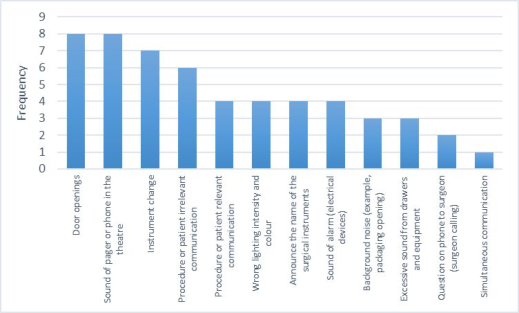
Figure 3 showed the frequencies of different types of distractions obse- rved among the ten participants under the distractive condition. The door openings, sound of pager or phone, instrument change and conversations (including procedure or patient irrelevant and relevant communication) were the main factors leading to participants’ distraction. The result of the Pear- son Correlation Coefficient showed that there was a significant correlation
Table 1. Self-reported mental workload after the VR laparoscopic surgery training. (0-100, the higher score means higher mental workload).
***indicates the significance at the 0.001 level; **is the significance at the 0.01 level; *is the significance at the 0.05 level.
Figure 3: Frequencies of different types of distractions.
between the frequency of each participant’s distractions and their task dura- tion under the distractive condition (r = 0.897, p<0.001). In other words, a higher frequency of distraction led to longer task duration.
DISCUSSION
VR has been widely used in many fields to improve skill proficiency. However, in clinical practice, it is equally important to train surgeons how to cope with the complex OR surroundings to ensure patient safety. The VR laparoscopic surgery training system outlined and evaluated in this study replicated typical distractions that occurred during the real surgeries. The preliminary results clearly demonstrated a decline in task performance and an increase in mental workload when the task was performed under the distractive condition. This has also been proven in prior research when exploring the influence of some social and technological distractions on a surgical training (Pluyter et al., 2010). Despite that the mental workload reflected in the self-reported question- naires was moderate under both non-distractive and distractive conditions, it
Introduction of Distractions in Immersive Virtual Reality Laparoscopic Surgery Training 147
was evident that it had statistically increased since distractions were introdu- ced into the VR laparoscopy training. As we expected, participants identified effort as the main source of mental workload without distractions, whereas in the distractive condition both temporal demand and effort had a high correla- tion with mental workload. This indicated that participants were well aware of their increased mental workload, prolonged task duration and decreased task performance in the distractive condition, and were required to devote additional mental resources to coping with various simulated distractions while concentrating on the assigned task. The benefit of this was to promote trainees to achieve better self-management for real distractions, to be better prepared and to adapt faster to their work in the real OR.
Among the distractions counted, the highest frequencies were all familiar auditory distractions to surgeons in the real OR. The frequency of distracti- ons was positively correlated with the task duration, which again confirmed the previous conclusion from another perspective that the introduction of distractions would force trainees to increase extra mental resources and lead to a decline in task performance.
In the semi-structured interviews, all participants appreciated the presence and realism of the VR laparoscopic surgery training. Meanwhile, many of them praised the design of the floating message, and commented that this design could not only identify if trainees were distracted, but also helped to bring their attention back to work in a timely manner. However, the lack of a localized language for conversations, with fewer interactive interfaces, was considered less realistic. This clearly indicated that future work should be done to upgrade the virtual OR environment from the personalization and interactivity of the system, so as to optimize the training process and improve the training efficiency of laparoscopic surgery.
The following limitations of this study would open room for further rese- arch: 1) The sample size of this study was small. Future studies should verify the results with a larger sample size. 2) All participants in this study were sur- gical trainees, (i.e., novice users). In future studies, normal and expert users should be included to investigate the differences in the effects of distractions. In addition, cross-cultural issues should also be considered as personalization is required with different languages and cultural backgrounds. 3) The subje- ctive evaluation method used in this study was susceptible to personal bias and low replicability (Li, et al., 2021). Future research should focus more on data-driven approaches that collect objective information, including physio- logical data (e.g., heart rate) and comprehensive task performance (e.g., task duration, error rate, etc.).
CONCLUSION
This VR-based immersive virtual OR reproduced various distractions of a complex real surgical surrounding, and initially demonstrated its potential to enhance surgeons’ ability to deal with distractions in laparoscopic training. Future work will focus on enhancing the personalization and interactivity of the system, thereby further improve the training efficiency.
ACKNOWLEDGMENT
The authors would like to thank all the participants and the staff of Health Science Centre in Xi’an Jiaotong University for their support in facilitating this study.
REFERENCES
Dawe, S. R., Pena, G. N., Windsor, J. A., Broeders, J. A., Cregan, P. C., Hewett, P. J., & Maddern, G. J. (2014). Systematic review of skills transfer after surgical simulation-based training. The British journal of surgery, 101(9), 1063–1076. Eyal, R., & Tendick, F. (2001). Spatial ability and learning the use of an angled lapa-
roscope in a virtual environment. Studies in health technology and informatics, 81, 146–152. Ganni, S., Li, M., Botden, S. M. B. I., Nayak, S. R., Ganni, B. R., Rutkowski, A., Goossens, R. H. M., & Jakimowicz, J. (2020). Virtual Operating Room Simulation Setup (VORSS) for procedural training in minimally invasive surgery – a pilot study. Indian Journal of Surgery, 82(5), 810–816. Hart, S. G. (2006). Nasa-Task Load Index (NASA-TLX); 20 Years Later. Proceedings
of the Human Factors and Ergonomics Society Annual Meeting, 50(9), 904–908. Jakimowicz, J. J., Buzink, S. (2015). Training curriculum in minimal access surgery.
In Training in Minimal Access Surgery, pp. 15–34. Springer, London, 2015. Lazeroms, M., Jongkind, W., & Honderd, G. (1997). Telemanipulator design for minimally invasive surgery. Proceedings of the 1997 American Control Conference. Li, M., Ganni, S., Albayrak, A., Rutkowski, A. F., Van Eijk, D., & Jakimowicz, J.
(2021). Proficiency from immersion: A human-centered design in cross-cultural surgical training. Frontiers in Virtual Reality, 2, [675334]. Li, M., Ganni, S., Ponten, J., Albayrak, A., Rutkowski, A., & Jakimowicz, J.
(2020). Analysing usability and presence of a virtual reality operating room (VOR) simulator during laparoscopic surgery training. In Proceedings of the 27th IEEE Conference on Virtual Reality and 3D User Interfaces, VR 2020 (pp. 566–572). IEEE Press. McCreery, G. L., El-Beheiry, M., & Schlachta, C. M. (2017). Local and national laparoscopic skill competitions: residents’ opinions and impact on adoption of simulation-based training. Surgical endoscopy, 31(11), 4711–4716. Mentis, H. M., Chellali, A., Manser, K., Cao, C. G., & Schwaitzberg, S. D. (2016).
A systematic review of the effect of distraction on surgeon performance: directi- ons for operating room policy and surgical training. Surgical endoscopy, 30(5), 1713–1724. Miao, X. (2018). Progress on minimally invasive treatment for calcaneal fracture.
China journal of orthopaedics and traumatology, 31(7), 591–593. Munz, Y., Kumar, B. D., Moorthy, K., Bann, S., & Darzi, A. (2004). Laparoscopic virtual reality and box trainers: is one superior to the other?. Surgical endoscopy, 18(3), 485–494. Paschold, M., Huber, T., Kauff, D. W., Buchheim, K., Lang, H., & Kneist, W. (2014).
Preconditioning in laparoscopic surgery--results of a virtual reality pilot study. Langenbeck’s archives of surgery, 399(7), 889–895. Persoon, M. C., Broos, H. J., Witjes, J. A., Hendrikx, A. J., & Scherpbier, A. J. (2011).
The effect of distractions in the operating room during endourological procedures. Surgical endoscopy, 25(2), 437–443.
Introduction of Distractions in Immersive Virtual Reality Laparoscopic Surgery Training 149
Pluyter, J. R., Buzink, S. N., Rutkowski, A. F., & Jakimowicz, J. J. (2010). Do absorption and realistic distraction influence performance of component task surgical procedure?. Surgical endoscopy, 24(4), 902–907. Schijven, M. P., Jakimowicz, J. J., Broeders, I. A., & Tseng, L. N. (2005). The Ein-
dhoven laparoscopic cholecystectomy training course--improving operating room performance using virtual reality training: results from the first E.A.E.S. accredited virtual reality trainings curriculum. Surgical endoscopy, 19(9), 1220–1226. Seymour, N. E., Gallagher, A. G., Roman, S. A., O’Brien, M. K., Bansal, V. K., Andersen, D. K., & Satava, R. M. (2002). Virtual reality training improves opera- ting room performance: results of a randomized, double-blinded study. Annals of surgery, 236(4), 458–464. van Dijk, A. H., Lamberts, M., van Laarhoven, C. J., Drenth, J. P., Boermeester, M.
A., & de Reuver, P. R. (2014). Laparoscopy in cholecysto-choledocholithiasis. Best practice & research. Clinical gastroenterology, 28(1), 195–209. van Dongen, K. W., van der Wal, W. A., Rinkes, I. H., Schijven, M. P., & Broeders, I. A.
(2008). Virtual reality training for endoscopic surgery: voluntary or obligatory?. Surgical endoscopy, 22(3), 664–667. van Houwelingen, B., Rutkowski, A. F., Ganni, S., Stepaniak, P. S., & Jakimowicz, J.
J. (2020). Effects of surgical flow disruptions on surgeons’ resources: a pilot study. Surgical endoscopy, 34(10), 4525–4535. Zheng, M. (2009). Operation specifications and guidelines for general surgical laparoscopic surgery. Beijing: People’s Medical Publishing House Co., LTD.
LISTED IN THE AHFE DIGITAL BOOKSTORE CATALOGUE
Explore the complete digital volume
Physical Ergonomics and Human Factors
Read this individual research paper free through the original publisher, or explore the full digital proceedings book.
ISBN 978-1-958651-39-1
Explore this ISBN in the AHFE Bookstore ↗Listed in the July 2026 bookstore catalogue; search by ISBN to confirm current availability · Digital book purchase optional