Weiyi Li, Pengbo Feng, Hongtao Ma, Longfei Ma, Hengyu Zhang, Yuanyuan Liu (2024). Design Exploration of an Augmented Reality Exergame for Walking Training: Target-by-Target vs. Multi-Target Guidance. In: Human Factors in Virtual Environments and Game Design. AHFE Open Access, vol. 137, pp. 156–163. https://doi.org/10.54941/ahfe1004998
Walking training is essential for the rehabilitation of lower limbs and overall health maintenance. With the progression in Augmented Reality (AR) and Virtual Reality (VR) technologies, serious exergames incorporating these innovations are gaining popularity in walking training. These games create engaging and interactive environments or tasks to enhance user motivation, training volume, and quality. This study investigates an AR exergame aimed at increasing training volume and improving user experience during walking training. The game underwent extensive multidimensional validations and comparisons. The game includes two modes: “Target-by-Target Guidance”, where users collect sequentially appearing gems at random locations, and “Multi-Target Guidance”, where multiple gems appear at once, allowing users to collect them in any order. The study involved twelve participants who, after becoming familiar with the game, completed 5-minute walking sessions under three conditions: without the game, with Target-by-Target Guidance, and with Multi-Target Guidance. Participants also filled out the Game Experience Questionnaire (GEQ) after each session with the order of conditions randomized. Results indicated that Multi-Target Guidance significantly outperformed Target-by-Target Guidance in terms of total walking distance and Positive affect in the GEQ. However, no significant differences were observed between the two modes in step length, step count, and other GEQ dimensions. Notably, both modes surpassed the “no game” condition in total walking distance and all GEQ dimensions, demonstrating the exergame’s effectiveness in enhancing training volume and user experience. The study’s insights into the superior benefits of Multi-Target Guidance provide valuable guidance for the design of similar serious exergames that focus on walking training through target-oriented tasks.
Design Exploration of an Augmented Reality Exergame for Walking Training 157
disability-adjusted life-years lost among diseases, with over 2 million new cases reported annually (Wu et al., 2019). Conditions like stroke often impair walking ability, which is crucial for daily health and offers protection against diseases such as heart disease and osteoporosis (Eng et al., 2007). Walking training has been proven to enhance walking abilities at different stages of stroke recovery (Peurala et al., 2014), and for healthy individuals, regular walking training can prevent or delay mobility disorders (Malatesta et al., 2010). Traditional walking training methods, however, face limitations, notably in sustaining user interest and motivation due to their monotonous nature. The integration of entertainment with exercise, hence becomes a signifi- cant enhancement. Serious games, transcending mere entertainment, have emerged a solution (Susi and Johannesson, 2007). As a subcategory of seri- ous games focused on physical activity and training (Fernandez-Cervantes et al., 2018), exergames motivate users to engage in physical activity under the influence of game mechanisms such as scoring, level completion, and badge acquisition.
The evolution of Augmented Reality (AR) and Virtual Reality (VR) tech- nologies has expanded design possibilities for exergames. These technologies have been widely applied in walking training and lower limb rehabilitation. Many AR/VR exergames employ a “target-guided” gaming mechanism. For instance, Rob Labruyère et al. designed a VR exergame with numerous col- lectible “flowers” as guiding targets for children’s gait training, enhancing the training effectiveness (Labruyère et al., 2013). Yi-Wen Wang et al. devel- oped an AR exergame with multiple “ingots” as guiding targets to enhance the user experience and effectiveness of lower limb training (Wang et al., 2020). Benjamin Michaud et al. designed a parkour-themed VR exergame for walking training of disabled children, where children need to step over sequentially appearing “obstacles” during their progression (Michaud et al., 2017). In James Finley et al.’s VR exergame, users walk to collect various “letters” to form “words” (Finley et al., 2021), while in Sharif Shahnewaz et al.’s VR exergame, users embody “giants” and need to approach and step on numerous “tanks” (Shahnewaz et al., 2016). Jaap Swanenburg et al.’s VR exergame required users to control a “snake” with their lower limbs to con- sume sequentially appearing target “food” (Swanenburg et al., 2018). These AR/VR exergame design cases all utilize various themed guiding targets to engage users in training. It is evident that these gaming mechanisms incor- porate the presentation of either a single guiding target or multiple guiding targets simultaneously. However, the training volume and user experience dif- ference between allowing multiple guiding targets to appear simultaneously versus sequentially have not been studied.
In home or community settings, AR has better mobility than VR and can better integrate into real life. Simultaneously, with numerous technology companies and researchers dedicating efforts to the technological develop- ment of AR glasses and their applications, there is a growing trend for AR glasses to become popular, convenient, and mobile daily smart terminals in the future (Dargan et al., 2022). Consequently, this study primarily focuses on the design and research of exergames in the AR environment.
This study introduces an indoor walking training AR exergame, where users approach “glowing gems” as guiding targets. The game features two modes: “Target-by-Target Guidance”, with gems appearing sequentially at random locations, and “Multi-Target Guidance”, with multiple gems appear simultaneously at random locations, allowing users to freely walk towards and collect all gems. Both modes have undergone multidimensional validations and comparisons.
The contributions of this paper are twofold: i) The AR exergame has shown effectiveness in motivating increased training and improving user experience; ii) It identifies the differences in training volume and user expe- rience between the two guidance modes, providing insights for designing similar target-guided exergames.
The following outlines the rest structure of the paper: Section 2 decribes the design and development of the AR exergame, Section 3 details the user test experiments, Section 4 analyzes the experimental data results, Section 5 discusses the experimental results and the final section presents conclusions and a summary.
DESIGN AND DEVELOPMENT OF THE AR EXERGAME This study aims to explore the impact on training volume and user expe- rience in the exergame when comparing the simultaneous versus sequential appearance of targets. To this end, we designed and developed an experimen- tal exergame using the Unity engine, and downloaded it to the HoloLens2 (an AR headset developed by Microsoft). This game is tailored to facilitate users in approaching and collecting target gems within an AR environment during walking training.
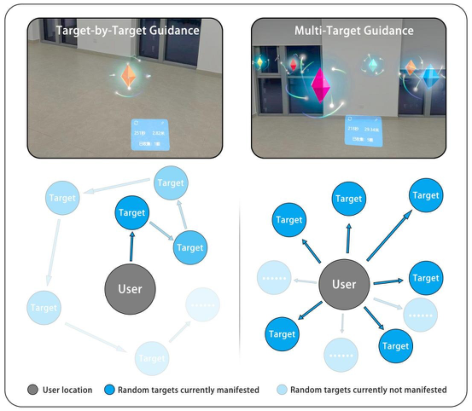
Figure 1: Introduction of target-by-target guidance and multi-target guidance.
The game has two modes (see Figure 1): “Target-by-Target Guidance” and “Multi-Target Guidance”. In the “Target-by-Target Guidance”, gems appear one after another at random locations, prompting users to walk towards and
Design Exploration of an Augmented Reality Exergame for Walking Training 159
collect each gem individually. Conversely, the “Multi-Target Guidance”mode presents multiple gems simultaneously at various locations, allowing users the flexibility to approach and gather all gems in any order. In both modes, users have access to a tracking interface that displays a 5-minute countdown, the count of collected gems, and the total walking distance measured by the HoloLens2. This interface provides real-time feedback and enhances the gaming experience, simultaneously allowing for the monitoring of walking training metrics.
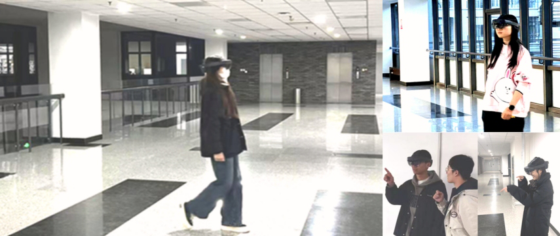
DESIGN AND IMPLEMENTATION OF USER TEST In this section, we initially recruited twelve participants aged between 18 and 24 through online platforms to take part in the experiment (see Figure 2). Before participating in the experiment, all participants signed a consent form. To compare the effectiveness of the two game modes and establish a baseline, we set up three experimental conditions: a control group without any game (No game), Target-by-Target Guidance, and Multi-Target Guidance. After becoming thoroughly familiar with the training content, each of the twelve participants underwent a 5-minute walking training session under each of these conditions. The sequence of training conditions was randomized for every participant. The details of the three conditions were as follows:
A) No game: Participants wore AR glasses for 5 minutes of walking training. A display page provided a countdown and showed the total walk- ing distance. Throughout the process, no gem refreshes appeared, allowing participants to walk without any specific targets.
B) Target-by-Target Guidance: Wearing AR glasses, participants aimed to collect as many gems as possible within a 5-minute session. The dis- play showed a countdown, the number of gems collected, and the total walking distance. Gems appeared sequentially at random locations, guiding participants toward each gem.
C) Multi-Target Guidance: Similarly, participants aimed to collect as many gems as possible in 5 minutes while wearing AR glasses. The display page showed the same metrics as the Target-by-Target mode. However, in this mode, multiple gems continuously appeared at random locations, enabling participants to freely approach and collect them.
Figure 2: Part of the participants in the experiment.
To evaluate the participants’ experience during each game mode, they were asked to complete the Game Experience Questionnaire (GEQ) after each 5-minute session. Developed by the Eindhoven University of Technology (IJsselsteijn et al., 2013), this questionnaire is widely used in serious game research to measure seven sub-dimensions of user experience: Sensory and Imaginative Immersion, Flow, Competence, Positive affect, Challenge, Neg- ative affect, and Tension/Annoyance. Furthermore, to quantify the training volume in each gaming session, we recorded several metrics: the total walk- ing distance was measured by HoloLens2, the step count was tracked by the Xiaomi Watch Color 2 worn by the participants, and the step length was calculated by dividing the total distance by the step count.
EXPERIMENTAL RESULTS AND DATA ANALYSIS After three rounds of walking training, the twelve participants each con- tributed data for the three conditions: No game (A), Target-by-Target Guid- ance (B), and Multi-Target Guidance (C). Each set of data included total distance, step count, step length for 5 minutes of walking training, and the 7 sub-dimensions of GEQ.
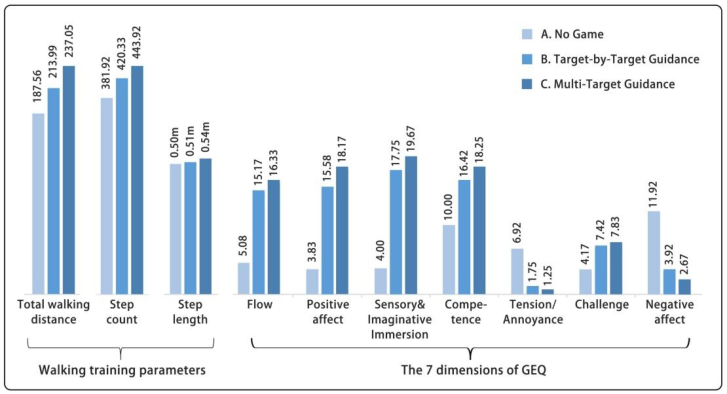
Analysis of Mean Values in Experimental Results Initial analysis of mean values (see Figure 3) indicates that Multi-Target Guid- ance (C) surpasses Target-by-Target Guidance (B) in all metrics, and both outperform the no game condition (A).
Figure 3: Comparison of mean values in experimental results.
ANOVA and Its Multiple Comparisons in Experimental Results The data were found to approximately follow a normal distribution, war- ranting the application of a one-way Analysis of Variance (ANOVA) and subsequent multiple comparisons (refer to Table 1 for detailed results).
Design Exploration of an Augmented Reality Exergame for Walking Training 161
From this comparative analysis, it emerged that both Target-by-Target Guidance (B) and Multi-Target Guidance (C) significantly increased the total walking distance and performed better across all GEQ dimensions when compared to No game (A). In terms of step count, a notable improvement was observed only in Multi-Target Guidance (C) compared to No game (A). However, no significant difference in step length was found among the three conditions.
Comparing Target-by-Target Guidance (B) and Multi-Target Guidance (C), significant differences were observed in total walking distance and the positive affect dimension of the GEQ, with Multi-Target Guidance (C) proving superior. Nonetheless, no significant differences between the two guidance modes were noted in step count, step length, or the other six dimensions of the GEQ.
Table 1. ANOVA and its multiple comparisons.
Table available in the original PDF paper.
Dimensions Group (Mean ± Standard Deviation) F p Multiple Comparisons A(n = 12) B(n = 12) C(n = 12) Total dis- tance / m
AR Exergames With Guiding Targets The analysis of the collected data, particularly in terms of total walking dis- tance and the GEQ outcomes, indicates that the use of AR exergame with guiding targets substantially enhances both the total distance and the over- all user experience compared to the scenario without the exergame. Notably, Multi-Target Guidance mode demonstrated a significant improvement in step count. These findings suggest that AR guiding targets effectively encourage users to engage a higher volume of training, aligning with the results of other exergames discussed in the introduction. Interestingly, the impact of the exergame on step length did not show a significant difference, which is consistent with the findings from the study involving an AR exergame with multiple “ingots” as guiding targets (Wang et al., 2020).
Target-by-Target vs. Multi-Target Guidance When comparing the two modes, significant differences emerged in terms of total walking distance and the Positive affect dimension of the GEQ, with Multi-Target Guidance outperforming Target-by-Target Guidance. While other dimensions did not show significant difference, the mean perfor- mance of Multi-Target Guidance was generally superior. Therefore, it can be inferred that Multi-Target Guidance is a more effective approach for AR exergames designed to facilitate walking training through target-oriented tasks. The preference for Multi-Target Guidance is also reflected in the design of exergame samples cited in the introduction (Finley et al., 2021, Labruyère et al., 2013, Shahnewaz et al., 2016, Wang et al., 2020). Additionally, some participants reported confusion and hesitation in the Target-by-Target Guid- ance mode, leading to frequent stops and uncertainty in target location, potentially diminishing training efficiency and disrupting the flow of the exergame. This might be an inherent reason why Multi-Target Guidance is superior to Target-by-Target Guidance.
CONCLUSION
Our investigation revealed that most current exergames for walking train- ing incorporate a target-guided approach. However, the difference between presenting multiple guiding targets simultaneously versus sequentially had not been thoroughly examined. To investigate this, we designed an AR exergame with the theme of “collecting gems” and conducted an experimen- tal comparison of Target-by-Target Guidance and Multi-Target Guidance. The results from our study clearly demonstrate the substantial influence of AR exergames with guiding targets on users’ engagement, as evidenced by increased training volume and enhanced user experience.
A pivotal conclusion drawn from this research is the evident advantage of Multi-Target Guidance over Target-by-Target Guidance for exergames design focused on walking training with AR targets. Multi-Target Guidance, which allows multiple “gems” to appear at the same time, granting users the auton- omy to navigate and strategize, proved to be more effective than a sequential, single-target presentation.
For certain experimental metrics where significant differences were not observed, the cause might be attributed to the limited precision of measur- ing devices or the relatively small sample size. Nonetheless, our conclusions offer useful insights for the design of serious exergames that employ AR/VR targets to facilitate walking training. These insights have the potential to guide future development, improving the efficacy and appeal of exergames in rehabilitation and health maintenance programs.
ACKNOWLEDGMENT
The research was funded by the Beige Institute of China, Cutting-edge Inter- disciplinary Project (Grant No. KG16250001) of Beihang University, and the Ministry of Education Industry-University Cooperation Collaborative Education Project (Grant No. CES/Kingfar 202309RYJG32).
Design Exploration of an Augmented Reality Exergame for Walking Training 163
REFERENCES
Dargan, S., Bansal, S., Kumar, M., Mittal, A. and Kumar, K. (2022). Augmented Reality: a Comprehensive Review. Archives of Computational Methods in Engineering, 30(2), pp. 1057–1080. Eng, J. J. and Tang, P.-F. (2007). Gait training strategies to optimize walking
ability in people with stroke: a synthesis of the evidence. Expert Review of Neurotherapeutics, 7(10), pp. 1417–1436. Fernandez-Cervantes, V., Neubauer, N., Hunter, B., Stroulia, E. and Liu, L. (2018).
VirtualGym: A kinect-based system for seniors exercising at home. Entertainment Computing, 27, pp. 60–72. Finley, J. M., Gotsis, M., Lympouridis, V., Jain, S., Kim, A. and Fisher, B. E. (2021).
Design and Development of a Virtual Reality-Based Mobility Training Game for People With Parkinson’s Disease. Frontiers in Neurology, 11. IJsselsteijn, W. A., Kort, Y. A. W. de and Poels, K. (2013). The Game Experience Questionnaire. [online] research.tue.nl. Available at: https://research.tue.nl/en/p ublications/the-game-experience-questionnaire. Labruyère, R., Gerber, C. N., Birrer-Brütsch, K., Meyer-Heim, A. and Hedel, van
(2013). Requirements for and impact of a serious game for neuro-pediatric robot-assisted gait training. Research in Developmental Disabilities, 34(11), pp. 3906–3915. Malatesta, D., Simar, D., Saad, H. B., Préfaut, C. and Caillaud, C. (2010). Effect of an overground walking training on gait performance in healthy 65- to 80-year-olds. Experimental Gerontology, 45(6), pp. 427–434. Michaud, B., Cherni, Y., Begon, M., Girardin-Vignola, G. and Roussel, P. (2017).
A serious game for gait rehabilitation with the Lokomat. In: 2017 International Conference on Virtual Rehabilitation (ICVR). Montreal, QC, Canada: IEEE. Peurala, S., Karttunen, A., Sjögren, T., Paltamaa, J. and Heinonen, A. (2014). Evidence for the effectiveness of walking training on walking and self-care after stroke: A systematic review and meta-analysis of randomized controlled trials. Journal of Rehabilitation Medicine, 46(5), pp. 387–399. Shahnewaz, S., Afarat, I., Irfan, T., Samaraweera, G., Dallaire-Côté, M., Labbe, D.
and Quarles, J. (2016). Gaitzilla: A Game to Study the Effects of Virtual Embod- iment in Gait Rehabilitation. In: 2016 IEEE Symposium on 3D User Interfaces (3DUI). Greenville, SC, USA: IEEE. Susi, T. and Johannesson, M. (2007). Serious Games -An Overview. [online] Available at: https://www.diva-portal.org/smash/get/diva2:2416/FULLTEXT01.pdf. Swanenburg, J., Wild, K., Straumann, D. and Bruin, E. D. de (2018). Exergaming
in a Moving Virtual World to Train Vestibular Functions and Gait; a Proof-of- Concept-Study With Older Adults. Frontiers in Physiology, 9(988). Wang, Y.-W., Chen, C.-H. and Lin, Y.-C. (2020). Balance Rehabilitation System for Parkinson’s Disease Patients based on Augmented Reality. In: 2020 IEEE Eurasia Conference on IOT, Communication and Engineering (ECICE). Yunlin, Taiwan: IEEE. Wu, S., Wu, B., Liu, M., Chen, Z., Wang, W., Anderson, C. S., Sandercock, P., Wang,
Y., Huang, Y., Cui, L., Pu, C., Jia, J., Zhang, T., Liu, X., Zhang, S., Xie, P., Fan, D., Ji, X., Wong, K.-S. L. and Wang, L. (2019). Stroke in China: advances and challenges in epidemiology, prevention, and management. The Lancet Neurology, 18(4), pp. 394–405.
LISTED IN THE AHFE DIGITAL BOOKSTORE CATALOGUE
Explore the complete digital volume
Human Factors in Virtual Environments and Game Design
Read this individual research paper free through the original publisher, or explore the full digital proceedings book.
ISBN 978-1-964867-13-7
Explore this ISBN in the AHFE Bookstore ↗Listed in the July 2026 bookstore catalogue; search by ISBN to confirm current availability · Digital book purchase optional