Margarita Gutjar, Matthias Kowald (2022). Human factors and political price regulations to enhance electric vehicle miles traveled. In: Human Factors in Transportation. AHFE Open Access, vol. 60, pp. 200–207. https://doi.org/10.54941/ahfe1002450
A shift to electric vehicles is necessary for transport decarbonization and requires the consideration of human factors in the design of political regulations. By applying the Theory of Planned Behavior this research identifies key motivational determinants of the decision to state a higher share of electric vehicle miles traveled. In a stated adaptation experiment, respondents were confronted with new price regulations and could adopt all mobility tools in their household, e.g. include an electric vehicle, and specify the annual vehicle miles traveled. The results of a structural equation model on data of 424 respondents show that the stated proportion of electric vehicle miles traveled is higher with a person’s greater intention to buy an electric vehicle, while the intention itself is predicted by a person’s attitude, subjective norm, and perceived behavior control of buying an electric vehicle.
The adoption of electric vehicles (EVs) together with reduced use of internal combustion engine vehicles (ICE) has a high potential to decarbonize tran- sportation. Thus, in near future, vehicle miles traveled (VMT) with an ICE need to be substituted by VMT with an EV. The market diffusion of EVs depends on multiple factors external to the individuals such as technological capabilities, economic performance, and political regulations. To accelerate the shift from ICEs to EVs, political interventions in terms of price regulations as providing bonuses for the use of an EV combined with malus factors for the use of ICE vehicles might be successful on the one hand. On the other hand, behavior is related to internal human factors such as personality traits and attitudes (Ajzen, 1991). Therefore, when designing interventions to enhance electric VMT, socio-psychological perspectives focusing on the motivational process concerning behavior need to be considered. For this reason, this study aims to answer the following research question: What are the motivational drivers of individuals to perform a higher proportion of annual VMT with an EV?
A widely used theoretical approach to predict and explain people’s beha- vior under consideration of human factors is the Theory of Planned Behavior
Human Factors and Political Price Regulations to Enhance Electric Vehicle Miles Traveled 201
(TPB) by Ajzen (1991). Since interventions based on TPB were shown to be successful in various behavioral domains (Steinmetz et al., 2016), TPB will be applied to answer the research question. Ajzen’s (1991) TPB focusses on the intention to perform a behavior (IB) as the major determinant of the actual behavior. Individuals with strong IB are more motivated to put the required effort into performing the behavior, which results in a higher likelihood for its occurrence. However, IB depends on an individual’s ability and resources to perform a certain behavior. In detail, IB is determined by the attitude (A) towards the behavior, subjective norm (SN), and perceived behavioral control (PBC). Concerning the performance of a certain behavior, A corresponds to a person’s evaluation of its favorability, SN represents a person’s perception of social pressure to its performance or avoidance, and PBC describes how far an individual perceives himself/herself to possess the required resources for its performance. Additionally, PBC is assumed not only to have a direct effect on IB but also on the behavior itself. Further, IB, SN, and PBC are inte- rcorrelated latent constructs. However, Ajzen points out that depending on the behavioral field, not all outlined relationships are necessarily significant. Therefore, although the TPB has been widely used (Steinmetz et al., 2016), it has to be translated and adopted to investigate the impact of human factors on the decision to drive a higher proportion of electric VMT.
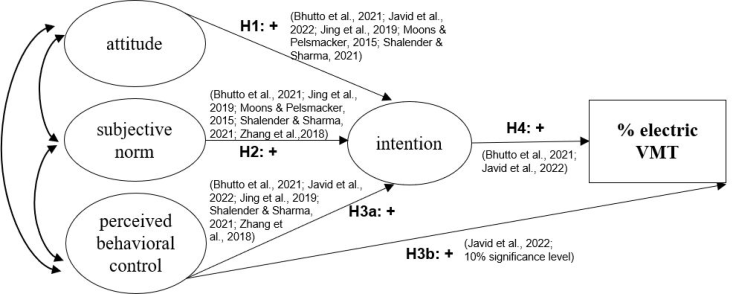
In the transportation sector, TPB was successfully employed to model the effects of A, SN, and PBC on the intention to use EVs (Moons & De Pelsma- cker, 2015; Shalender & Sharma, 2021), EV sharing (Zhang et al., 2018), (shared) autonomous vehicles (Jing et al., 2019). Only a few studies modeled the impact of PBC and IB on the actual performance of a behavior. Javid et al. (2022) found a weak direct effect of PBC on willingness to use an EV but not on willingness to buy an EV, while IB showed a positive significant effect on both behavioral outcomes. Bhutto et al. (2021) found a positive significant effect of IB on willingness to pay more for an EV but did not specify the path from PBC to the behavior. Both studies consider latent (not directly obse- rvable) behavioral outcomes and do not investigate any manifest behavior. Moreover, none of the outlined research has focused on the substitution of VTM with an ICE by electric VMT, which will be done in the given study to close this gap. Based on TPB and empirical findings in the introduced studies, the following hypotheses were outlined (see Figure 1 for graphical representation and empirical support): H1: Individuals with higher A towards EVs have higher intention to buy an EV; H2: Individuals with higher SN have higher intention to buy an EV; H3a: Individuals with higher PBC have higher intention to buy an EV; H3b: Individuals with higher PBC indicate a higher proportion of electric VMT; H4: Individuals with higher intention to buy an EV indicate a higher proportion of electric VMT.
202 Gutjar and Kowald
Figure 1: Theory of planned behavior (Ajzen, 1991, p. 182) with hypotheses and empi- rical support.
Latent variables are represented as ovals and the manifest variable as square. One-sided arrows represent direct effects and two-sided arrows represent covariances. Empirical support on the hypotheses is referenced in brackets.
METHODOLOGY
Computer-assisted personal interviews (CAPI) were conducted with respon- dents in the South-West of Germany. TPB constructs A, SN, PBC, and IB are latent constructs (Ajzen, 1991), which need to be reflected by manifest indi- cators (Brown, 2015). Therefore, for every TPB construct, four items were formulated as indicators to be measured on a seven-point Likert scale (items used in the final model will be presented in the results section). Furthermore, respondents provided information on socio-demographics and details on all available vehicles, motorcycles, and public transport tickets (PT). Based on these data, annual mobility costs of the household were immediately calcula- ted by the survey program and directly implemented into a stated adaptation (SA) experiment designed to measure the effect of political price regulations on vehicle choices and VMT. In the experiment, respondents were asked to complete four choice tasks, whereby they were confronted with varying price regulations for fuel price, CO2 surcharge on fuel prices, electricity price at EV charging stations, financial bonus for the purchase of an EV, and PT pri- ces. The resulting changes in annual costs for the currently existing mobility tools in the respondent’s household were presented as well. For each resul- ting choice situation, respondents were asked to react to these changes by adapting the mobility tools in the household. Hereby they could remove cur- rent and/or adopt new vehicle(s), motorcycle(s), and PT subscriptions for themselves and their household members. Annual VMT could be adjusted for every current and newly adopted vehicle. For every adopted vehicle, the engine type had to be specified: gasoline, diesel, battery electric vehicle (BEV), or Plug-In Hybrid (PHEV). After every adaptation, resulting costs were com- pared to the current costs so that respondents were able to adapt the tools until they were satisfied with their decision under consideration of the fina- ncial restrictions of their household (for more details on the study design,
Human Factors and Political Price Regulations to Enhance Electric Vehicle Miles Traveled 203
please consult previous reports by Gutjar and Kowald (2021)). The colle- cted data allow a calculation of the stated annual VMT for each vehicle and engine type as a reaction to the hypothetical political price regulations. This study in particular aims to explain the chosen proportion of electric VMT as the finally stated behavior in the SA experiment situations by applying the TPB. As only BEVs drive completely electric and PHEVs only to a limited range (Shalender & Sharma, 2021), we consider only VMT with BEVs as electric. Finally, the behavioral aspect under consideration is the proportion of electric VMT (in %) (annual VMT with all stated BEVs divided by the total annual VMT with all stated vehicles and multiplied by 100). To allow its computation, observations not specifying a vehicle and/or VMT in the SA experiment were deleted. After data cleaning, the sample consists of n = 424 individuals and n = 1653 observations in the SA experiment (4 situations per respondent).
To represent the latent TPB constructs and the set of relationships outlined by the hypotheses a structural equation model (SEM) (Brown, 2015; Byrne, 2010) was estimated. Before that, a measurement model was established for every TPB construct after running confirmatory factor analyses (CFA) and modifying the model by removing items with low factor loadings and consulting model fit indices (results are available upon request). The items included to serve as indicators for the TPB constructs in the final model along with their means and standard deviations are presented in Table 1. All data analyses were performed in R (R Core Team, 2020; Rosseel, 2012). Full infor- mation maximum likelihood estimation with robust standard errors (MLR) was applied to handle missing values and non-normality of the measurements (Brown, 2015; Rosseel, 2012; Schreiber et al., 2006). Results of the final SEM are presented in the following section.
RESULTS
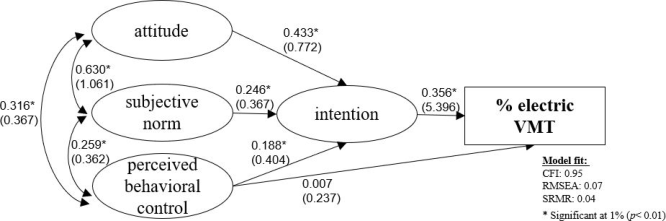
The results on SEM estimation are presented in Table 2 and visualized in Figure 1. The estimated model shows an adequate model fit as CFI rea- ched the value 0.95, RMSEA is up to 0.7, and SRMR is below 0.08 (Brown, 2015; Schreiber et al., 2006). For each latent TPB factor, all standardized factor loadings are high (β >0.5) (Brown, 2015). The latent constructs A, SN, and PBC show positive covariances as outlined by the TPB (Ajzen, 1991).
Concerning the outlined direct effects on IB, the data supports H1, H2, and H3a. Namely, the standardized direct effects of A (β=0.433, z-value = 11.636), SN (β=0.246, z-value = 7.062), and PBC (β=0.188, z- value = 5.156) on IB show significant positive estimates, with z-values greater than 1.96 (Brown, 2015). The explained variance of IB by the TPB constructs is 49% (R2=0.493).
The relative amount of the total VMT respondents stated to perform with a BEV is positively related to an individual’s intention to buy an EV. The stan- dardized direct effect of IB on the percentage of electric VMT is significantly positive (β=0.356, z-value = 12.145), which supports hypothesis H4. The data does not support H3b, which postulates a direct effect of PBC on the
204 Gutjar and Kowald
Table 1. Items as indicators for the TPB constructs.
Table available in the original PDF paper.
construct item scale mean sd 1 useful – 7 harmful 4.5 1.4 A A2 The purchase of an electric vehicle is ... for solving current challenges.
1 positively– 7 negatively 5.0 1.5
A3 By using an electric vehicle, I … set myself apart from other road users.
1 positive – 7 negative 4.6 1.5
A4 All in all, the purchase of an electric vehicle makes a ... contribution to addressing current challenges.
3.4 1.9
SN SN1 People who are important to me emphasize the advantages of using electric vehicles.
1 applicable – 7 not applicable
3.6 1.8
SN2 People who are important to me are hoping for a fast diffusion of electric vehicles.
3.1 2.0
SN3 People who are important to me think I should buy an electric vehicle as my next vehicle.
4.1 1.8
SN4 People who are important to me see the shift to electric vehicles as one solution to current challenges.
PBC PBC1 The use of an electric car would be technically ... for me.
1 easy – 7 difficult 6.1 1.4
5.8 1.7
PBC2 Performing a charging process would be ... for me.
3.7 2.3
IB IB1 I am thinking of switching to an electric vehicle.
1 strongly agree – 7 strongly disagree
4.8 2.2
IB2 The next time I buy a vehicle, I will consider buying an electric vehicle.
3.1 2.1
IB3 I have a strong intention to buy an electric vehicle.
3.6 2.5
IB4 I have already done some research on buying an electric vehicle.
Note: All scales were reversed for analyses to ease interpretation.
stated proportion of electric VMT (β=0.007, z-value = 0.233), which is not surprising, since there is only little empirical support for this relationship as reported previously. The explained variance in the stated behavior by IB and PBC (while PBC has no significant direct effect) is 13% (R2=0.129).
Human Factors and Political Price Regulations to Enhance Electric Vehicle Miles Traveled 205
Table 2. Results of the structural equation model (SEM).
Table available in the original PDF paper.
β B se z-value p-value R2
0.129
Factor loadings IB IB1 0.918 1.000 IB2 0.775 0.824 0.019 43.319 0.000 IB3 0.853 0.857 0.015 56.922 0.000 IB4 0.489 0.585 0.027 22.032 0.000 A A2 0.816 1.000 A3 0.674 0.823 0.036 23.082 0.000 A4 0.840 1.102 0.030 36.826 0.000 SN SN1 0.772 1.000 SN2 0.826 1.059 0.029 35.921 0.000 SN3 0.794 1.093 0.028 39.237 0.000 SN4 0.783 0.963 0.029 32.993 0.000 PBC PBC1 0.698 1.000 PBC2 0.559 0.954 0.121 7.910 0.000 Regressions Predictors of IB 0.493 A 0.433 0.772 0.066 11.636 0.000 SN 0.246 0.367 0.052 7.062 0.000 PBC 0.188 0.404 0.078 5.156 0.000 Predictors of % electric VMT IB 0.356 5.396 0.444 12.145 0.000 PBC 0.007 0.237 0.939 0.233 0.800 Covariances A and SN 0.630 1.061 0.055 19.120 0.000 A and PBC 0.316 0.367 0.050 7.381 0.000 SN and PBC 0.259 0.362 0.053 6.842 0.000 Model fit χ2 561.077 CFI 0.948 RMSEA 0.068 SRMR 0.043
β = standardized parameter estimates (latent and observed variables are standardized); B = unstan- dardized parameter estimates; CFI = comparative fit index; RMSEA = root mean square error of approximation; SRMR = standardized root mean square residual.
Figure 2: Final estimated structural equation model (SEM).
The figure presents standardized solution with unstandardized estimates in brackets. Indicators of latent variables and corresponding factor loadings are not displayed for readability.
206 Gutjar and Kowald
DISCUSSION AND OUTLOOK To derive recommendations for the design of political interventions to enh- ance the proportion of electric VMT, this study investigated the effect of human factors on the stated proportion of annual electric VMT as a reaction to new price regulations. For this aim, TPB (Ajzen, 1991) as a widely used approach to predict human behavior was applied. The analyses of the SEM found empirical support for a direct effect of intention to buy an EV on the stated proportion of electric VMT. IB in its turn is directly positively affected by A, SN, and PBC to buy an EV. Despite the lack of direct effect of PBC on the behavior, all TPB constructs are relevant to enhance electric VMT due to their indirect effect over IB. Therefore, interventions aiming to promote the shift from ICE vehicles to EVs need to target all latent TPB constructs (IB, A, SN, and PBC). In addition to financial incentives, such interventions can include, among other things, information support (Steinmetz et al., 2016).
The explained variance in the behavior (stated proportion of electric VMT) by the TPB construct IB seems to be very low (13%) at the first glance. How- ever, the behavior considered here was the reaction to new price regulations presented to the respondent during the SA experiment, while their effects are not modeled, yet. Considering this fact, the effect of IB on behavior can be considered strong. In the next step, the presented model needs to be extended by investigating the effects of the price regulations varied in the experiment. Furthermore, socio-demographics and household characteristics are aimed to be included into the model to get further insights on human behavior. Yet, this is very rarely done in studies implementing TPB in a SEM (Shalender & Sharma, 2021).
ACKNOWLEDGEMENT
The work is part of the project “Electric City Rüsselsheim”, funded by the German Federal Ministry for Economic Affairs and Energy; Grant number: 01MZ18008B.
REFERENCES
Ajzen, I. (1991). The theory of planned behavior. Organizational Behavior and Human Decision Processes, 50(2), 179–211. Bhutto, M. H., Shaikh, A. A., & Sharma, R. (2021). Factors Affecting the Consumers’
Purchase Intention and Willingness-to-Pay More for Electric-Vehicle Technology. Proceedings of the International Conference on Electronic Business. Brown, T. A. (2015). Confirmatory Factor Analysis for Applied Research, Second Edition. The Guilford Press. Byrne, B. M. (2010). Structural Equation Modeling with Mplus: Basic Concepts,
Applications, and Programming (Second Edition). New York, NY: Routledge. Gutjar, M., & Kowald, M. (2021). Electro mobility acceptance: The influence of political bonus and malus factors. Symposium of the European Association for Research in Transportation, Lyon, France. http://www.heart-web.org/ Jing, P., Huang, H., Ran, B., Zhan, F., & Shi, Y. (2019). Exploring the factors affecting
mode choice Intention of autonomous vehicle based on an extended theory of planned behavior—A case study in China. Sustainability, 11(4), 1155.
Human Factors and Political Price Regulations to Enhance Electric Vehicle Miles Traveled 207
Moons, I., & De Pelsmacker, P. (2015). An extended decomposed theory of planned behaviour to predict the usage intention of the electric car: A multi-group comparison. Sustainability, 7(5), 6212–6245. R Core Team. (2020). R: A language and environment for statistical computing. R
Foundation for Statistical Computing. https://www.R-project.org/ Rosseel, Y. (2012). Lavaan: An R package for structural equation modeling and more.
Version 0.5–12 (BETA). Journal of Statistical Software, 48(2), 1–36. Schreiber, J. B., Nora, A., Stage, F. K., Barlow, E. A., & King, J. (2006). Reporting Structural Equation Modeling and Confirmatory Factor Analysis Results: A Review. The Journal of Educational Research, 99(6), 323–338. https://doi.org/10. 3200/JOER.99.6.~323--338 Shalender, K., & Sharma, N. (2021). Using extended theory of planned behaviour
(TPB) to predict adoption intention of electric vehicles in India. Environment, Development and Sustainability, 23(1), 665–681. Steinmetz, H., Knappstein, M., Ajzen, I., Schmidt, P., & Kabst, R. (2016). How effective are behavior change interventions based on the theory of planned beh- avior? Zeitschrift Für Psychologie, 224(3), 216–233. https://doi.org/10.1027/ 2151-2604/a000255 Zhang, K., Guo, H., Yao, G., Li, C., Zhang, Y., & Wang, W. (2018). Modeling
Acceptance of Electric Vehicle Sharing Based on Theory of Planned Behavior. Sustainability, 10(12), 4686. https://doi.org/10.3390/su10124686
LISTED IN THE AHFE DIGITAL BOOKSTORE CATALOGUE
Explore the complete digital volume
Human Factors in Transportation
Read this individual research paper free through the original publisher, or explore the full digital proceedings book.
ISBN 978-1-958651-36-0
Explore this ISBN in the AHFE Bookstore ↗Listed in the July 2026 bookstore catalogue; search by ISBN to confirm current availability · Digital book purchase optional