Jiaren Yang, Danhua Zhao (2024). Analysis of Design for Sustainable Behavior in Driving: Theory, Methods, and Future Trends. In: Advances in Human Factors of Transportation. AHFE Open Access, vol. 148, pp. 470–479. https://doi.org/10.54941/ahfe1005238
Design for sustainable behavior, as an approach that comprehensively considers social, environmental, and economic factors, has garnered significant attention in the realm of contemporary sustainable development. When applied to automotive driving, incorporating the principles of sustainable behavior design becomes crucial in guiding users toward more eco-friendly driving habits and mitigating the additional energy consumption resulting from poor driving behaviors. This article begins by elucidating the theoretical foundation of design for sustainable behavior, focusing on major theoretical models in the field of behavioral science, specifically the Theory of Planned Behavior (TPB) and the Comprehensive Action Determination Model (CADM).Moving forward, the article explores methods of design for sustainable behavior applicable during the driving phase. These methods encompass a variety of approaches, such as energy information feedback, user choices, feedback mechanisms, incentives, guidance, and interventions. Leveraging digital participation platforms, decision support systems, feedback incentive tools, among others, these methods aim to guide users and driving communities toward more sustainable behaviors on different levels. Emphasizing the analysis of the three crucial dimensions of design for sustainable behavior, the article introduces a behavioral dimension reference model.In conclusion, the article summarizes methods of design for sustainable behavior applied in the driving context and provides insights into future developments. While design for sustainable behavior has seen some success in automotive driving applications, broader dissemination and in-depth research are still required. Future research directions may include more personalized behavior design methods, the application of emerging technologies in this field, and the exploration of sustainable behavior patterns in diverse cultural contexts. By continually advancing theoretical research and expanding practical applications, design for sustainable behavior is poised to become an effective tool for enhancing automotive energy efficiency and contributing to societal sustainable development.
Analysis of Design for Sustainable Behaviour in Driving 471
INTRODUCTION
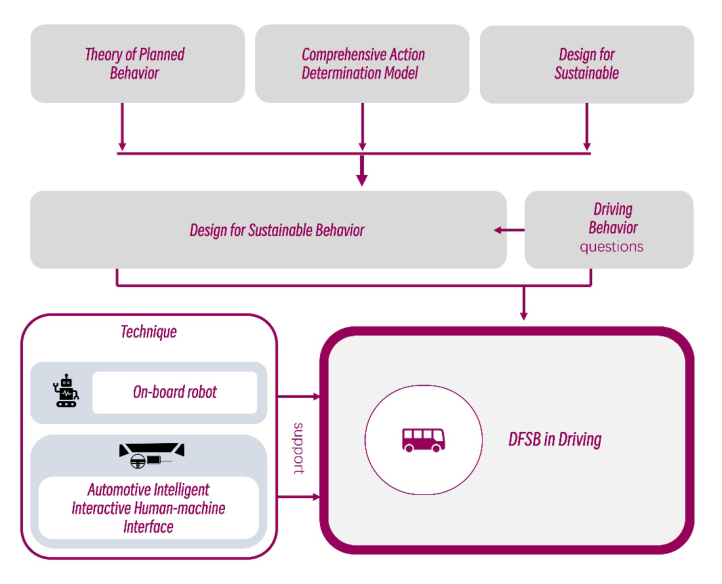
In today’s society, the impact of transportation behaviors on the environment and society is becoming increasingly prominent. As one of the main means of transportation, vehicles have significant effects on energy consumption, car- bon emissions, and traffic safety. Therefore, guiding drivers to adopt more sustainable driving behaviors has become one of the important challenges in the transportation field. Design for sustainable behavior, as a comprehensive approach considering social, environmental, and economic factors, provides us with ideas and tools to address this issue. Designers have come to real- ize that design is not just about solving immediate problems but also about considering the long-term impact. Sustainable design emphasizes the balance between social, economic, and environmental aspects, aiming to create a more harmonious and sustainable future. At the theoretical level, it is essen- tial to deeply understand the nature of human behavior and integrate this understanding into the design of driving habits, combining behavioral psy- chology and the theory of planned behavior. At the level of driving behavior, technologies such as vehicle-mounted robots and intelligent vehicle interfaces can be combined to moderately correct drivers’ behaviors, thereby achieving sustainability both economically and behaviorally in vehicle driving.
THEORETICAL BASIS: AN OVERVIEW OF SUSTAINABLE BEHAVIOR DESIGN THEORY The Design for Sustainable Behavior Theory (DFSB) is an interdisciplinary approach aimed at deeply understanding and shaping human behavior pat- terns to promote sustainability at both the micro-level of individual user behavior and the macro-level of user communities. Fundamentally, to effec- tively guide sustainable driving behavior, we need to change and guide people’s core foundational behaviors in their daily activities.
The Theory of Planned Behavior (TPB), as one of the theoretical foun- dations of sustainable behavior design, originates from the field of social psychology and was proposed by Icek Ajzen in 1985. This theory primar- ily focuses on explaining and predicting human behavior, emphasizing the relationship between individuals’ intentions and actual behaviors regarding specific actions. It provides profound psychological support for sustainable behavior design.
At the core of TPB, concepts such as behavioral beliefs, normative beliefs, and control beliefs form a comprehensive framework. Behavioral beliefs involve an individual’s beliefs about the consequences of a particular behav- ior, normative beliefs describe societal or others’ perceptions of an individ- ual’s behavior, and control beliefs encompass beliefs about factors influencing behavior. Subjective norms integrate normative beliefs and the importance attached to them, while perceived behavioral control expresses an individ- ual’s belief in their ability to control their behavior. Behavioral intention is considered a precursor to actual behavior, with actual behavior representing the behavior individuals engage in under specific circumstances.
472 Jia-Ren and Dan-Hua
TPB has been widely applied in the field of sustainable behavior design. By understanding individuals’ behavioral beliefs, normative beliefs, and con- trol beliefs, designers can develop targeted strategies to encourage individuals to adopt sustainable behaviors. For example, by enhancing social iden- tity and strengthening individuals’ perceived control over environmentally friendly behaviors, sustainable behavior design is expected to more effectively encourage individuals to engage in environmentally friendly actions.
However, TPB also has some limitations. It fails to fully consider the influence of irrational factors on behavior and its applicability varies across different cultures and social contexts. Therefore, in sustainable behavior design, integrating TPB with other theories and methods helps to comprehen- sively and deeply analyze human behavior, providing more targeted guidance and intervention methods for design. By understanding and fully utilizing the advantages of TPB, sustainable behavior design can more accurately interpret human behavior, providing substantial support for creating a more sustainable society.
Figure 1: Theoretical model of DFSB in driving.
In addition, the Comprehensive Action Determination Model (CADM) is a deeply integrated behavioral model designed to capture and explain the multiple factors behind individual behavior. Its core viewpoint is that human behavior is influenced not only by personal intentions but also by environ- mental factors, habits, and social norms. Unlike single behavioral theories,
Analysis of Design for Sustainable Behaviour in Driving 473
CADM suggests that to fully understand and predict a specific behavior, we need to consider a range of interconnected factors.
In CADM, intention is the internal driving force behind an individual’s behavior, involving the individual’s attitudes and subjective norms. Attitude reflects the individual’s positive or negative feelings towards the behavior, while subjective norms are the perceived social pressures, including the expec- tations of others and the individual’s degree of importance attached to these expectations. In addition to intention, context also plays a crucial role in CADM. Context refers to the physical and social environment in which the individual is situated, which can strengthen or weaken the influence of inten- tion and may even lead to changes in behavior. Furthermore, habit is a key concept in CADM. When a behavior is repeatedly performed and associated with a particular context or reward mechanism, individuals may develop habitual behavior patterns, which are largely automatic and reduce the need for intention and decision-making intervention. Finally, CADM also consid- ers norm activation, which refers to how individuals adjust their behavior based on the actions and opinions of others. This is similar to the concept in social cognitive theory, whereby individuals learn and adjust their behavior through observation and imitation of others.
METHODS
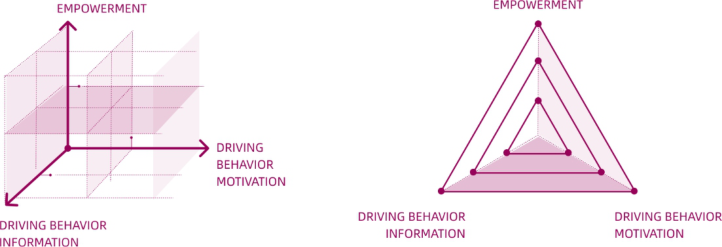
Three Dimensions of DFSB in Driving Designing for sustainable driving behavior is a comprehensive approach that considers drivers, vehicles, and road environments, aiming to guide drivers towards safer, more efficient, and environmentally friendly driving behaviors. This design theory is based on behavioral science and traffic psychology, encompassing three major dimensions: empowerment, driving behavior information, and driving behavior motivation. These three dimen- sions are intertwined and complementary, forming the core framework of driving behavior design. By comprehensively considering empowerment, driving behavior information, and driving behavior motivation, designers can better understand the mechanisms behind driving behavior formation and design targeted interventions for driving behavior.
Empowerment The empowerment dimension is one of the key dimensions in designing for sustainable driving behavior, involving the decision-making and control rights of drivers during the driving process. The design of the empower- ment dimension is based on the self-determination theory and the theory of behavioral decision-making in social psychology. According to the self- determination theory, individual behavior is influenced by autonomy, compe- tence, and relatedness, with empowerment being a core concept among them. In driving behavior design, we can enhance drivers’ sense of empowerment to stimulate their autonomy and sense of responsibility, thereby promoting the formation of more sustainable driving behavior.
474 Jia-Ren and Dan-Hua
Table 1. The empowerment dimension consists of three aspects.
Table available in the original PDF paper.
Control empowerment(CE)
Empowerment Information empowerment(IE)
Decision empowerment(DE)
Concrete behaviors
Drivers need to have a certain level of control over the vehicle to ensure safe and stable driving. By providing flexible and easy-to-use vehicle control systems and driving assistance features, drivers can better control the vehicle, reduce driving errors, and minimize the risk of accidents, thereby enhancing the sustainability of driving behavior.
Drivers need to make various driving decisions during the driving process, such as accelerating, braking, and steering. By providing real-time driving advice and prompts, drivers can have a clearer understanding of the driving situation and make more autonomous driving decisions, thereby reducing unnecessary energy consumption and emissions.
Drivers need to obtain and understand various driving-related information, such as vehicle status and road conditions. By providing clear and accurate information displays and driving assistance systems, drivers can better grasp the driving situation, enhancing their confidence and initiative in driving decisions.
Driving Behavior Information Driver behavior information is one of the important dimensions in sustain- able behavior design, involving the driver’s ability to acquire, understand, and apply driving-related information. This dimension’s design is based on the information processing theory and principles of cognitive psychology in behavioral science. The information processing theory holds that individuals, upon receiving information, undergo processes such as perception, process- ing, understanding, and application, ultimately influencing their decision- making and behavior execution. In driver behavior design, we can leverage the information processing theory to guide drivers towards more sustainable driving behavior by providing effective driving behavior information. This information can be elaborated on in the following three aspects.
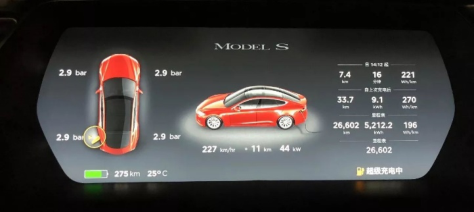
Energy Consumption Information Drivers need to understand the vehicle’s energy consumption during the driving process, including fuel consumption, electricity consumption, etc. Through onboard robots or intelligent vehicle systems, drivers can instantly grasp the vehicle’s energy consumption situation and adjust their driving behavior accordingly, adopting energy-saving driving strategies.
Figure 2: Energy consumption information of tesla model S.
Analysis of Design for Sustainable Behaviour in Driving 475
Road Condition Information Drivers need to obtain and understand traffic conditions and road conditions, including congestion, traffic accidents, road construction, etc. Through navi- gation systems or traffic information platforms, drivers can promptly obtain road condition information and choose the optimal driving route and driving strategy to reduce energy consumption and emissions.
Driving Behavior Assessment Information Drivers need to understand their own driving behavior performance, includ- ing acceleration, braking, steering, etc. Through onboard driving behavior assessment systems or driving behavior analysis tools, drivers can assess whether their driving behavior meets the requirements of sustainable driving and adjust their driving behavior in a timely manner.
Driving Behavior Motivation Driver behavior motivation is another important dimension in sustainable behavior design, involving both intrinsic and extrinsic motivations that influ- ence the formation and sustainability of driving behavior. The design of driver behavior motivation is based on psychological theories of motivation and behavioral incentives, aiming to stimulate drivers’ positive motivations to adopt more sustainable driving behaviors.
Intrinsic Motivation Intrinsic motivation refers to the driver’s motivation to engage in driving behavior based on inner interests, values, and self-realization. By providing enjoyable, challenging, and meaningful driving experiences, and by encourag- ing drivers to actively participate in driving decisions and behavior planning, intrinsic motivation can be enhanced, thereby promoting the formation of more sustainable driving behaviors.
Extrinsic Incentives Extrinsic incentives refer to the driver’s motivation to engage in driving behavior based on external rewards and punishments. By designing rea- sonable reward mechanisms and punishment systems, such as vehicle fuel consumption leaderboards, driving behavior scoring systems, etc., drivers can be incentivized to adopt more energy-efficient and environmentally friendly driving behaviors, reducing unnecessary energy consumption and emissions.
Social Motivation Social motivation refers to the driver’s motivation to engage in driving behav- ior based on social recognition, group pressure, and moral responsibility. By providing social recognition of driving behavior and emphasizing the impact of driving behavior on the environment and society, drivers’ social motivation can be strengthened, encouraging them to pay more attention to and actively participate in sustainable driving behaviors.
476 Jia-Ren and Dan-Hua
Figure 3: Three dimensions of design for sustainable behavior in driving.
Overall, these three dimensions are intertwined and complement each other, collectively forming the core framework of driver behavior design. By comprehensively considering empowerment, driver behavior information, and driver behavior motivation, designers can better understand the mech- anisms behind driving behavior formation and design targeted intervention measures, thereby achieving sustainable development of driving behavior.
FUTURE TRENDS In the future, with the development of technology and changes in social demands, sustainable behavior design will present several important trends and research predictions in guiding driving behavior.
The Popularization and Improvement of Intelligent Driving Assistance System With the rapid development of artificial intelligence (AI) and autonomous driving technology, intelligent driving assistance systems are becoming the main direction of the automotive industry. These systems not only improve the safety of driving behavior but also promote drivers to adopt more sus- tainable driving habits. Firstly, the application of artificial intelligence in perception and recognition provides drivers with comprehensive and accurate driving environment information. Through devices such as lidar, cameras, and sensors, intelligent systems can capture real-time road conditions, vehicle status, and surrounding environments, thereby identifying potential hazards and obstacles, and providing drivers with timely warnings and prompts.
Secondly, the application of artificial intelligence in decision-making and control makes driving behavior more intelligent and sustainable. Intelligent driving assistance systems can automatically adjust the vehicle’s speed, accel- eration, and steering based on the driver’s driving habits and road conditions, avoiding sudden braking and acceleration, thereby reducing fuel consump- tion and emissions. For example, intelligent cruise control systems can auto- matically adjust the vehicle’s speed according to traffic conditions, maintain a safe distance from the preceding vehicle, and avoid frequent acceleration and deceleration, effectively reducing energy waste and environmental pollution.
Analysis of Design for Sustainable Behaviour in Driving 477
Additionally, intelligent driving assistance systems can intelligently cor- rect and guide driving behavior based on the theory of sustainable behavior design. By analyzing the driver’s behavior patterns and driving environ- ment, the system can identify bad driving habits such as rapid acceler- ation, sudden braking, and long idle times, and then remind the driver to adjust their driving behavior through methods such as voice prompts and vibrating seats. At the same time, the system can personalize driv- ing behavior correction strategies based on the driver’s preferences and driving conditions, maximizing the sustainability and safety of driving behavior.
Emphasis on User Experience and Gamification Elements In the future of sustainable behavior design in driving, there will be a significant emphasis on leveraging user experience design and gamifica- tion principles to transform the interactive infotainment systems in cars. Designers will focus on creating intuitive interfaces that are easy to nav- igate and understand, ensuring that drivers can quickly access relevant information without distraction. These interfaces may feature interactive elements such as touchscreens, voice commands, and gesture controls, allow- ing drivers to interact with the system seamlessly while focusing on the road.
Moreover, engaging feedback mechanisms will be integrated into the info- tainment systems to provide drivers with real-time feedback on their driving behavior and its impact on the environment. For example, visualizations of fuel efficiency and CO2 emissions can be displayed on the dashboard, allowing drivers to monitor their environmental footprint and make imme- diate adjustments to their driving habits. Additionally, personalized feed- back messages and notifications can be delivered to drivers based on their individual driving patterns, encouraging them to adopt more eco-friendly behaviors.
To further enhance the user experience and motivate drivers, gamification elements will be incorporated into the infotainment systems. Leaderboards can rank drivers based on their eco-friendly driving performance, fostering a sense of competition and camaraderie among drivers. Achievements and rewards can be unlocked for reaching sustainability milestones or consis- tently practicing eco-friendly driving habits, providing drivers with tangible incentives to continue their efforts.
Ethical and Moral Considerations in Driving Behavior Design As the field of sustainable behavior design in driving continues to advance, it becomes imperative to delve deeper into the ethical and moral dimensions inherent in shaping driving behavior. Designers will encounter increasingly complex ethical dilemmas, requiring careful consideration and deliberation.
One critical ethical consideration revolves around the balance between promoting sustainable behaviors and respecting individual privacy rights. Interventions aimed at modifying driving behavior may involve the collec- tion and analysis of sensitive personal data, raising concerns about privacy
478 Jia-Ren and Dan-Hua
infringement and data security. Designers must prioritize transparency and consent, ensuring that drivers are fully informed about the data collected and how it will be used to influence their behavior. Additionally, robust data protection measures should be implemented to safeguard drivers’ privacy and prevent unauthorized access to their personal information.
Another ethical concern pertains to the principle of autonomy and freedom of choice. While interventions may seek to encourage eco-friendly driving practices, designers must refrain from imposing behavior changes on drivers against their will. Instead, interventions should empower drivers with infor- mation and tools to make informed decisions about their driving habits. By respecting drivers’ autonomy and agency, designers can foster a sense of ownership and accountability for their behavior changes.
Furthermore, ethical driving behavior design should prioritize equity and social justice considerations. Interventions should be designed with sensitiv- ity to diverse socio-economic backgrounds, ensuring that all drivers have equal access to sustainable driving resources and support. Designers should actively engage with communities to understand their unique needs and challenges, co-creating interventions that address systemic inequalities and promote inclusive participation.
CONCLUSION
In summary, sustainable driving behavior design comprises three primary dimensions: empowerment, driving behavior information, and energy con- sumption information. Primarily, the empowerment facet underscores the driver’s autonomy and accountability during vehicular operation, aiming to augment their consciousness and capabilities to engage in environmentally conscious practices. Secondly, the driving behavior information dimension pertains to the driver’s aptitude to acquire, comprehend, and apply driving- related data, facilitating eco-conscious driving behaviors via real-time traffic updates and driving behavior assessments. Lastly, the energy consumption information dimension revolves around drivers’ comprehension of vehicle energy consumption trends, proffering lucid energy consumption metrics and eco-driving advisories to promote energy-efficient and eco-friendly driving practices. These dimensions collectively form the fundamental framework of sustainable driving behavior design, facilitating the effective advocacy of eco-conscious behaviors among drivers and contributing positively to the actualization of sustainable transportation and environmental conservation endeavors.
Moreover, with the pervasive dissemination and refinement of intelli- gent driving assistance systems, the accentuation of user experience and gamification elements, alongside the escalating focus on ethical and moral considerations, sustainable driving behavior design is progressing towards heightened intelligence, engagement, and societal conscientiousness. These trajectories will further propel advancements and implementations in sustain- able driving behavior design, ultimately yielding substantial contributions to forthcoming transportation sustainability objectives and environmental preservation endeavors.
Analysis of Design for Sustainable Behaviour in Driving 479
REFERENCES
Blomquist, Å., Arvola, M. (2002) Personas in action: Ethnography in an interaction design team. In: Proceedings of the Second Nordic Conference on Human- Computer Interaction. ACM. Carey, M. (2011) Designing Environmental Sustainability into New Products Using
Personas at the Early Concept Stage of the Design Process. Charter, M., Tischner, U. (2001) Sustainable Solutions: Developing Products and Services for the Future. Greenleaf publishing. E Elias, E. (2011) User-Efficient Design: Reducing the Environmental Impact of User
Behaviour Through the Design of Products. Ph. D. Thesis, University of Bath, Bath, UK. Ehrenfeld, J. (2008) Sustainability by Design: A Subversive Strategy for Transforming Our Consumer Culture. Yale University Press. Hadfield, M, Howarth, G. (24–25 October 2002) Sustainable development training
and educational challenges for business and universities. In: International con- ference: Engineering education in sustainable design. Delft, The Netherlands; pp. 174–82, ISBN 90-5638-099-0. Lilley, D.; Wilson, G.; Bhamra, T.; Hanratty, M.; Tang, T. (2017) Design interventions for sustainable behaviour. In Design for Behaviour Change: Theories and Practices of Designing for Change; Routledge: Abingdon-on-Thames, UK. Lilley, D.; Wilson, G.T. (2013) Intergrating Ethics into design for sustainable
behaviour. J. Des. Res. Lockton, D.; Harrison, D.; Stanton, N. (2010) Design with Intent: 101 Patterns for Influencing Behaviour through Design; Equifine: Middlesex, UK. Long, F. (2009) Real or imaginary: the effectiveness of using personas in product
design. In: Proceedings of the Irish Ergonomics Society Annual Conference. Irish Ergonomics Society. Meilich, Abe. (2008) INCOSE MBSE Initiative Status of HSI/MBSE Activity (Presentation). Olsen, G., (2004) Making personas more powerful: Details to drive strategic and
tactical design. Boxes and Arrows. Pruitt, J., Adlin, T. (2010) The Persona Lifecycle: Keeping People in Mind throughout Product Design. Morgan Kaufmann. Puthenpurackal, S. (2008) The Development of a Process Tool for Eco-Product
Design. Unpublished thesis University of Cincinnati. Schöggl, J.-P., Baumgartner, R. J., Hofer, D. (2017) Improving sustainability performance in early phases of product design: A checklist for sustainable product development tested in the automotive industry. J. Clean. Prod. Shin, H. D. and Bull, R. (2019) Three dimensions of design for sustainable behaviour.
Sustainability, 11(1). Velden, R. d. (2003) Using Awareness in Product Design to Influence Sustainable Behaviour’, Trondheim. Department of Product Design, Norwegian University of Science and Technology, Norway. Vidal, R., Salmeron, J.L., Mena, A., Chulvi, V. (2015) Fuzzy cognitive map-based
selection of TRIZ (theory of inventive problem solving) trends for eco-innovation of ceramic industry products. J. Clean. Prod. Waller, S., Bradley, M., Hosking, I., Clarkson, P.J. (2015) Making the case for inclusive design. Appl. Ergon. Wilson, G. T.; Lilley, D.; Bhamra, T. (2013) Design feedback interventions for house-
hold energy consumption reduction. In Proceedings of the 16th Conference of the European Roundtable on Sustainable Consumptionand Production (ERSCP) & the 7th Conference of the Environmental Management for Sustainable Universities (EMSU) (ERSCP-EMSU 2013), Istanbul.
LISTED IN THE AHFE DIGITAL BOOKSTORE CATALOGUE
Explore the complete digital volume
Advances in Human Factors of Transportation
Read this individual research paper free through the original publisher, or explore the full digital proceedings book.
ISBN 978-1-964867-24-3
Explore this ISBN in the AHFE Bookstore ↗Listed in the July 2026 bookstore catalogue; search by ISBN to confirm current availability · Digital book purchase optional