Lampros Tsolakidis, Alexander Mueller, Simon Buck, Fabian Schmiel (2022). User-Friendly Embedding of Vehicle Fast Charging in Primary Vehicle Use with Persona Models. In: Human Factors in Transportation. AHFE Open Access, vol. 60, pp. 551–558. https://doi.org/10.54941/ahfe1002489
In addition to the reduction of charging times, the optimization of the charging process and its integration into the primary vehicle use is a central approach to minimize the loss of comfort for the user. In a first step, design-critical vehicle users were identified and modelled in typical user scenarios. Then, on this basis and taking into account an analysis of the strengths and weaknesses of fast-charging technology currently available on the market, the requirements definition for the development of a system for "user-friendly support in the planning of a transport task for EVs" is carried out. The focus will be on the development of a multi input device operating system that is based on a different degree of connec-tivity and automation depending on the different user types. The focus of the evaluation lies in the discussion of the correlation between the degree of connec-tivity and automation and the user types. Systematically derived operating con-cepts are evaluated in the context of subject studies.
In the age of accelerating electrification of the powertrain, the importance of a user-centered operating concept for the charging of fully electric vehi- cles (EVs) is increasingly coming into focus. The loss of comfort in terms of range poses major challenges for vehicle manufacturers and must be compen- sated for in other ways. One approach is to reduce the complexity of vehicle charging and prioritize the user. To ensure that users can access the charging infrastructure as easily as at conventional service stations, a systematic analy- sis and a methodical approach to the development of new operating concepts are required.
Status Quo EVs currently available on the market have a real range of approx. 400 - 500 km at low temperatures [1]. The shortest charging time of an EV is cur- rently about 22 min. to charge the vehicle battery with max. 270KW from
5% to 80% [2]. Current smartphone applications allow users to locate char- ging stations and, if necessary, integrate them into their route planning [3]. These systems are usually not networked with the vehicle navigation system, and the reservation of a charging station is currently only possible to a limi- ted extent and is strongly dependent on the distance to the charging station and the required travel time.
Problem In addition to the short range of EVs compared to conventionally powered vehicles, the vehicle charges take a long time. Accordingly, the EV driver has to make the additional journey to an appropriate charging facility more often. Furthermore, finding charging stations involves additional planning effort and usually requires the operation of diverse systems with various input devices from different providers. Furthermore, compared to conventi- onal refuelling, the complexity of the process has increased significantly due to the large number of providers, systems, charging plugs and charging servi- ces. Planning options, such as reserving a charge point, are only available to users to a very limited extent and depend on the distance to the charge point. In conclusion, it can be stated that charging an all-electric vehicle requires a distinct additional effort for users, especially with regard to the planning process. In this context, the key question of integrating the fast charging of an EV into the user-friendly planning of a transport task arises.
Solution Approach In this research work, the goal is to develop and evaluate a systematically generated and user-oriented operating concept for fast charging of EVs in order to answer the key research question. The method of resolution con- sists of modifying existing operating concepts in order to take into account a human-centred development approach as well as various analytical and empirical studies. In the first step, a suitable underlying model of human - machine interaction is selected for the systematic analysis and evaluation of current operating concepts [4]. Based on this model, a functional analysis for optimal and multi-device feasible user-system interaction is conducted. The functional analysis serves as a basis for the definition of individual intera- ctions in chronological order and for the assignment to possible interaction platforms. Identification of design-critical situations is the focus throughout. Subsequently, a workshop is carried out to define fictitious users who repre- sent the potential user during charging of the vehicle. Considering fictitious user types, operating and user scenarios are created in the course of a second workshop, which serve to specify the user requirements. By means of a functi- onal analysis of the storyboards, user-centred operating concepts are derived. The interaction scenarios and an interactive operating concept are prototy- ped using AdobeXD [5]. The prototype is used to evaluate the assumptions and hypotheses made with regard to the degree of connectivity and automa- tion of the operating concept and serves as a tool for visualizing the sequence of actions.
User-Friendly Embedding of Vehicle Fast Charging in Primary Vehicle 553
METHODS
Fundamental to a human-centered development approach is the early embed- ding of users in the development phase. DIN EN ISO 9241-210 [6] describes such a development set and sees four interrelated design activities that must be followed. Thus, the context of use must be understood and described, the requirements for use must be specified, and the design solutions must be developed and evaluated.
Modeling Critical Users The description of ideal-typical users provides an important basis for the con- text of use and user analysis. As part of this research, a creative workshop was held to define fictitious and design-critical user types. The workshop was conducted following the method of Cooper et al. [7], and supplemented by the consideration of demographic and geographic factors [8]. The modeling of so-called personas was based on research into the characteristics, goals, and events of the target group. In this process, the collected data were clu- stered according to their similarity and sorted according to their relevance. The data collection was reviewed and adjusted with the participants at the beginning of the workshop to form a common consensus. A total of eight people participated in the workshop and three personas were defined. Based on the customer typology of Koppelmann [9], the goal of the workshop was to define a performance-oriented, novelty-oriented and security-oriented per- sona. The selected orientation types represent the design-critical user and were preferred to other types for this reason.
User Scenarios In analogy to the definition of the personas, another workshop was held to define usage scenarios in the form of storyboards [10], which play a decisive role for the sequence of actions and the usage requirements. Each persona is thereby assigned to a sub-process of the holistic process modeling. Based on the findings from the usability and user analysis, the focus of the workshop is on the operation in the planning sub-process as well as the deve- lopment of meaningful functions that the operating concept should contain. Thus, the performance-, novelty- and security-oriented persona is assigned to the planning phase. Furthermore, the usability analysis has shown that no design-critical situations occur in the operating concept within coupling, loa- ding and decoupling phases and are therefore not considered further for the development of the storyboards.
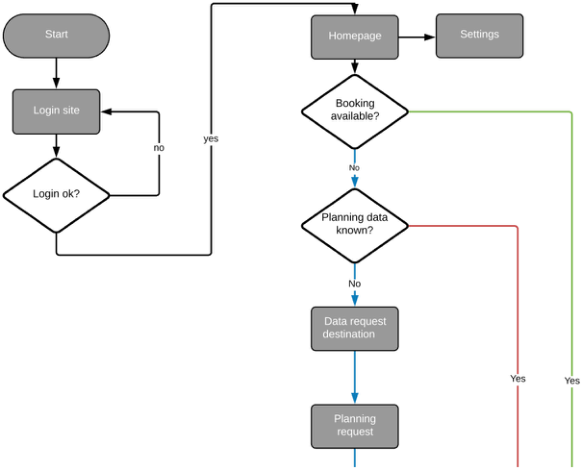
Generic User-Flow Conception The user flow is the actual starting point of the user interface design and provides the basis for further layout. Based on the process modeling, four essential display contents could be identified. These include the data requ- est, the planning request, the planning offer and the planning status. These display contents were supplemented and integrated into the user flow depen- ding on the degree of automation. The supplemented displays here are the settings and the home screen of the system. The green arrows in Figure 1
Figure 1: User-flow planning a fast charge (Extract).
represent the user flow using the high level of automation, red the use of the partially automated system and blue the low level of automation. Basi- cally, there are three parameters that can be used to define the level of automation and connectivity. The configurable parameters are location tran- smission, transmission of planning data, e.g. by synchronization with the private or business calendar, and transfer of decision-making power to the system (Smart Charge).
Customized Wireframe Conception Computer-aided software [5] is used to create wireframes on the basis of the user flow. In a first step, these wireframes are used to represent the layout and arrangement of individual elements. This is an abstracted and outlined representation of the user interface. First, the necessary user actions are grou- ped and assigned to the display elements from the process modeling and the user flow. Furthermore, the individual user actions are assigned to graphi- cal elements. At first, no specific representation of the textual and graphical contents takes place. From the identified parameters from chapter 2.3, which determine the degree of automation and connectivity, three follow-up questi- ons regarding the users result. In this case, the following questions must be answered:
– Are users willing to transmit their location? – Are users willing to share their planning data with the system? – Are users willing to hand over decision-making power to the system?
Furthermore, it should be clarified whether reserving a charging station leads to a higher level of planning reliability.
User-Friendly Embedding of Vehicle Fast Charging in Primary Vehicle 555
User Survey Within the scope of a test person study, the test persons are each assigned to one of the above-mentioned personas in order to evaluate the solution approaches from their point of view. A total of 45 people were invited to participate in the subject study. The study took place virtually within the scope of a video conference. The distribution of the test persons is 15 persons per defined user group (persona).
Procedure of the User Survey The study is structured in four sections. At the beginning, the assigned per- sona is presented to the participant in the form of a profile. In the second section, a usage scenario is presented using the associated storyboard as an example so that the participant can better put himself in the position of the persona. Subsequently, the conceptualized operating concept of the respe- ctive persona is presented to the participant. The presentation includes all steps from the configuration of the settings to the start of the route guidance and thus covers the entire planning process. Furthermore, it is asked whether the embedding of vehicle charging in the transport task provides support and whether the reservation of a charging station leads to a higher planning reliability.
Questionaire The questionnaire is divided into two sections. In the first section, the respon- dent is asked to answer five questions about himself, relating to his age, gender, level of education, the operating system used on his smartphone, and his experience with electric vehicles. The second part of the questi- onnaire relates to questions that the respondent should answer from the perspective of the persona assigned and presented. The questionnaire asks whether the assumptions made regarding connectivity, automation, location transmission, support for planning by embedding vehicle charging in the transportation task and booking of the charging station meet the needs of the users. Thereby, all persona groups are asked the same questions regar- ding support, location transmission and booking. Regarding automation, the subjects are asked a different question per user group, which refers to the respective degree of automation. Since the interpretation of connectivity is the same in the case of the performance-oriented and novelty-oriented per- son, the same question is asked here. The security-oriented type is asked the question if he would not use connectivity.
RESULTS
The central hypothesis to be tested is that at most 50% of all users will be supported if vehicle charging is embedded in a primary transportation task. Furthermore, the second and third hypotheses to be tested are whether at most 50% of all users would a) share their location with the system and b) have higher planning reliability as a result of reserving a charging pole. Results are assumed to be based on a binomial distribution, with “yes” being
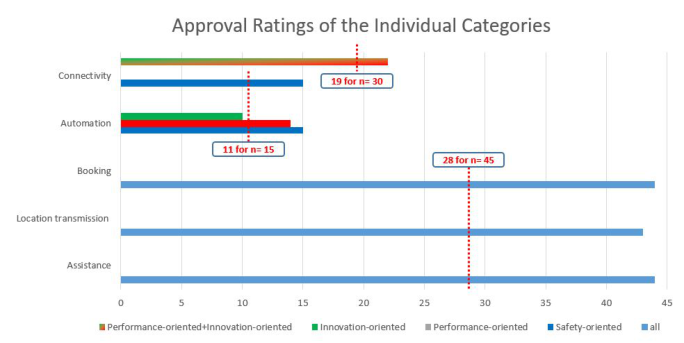
Figure 2: Results of the user survey.
a success and “no” being a failure. Significances are tested based on a right- sided hypothesis test, the sample size for the above hypotheses is n = 45 with a fixed significance level of 5%. If the hypotheses are rejected, it can be stated that significantly more than 50% of the users a) feel supported b) would share their location and c) associate the reservation of a charging station with a higher planning reliability. In the present experiment, this is the case from a critical value of 28 people. According to the same scheme, but with a sample size of 15 and 30, respectively, the hypotheses relating to the individual configurations regarding the connectivity and automation of the personas are also tested. Here, the critical value is 11 and 19 persons, respectively. Based on the results, it can be stated that significantly more than 50% of the users a) feel supported (44 persons), b) would share their location with the system (43 persons) and c) have a higher planning reliability by reserving a charging station (44 persons). 22 of the 30 performance- and novelty-oriented persons surveyed are willing to share their planning data with the system via calendar synchronization. At the same time, 100% of the safety-oriented persons state that they do not want to have connectivity and automation. In contrast, 14 of the 15 performance-oriented persons vote for partially automated use and only 10 of 15 novelty types vote for full automation. Thus, it is hypothesized that at most 50% of novelty-oriented users, would use the presented level of automation. Therefore, the significant majority would not leave the decision-making power to the system. Figure 2 shows the results of the individual categories graphically.
DISCUSSION
The concepts developed within the scope of this research work as well as the resulting prototypical and interactive representation refer to defined and design-critical usage scenarios, which may still need to be supplemen- ted. Regarding the results, it can be said that the embedding of the vehicle charge in the primary transportation task of the users, supports the majority regardless of the orientation type. Furthermore, the performance and novelty
User-Friendly Embedding of Vehicle Fast Charging in Primary Vehicle 557
oriented users are for the most part willing to share their planning data with the system. In this regard, the subjects’ comments during the study showed that the individual need for data protection is very strong. Thus, 8 out of 30 subjects stated that they would not share their planning data with the system for this reason. Sensible suggestions from the test persons, such as only transmitting the location and time of an appointment, could be a solu- tion approach in this context. This would significantly reduce the range of sensitive information transmitted to the system. Regarding the selection and assignment of the different levels of automation, it can be said that the three user groups would use it as suggested. While 100% of the security-oriented and 93.3% of the performance-oriented persons agree with the degree of automation, 66.6% of the novelty-oriented persons agree, which is the only case in the study where the null hypothesis is accepted. According to the sub- jects, this can be attributed to their trust in such systems. Whereby it must be mentioned at this point that the evaluation from the point of view of the test persons took place passively and thus a difference between the recorded, documented and analyzed data and the actions in a real environment cannot be excluded.
CONCLUSION
The results clearly show that the majority of users would share their location with the system and embedding the vehicle load in the users’ transportation task provides support in the planning phase. Providing data from personal or business calendars needs to be further explored. Exactly what data is tran- sferred to the system’s server needs to be clarified. It is conceivable that the system will only receive information about the location and time. The tech- nical feasibility of this must be examined. Further questioning regarding data protection and data transfer could be useful, since the trust in such systems is currently not uniformly present. It must be examined which steps would be necessary to win the confidence of the users, for this further questioning would offer itself. The results clearly show that users have greater planning certainty if they have reserved a charging station at a specific time at a specific location.
ACKNOWLEDGMENT
The described research activities were part of the collaborative project “Coo- lEV”, funded by the German Federal Ministry of Economic Affairs and Climate. Sincere thanks on behalf of the entire project consortium for the funding of this project.
REFERENCES
Adobe, https://www.adobe.com/de/products/xd/learn/get-started/what-is-adobe-xdused-for.html, last access: 14.02.2022. Bauman K.: Personas as a user-centred design method for mobility related service.
John Benjamin Publishing Company, Amsterdam, 2010.
Beyer S., Müller A.: Evaluation of Persona-Based User Scenarios in Vehicle Development. In: Ahram T., Karwowski W., Taiar R. (eds) Human Systems Engineering and Design. IHSED 2018. Advances in Intelligent Systems and Computing, vol. 876. Springer, Cham, 2018. ChargeMap, https://de.chargemap.com/mobile, last access: 11.02.2022. DIN EN ISO 9241: Ergonomics of human-system interaction - Part 210: Human-
centered design of interactive systems, 2019. Electric Vehicle Database, http://www.ev-database.de, last access: 10.01.2022. Koppelmann U.: Produktmarketing – Entscheidungsgrundlage für Produktmanager.
Springer Berlin Heidelberg, 2001. Porsche AG, http://newsroom.porsche.com/de/produkte/taycan/laden-18540.html, last access: 10.01.2022. SAP, shttps://news.sap.com/2016/03/scenes-a-new-method-and-tool-to-create- storyboards/, last access: 10.02.2022. Schmid M., Maier T.: Technisches Interface Design - Anforderungen, Bewertung und
Gestaltung. Springer Vieweg, Heidelberg, 2017.
LISTED IN THE AHFE DIGITAL BOOKSTORE CATALOGUE
Explore the complete digital volume
Human Factors in Transportation
Read this individual research paper free through the original publisher, or explore the full digital proceedings book.
ISBN 978-1-958651-36-0
Explore this ISBN in the AHFE Bookstore ↗Listed in the July 2026 bookstore catalogue; search by ISBN to confirm current availability · Digital book purchase optional