Fabian Schmiel, Simon Buck, Lampros Tsolakidis, Alexander Müller (2022). User-Centered Development and Evaluation of a Physical Ultrafast Charging Interface. In: Intelligent Human Systems Integration (IHSI 2022): Integrating People and Intelligent Systems. AHFE Open Access, vol. 22. https://doi.org/10.54941/ahfe1001029
IntroductionThe CoolEV consortium, consisting of Porsche, Hydac, ZSW, IFS and the University of Applied Science Esslingen (UAS Esslingen) is currently working on the fast charging station of the future. In this context, the UAS Esslingen is developing a new type of charging interface, which, in addition to the electrical lines, also provides fluid lines for temperature control of the vehicle battery. Main research areas of the current work are a user-friendly physical charging interface and the overall operating concept of the charging process. The novel interface and the evaluation of user-friendliness are highlighted in this contribution.ProblemState of the art CCS charging connectors have added cooling to the contacts and the electrical lines, in order to prevent overheating within the connector [1]. The remaining bottleneck in charging speed now is the vehicle battery. To control its temperature, the novel charging interface, developed in the CoolEV consortium, provides two fluid lines, adding the capability of externally cooling the vehicle. Disadvantage of this addition is an increase in size, weight and line stiffness, compared to current charging connectors. This could cause problems concerning handling or carrying for a user. There needs to be a verification, if the interface is still usable for everyone and for all types of electric vehicles. Another question in need of an answer is, if a person would prefer the combination of fluid and electrical lines in one plug or a solution consisting of two separate plugs, keeping the CCS connection and adding a second line for the fluid.Method of ResolutionTwo different trials were held to answer the questions that were brought up while developing the physical interface. At first, a test rig with an adjustable ergonomics model of the new hand piece was built. The sockets, simulating the vehicle side of the rig, are arranged in two different heights, both on opposite ends of a comfort zone, determined by means of the digital human-model RAMSIS® [2]. Using this rig, 30 participants were guided through the experiment, each using the new interface and subsequently answering a questionnaire about their experience. For an objective review of the experience, every participant was also filmed while conducting the charging process. Using the videos different problems were identified, mostly involving body position and sight of the vehicle socket, giving inputs for improvement of the hand piece. For the second trial, the rig was extended with an assembly containing the dual line solution. The improved hand piece was 3D printed and added to the single line solution. In a comparison experiment, 30 participants used both variants and rated their experience, resulting in the identification of a user favourite. The experiment results prove that a one line solution is usable for everybody and preferred to a dual line solution. The significance of the results were statistically tested and secured.[1] PHOENIX CONTACT Deutschland GmbH, “High Power Charging – die Technologie für Schnellladestationen,” 2021. [Online]. Available: https://www.phoenixcontact.com/online/portal/de?1dmy&urile=wcm:path:/dede/web/main/products/technology_pages/subcategory_pages/High_power_charging/b1c8a245-f088-4fad-b144-cea31e7f9a82.[2] Human Solutions GmbH, “3D-Menschmodell & Ergonomiesimulation,” 2021. [Online]. Available: https://www.human-solutions.com/de/produkte/ramsis-allgemein/index.html.
COOLEV RESEARCH GROUP The CoolEV project consortium, consisting of Porsche, Hydac Cooling GmbH, Zentrum für Sonnenenergie- und Wasserstoff-Forschung Baden-Württemberg (ZSW), the IFS of the University of Stuttgart and Esslingen University of Applied Sciences, is working on the
Intelligent Human Systems Integration (IHSI 2022): Integrating People and Intelligent Systems https://openaccess.cms-conferences.org/#/publications/book/978-1-7923-8988-7 electric car charging station of the future. The focus here is on significantly reducing the charging time and subsequently on heat dissipation, efficiency and economy of future fast charging (Esslingen University of Applied Sciences, 2020)
TEST PERSON STUDIES TO SUPPORT THE DEVELOPMENT OF THE CHARGING INTERFACE For this purpose, the project group of the University of Applied Sciences is currently developing a new type of charging interface that, in addition to electrical lines, also provides fluid lines for temperature control of the vehicle battery. The main areas of development are:
1. A user-friendly charging plug 2. The operating concept of the charge As part of the first area, an ergonomics prototype of the charging plug was developed, taking into account a specifically designed function structure, with which findings regarding its usability across the widest possible group of people are to be collected in an initial ergonomics study. Subsequently, a comparative study is to clarify whether this new interface increases the user's utility value.
RESEARCH QUESTIONS These studies will be used to answer three fundamental research questions that have arisen within the development area of user-friendly charging interfaces:
1. Is the plug usable by everyone? 2. Is the plug usable at critical heights? 3. Do users prefer a one- or two-plug variant?
To find answers to these questions, two different studies are being conducted.
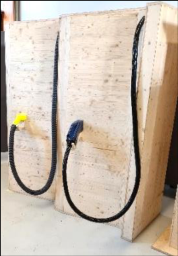
DESCRIPTION OF THE STUDIES For the ergonomics study, a test rig is first set up, which is modelled according to a future charging station concept, in which the vehicle stands parallel to the charging station, similar to a current petrol pump. By guiding the cable and aligning the mating face to the vehicle, the charging cable does not have to be bent or twisted. The ergonomic model of the new charging plug is attached to this charging station. The comparative study will also include a second charging station variant with two separate plugs. This combined setup will be used to test which of the two variants is preferred by the test persons. Both setups are shown in Figure 1.
Intelligent Human Systems Integration (IHSI 2022): Integrating People and Intelligent Systems https://openaccess.cms-conferences.org/#/publications/book/978-1-7923-8988-7
Figure 1. Test rig setup; left: ergonomics study; right: two-plug setup, comparative study Ergonomics Study
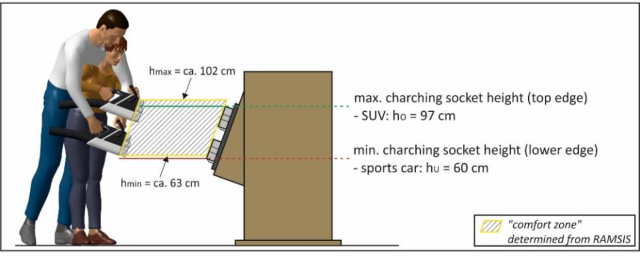
The ergonomics study serves to answer the first two research questions. On the vehicle side, two charging sockets were set up for this purpose, each of which lies in the area of a height considered as critical. In one case, this is a low sports car, in the other a high SUV. Both heights were measured from currently available vehicles. Figure 2 shows that these heights correlate well with a virtually generated height specification created with the RAMSIS® digital human model (Human Solutions GmbH, 2021). The marked comfort zone results from the maximum charging socket height that can be comfortably used by a small person (e.g. 5th percentile woman) and the lowest charging socket height that can be comfortably used by a tall person (e.g. 95th percentile man). The aim is to find out whether the user's height or gender, or the socket height, has an influence on the usability of the plug.
Figure 2. RAMSIS model of the structure with 5% woman and 95% man
Procedure of the Study. The study procedure is divided into three sections. First, the participant should familiarize himself with the plug and the plugging process until it runs smoothly. Starting from a specified starting point, the plugging process is then carried out
Intelligent Human Systems Integration (IHSI 2022): Integrating People and Intelligent Systems https://openaccess.cms-conferences.org/#/publications/book/978-1-7923-8988-7 twice in each of the two sockets. Between each plugging and unplugging, the participant returns to the specified starting point. These four insertion procedures are recorded on video for an impartial evaluation. Finally, a questionnaire is used to find out how the test person likes each phase of the procedure.
Questionnaire. The questionnaire of the ergonomics study divides the process of insertion into multiple steps:
- Removal from the charging Station - Guiding to the vehicle - Coupling - Uncoupling - Socket height Ergonomic points such as weight, cable resistance and hand position are considered in each sub-process. The evaluation is done with a score from 0 to 3 points. A higher score corresponds to a better liking of the user. Comparative Study In order to answer the third research question, a second approach for the fluid interface is pursued in comparison to the proposed single connector variant. The state of the art (HPC cable, (PHOENIX CONTACT Deutschland GmbH, 2021)) is retained here and supplemented by the additional fluid lines in a separate connector. The design is based on charging stations currently offered on the market. The plugs are inserted into the station for storage and must be turned 180° to connect to the vehicle, the respective cables are led out at the top of the station. In order to be able to compare the concepts, both charging points are set up next to each other. Any improvements resulting from the first study are applied to the charging station of the single-plug variant, these are described in chapter 0. The socket height is kept constant in this study in order to exclude it as an influencing factor on the evaluation. It is set to the middle height of the comfort zone shown in Figure 2.
Procedure of the Study. The procedure is also divided into three sections. At the beginning, the participant familiarizes himself with both variants by plugging and unplugging them several times. Then, starting from a predefined starting point, the plugging process is carried out twice with both concepts. These four plugging processes are recorded on video. Finally, the user is asked in a questionnaire which of the two connector concepts he or she likes better.
Questionnaire. In the questionnaire, the process of plugging in and unplugging is again divided into several sub-steps, e.g. removal from the charging station, transport to the vehicle or coupling with it. The evaluation is comparative, the user can select for each sub-step whether the one-plug or the two-plug variant is better, or rate it as "equal".
Intelligent Human Systems Integration (IHSI 2022): Integrating People and Intelligent Systems https://openaccess.cms-conferences.org/#/publications/book/978-1-7923-8988-7
RESULTS AND DISCUSSION OF THE STUDIES Ergonomics Study
In accordance with the recommendation of Mossig (Mossig, 2012), a total of 30 subjects were recruited to participate in the ergonomics study. The age range was between 22 and 60 years, 12 participants were female, 18 male. The height of the participants ranged from 195 cm to 153 cm, with the heights of the participants shifted slightly towards short persons in females and slightly towards tall persons in males compared to the percentile data from RAMSIS®. Thus, the study considers more critical cases than are given on average. To investigate the first question, the subjects' subjective liking of the entire plugging process is evaluated in relation to the combination of both socket heights. To answer the second research question, the participants' liking of the upper and lower sockets is evaluated separately. It is examined whether the gender or the height of the test person influences the liking. The significance of the results is checked using the 2-sample t-test (Meier, 2020). This tests whether the mean values of two distributions differ systematically. The significance level is set at α=5 %.
Influence of Gender. First, the influence of gender is tested. The hypothesis to be tested states that one gender evaluates the process at least one point better or worse than the other. The test statistic calculated by means of t-test is 2.89 and thus exceeds the critical value of 1.74 for the selected significance level. Thus, the hypothesis that gender has an influence can be rejected.
Influence of Body Height. The evaluation of a test person is then considered in relation to his or her body size. Since gender has already been excluded as an influencing factor, all body sizes are considered here. The answers of the test persons are sorted by ascending body size and then the 15 smallest are compared with the remaining 15. As a hypothesis for this test, it is assumed that one group scores the test differently by at least one point. The calculated test statistic of 4.2 is significantly above the critical value of 1.74. Thus, this hypothesis can also be rejected, whereby it is assumed that body size has no significant influence.
Usability at Critical Heights. Finally, the use of the plug is evaluated in relation to the height of the sockets. Since both gender and height can already be excluded as an influence, these factors are no longer considered. The hypothesis of the test is that the evaluation of the two sockets differs by at least one point. The test statistic results in 2.75, exceeding the critical level of 1.69. With the available data, the hypothesis can be rejected and thus no influence of the socket height can be determined.
Video Evaluation. While reviewing the videos, several details stood out that were not evaluated or were evaluated differently by the questionnaire. The view of the vehicle sockets was rated on average as good to very good. However, as can be seen in the following Figure 3, the body angles were adjusted to the visual beam (marked in red) in order to optimize the view of the socket.
Intelligent Human Systems Integration (IHSI 2022): Integrating People and Intelligent Systems https://openaccess.cms-conferences.org/#/publications/book/978-1-7923-8988-7
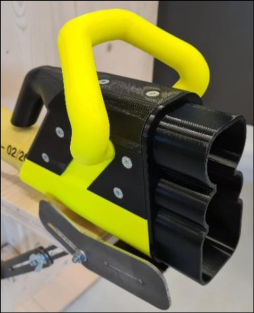
Figure 3. 98% man; left: using the first ergonomics model; center: using the improved model. Both sockets are within the identified comfort zone; right: improved connector design
This results in a rather unnatural body posture. In addition to this, it was noted that the posture of very tall individuals (>= 95% percentile) was not ideal when they inserted the plug into the lower socket. As can also be seen in Figure 3, the subject angles the front knee and hyperextends the neck in order to reach the comfort zone with his arms. From an ergonomic point of view, this can be justified by the fact that the default socket height, which results when a comfortable body angle chain is taken into account, is slightly above the lower socket height. Thus, there is a discrepancy between impartial values of ergonomics and subjective evaluation of the sample. Another observation from the videos is that the handle, which allows access from several directions, is only held sideways. The retraction of the plug and its insertion into the charging station can be seen as problematic. The attachment of the retraction mechanism collides with the charging station when it is returned, which is perceived as unpleasant by many test subjects. In order to place the plug in the charging station, the cable also has to be pressed into the station, which requires more force. In addition, the receptacle of the plug is only slightly wider than the plug itself, which is why problems arose when placing it precisely. Improvements to Connector Design & Test Rig Setup Based on the results of the questionnaire and the videos, various deficits of the charging station setup were identified, which will be improved during the setup of the comparison study. The attachment of the cable retraction on the charging cable, which got stuck when the plug was transported into the charging station, was narrowed so that collisions no longer occur. The force required to place the plug down is to be reduced by a cutout in the rear wall of the charging station, which prevents the cable from having to be bent in the station. To improve the subjects' view of the socket, the shape of the front handle was changed to a V-shape (Figure 3, right). This also creates a lateral grip offer, which was mainly used in the first experiment. The shape also aligns the front hand according to the direction of the forearm, resulting in a more ergonomic posture.
Intelligent Human Systems Integration (IHSI 2022): Integrating People and Intelligent Systems https://openaccess.cms-conferences.org/#/publications/book/978-1-7923-8988-7
Comparative Study In accordance with the recommendation of Mossig (Mossig, 2012), a total of 30 subjects could also be recruited for participation in the comparative study. With a distribution of 15 females and 15 males, the age range is from 23 to 64, and the range of body heights is from 153 cm to 195 cm. The hypothesis to be tested is that at most 50% of the participants will opt for the one-plug variant. A binomial distribution of the results is assumed, a success is a decision for the one-plug variant, a failure is a decision for "equal" or the two-plug variant. Significance is tested using a right-sided significance test, and the significance level is set at 5% (Schiefer & Schiefer, 2018). If the hypothesis is rejected, it can be stated that significantly more people prefer the one-plug variant. In the present test, this is the case if more than 19 persons decide for the one-plug variant. Based on the results of the questionnaires, it can be stated that there is a significant preference for both the effort of the process (20 people), the motion sequences during plugging (25 people) and the coupling with the vehicle (20 people). The total score obtained by adding up all the answers given also shows a significant preference for the one- plug variant, which is consistent with the question of personal preference. In the test, 90% of the participants prefer this variant. In contrast, no preference is found for the cable resistance and the return transport of the plug to the charging station. This may be where the single-plug variant has potential for improvement.
Video Evaluation. It is noticeable that even when using the HPC plug, which is designed for one-handed use, the second hand is used to support and guide the plugging movement. In this respect, the single-plug variant is advantageous because it directly offers a grip for both hands. It is also noticeable that the rotation of the two-plug variant poses a problem for left-handed users. They have to change grip the plug during transport to the vehicle. In addition, the cable of the two-plug variant often touches the user's clothing during rotation, which can possibly lead to soiling. Another conspicuous feature is the connection of the liquid plug of the two- plug variant. Due to the low position of the socket, tall people in particular have to bend their upper body to reach it.
Discussion of the Improvements. As assumed, the narrower connection of the cable return prevents collisions during the return to the charging station. The cutout in the rear wall of the charging station also serves the purpose of reducing the force required towards the end of the cable return. Furthermore, the lateral grip offer is well received by users. As expected, no wrist flexing is seen and an improvement in the view of the socket during the plugging process can be observed. An improvement in posture, especially for tall people, is seen, as the modified handle shape no longer blocks the line of sight. Figure 3 (center) shows the new line of sight, its path would have been blocked using the old variant.
ANSWERING THE RESEARCH QUESTIONS Evaluations of the liking of the plugging process across both socket heights showed that neither the gender nor the height of the test person had a significant influence on their evaluation of the plugging process. From this, the first research question, whether the plug
Intelligent Human Systems Integration (IHSI 2022): Integrating People and Intelligent Systems https://openaccess.cms-conferences.org/#/publications/book/978-1-7923-8988-7 can be used by everyone, can be answered with a "yes". With the influence of gender and height already excluded, the separate survey on plug use at two critical heights was conducted. Since no significant difference in the evaluation can be determined, and the average evaluation of both sockets is in the range of "good" in each case, it can be concluded that the second research question can thus also be answered with a "yes". Finally, the evaluation of the comparative test also provides an answer to the third research question. The question of whether the one- or two-connector variant is preferred can be answered clearly in favor of the one-connector variant, since significantly more people favored this variant both in relation to the entire connection process and in most of the sub-steps.
OUTLOOK Results presented in this paper will be incorporated into the product development of the new interface. Acknowledgements The described research activities were part of the collaborative project “CoolEV”, funded by the German Federal Ministry of Economic Affairs and Climate. Sincere thanks on behalf of the entire project consortium for the funding of this project.
REFERENCES
Esslingen University of Applied Sciences, 2020. RESEARCH PROJECT COOLEV.
[Online] Available at: https://www.hs-esslingen.de/en/mobility-and- technology/research-laboratories/projects/coolev/ [Accessed 29 10 2021]. Human Solutions GmbH, 2021. 3D-Menschmodell & Ergonomiesimulation.
[Online]Available at: https://www.human-solutions.com/de/produkte/ramsis- allgemein/index.html [Accessed 27 10 2021]. Meier, L., 2020. Wahrscheinlichkeitsrechnung und Statistik : Eine Einführung für Verständnis, Intuition und Überblick. Berlin, Heidelberg: Springer Berlin Heidelberg. Mossig, I., 2012. Stichproben, Stichprobenauswahlverfahren und Berechnung des
minimal notwendigen Stichprobenumfangs, Bremen: Universität Bremen. PHOENIX CONTACT Deutschland GmbH, 2021. High Power Charging – die Technologie für Schnellladestationen. [Online] Available at: https://www.phoenixcontact.com/online/portal/de?1dmy&urile=wcm:path:/dede/w eb/main/products/technology_pages/subcategory_pages/High_power_charging/b1c 8a245-f088-4fad-b144-cea31e7f9a82 [Accessed 21 10 2021]. Schiefer, H. & Schiefer, F., 2018. Statistik für Ingenieure. Mönchweiler; Stuttgart:
Intelligent Human Systems Integration (IHSI 2022): Integrating People and Intelligent Systems https://openaccess.cms-conferences.org/#/publications/book/978-1-7923-8988-7
LISTED IN THE AHFE DIGITAL BOOKSTORE CATALOGUE
Explore the complete digital volume
Intelligent Human Systems Integration (IHSI 2022): Integrating People and Intelligent Systems
Read this individual research paper free through the original publisher, or explore the full digital proceedings book.
ISBN 978-1-7923-8988-7
Explore this ISBN in the AHFE Bookstore ↗Listed in the July 2026 bookstore catalogue; search by ISBN to confirm current availability · Digital book purchase optional