Huifang Shang, Guo Xincheng, Chuanshun Wang (2022). The Positive Distraction Effect of Toys in Children's Venous Blood Sampling. In: Healthcare and Medical Devices. AHFE Open Access, vol. 51, pp. 37–44. https://doi.org/10.54941/ahfe1002096
Based on the positive distraction concept in Roger S. Ulrich's supportive design theory, this research selected toys as positive distraction elements in children's venous blood sampling to find more game elements that can effectively divert children's attention and alleviate children's anxiety and fear emotions. The research designed the Children’s Venous Blood Sampling Anxiety Scale by referring to the modified version of the Yale Preoperative Anxiety Scale. The experiment took 3-5 years old children as the research object, and accessed the general distraction effects of toys on children in the process of venous blood sampling. As well as the differences of the distraction effect between normative toy and medical toy on children in blood sampling process, and the differences in long-term impact on children's emotional recovery after blood sampling were compared.
The medical examination and treatment are usually accompanied by a cer- tain degree of invasiveness and pain, which is poorly tolerated by children. Combined with the discomfort caused by their own illness, the mild sense of intrusion and pain will cause strong fear in children, which will cause fear and anxiety to the entire diagnosis and treatment process and even the medical environment. These negative emotions will not only reduce children’s coo- peration in the process of medical treatment, but also prolong the physical recovery time of the diseases. Based on the supportive design theory propo- sed by professor Roger S. Ulrich (1991), this research explores the role of game elements in attracting children to divert attention from diseases and improving children’s emotion during diagnosis and treatment process from the perspective of Positive Distraction.
Game elements in children’s medical area can be divided into two types: normative games and medical games. Normative games provide children with familiar game types and content, such as board games, video games, jig- saw puzzles, pretend games, and handicraft making, etc. By letting children participate in familiar games, increase their adaptability to the medical envi- ronment. Medical games use medical themes and medical devices to allow children to explore medical procedures. During these processes, children will get the experience of diagnosis and treatment in advance, to establish a sense
of control and security over the diagnosis and treatment procedure, and then reduce fear of the medical environment. In order to clarify the differences in the positive distraction effects of these two types of game elements on chil- dren when they undergoing invasive medical examinations, the venous blood sampling was chosen for the experiment. By observing the different emoti- onal reactions of children playing with toys representing these two types of game elements during blood sampling, this study discusses the key issues of implanting game elements in the diagnosis and treatment procedures.
METHOD
The experiment took 3-5 years old children as the research object, and set up three control groups: a blank group, a normative toy group, and a medical toy group. The Children’s Venous Blood Sampling Anxiety Scale, which was designed with reference to the modified version of Yale Preoperative Anxiety Scale (1995), was used to observe and measure the anxiety level of children in the three groups. The experiment accessed and analyzed the distraction effects of toys on children during the blood sampling. Including the diffe- rences in the distraction effects between normative toy group and medical toy group, and the differences in children’s emotional recovery time after the blood sampling.
Children’s Venous Blood Sampling Anxiety Scale The pilot study was conducted in the clinical laboratory of Shanghai Chil- dren’s Hospital (Luding Road Branch), Children’s Hospital of Fudan Univer- sity, Anhui Provincial Children’s Hospital, and Henan Provincial Children’s Hospital. Firstly, observe the behavior of children who were taken venous blood sampling according to the five descriptions of activity, vocalizations, emotional expression, state of apparent arousal and use of parents in M- YPAS. Then summarize, condense, and rank the observed phenomena to form the children’s venous blood collection anxiety scale suitable for the needs of this study. In order to make clear the continuous impact of toys on chil- dren’s emotions, two access items emotional recovery time of children after blood sampling and the children’s attitude towards toys after blood sampling were added to the scale. Comparing whether children’s attitudes towards normative toys and medical toys are different, especially whether they show rejection behaviors towards medical toys.
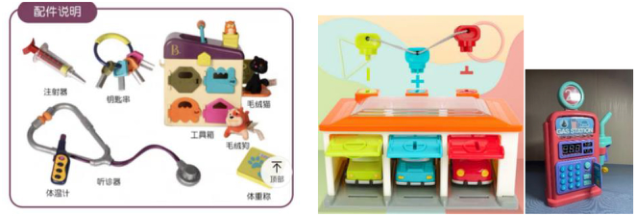
Experimental Toy Screening According to the needs of the experiment, one medical toy and one norma- tive toy were selected as the experimental toys from the market. In order to control the experimental variables, the two toys were required to be as consistent as possible in all aspects. Firstly, selected medical toy with the con- sideration of the following characteristics. xContaining medical examination items, such as injections; ymeeting the age range of the target experimental children; zno obvious gender bias; {easily to play or operate; |no sound, would not affect other patients in the hospital. According to the screening cri- teria, Animal Hospital which with a clear theme, strong operability, and no
The Positive Distraction Effect of Toys in Children’s Venous Blood Sampling 39
I. Behavior and facial expression during blood sampling.
A. Activity
1. Looking around, curious, playing with toys, reading, playing with mobile phones, eating, playing with other children, moving around the waiting area, may turn to the blood sampling table to watch. (0.25) 2. Not engaging in exploration activities or playing; close to parents with eyes drop- ping; unnatural behaviors such as scratching hair, touching face, or fiddling with fingers; involuntarily stepping back or covering eyes with hands when blood sampling is about to start, but still can cooperate with medical staff. (0.5) 3. Eyes fixed on the blood sampling table, close to parents or pulling parents away; when the blood sampling is about to start, keep looking at the pressed arm; finally turning head in fear and hugging parents tightly. (0.75) 4. Trying to get away when seeing the blood sampling table, pushing with feet and arms, do not cooperate with medical staff, try to break free of control and escape from the blood sampling table when be strongly held to the table by parents. (1) B. Vocalizations
1. Reading, playing with peers, keep asking and answering questions quickly, laughing, keep quiet while playing with a mobile phone, talking nonsense or too absorbed in playing to talk. (0.25) 2. Responding to adults in a low voice, or just nodding or other slight body movements without answering. (0.5) 3. Moaning, crying or sobbing silently. (0.75) 4. Crying, yelling “No” or calling “Mom” continuously. (1) C. Emotional Expressivity
1. Manifestly happy, smiling or concentrating on the game. (0.25) 2. Neutral, no visible expression on face. (0.5分) 3. Sad expression, tears in the eyes or crying with open mouth. (0.75) 4. Extremely scared, sad, facial contortions, tears flowing or convulsions. (1) D. State of apparent arousal
1. Pay no attention to the surrounding environment, be in one’s own world (relaxed), or curious to watch what the nurse is doing. (0.25) 2. Sitting still and quiet, looking around aimlessly from time to time or suddenly in a daze, burying the face in the arms of an adult. (0.5) 3. Vigilant, looking quickly all around, eyes wide, body tense, staring at the nurse, retreat or push someone aside and turn away. (0.75) 4. Panicked whimpering, crying and fighting with all the strength, drowning in fear. (1) E. Use of parents 1. Indulge in play, no parents needed, respond to interactions initiated by parents quickly. (0.25) 2. Close to parents seeking security and comfort, may need parents to hold hands or embrace. (0.5) 3. Pull parents back or push parents aside and run away, resist against parental control or cling to the parent during blood sampling. (0.75) 4. Desperately resist and push the parents hard to break free. (1) II. Emotional recovery time of children after blood sampling □Within 1 minute □1-3 minutes □3-5minutes □More than 5 minutes III. Children’s attitude towards medical toys or conventional toys after blood sampling
(blank group needn’t to fill this item) □Still keen to play □Just watching, not playing □Cry more severely when seeing the toy □Push or throw the toy away □Others (Please record the specific performance of the child)
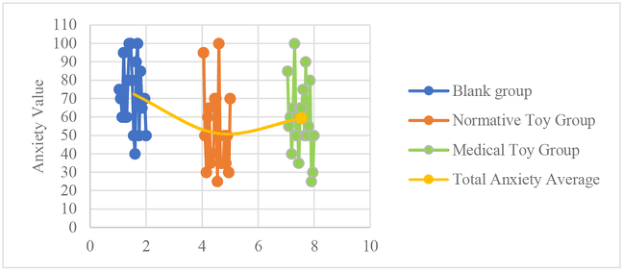
Figure 1: Medical toy “animal hospital” and normative toy “parking and refueling”.Figure 2: Mean anxiety value and scatter plot of each group.
obvious gender bias was selected as the experimental toy for the medical toy group (Fig. 1). Then matched the Parking and Refueling as the experimental toy for the normative toy group (Fig. 1).
RESULT AND DISCUSSION
The experiment was carried out in the Clinical Laboratory Department of Henan Children’s Hospital. The average daily venous blood sampling cases in this hospital is close to 500, which can meet the experimental needs of randomly selecting 20 children aged 3-5 in each of the three groups based on gender balance.
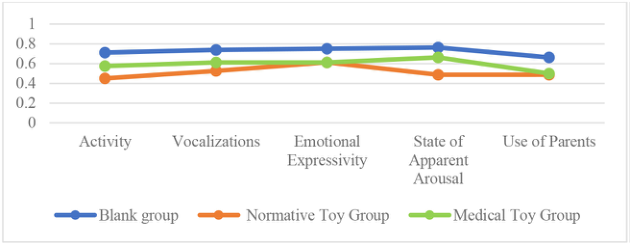
The Mean Anxiety Value in Each Group The total mean anxiety values of normative toy group, medical toy group and blank group are 51, 59.25 and 72.5 (Figure 2). The extreme cases in each group is 3 in blank group, 1 in normative toy group, and 1 in medical toy group (Figure 2). Although there are still extreme cases of ineffective interfe- rence in the experimental groups, it is clearly less than that in the blank group. Furthermore, both the normative toy group and the medical toy group have a significant decrease compared with the blank group in each five values of activity, vocalizations, emotional expressivity, state of apparent arousal and use of parents (Figure 3). It can be considered that the toys of both groups
The Positive Distraction Effect of Toys in Children’s Venous Blood Sampling 41
Figure 3: Distribution of the mean anxiety value of five option.
can have an effective positive distraction effect on children’s venous blood sampling.
Total mean anxiety value of the normative toy group is 8.25 lower than that of the medical toy group (Fig. 3). Specifically, mean anxiety value of activity, vocalizations, and state of apparent arousal in the normative toy group are significantly lower than those in the medical toy group, use of parents and emotional expressivity are almost the same (Fig. 3). Therefore, it can be considered that the positive distraction effect of normative toys on children during the process of venous blood sampling is better than that of medical toys.
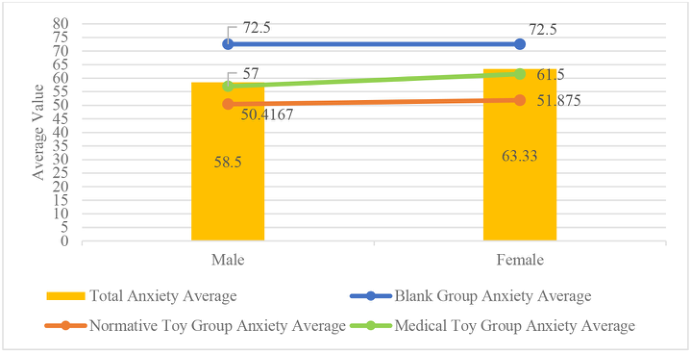
The Mean Anxiety Value of Male and Female Children The proportion of male and female children in this experiment was 1:1. The total mean anxiety value of female children is higher than that of male chil- dren, and the difference is 4.85. Specifically compare the data of three groups, the gender difference in the medical toy group is the largest, with a difference of 4.5, and the normative toy group is 1.4, the blank group is 0. Based on the above statistical data, it can be considered that toys have different interfere- nce effects on children of different gender. The positive distraction effect of toys on male children is greater than that on female children.
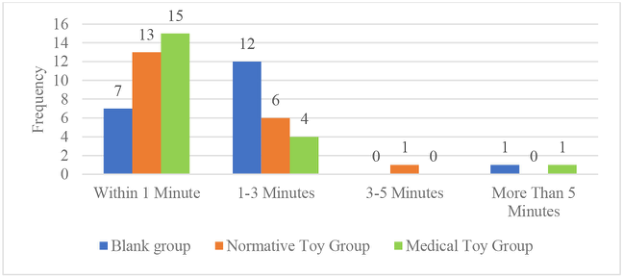
The Emotional Recovery Time After Blood Collection Considering the inconsistent emotional performance of children, it’s diffi- cult to record emotional recovery time accurately. Therefore, the experiment recorded emotional recovery time of children after blood sampling in peri- ods. The emotional recovery time of most children in the blank group is 1-3 minutes, while in the medical toy group and normative toy group is within 1 minute (Figure 5). This indicates that the intervention of toys in these two groups had a significant effect on the emotional recovery of children after blood sampling. In addition, children in the medical toy group whose emotional recovery time within 1 minute were slightly more than children in normative toy group, indicating that medical toy had a better long-term positive impact on children’s emotions.
Figure 4: Mean anxiety value of male and female children.Figure 5: Frequency of children’s emotional recovery time after blood sampling.
Although each group has a child whose emotional recovery time is more than 3-5 minutes due to the individual differences in the pain tolerance and recovery ability show the possibility of ineffective interference, it doesn’t affect the overall trend.
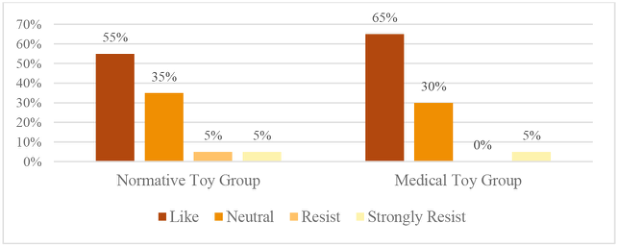
Children’s Attitudes Toward Toys After Blood Sampling The four options for assessing children’s attitudes toward toys after blood sampling are: love-still keen on playing with toys, neutral-standing and watching others play, resist-crying more when saw the toys, and strongly resist -pushing or throwing the toys away. Statistics show that more than 90% of children in the two experimental groups had a fondness for toys after blood sampling, and wanted to continue playing. Many children were unwil- ling to return toys until being persuaded by parents, and behaved reluctantly when they were taken away. Only a few children left immediately.
Children in the medical toy group not only didn’t show rejection of the toy, but the proportion of children who liked the toy was slightly higher than that in the normative toy group. It can be considered that the experience
The Positive Distraction Effect of Toys in Children’s Venous Blood Sampling 43
Figure 6: Children’s attitudes toward toys after blood sampling.
of venous blood sampling stimulates children’s curiosity about medical exa- mination and treatment, making them more willing to continue exploring medical toys (Figure 6).
Feedback from Medical Staff The experiment was carried out with the assistance of medical staff in the laboratory. They found that the distraction effect was significantly better when giving the toys to children about 3-5 minutes before the blood sam- pling. If children were given toys to play with only at the beginning of the blood sampling, their attention would not be easily diverted by the toys. It can be considered that the children’s anxiety has been aroused when blood sampling is about to begin, and toy will not be able to play a distracting role at this time. 3-5 minutes is the effective time obtained in the experiment. During this time, children will experience the psychological process from recognizing the toy to immersing in the game. Children expose to toys before this time can receive blood sampling in a better distracted state.
CONCLUSION
In generally, toys have a significant positive distraction effect on children in venous blood sampling, and have a significant effect on children’s emotio- nal recovery after venous blood sampling. In the process of venous blood sampling, the positive distraction effect of normative toys on children is gre- ater than that of medical toys. After venous blood sampling, the continuous impact of medical toys on children is more obviously. Toys have different interference effects on children of different gender. The dis traction effect of toys on male children is greater than on female children. Allowing children to start playing with toys 3-5 minutes before the beginning of the venous blood sampling will have a better positive distraction effect. Toys that chil- dren can play independently without parents’ guidance, and toys that can provide timely feedback to children’s operation have more significant positive distraction effects.
REFERENCES
Roger S. Ulrich. (1991), “Effects of Interior Design on Wellness: Theory and Recent Scientific Research.” Journal of Health Care Interior Design: Proceedings from the. Symposium on Health Care Interior Design, 3: 97. Zeev N. Kain, Linda C. Mayes, Domenic V. Cicchetti, Lisa A. Caramico, Martha
Spieker, Margaret M. Nygren, Stephen Rimar. (1995), “Measurement tool for preoperative anxiety in young children: The Yale Preoperative Anxiety Scale.” Child Neuropsychology: A Journal on Normal and Abnormal Development in Childhood and Adolescence, Jul., 203–210.
LISTED IN THE AHFE DIGITAL BOOKSTORE CATALOGUE
Explore the complete digital volume
Healthcare and Medical Devices
Read this individual research paper free through the original publisher, or explore the full digital proceedings book.
ISBN 978-1-958651-27-8
Explore this ISBN in the AHFE Bookstore ↗Listed in the July 2026 bookstore catalogue; search by ISBN to confirm current availability · Digital book purchase optional