Fahmi Bellalouna, Robin Langebach, Volker Stamer, Mike Prakash, Mika Luimula, Anis Jedidi, Faiez Gargouri (2022). VR-based Serious Games Approach for a Virtual Installation of an Ammonia Compressor Pack in the Industrial Refrigeration. In: Human Factors in Virtual Environments and Game Design. AHFE Open Access, vol. 50, pp. 55–63. https://doi.org/10.54941/ahfe1002061
Extended Reality technology (xR) contains Augmented, Virtual and Mixed Reality Technology (AR / VR / MR) is one of the key technologies of digital transformation. Thanks to the existing powerful immersive hardware systems, complex technical and natural systems can be digitally represented in a realistic virtual environment. This enables users to completely immerse in the virtual environment and to observe and interact with the systems and objects contained therein without major restrictions, or to augment real products and systems with digital data in runtime. This creates new opportunities to present the behaviour and functionalities of complex systems in a tangible and understandable way. Therefore, the xR technology has the ability to revolutionize learning and training methods, especially in the qualification of specialists and experts. Within the international project “International Cooperation on VR/AR Projects” (IC xR-P) – cooperation between University of Applied Sciences Karlsruhe from Germany, Turku University of Applied Sciences from Finland, and Higher Institute of Computer Science and Multimedia Sfax from Tunisia – the application of the VR technology in the training area in terms of supporting of cognitive skills will be investigated. IC xR-P focuses on the implementation of VR training apps for medical training, rescue and knowledge transfer. This paper presents and discusses the implementation of a VR-Training App for the installation of an industrial refrigeration Ammonia Compressor Pack (ACP). The VR app has been developed in cooperation with the German refrigeration technology manufacturer BITZER Kühlmaschinenbau GmbH. The implemented VR training App has been developed in terms of a feasibility study to demonstrate the aibilty of the VR technology to train Bitzer's customers to install the ACP worldwide. The VR app should support the customers engineers to perform an error-free installation of the ACP based on simplified and tangible virtual process description and virtual instruction. The VR training app comprises four main modules: VR logging and reception room, VR delivery and unloading process for the ACP, VR installation of the ACP, and VR visualization room for the refrigerant flow and technical details of the ACP. The VR app can be used as a single and multiplayer mode. A summary of the app evaluation by the engineers of BITZER will be presented at the end of the paper.
Extended Reality technologies (xR) containing Augmented, Virtual and Mixed Reality Technology (AR / VR / MR) is one of the key technologies of digital transformation. Thanks to the existing powerful immersive hardware systems, complex technical and natural systems can be digitally represen- ted in a realistic virtual environment. This enables the users to completely immerse into the virtual environment and to observe and interact with the virtual objects without major restrictions. This creates new opportunities to present the behavior and functionalities of complex systems in a tangible, interactive and understandable way. The use of xR for the implementation of serious games has the ability to revolutionize the learning and training methods, especially in the qualification of specialists and experts. Serious
games are games designed with the purpose of educating or training the user in a specific domain (Simões-Marques et al., 2020). Within the internatio- nal project “Inter-national Cooperation on VR/AR Projects” (IC xR-P) – a cooperation between the University of Applied Sciences Karlsruhe from Ger- many, the Turku University of Applied Sciences from Finland, and the Higher Institute of Computer Science and Multimedia Sfax from Tunisia – the appli- cation of VR-based serious games for training (e.g. health care, engineering, rescue) in terms of supporting of cognitive skills have been investigated. This paper presents the implementation of a VR-based serious game in the form of a training app for the virtual onsite installation of an industrial refrigera- tion Ammonia Compressor Pack (ACP) during commissioning. The VR app was developed by the project consortium in cooperation with the German refrigeration technology manufacturer BITZER Kühlmaschinenbau GmbH and The SCHAUFLER Academy as BITZER’s international training center for refrigeration and compressor technology. The developed app is planned to be used to train BITZER’s customers and onsite commissioning personnel to install the ACPs worldwide.
SERIOUS GAMES According to Schäfer el al. (Schäfer et al., 2020) serious games are computer- aided digital games in which real processes and activities are integrated into a game. The aim is to support and to improve the knowledge transfer with the help of playful elements. Serious games follow the experience-based approach, where learned content in the game can be reflected and applied afterwards in the reality. Therefore, serious games are suitable for training and education purposes. Through the targeted use of the incentive elements e.g. high-score, awards, virtual goods and bonus, the intrinsic motivation of the players and thus the learning efficiency can be in-creased (Schäfer et al., 2020) (Kretschmer et al., 2018). Unlike traditional training methods such as classroom-based instruction, which rely solely on the instructor, or simulation-based training, which is a replication of a real-world scenario, serious games act as an instructional approach with a defined learning obje- ctive using game elements to promote active learning (Griffith et al., 2018). In addition, wrong decisions within the virtual game have no impact on the real world and this gives the players a feeling of security and encourages their willing to experiment and what if analysis. The cognitive effect of the playful elements within the serious games can be enhanced by the use of Virtual Rea- lity. Through the immersive capability of VR, the gaming experience becomes more perceptive and realistic. The more real the virtual environment appears and the more similar the virtual interactions to the real processes, the easier it is for the players to apply what they have learned into practice (Kolberg, 2020).
RELATED RESEARCH WORKS Since the rapid development of VR technologies in terms of hardware and software performance, the research and the development of VR-based seri- ous games for training purposes have grown in importance in the last few
VR-Based Serious Games Approach for a Virtual Installation 57
years. In this section, some research projects with relevance to this paper are presented. In the project EPICSAVE serious game simulation approach based on VR was developed to train Paramedics on emergencies that are otherwise hardly trainable e.g. life-threatening allergic shock for children (Schild et al., 2019). The main outcome of this project is a VR app that provides a conne- cted multi-user environment, showcasing a paramedic emergency simulation with focus on anaphylactic shock, a representative scenario for critical medi- cal cases that happen too rare to eventually occur within a regular curricular term of vocational training (Schild et al., 2018). The logistics company Schen- ker Deutschland AG and Fraunhofer Institute of Material Flow and Logistics have developed the VR-based serious game PackNick for employee training in the field of picking and packaging. The training app is a VR app that consists of six exercises in which the whole processes can be learned play- fully (Schäfer et al., 2020) (Kretschmer et al., 2018). In the paper of Radionti (Radianti, 2018) an approach for an indoor fire search-and-rescue game is presented. This game was implemented for testing an alternative smartph- one app using smartphone sensors for locating victims and predicting fire development. The app can support firefighters to detect victims’ locations both remotely or in the short distance as long as the victims have activated the app. Simões-Marques et al. presented an approach for a serious game aimed at sup-porting the preparedness of responders in a context of disaster management (Simões-Marques et al., 2020). The presented purpose is VR environment which supports the training of disaster responders, by means of immersive disaster environments and the scoring of the user’s performa- nce while executing missions where they have to apply previously acquired knowledge. The paper of Correia el al. (Correia et al., 2020) addresses the implementation of a VR solution for the training of maritime rescue profes- sionals. The paper is mainly focusing on the process followed in the design and development of an interactive environment using VR.
VR TRAINING APP FOR A VIRTUAL INSTALLATION OF ACP Motivation for VR Training App for a Virtual Installation of ACP
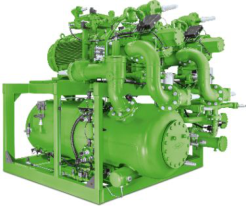
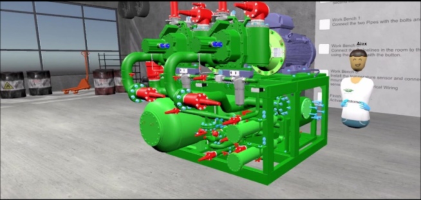
The ACP refrigerant compressors (Figure 1) are based on the screw compres- sor technology which is specially designed for the ammonia as a refrigerant and meets industrial refrigeration standard. Transportation, unloading and installation of the ACP onsite during commissioning are very crucial for safe and reliable operation. In order to ensure a quality-appropriate commissi- oning and operation of the ACP, BITZER offers an extensive training for its customers worldwide. However, this training is very elaborate, and time- consuming in terms of planning and implementation. Simple remote training usually is not sufficient in typical cases. Hence, BITZER’s support engineers have to travel to the costumer and in order to give frontal presence training. Such kind of training ties up many re-sources and depends on several restri- ctions, e.g. the worldwide travel restrictions due to the Covid-19 pandemic. Resulting from this, the question is, whether a VR-based training app can replace or complement the todays existing presence installation training for the ACP? This research question was addressed by BITZER in order to be
Figure 1: Ammonia compressor pack (ACP, BITZER).
worked out within the project IC xR-P. A team of students from the three partner universities have developed a prototype of the VR training app for the ACP installation with the aim to demonstrate the potential of VR as immersive and interactive training approach for this application case. The VR app to be implemented must include the following training functionalities: Multi-player and single-player mode, truck unloading process, connecting the refrigerant pipelines, assembly of the ACP sensors, electrical wiring, instal- lation check, virtual start-up, and visualization of the internal refrigerant flows.
Functions of the VR Training App for a Virtual Installation of ACP The implemented VR training App has been developed in terms of a feasibi- lity study to demonstrate the ability of the VR technology to train BITZER’s customers to install the ACP worldwide. The VR app should support the customers engineers to perform an error-free installation of the ACP based on simplified, tangible, and interactive virtual process description and instru- ction. The VR training app comprises five main VR rooms: user logging room, reception room, ACP delivery and unloading room, ACP installation room, and room for the visualization of the refrigerant flow and the technical details of the ACP. The VR app can be used in single and multiplayer mode. In the following a description of the different rooms and its functions will be presented.
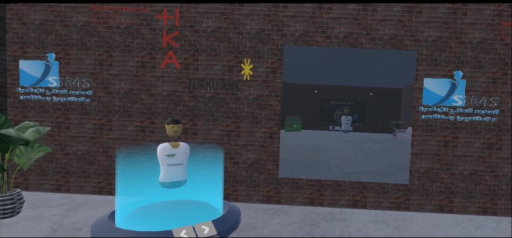
User Logging Room In the logging room the user can choose between the single-player or the multi-player mode. The single-player mode enables the user to use app as standalone app without the participation of further user. For the multi-player mode, the users should select a specific avatar and enter their name using the “Avatar Selection Manager” (Figure 2). Thereby, the different users can be identified in the multiplayer VR space that is also known as a metaverse.
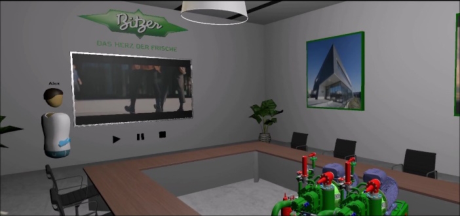
Reception Room After the logging, the users can enter the reception room that has the ambie- nce of a conventional conference room (Figure 3). Different objects following BITZER’s corporate design - e.g. logo, specific BITZER green color, murals of
VR-Based Serious Games Approach for a Virtual Installation 59
Figure 2: Logging room and avatar selection.Figure 3: Reception room.
the BITZER headquarters, and the SCHAUFLER Academy, TV screen sho- wing the BITZER image film - have been placed in the reception room to enable a brand recognition.
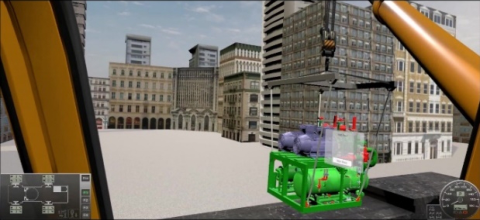
ACP Delivery and Unloading Room Within the delivery and unloading room the correct and safe fixation of the ACP on the lifting beam and the unloading of the ACP from the truck using a crane can be trained (Figure 4). The main reason for this scene is to prevent dropping and breaking the ACP during the unloading phase. This training contains a function to attach the steel cables of the lifting beam to the ACP eyelets, a function to link the lifting beam with the crane using a joystick, and a function to lift the whole ACP from the truck and place it in the virtual costumer facility. The use of a toolbox for physical modeling of the move- ment allows realistic unloading with effects such as dangling of the load. The training app includes a check list that illustrates the unloading process step- by-step. Thus, the users can have an assisted training and the completeness and correctness of the training can be ensured. The multiplayer mode allows the BITZER’s sale engineer to control the training process and to intervene in case of errors.
ACP Installation Room The ACP installation room includes several workbenches for the different assembly steps (Figure 5). The workbenches provide checklists that guide the
users through the assembly process successively. In addition, 3D animations are implemented that illustrate the correct assembly procedure. For this, the exact position of the parts within the ACP and the motion sequence of the assembly are indicated and animated using the holograms of the parts and the snap-zone function. The following assembly steps are implemented in the ACP installation room: Disassembly of the connecting flanges, Mounting the ACP motor, Connecting the refrigerant pipelines, Mounting the sensors, Connecting the electrical wiring, Connecting to the power supply. The 3D model of the ACP to be commissioned stands in the center of the room. A PDF reader is added to the room, which can be used to call up the “Quick Installation Guide”from BITZER for further instructions during the training. The training attendees can use the integrated VR whiteboard to out-line and explain the technical details if the ACP.
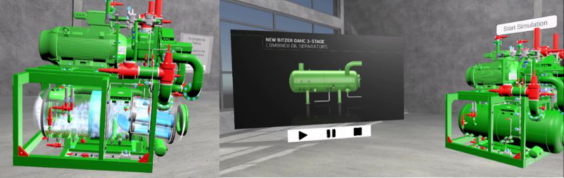
Room for the Visualization of the Refrigerant Flow and the Technical Details This room provides the customer with an extensive insight as well as an ove- rview of the technical details of the ACP (Figure 6). After the ACP has been successfully assembled in the assembly room, the customer can learn about the main technical components and the refrigerant flow with the help of an interactive flow visualization. Ammonia as refrigerant is toxic and mildly flammable. Therefore, the understanding of the ACP assembly structure as well as safety feature installations are very crucial for the costumer to ensure a safe and reliable operation. In addition, the user can use the information
VR-Based Serious Games Approach for a Virtual Installation 61
Figure 6: Room for the visualization of the refrigerant flow and the technical details.
button “I”to show further technical information on the whiteboard that also contains a VR pen to add personal notes.
Used Software for the Implementation of the VR Training App for a Virtual Installation of ACP Unity Unity real-time development platform and game engine from Unity Tech- nologies was used to develop the application. The platform provides a development environment to generate rich and interactive real-time 3D expe- riences. Unity offers, among other things, a built-in physics engine that allows the simulation of 3D motion, mass, gravity and collisions.
XR Interaction Toolkit The XR Interaction Toolkit package is a high-level, component-based, inte- raction system for creating VR and AR experiences. The core of this system is a set of base interactor and interactable components, and an interaction manager that ties these two types of components together. The XR Intera- ction Toolkit supports the basic interaction tasks e.g. controller input and output, object select and grab, haptic, visual and sound feedback as well as UI interactions. The XR Interaction toolkit was used to implement all the basic interaction function in the VR training app.
Photon Asset For the network solution for multiplayer integration, the assets of Exit Games were used. These offer a simple implementation, many resources for learning the framework, and detailed documentation. Photon PUN 2 was used for general synchronization between all users, lobby and room management and Photon Voice 2 provides the voice chat.
Evaluation of the VR Training App for a Virtual Installation of ACP The professional and functional evaluation of the VR training app in terms of VR potential in the training field was done by the in IC xR-P involved BITZER’s engineers from the sale department. The evaluators agree that the implemented prototype of the VR app has clearly shown the potential of VR in the field of education and training to explain complex systems. The major steps for the ACP installation can be visualized in the VR app with the nee- ded details adequately and intelligible. BITZER intends to deploy the VR app
as part of the customer onboarding process in order to collect comprehen- sive experience for future development. The VR training app is planned to be extended with further functions to configurate different ACP operation modes and to simulate basic operational errors and troubleshooting.
CONCLUSION
The developed VR-based serious game presents a training metaverse that enables trainer and trainees to meet virtually and to conduct an interactive training without major restrictions, which was in the recent past only in pre- sence possible. This opens new opportunities to develop innovative VR-based training approaches that are flexible in functionality and due to likely redu- ced travel volume economically friendly compared with the conventional presence trainings. The use of the game engine Unity for the implementa- tion of the VR app has several advantages especially in terms of the scripting functionality that allows the implementation of realistic interaction functi- ons. However, the import and the dealing with CAD data in such game engine remains challenging. The implementation of a VR app with a high 3D gra- phic processing performance always de-pends to the data quality of the VR scene. On the one hand the 3D models must have a high level of detail for the assembly structure and surface modeling, on the other hand the data volume of the VR app must be as low as possible to allow a smooth VR experience. To achieve this balance - as roughly as possible, as detailed as necessary -, elaborative manual CAD data processing work is up-stream of the VR app programming. This require not negligible efforts with respect to both CAD system and game engine platform.
ACKNOWLEDGMENT
The discussed work and the outcomes were achieved during the project IC xR-P that is part of the programme Baden-Württemberg-STIPENDIUM for University and Students (BWS plus) and funded by the Baden-Württemberg Foundation. Further, we would like to thank the company BITZER Kühlma- schinenbau GmbH for their support and the fruitful cooperation.
REFERENCES
Correia, A., Simões-Marques, M., Luzes, T. (2020) “Virtual Reality in Support of Maritime Rescue Training”, in: AHFE 2020 Virtual Conference on Human Factors and Systems Interaction, Springer. pp. 116–122. Griffith, T., Maraj, C., Flynn, J., Ablanedo, J. (2018) “A Usability Review of the Lear-
ning Master Serious Game in Support of the US Army Jumpmaster’s Course”, in: AHFE 2018 International Conferences on Human Factors and Wearable Techno- logies, and Human Factors in Game Design and Virtual Environments, Orlando, Springer. pp. 307–317. Kolberg, S. (2020) “In der Praxis: VR/AR in Gamification und Serious Games”, in: https://blog.fintechcube.com/vr-ar-gamification-serious-games/. Visited on 22nd December 2021.
VR-Based Serious Games Approach for a Virtual Installation 63
Kretschmer, V., Terharen, A. (2018) “Serious Games in Virtual Environments: Cognitive Ergonomic Trainings for Workplaces in Intralogistics”, in: AHFE 2018 International Conferences on Human Factors and Wearable Technologies, and Human Factors in Game Design and Virtual Environments, Orlando, Springer. pp. 266–274. Radianti, J. (2018) “Experience from Indoor Fire Search and Rescue Game Design
for Technology Testing”, in: AHFE 2018 International Conferences on Human Factors and Wearable Technologies, and Human Factors in Game Design and Virtual Environments, Orlando, Springer. pp. 253–256. Schäfer, S., Müller, G., Kretschmer, V. (2020) “ Mit Serious Games zum Trainingserfolg: Digitale Lernspiele in der Mitarbeiterschulung”, in: Handbuch Industrie 4.0, vol. 3: Logistik, Springer Vieweg, Berlin. pp. 513–527. Schild, J., Flock, L., Martens, P., Roth., B., Schünemann, N., Heller, E., Misztal,
S. (2019) “EPICSAVE Lifesaving Decisions – a Collaborative VR Training Game Sketch for Para-medics”, in: 2019 IEEE Conference on Virtual Reality and 3D User Interfaces, Osaka. pp. 1389. Schild, J., Misztal, S., Roth, B., Flock, L., Luiz, T., Lerner, D., Herkersdorf, M., Wegner, K., Neuberger, M., Franke, A., Kemp, C., Pranghofer, J., Seele, S., Buh- ler, H., Herpers, R. (2018) “Applying Multi-User Virtual Reality to Collaborative Medical Training”, in: 2018 IEEE Conference on Virtual Reality and 3D User Interfaces, Reutlingen. pp. 775–776. Simões-Marques, M., Moreno, D., Correia, A. (2020) “Developing a Serious Game
to Support Disaster Management Preparedness - A Design Thinking Approach”, in: AHFE 2020 Virtual Conference on Human Factors and Systems Interaction, Springer. pp. 108–115.
LISTED IN THE AHFE DIGITAL BOOKSTORE CATALOGUE
Explore the complete digital volume
Human Factors in Virtual Environments and Game Design
Read this individual research paper free through the original publisher, or explore the full digital proceedings book.
ISBN 978-1-958651-26-1
Explore this ISBN in the AHFE Bookstore ↗Listed in the July 2026 bookstore catalogue; search by ISBN to confirm current availability · Digital book purchase optional