Pilar Contero López, Jorge Camba, Manuel Contero (2022). An Analysis of Influencer Marketing Effectiveness in Luxury Brands using Eye tracking Technology. In: Human Factors in Communication of Design. AHFE Open Access, vol. 49, pp. 167–173. https://doi.org/10.54941/ahfe1002051
In this paper, we examine the advertising impact of influencers on the promotion of a luxury fashion item and the effect of the presentation style. More specifically, we focus on the application of eye-tracking technologies to analyze how consumers respond to different presentation strategies used by influencers when promoting a product in a photograph.We report the results of an experimental study in which a group of participants were exposed to a set of static visual stimuli (i.e. photographs) related to new product launches by luxury fashion brands in the form of promotions by social media influencers. Individual responses were evaluated based on the participant’s ability to recall information from the stimuli as well as their recorded gaze points and fixations, which were tracked to identify areas in which the viewer had a particular interest at a specific time during exposure.Our results revealed that consumers tend to be impacted more heavily and recall a luxury item more easily when the product is promoted by influencers who appear not to be looking directly at the camera in the pictures (i.e. not making eye contact with the viewer). The percentage of individuals who correctly identified the luxury item with this type of stimulus was 87.5% as opposed to 46.25% when the influencer was looking directly at the camera. In addition to the influencers' visual contact, two other aspects were evaluated: the impact of the influencers' popularity and the aesthetic characteristics of the photographs used as stimuli.Our study confirms the effectiveness of the marketing strategies pioneered by some of the most recognized luxury fashion brands and delivered by influencers, particularly if the influencer does not establish visual contact with the target audience. This type of communication enables a more targeted type of advertising which moves from the exclusivity of promoting luxury fashion brands in certain events and marketing campaigns by celebrities to influencers that can reach large audiences on social networks.
Influencer culture is becoming a core element of the marketing strategy of many luxury fashion brands, which rely on influencers to promote their pro- ducts, increase their visibility, and expand to other consumer segments. The almost exclusive role of celebrities in the promotion of luxury items is now being shared with individuals who have a certain level of reputation or social influence in digital platforms such as Instagram or Facebook and can gene- rate and engage large followings of people who pay close attention to their posts. According to Kapferer and Bastien (2012), luxury brands should direct their communication to both target and non-target audiences. By doing this, consumers who cannot access or afford these brands can at least recognize them, leading to increase brand recognition.
Influencer marketing in the luxury fashion industry increases consumer’s awareness and engagement. A popular influencer may trigger specific seman- tic associations in the customer’s mind, whereas an anonymous endorser may generate fewer mental associations. The audience’s attention to the influencer in an ad is likely to lead to interest in the brand and even brand association in the future (Bruce and Young, 1986; Misra and Beatty, 1990). However, influencers may not always have a positive or sufficiently significant impact on the advertised brand, as consumers may only recall the influencer but not the brand itself (Belch and Belch, 2004; Rossiter and Percy, 1987).
Some researchers have studied the impact of a person’s face and gaze - towards a promoted product or towards the viewer – on attention (Langton et al., 2008; Theeuwes and Van der Stigchel, 2006). Faces possess the natural ability to capture an individual’s attention more rapidly and automatically than other non-social stimuli. Due to its emotional and social significance, faces and gaze behavior can be powerful mechanisms to capture and direct a viewer’s visual attention (Vuilleumier and Schwartz, 2001; Palermo and Rhodes, 2007; Bindemann et al., 2005; Langton et al., 2006).
RESEARCH AIMS AND OBJECTIVES The purpose of this study is to evaluate the impact of different influencer strategies during the new launch of a luxury fashion brand. We hypothesize that, when exposed to an advertising photograph from an influencer, consu- mers can recall the luxury product promoted in the photograph more easily when the influencer is not looking directly at the camera (i.e., not making eye contact with the consumer).
METHOD
Our study was conducted with a group of volunteers in Spain and designed in two stages. In the first stage, we developed a screening survey based on the work by O’Cass (2000) and Amatulli et al. (2016) to select the partici- pants for our study. A total of 40 individuals with ages between 18 and 65 were selected. All participants had previous experience in fashion and a high capacity for recognition of luxury fashion brands.
In the second stage, we used a questionnaire and eye-tracking technology (Gazepoint GP3 eye tracker) to study the participants’ behavior. To record and analyze eye-tracking data, we used the software OGAMA (2008). The fixation calculation used by OGAMA is based on a dispersion-type algorithm that searches for sequences of points where the subject’s gaze is fixed which remain relatively close. Specifically, the values of the fixation parameters used in OGAMA were the maximum distance (in pixels) that a point may vary from the average fixation point and still be considered part of the fixation, and the minimum number of samples that can be considered a fixation, of 20 and 5 gazes, respectively. Participants completed the study one at a time. Two stimuli were used in our experiment to evaluate the individual’s ability to recall luxury items shown in photographs promoted by influencers. Each stimulus was shown
An Analysis of Influencer Marketing Effectiveness 169
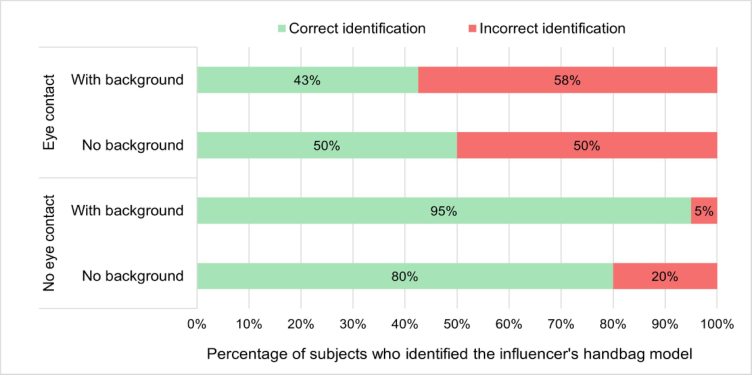
Figure 1: Identification of selected handbag models promoted by influencers.
for 8 seconds (Amatulli et al., 2016). After exposure, the participant was asked to identify the influencer in the photograph and the luxury items they were wearing. Both questions were part of declarative measures based on product recall from a list of 6 luxury handbags of the same brands with simi- lar characteristics, and influencer recall from a list of 4 other influencers (two target and two distractors) and 2 response options such as not recognizing one or both influencers.
The selection of the stimuli was based on the aesthetics and the artistic characteristics of the photograph (particularly the presence of neutral and non-neutral backgrounds) and the influencer’s eye contact. Two additional photographs of other influencers with similar characteristics were mixed with the stimuli to randomize the presentation and minimize the influence of previously shown stimuli on the subjects’ responses.
The selection of influencers was based on the number of followers. We considered only influencers with more than half a million followers in their Instagram accounts where most of the photographs were promoted by luxury fashion brands. In particular, our study focused on Christian Dior and Louis Vuitton which are leaders in this type of digital marketing.
RESULTS
The results of our study are shown in Figure 1. The luxury items promoted in the images, specifically new models of handbags, were identified more easily by participants when the influencers did not establish visual contact with the camera. For this condition, 95% of participants correctly identified the handbag models for the photograph with a non-neutral background, and 80% for the photograph with a neutral background. In contrast, the existence of visual contact led to a decrease in the ability to identify the correct models: 42.5% for the photographs with background, and 50% for the photograph with a neutral background.
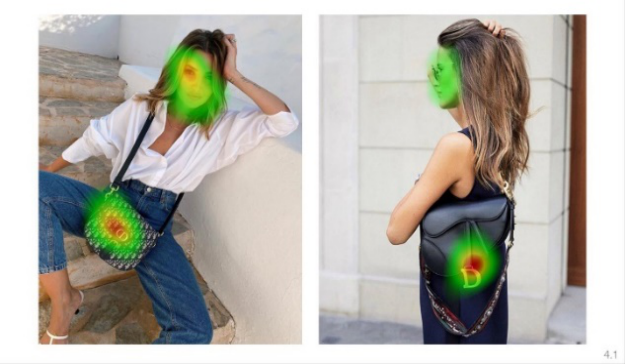
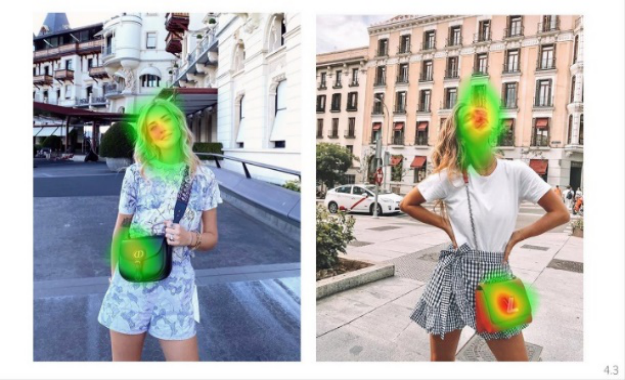
Figure 2: Aggregate heatmap for first stimuli (participants who correctly identified the handbag).Figure 3: Aggregate heatmap for second stimuli (participants who correctly identified the handbag).
To illustrate the reaction to the exposed stimuli, the fixations of the par- ticipants who correctly identified the handbag models are shown through aggregated heat maps in Figures 2 and 3.
We used a McNemar test to compare the identification of the handbag models on a neutral background (see Figure 2 and Table 1). Significant diffe- rences were found between the correct identification of the handbag model with and without the influencer’s visual contact (χ2(1) = 6, p = .014). A second McNemar test was used to compare the identification of the handbag models on an urban background (see Figure 3 and Table 2). Significant dif- ferences were found between the correct identification of the handbag model with and without the influencer’s visual contact χ2(1) = 19.17 p<.01).
An Analysis of Influencer Marketing Effectiveness 171
Table 1. Contingency table for neutral background.
Table available in the original PDF paper.
Recognition without visual contact Recognition with visual contact 0 1 Total
0 2 18 20 1 6 14 20 Total 8 32 40
Table 2. Contingency table for urban background.
Table available in the original PDF paper.
Recognition without visual contact Recognition with visual contact 0 1 Total
0 1 22 23 1 1 16 17 Total 2 38 40
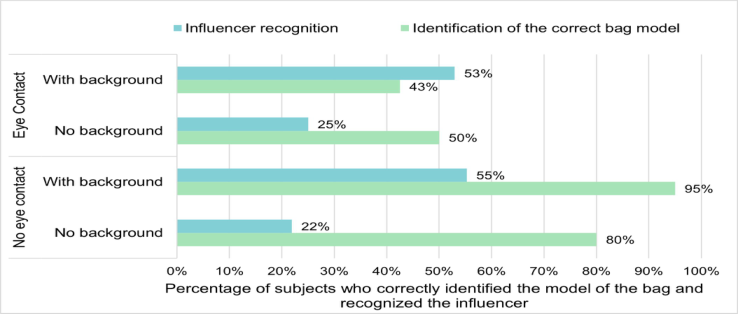
Figure 4: Relationship between the correct identification of the handbag and the recognition of the influencer by participants.
In addition to the influencers’ visual contact, we evaluated two other aspe- cts related to the participants’ ability to recall the promoted luxury item: recognition of the influencer and the artistic characteristics of the selected photographs. The relationships between participants who identified the cor- rect model of handbag and recognized the influencer in the photograph are shown in Figure 4. The combinations of the aforementioned effects and their corresponding results in relation to the advertising impact are summarized in Table 3.
DISCUSSION AND CONCLUSIONS The results of our experimental study confirm the influence of face prese- nce and gaze direction on memorization and agree with previous research by Adil et al. (2018). This phenomenon has implications in advertising where
Table 3. Components affecting the effectiveness of luxury goods promotion.
Table available in the original PDF paper.
Condition Influencer recognition Background Advertising impact With eye contact High (53%) Yes Very low (43%) Low (25%) No Low (50%) No eye contact Low (22%) No High (80%) High (55%) Yes Very high (95%)
the presence of faces can increase marketing impact and attract viewer atten- tion. The eyes (more specifically, gaze direction) are particularly significant as they can direct the viewer’s attention. From a marketing standpoint, an photograph is more impactful when the influencer’s gaze is directed toward the product and not the viewer. Our findings agree with Droulers and Adil (2015) who reported similar results and concluded that magazine ads that featured a gaze toward a product increased memory performance both for the product and the brand.
The influencer’s popularity also has an effect on the viewer’s attention to the ad. Eye-tracking results from our study indicated that the number of fixa- tions to the various elements of the ad was significant. The endorser’s face received the highest number of fixations and the longest fixation duration. Our method and results are similar to Zahmati et al.’s (2020) who studied the impact of celebrity athlete endorsement on advertising attention when promoting fashion products such as sunglasses.
In the luxury fashion industry, influencer marketing is enabling the transi- tion from exclusive events and celebrity campaigns to promotional strategies that leverage social media platforms to reach wider audiences. Through these platforms, companies can increase brand recognition and consumer enga- gement. In this regard, the communication strategies based on influencer culture and pioneered by some of the luxury fashion brands such as Chri- stian Dior and Louis Vuitton are more effective when the influencer does not establish direct visual contact with the target audience.
As future work, we are interested in replicating our experiment with a group of participants who are not as familiar with luxury brand products as the participants in this study. The additional data from this test would be used to analyze differences between target and non-target audiences, and to determine whether brand recognition and familiarity have a significant effect on the participants’ behavior.
REFERENCES
Adil, S., Lacoste-Badie, S., & Droulers, O. (2018). Face presence and gaze direction in print advertisements: How they influence consumer responses—An eye-tracking study. Journal of Advertising Research, 58(4), 443–455. Amatulli, C., Guido, G., Mileti, A., Tomacelli, C., Irene Prete, M., & Longo, A. E.
(2016). “Mix-and-match” fashion trend and luxury brand recognition: An empi- rical test using eye-tracking. Fashion Theory, 20(3), 341–362. Belch, G. E., & Belch, M. A. (2004). Advertising and promotion: An integrated marketing communications perspective 6th. New York: McGraw-Hil I.
An Analysis of Influencer Marketing Effectiveness 173
Bruce, V., & Young, A. (1986). Understanding face recognition. British Journal of Psychology, 77(3), 305–327. Bindemann, M., Burton, M. A., Hooge, I. T. C., Jenkins, R., and de Haan, E. H. F.
(2005). Faces retain attention. Psychon. Bull. Rev. 12, 1048–1053. Kapferer, J. N., & Bastien, V. (2012). The luxury strategy: Break the rules of marketing to build luxury brands. UK: Kogan page publishers. Langton, S. R. H., O’Donnell, C., Riby, D. M., and Ballantyne, C. J. (2006). Gaze cues
influence the allocation of attention in natural scene viewing. Q. J. Exp. Psychol. 59, 2056–2064. Langton, S. R., Law, A. S., Burton, A. M., & Schweinberger, S. R. (2008). Attention capture by faces. Cognition, 107(1), 330–342. Misra, S., & Beatty, S. E. (1990). Celebrity spokesperson and brand congruence: An
assessment of recall and affect. Journal of business research, 21(2), 159–173. O’ Cass, A. (2000). An assessment of consumers’ product, purchase decision, advertising and consumption involvement in fashion clothing. Journal of Economic Psychology, 21(5), 545 – 576. Palermo, R., and Rhodes, G. (2007). Are you always on my mind? A review of how
face perception and attention interact. Neuropsychologia 45, 75–92. Rossiter, J. R., & Percy, L. (1987). Advertising and promotion management.
McGraw-Hill Book Company. Theeuwes, J., & Van der Stigchel, S. (2006). Faces capture attention: Evidence from inhibition of return. Visual Cognition, 13(6), 657–665. Voßkühler, A., Nordmeier, V., Kuchinke, L., & Jacobs, A.M. (2008). OGAMA -
OpenGazeAndMouseAnalyzer: Open source software designed to analyze eye and mouse movements in slideshow study designs. Behavior Research Methods, 40(4), 1150–1162. Vuilleumier, P., and Schwartz, S. (2001). Emotional facial expressions capture attention. Neurology, 56 (2), 153–158. Zahmati, M., Azimzade, M., & Sotode, M. S. (2020). Using Eye Tracking Technology
to Investigation the Impact of Celebrity Athlete Endorsement on the Attention to Advertising. Journal of Advanced Sport Technology, 3(2), 61–70.
LISTED IN THE AHFE DIGITAL BOOKSTORE CATALOGUE
Explore the complete digital volume
Human Factors in Communication of Design
Read this individual research paper free through the original publisher, or explore the full digital proceedings book.
ISBN 978-1-958651-25-4
Explore this ISBN in the AHFE Bookstore ↗Listed in the July 2026 bookstore catalogue; search by ISBN to confirm current availability · Digital book purchase optional