Jorge Camba, Manuel Contero, David Pérez-López (2022). From Emotion to Geometry: The Analysis of Tone in Written Communication as a Computational Design Tool. In: Intelligent Human Systems Integration (IHSI 2022): Integrating People and Intelligent Systems. AHFE Open Access, vol. 22. https://doi.org/10.54941/ahfe1001004
This paper explores the relationship between geometry and emotion through the use of language analysis. We describe a novel computational design approach and the implementation of a software prototype that uses sentiment analysis in written communication to automatically generate parametric variations of a particular design. Our system provides a hybrid-centered approach to design that transforms the qualitative nature of tone and emotion in text into quantitative design parameters that can be manipulated in a 3D modeling software, thus facilitating more creative conversations between the designer and the computer. Our exploration is a first step toward the evolution of de-sign tools into intuitive artificial cognitive systems that can process ideas and semantic constructs and transform them into concrete geometric forms.
Intelligent Human Systems Integration (IHSI 2022): Integrating People and Intelligent Systems https://openaccess.cms-conferences.org/#/publications/book/978-1-7923-8988-7
INTRODUCTION
Many theories and practices have been developed around the design language of products and product semantics (Krippendorff et al., 1984), (Demirbilek and Sener, 2001), (Dell’Era and Verganti, 2007). Expert designers consciously understand this language and often use form, style, color, and other facets of the product to generate meaning and substance far beyond its purely utilitarian value. Design language is not a concept that most consumers are necessarily familiar with, but even non-experts have an intuitive and often unconscious understanding of the emotive character, impact, and influence of a form (Karjalainen, 2003), (Demirbilek and Sener, 2003), (Rojas et al., 2015).
For designers, form is a critical element of design embodiment (Van Rompay and Ludden, 2015). The design of forms is typically enabled by Computer-Aided Design (CAD) software, where designers use lines, dimensions, geometric constraints, and other modeling tools to externalize their vision in a very concrete (and to a certain extent, limited) manner (Otey et al., 2014). Although undoubtedly powerful, these tools do not allow for an abstract and semantic exploration of the design space or a more intuitive materialization of a particular design language. These exercises are common in the early stages of the design process, where the designer’s creativity transforms abstract sources of inspiration and semantic constructs into physical geometries.
In this paper, we explore geometry as a mechanism to evoke emotion and examine the various characteristics of shape that are used in product design to convey a particular emotional response on the user. We study emotion as an enabler of form in computational modeling processes. More specifically, our goal is to extract emotive elements from written text in a manner that can be transformed into expressive qualities to sup-port geometric modeling processes.
We present an approach and a software prototype that uses linguistic analysis in written text to drive the construction of parametric geometry based on tone and emotion. The paper is structured as follows: first, we provide a brief review of the literature on the topic of emotional design and discuss some of the relevant efforts and tools that have been developed in recent years. Next, we describe the architecture and implementation details of our software prototype and provide some use cases, examples, and results. Finally, we conclude with a discussion on the applications and limitations of our system as well as future work.
BACKGROUND
Emotional design strategies play a critical role in the development of products, particularly in influencing purchasing decisions and in providing a richer and more satisfying user experience after the purchase (Holbrook, 1985). The connection between emotion and design is not new. The experiments conducted by Poffenberger and Barrows (1924) in the early 1920s revealed how the relation between quality, direction, and rhythm of a simple line can elicit different feelings in viewers. Since then, the notion of how design influences emotion
Intelligent Human Systems Integration (IHSI 2022): Integrating People and Intelligent Systems https://openaccess.cms-conferences.org/#/publications/book/978-1-7923-8988-7 has been the focus of many studies. Notable examples include the experiments by Kohler (1947), Collier (1996) and Isbister et al. (2007), which demonstrated how certain shapes tend to be more associated to specific emotions than others and how these elements can be broken down into quantitative design variables that make up a form (e.g. aspect ratio, smoothness, curvature, etc.). Similarly, authors Tenneti and Duffy (2006) showed how different rendering styles can also influence emotive effectiveness when presenting a particular stimulus to a viewer.
Despite the body of work connecting shape to emotion, it remains unclear which dimensions of shape relate to which particular emotion (Melcer and Isbister, 2014). In an effort to address this gap, Melcer and Isbister (2016) developed a taxonomy of affective shape dimensions and provided insight into how emotion is embodied in form.
From a practical standpoint, some experimental design tools have been developed that leverage the relationship between design and emotion to give designers more expressive freedom when creating three-dimensional shapes. For example, Mothersill and Bove’s EmotiveModeler (2015) is a CAD tool built on Russell’s valence-arousal circumplex model (Russell, 1980) and Plutchik’s model of primary emotions (Plutchik, 1991), that uses expressive words as an input to generate geometric forms that convey a particular emotive character (Mothersill and Bove, 2015). The tool, which was built as a plugin for the Rhinoceros 3D modeling software, modifies a form in neutral shape based on the words entered by the user in the system’s UI.
In this paper, we propose an alternative design approach that uses the emotion elicited by a block of text, instead of single words, as determined by a linguistic analysis of tone, to drive parametric geometry. In addition, our approach gives the designer the freedom to decide which particular elements of the form are connected to a particular emotional dimension, and to what extent, by manipulating the mappings between geometric parameters and the various dimensions of emotion.
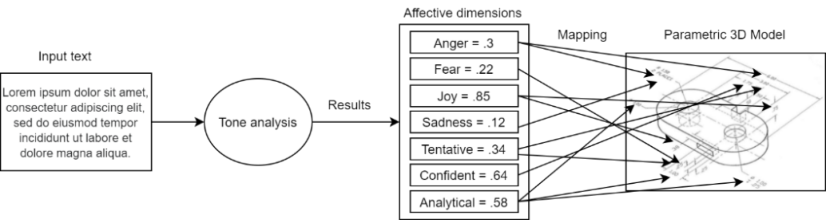
SYSTEM ARCHITECTURE We present a software prototype implemented as a software addon for a CAD system (i.e., SolidWorks) that uses cognitive linguistic analysis to detect emotional and language tones in a particular written text entered as input. Our tool leverages IBM Watson technology (High, 2012), an AI-based cloud service that can be used to infer the tone of an input text based on three categories: emotion (anger, disgust, fear, joy, and sadness), social propensities (openness, conscientiousness, extroversion, agreeableness, and emotional range), and language styles (analytical, confident, and tentative). For the purposes of our computational design tool, we selected only seven dimensions: anger, fear, joy, sadness, analytical, confident, and tentative.
From an implementation standpoint, The IBM Watson service returns a JSON object with the scores (from 0 to 1) of each tone recognized in the input content. The higher the score of a particular tone, the higher the likelihood that that tone is perceived in the utterance. Each
Intelligent Human Systems Integration (IHSI 2022): Integrating People and Intelligent Systems https://openaccess.cms-conferences.org/#/publications/book/978-1-7923-8988-7 individual tone or emotional dimension is then mapped to a particular design element in the 3D model (as defined by the designer) to vary its form. The particular geometry of each design element is controlled by one or more geometric parameters as defined in the CAD model. The architecture of our system is illustrated in Figure 1.
Figure 1. System architecture.
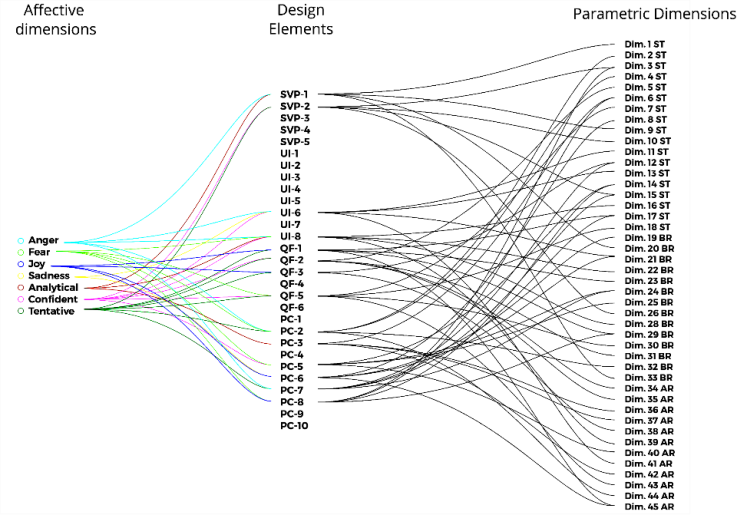
The mapping of the affective dimensions to the geometric parameters in the 3D model must be performed manually by the designer in a two-step process. First, the general design elements of the 3D model must be identified and mapped to the affective dimensions, specifying how each design element is influenced (i.e., they increase or decrease their current values) and to what extent. For example, the general design elements of a chair can be identified as chair frame style, seating surface area, arm rests, and back rest curvature, for example. Next, the specific dimensions of the model that contribute to define the shape of each design element must be mapped to the corresponding design element. In the case of a chair, a design element “back rest curvature,” for example, may be controlled by a set of dimensions and geometric constraints that define its curvature and overall style, etc. A particular dimension may contribute to more than one design element.
A visualization of these mappings is shown in Figure 2. The grouping of parameters into design elements provides an additional level of abstraction that facilitates the remapping of the affective dimensions to create alternative configurations or apply the mappings to new models, if necessary. The user interface for defining the mappings is shown in Figure 3.
Intelligent Human Systems Integration (IHSI 2022): Integrating People and Intelligent Systems https://openaccess.cms-conferences.org/#/publications/book/978-1-7923-8988-7
Figure 2. Visualization of mappings between affective dimensions and design elements and parametric dimensions in the CAD model.Figure 3. User interface for defining the mappings of the affective dimensions to the general design elements. The row labeled “direction” indicates whether the dimensions of a particular design element will increase (+) or decrease (-). The rows “Range Low” and “Range High” are used to define the variability range of a particular mapping. If a particular design element is mapped to more than one affective dimension, a weighted average is applied.
Figure available in the original PDF paper.
Intelligent Human Systems Integration (IHSI 2022): Integrating People and Intelligent Systems https://openaccess.cms-conferences.org/#/publications/book/978-1-7923-8988-7
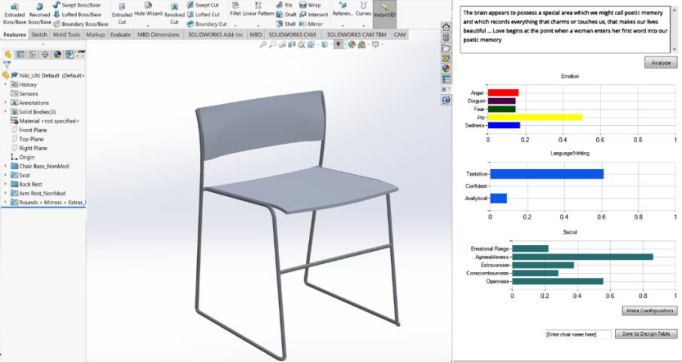
The software UI which is fully integrated in the CAD environment (i.e. SolidWorks) is shown in Figure 4.
Figure 4. Software prototype UI.
RESULTS
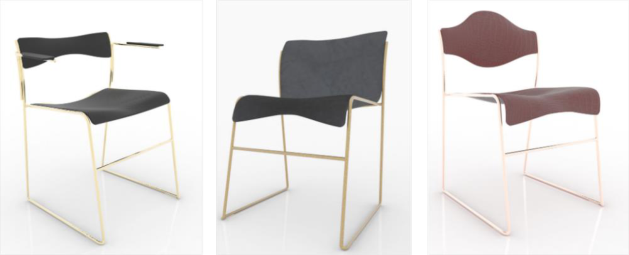
We tested our prototype with a neutral 3D model of a chair (shown in Figure 4) and various diverse texts. The chair was modeled using common CAD quality practices to ensure the flexibility and adaptability of the geometry to subsequent changes (Company et al., 2014). The mapping of the dimensions was performed by the research team. A decision was made to maintain the chair frame static, so the only design elements that are controlled by the affective dimensions are the sitting surface, arm rests, and back rests. Examples of chair models generated by our system are shown in Figure 5.
A B C
Figure 5. Chair models generated by our system: (A) data from LG Microwave user manual; (B) data
Intelligent Human Systems Integration (IHSI 2022): Integrating People and Intelligent Systems https://openaccess.cms-conferences.org/#/publications/book/978-1-7923-8988-7 from Leo Tolstoy’s “The Death of Ivan Ilyich”; and (C) data from Fanta commercial.
CONCLUSIONS
In this paper, we presented a hybrid-centered approach to design that transforms the qualitative nature of tone and emotion in written communication into quantitative design parameters that can be manipulated in a 3D modeling software, thus facilitating more creative conversations between the designer and the computer.
We developed a software prototype to validate our approach and tested it with a representative 3D model and a variety of texts of different styles to illustrate the process. Using our system, we were able to automatically generate design variations through the implicit emotions embedded in natural language. The proposed tool is also useful for quickly modifying existing geometry that must conform to a new style or design language to elicit a new desired emotional response.
Our approach relies heavily on the quality and robustness of the CAD model, specifically on the parametric relationships that define its form. The model needs to be adaptable to changes, ensuring that the geometry can be successfully rebuilt after dimensions are modified. As future work, we are interested in improving or even automating part of the mapping processes. Although manual mappings provide the highest level of control to the designer, they are also time consuming and not always intuitive. An automatic or an AI-based mechanism to configure the mappings could provide additional functionality to the system. The exploration discussed in this paper is a first step toward the evolution of design tools into intuitive artificial cognitive systems that can process abstract ideas and semantic constructs and transform them into concrete geometric forms.
ACKNOWLEDGMENTS
The authors would like to thank Aaron McEuen for the models and renderings used in this paper.
REFERENCES
Collier, G.L. (1996), “Affective synesthesia: Extracting emotion space from simple perceptual stimuli.” Motivation and Emotion, 20(1), 1-32. Company, P., Otey, J., Camba, J., and Contero, M. (2014), “Leveraging Mechanical 3D CAD
Systems Through Improved Model Quality Based on Best Practices and Rubrics.” International Design Engineering Technical Conferences and Computers and Information in Engineering Conference, 46407, p. V007T07A013. American Society of Mechanical Engineers. Dell'Era, C. and Verganti, R. (2007), “Strategies of innovation and imitation of product languages.” Journal of Product Innovation Management, 24(6), 580-599.
Intelligent Human Systems Integration (IHSI 2022): Integrating People and Intelligent Systems https://openaccess.cms-conferences.org/#/publications/book/978-1-7923-8988-7
Demirbilek, O. and Sener, B. (2001), “A design language for products: designing for happiness.” International Conference on Affective Human Factors Design, 19-24. Demirbilek, O. and Sener, B. (2003), “Product design, semantics and emotional response.”
Ergonomics, 46(13-14), 1346-1360. High, R. (2012), “The era of cognitive systems: An inside look at IBM Watson and how it works.” IBM Corporation, Redbooks, 1, 16. Holbrook, M.B. (1985), “Emotion in the consumption experience: Toward a new model of
the human consumer.” In: Peterson, Hoyer and Wilson (Eds), The role of affect in consumer behaviour: Emerging theories and applications. Isbister, K., Höök, K., Laaksolahti, J., and Sharp, M. (2007), “The sensual evaluation instrument: Developing a transcultural self-report measure of affect.” International Journal of Human-Computer Studies, 65(4), 315-328. Karjalainen, T-M. (2003), “Strategic design language–transforming brand identity into
product design elements.” 10th International Product Development Management Conference, 1-16. Brussels. Kohler, W. (1947), “Gestalt psychology.” New York: Liveright. Krippendorff, K., and Butter, R. (1984), “Product semantics: Exploring the symbolic qualities of form.” Innovation, 3(2), 4-9. Melcer, E. and Isbister, K. (2014), “CSEI : The Constructive Sensual Evaluation
Instrument.” In: Workshop on Tactile User Experience Evaluation Methods, CHI 2014. Melcer, E. and Isbister, K. (2016), “Motion, emotion, and form: exploring affective dimensions of shape.” Proceedings of the 2016 CHI Conference Extended Abstracts on Human Factors in Computing Systems, 1430-1437. Mothersill, P. and Bove Jr, V.M. (2015), “The EmotiveModeler: An emotive form design
CAD tool.” 33rd Annual ACM conference extended abstracts on human factors in computing systems, 339-342. Otey, J.M., Contero, M., and Camba, J.D. (2014), “A review of the design intent concept in the context of CAD model quality metrics.” ASEE Annual Conference & Exposition, 24-100. Plutchik, R. (1991), “The emotions.” University Press of America. Poffenberger, A. and Barrows, B. (1924), “The Feeling Value of Lines.” Journal of Applied
Psychology, 8(2), 187. Rojas, J.C., Contero, M., Camba, J.D., Castellanos, M.C., García-González, E., Gil-Macián, S. (2015), “Design perception: combining semantic priming with eye tracking and event-related potential (ERP) techniques to identify salient product visual attributes.” ASME International Mechanical Engineering Congress and Exposition, 57540, V011T14A035. American Society of Mechanical Engineers. Russell, J.A. (1980), “A circumplex model of affect.” Journal of personality and social
psychology, 39.6, 1161-1178. Tenneti, R. and Duffy, A. (2006), “Analysing the emotive effectiveness of rendering styles.”
Design Computing and Cognition’06, 285-304. Springer, Dordrecht. Van Rompay, T. and Ludden, G. (2015), “Types of embodiment in design: The embodied foundations of meaning and affect in product design.” International Journal of Design, 9(1).
Intelligent Human Systems Integration (IHSI 2022): Integrating People and Intelligent Systems https://openaccess.cms-conferences.org/#/publications/book/978-1-7923-8988-7
LISTED IN THE AHFE DIGITAL BOOKSTORE CATALOGUE
Explore the complete digital volume
Intelligent Human Systems Integration (IHSI 2022): Integrating People and Intelligent Systems
Read this individual research paper free through the original publisher, or explore the full digital proceedings book.
ISBN 978-1-7923-8988-7
Explore this ISBN in the AHFE Bookstore ↗Listed in the July 2026 bookstore catalogue; search by ISBN to confirm current availability · Digital book purchase optional