Xinyin Bao, Wen Tao Zhu (2022). Exploring Visual Design Strategies for Gender Diversity Representation through a Design Game Workshop. In: Human Factors in Communication of Design. AHFE Open Access, vol. 49, pp. 153–159. https://doi.org/10.54941/ahfe1002049
Everyday objects are usually visually designed to imply that they belong to men or women. They are, thereby, tools for people to represent their gender identities. However, even though gendered design is a common topic in academic research, the representation of gender diversity remains relatively marginal. This study aims to organize people's life experiences with different gender identities to explore visual design strategies that change the original gender implication of everyday objects, thus representing gender diversity and promoting social inclusion of sexual minorities. To do so, a participatory design game workshop has been created and conducted. Three game characters with diverse gender identities were developed, and design materials that implied gender binary or diversity were provided, such as everyday objects and visual elements. During the workshop, six participants imagined themselves as admirers of the game characters and used the prepared materials to design gifts for them that fit their gender identities. The results of the workshop show that the gender implication of objects can be changed through reorganizing visual elements of color, shape, decoration, and cultural symbols. In addition, cisgender heterosexual participants preferred to represent diverse gender identities through innovative arrangements of gender-stereotypical visual elements, while participants that belong to sexual minorities preferred to adopt personalized design strategies to "de-genderize" everyday objects. This variation may be caused by the tendency of cisgender heterosexual people to confirm their gender identity through gender stereotypes, while sexual minority people escape the binary gender system through individualized representation. Therefore, the study concludes that design process representing gender diversity not only needs critique and innovation, but that de-genderdizing strategies cultivated by sexual minorities from their practices are also essential design resources.
Although everyday objects have no ‘gender’, gender implications are stru- cturally embedded in their design, categorizing objects as ‘masculine’ or ‘feminine’ (Oudshoorn et al., 2002). Oudshoorn et al. concluded that this process is embodied in two main ways: functional gender scripts and visual gender features . There is a range of strategies used in the visual design of pro- ducts to represent binary gender constructions, such as the use of soft, bright
colors for women and strong, dark colors for men (Auster & Mansbach, 2012), or curvy shapes for women and angular shapes for men (Lieven et al., 2015; Pang & Ding, 2021). In metaphorical symbols, naturally-related sym- bols represent women, and culturally-related symbols represent men (César Machado et al., 2021). These visual design strategies repeat binary gen- der construction and continually reinforce gender stereotypes through mass media (Bucchetti & Casnati, 2019). Current design processes seldomly con- sider the needs of people with non-normative gender identities. Therefore, it is challenging for individuals to represent either a social gender that is incon- gruent with their biological sex or a non-heterosexual status. Accordingly, this study explores how to represent gender diversity through visual design in everyday objects.
EXPLORING GENDER DIVERSITY REPRESENTATION THROUGH DESIGN GAMES In order to explore visual design strategies for gender diversity representa- tion, it may not be enough to design for the ‘imagined user’. The experiences and needs of sexual minorities who do not conform to the gender binary construction must be integrated into the design process. Therefore, this study adopts a participatory design approach, using design games to co-design with participants of different gender identities. The design game approach ori- ginates from Habraken and Gross’ (1988) ‘Concept Design Game’, which abstracts architectural design steps into a series of board games with game pieces that allow players to understand design thinking through playing the game. Brandt (2006) classifies existing design games into four types: games to conceptualize designing, games that exchange participants’ perspectives, games that originate from workflows and negotiations, and games that ori- ginate from scenarios. By organizing stakeholders with different interests through game rules, design games can channel the knowledge and abilities of participants toward a shared design goal. In design games such as role-playing and scenario games, the game’s goal is often not to compete but to explore new knowledge through collaboration (Brandt et al., 2008). This study ado- pts a methodology that combines scenario games and role-play games in the co-design workshop.
Methodology
The design game was organized as an online workshop on the collaborative design platform ‘JS Design’1 to enable instant collaboration of the partici- pants. In addition to the researcher as a host, there were six participants in the workshop, three biological males and three biological females. Two participants were cisgender-heterosexual, and four were sexual minorities.
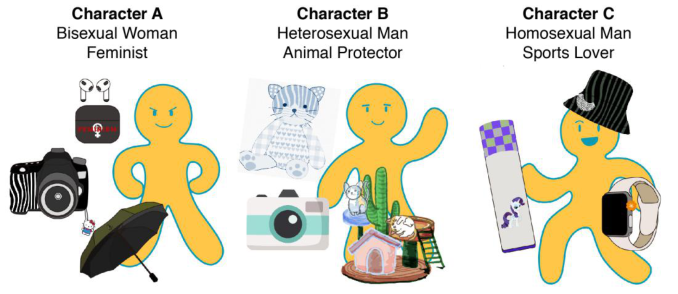
As part of the design game, a scenario of ‘pursuing the game characters by sending gifts’ was introduced, including three game characters who had non-normative gender identities. The participants were asked to imagine themselves as admirers of one of the characters. Furthermore, they were 1https://js.design/workspace
Exploring Visual Design Strategies for Gender Diversity Representation 155
Table 1. Game characters and objects designed by participants (Co-created by researchers and participants, 2021).
Table available in the original PDF paper.
Game Character
Gender Identity
Gifts Original Gender Implication
Designed Gender Implication
A bisexual woman, feminist
blue-tooth earphone neutral masculine camera masculine neutral umbrella feminine neutral B heterosexual man, animal protector
plush toy feminine neutral camera masculine feminine building blocks neutral feminine C homosexual man, sports lover
asked to design gifts that matched the characters’ gender identities to gain their acceptance. Therefore, the game focused on representing diverse gender identities by everyday objects and reduced the interference of other real-life factors.
The six participants, who did not know each other in advance, were sepa- rated into three groups. Each group had different gender identities and at least one group member was a design student. Each group was free to choose one character for whom to design three unconventional objects as gifts. The game provided a pool of 20 objects, divided into traditionally feminine (6 objects), masculine (6 objects), and gender-neutral (8 objects). They had to choose 3 objects from the pool and design them to have a different gender implication by changing color, decoration, shape, and other visual elements. For example, a plush toy must be designed as masculine or gender-neutral rather than feminine. The game provided a pool of patterns, color swatches, and decorations as references to participants. After completing the gift design, participants had to explain the rationale for choosing the objects, the unco- nventional design strategies they adopted, and how the gifts fit the gender identity of their character.
Research Findings In the workshop, all three groups completed the design task and constructed three non-normative gender identity representations through unconventional objects. The results of the game are shown in Table 1 and Figure 1.
Based on the unconventionally gendered objects designed by the partici- pants, the visual design strategies of gender diversity representation were synthesized. Concerning the game characters’ and participants’ gender identi- ties, the differences between the design strategies were summarized according to the different gender identity groups they belong to.
Representing Gender Diversity in Color and Shape Participants used color and shape to determine the overall gender implication of the objects. In order to change the original gender implication, adopting
156 Bao and Zhu
Figure 1: Game results. (Co-created by researchers and participants, 2021).
colors and shapes that suggest the opposite gender turned out to be a very effective method. This strategy was used by both groups of participants for Character A and Character B. To mitigate the femininity of Character A, the participants chose dark colors as the primary color of the three gifts, thus making the gifts more masculine. In contrast, to reflect Character B’s different personalities compared to a traditional heterosexual men, participants used high-brightness colors to enhance femininity in all three gifts. In addition, they changed the shape of the camera for Character B, modifying the initially complex, large, and heavy single lens reflex camera to a simple, small, and portable card camera, with the intention to make the originally masculine camera feminine.
Representing Gender Diversity in Decoration and Symbol After changing the color and shape of the objects, participants added deco- rations and symbols to the objects in order to match the characters’ gender identities. Thereby, they compromised and mixed the objects’ gendered impli- cations and removed them from gender stereotypes. Decoration always plays a role in diminishing masculinity in the gendered design of objects. To make Character A’s camera and Character C’s bucket hat less masculine, participants added decorative shadings to the surfaces of dark-colored obje- cts. Since masculine objects were often associated with high functionality and low decoration, the addition of shadings reduced the masculinity of the dark-colored objects. Similarly, Character C’s toner and sports watch both primarily used a neutral gray color, while adding floral and checke- red embellishments to enhance femininity, hence creating a blurred gender implication.
Both groups of participants working with Character A and Character C adopted cultural symbols to emphasize the characters’ identities. The headphone and umbrella of Character A used the cultural symbols of femi- nism, while the toner of Character C used a cartoon image symbolizing the LGBTQ community. This strategy directly conveys a ‘feminist’ or ‘homo- sexual’ identity and creates a conflicting visual effect with the colors and shapes.
Exploring Visual Design Strategies for Gender Diversity Representation 157
The Typological Design Strategy by Sexual Majorities The two participants of Character A, both cisgender heterosexual, used a typological design strategy in designing the gifts. They gave Character A a distinctly masculine visual representation and then emphasized her gender identity through feminism and feminine cultural symbols. They used a com- bination of gender stereotypes to deconstruct those stereotypes, thus creating multiple conflicts and non-normative gender representations.
The Personalized Design Strategy by Sexual Minorities In contrast to the typological design ideas of the sexual majority partici- pants, the four sexual minority participants adopted a personalized design strategy when designing the gifts for Character B and Character C. In order to represent Character B’s feminine personality traits while maintaining his heterosexual man identity, the participants proposed to print the patterns of homeless animals that Character B had (supposedly) rescued on the sur- face of the plush toys. The original feminine plush toy was completely ‘de-genderized’ by incorporating the character’s personal experiences onto the object. Meanwhile, the participants of Character C explained that they drew on the features of objects derived from their own lives and adopted their preferred design styles when designing the gifts. By emphasizing textu- res, patterns, and decorations, they made the objects unique and thus escaped from being categorized as masculine or feminine.
DISCUSSION
In the workshop, participants used different design strategies, and this diffe- rence which originated from the various approaches they used in perceiving and representing their gender identities.
Sexual majorities tend to adopt such a design strategy because they are less likely to perceive the conflict between gender identity and gender norms in their daily lives, and they lack knowledge of people with non-normative gender identities. When designing the gifts for Character A, the two cisgen- der heterosexual participants found it difficult to relate the character to their life experiences. Consequently, they could only resort to cultural symbols to find the ‘right answer’. In fact, they put Supreme Court Justice Ruth Bader Ginsburg’s icon onto the umbrella without knowing its meaning. From sexual majorities’ perspective, sexual minorities are usually mysterious and symboli- zed, and they tend to construct and confirm their own identity by comparing themselves with gender stereotypes. Therefore, they are more likely to use stereotypical representations in representing gender diversity.
According to the participants’ presentation, the personalized design stra- tegy adopted by sexual minorities stems from their gender representation practices, as they are more constrained by binary gender constructions in their daily lives and tend to rebel against these norms through their everyday objects. Personalized design objects allow them to represent their identities through customization without having to make a difficult choice between two false mainstream identities.
158 Bao and Zhu
The difference in design outcomes resulting from various life experiences implies that the designer’s gender perspective also influences the design out- put in the research and practice of gendered design. Moreover, there are more critical studies of the gender divide in design practice in the research field. Pra- ctitioners tend to employ typological design strategies that swap masculine and feminine design elements to reveal the gender stereotypes rooted in design objects. The critical studies on the gynecological examination chair and hou- sehold appliances by Ehrnberger et al. (Ehrnberger et al., 2017, 2012) are good examples for this. However, these studies employ typological design strategies that could not extend the boundaries of gendered design or create new gender representations beyond the binary gender construction.
While the gendered objects and visual elements provided by the design games in this study are based on the perspective of binary gender con- struction, the individualized design strategies introduced by sexual minority participants are new knowledge from outside this framework that were not anticipated here. Therefore, design research that explores gender diversity should never treat sexual minorities as mere objects waiting to be served. Instead, designers should be aware that people of different gender identities have their own experiences of gender representation practices. These diverse experiences are significant design resources that hold the potential for gender fluidity.
CONCLUSION
This study conducted a design game workshop for six participants with dif- ferent gender identities to design nine unconventional gendered objects and construct three non-normative gender identities. It was found that when representing diverse gender identities through visual design approaches, the overall gender implications of the objects can be changed by altering their colors and shapes. Moreover, decorations and cultural symbols can make compromises and thereby generate hybrid gender implications. Sexual majo- rity participants tend to adopt typological design strategies, while sexual minority participants adopt personalized design strategies. This difference stems from the different life experiences of different gender identity groups. Therefore, designers should not only consider the need for diverse gender representation, but also the life experiences of sexual minority people.
REFERENCES
Auster C J, Mansbach C S. The gender marketing of toys: An analysis of color and type of toy on the Disney store website[J]. Sex roles, 2012, 67(7): 375–388. Brandt, E. (2006, August). Designing exploratory design games: a framework for
participation in participatory design?. In Proceedings of the ninth conference on Participatory design: Expanding boundaries in design-Volume 1 (pp. 57–66). Brandt, E., Messeter, J., & Binder, T. (2008). Formatting design dialogues–games and participation. Co-Design, 4(1), 51–64. Bucchetti, V., & Casnati, F. (2019). The Contribution of Communication Design to
Encourage Gender Equality. In 3rd LeNS World Distributed Conference (Vol. 2, pp. 619–623). Edizioni POLI. design.
Exploring Visual Design Strategies for Gender Diversity Representation 159
César Machado, J., Fonseca, B., & Martins, C. (2021). Brand logo and brand gender: examining the effects of natural logo designs and color on brand gender perceptions and affect. Journal of Brand Management, 28(2), 152–170. Ehrnberger, K., Räsänen, M., Börjesson, E., Hertz, A. C., & Sundbom, C. (2017).
The androchair: Performing gynaecology through the practice of gender critical design. The Design Journal, 20(2), 181–198. Ehrnberger, K., Räsänen, M., & Ilstedt, S. (2012). Visualising Gender Norms in Design: Meet the Mega Hurricane Mixer and the Drill Dolphia. International Journal of design, 6(3). Habraken, N. J., & Gross, M. D. (1988). Concept design games. Design Studies, 9(3),
150–158. Lieven, T., Grohmann, B., Herrmann, A., Landwehr, J. R., & Van Tilburg, M. (2015).
The effect of brand design on brand gender perceptions and brand preference. European Journal of Marketing. Oudshoorn, N., Saetnan, A. R., & Lie, M. (2002, July). On gender and things: Reflections on an exhibition on gendered artifacts. In Women’s Studies International Forum (Vol. 25, No. 4, pp. 471–483). Pergamon. Pang, J., & Ding, Y. (2021). Blending package shape with the gender dimension of
brand image: How and why?. International Journal of Research in Marketing, 38(1), 216–231.
LISTED IN THE AHFE DIGITAL BOOKSTORE CATALOGUE
Explore the complete digital volume
Human Factors in Communication of Design
Read this individual research paper free through the original publisher, or explore the full digital proceedings book.
ISBN 978-1-958651-25-4
Explore this ISBN in the AHFE Bookstore ↗Listed in the July 2026 bookstore catalogue; search by ISBN to confirm current availability · Digital book purchase optional