Elsie Osei, Zoe Wagner, Emma Carr, Michael Antwi, Jackie Fisher, Thomas Lai, Elizabeth Lai, Chenshuo Li, Megan Strickfaden (2026). Hacking as a Co-creation Method for Specialized Soft Product Design. In: Interdisciplinary Practice in Industrial Design. AHFE Open Access, vol. 222, pp. 229–240. https://doi.org/10.54941/ahfe1007762
Traditional clothing design often fails to address the unique needs and desires of people who wear specialized clothing, resulting in garments that they perceive as functional but not personal. The field of adaptive clothing is increasingly recognizing the importance of human-centered design; however, moving beyond a problem-solving paradigm to one that embraces individual identity and creative expression remains a challenge. This chapter proposes and explores ‘hacking’ as a co-creation method to bridge this gap. We present a case study of workshops where individuals with disabilities were guided through a process of fashion hacking and personalizing garments. The workshop structure empowered hackers to act as experts of their own experience, transforming standard clothing into bespoke items that reflect their personal style, cultural identity, and specific functional requirements. Our analysis reveals that the hacking process: (1) democratizes design; (2) generates rich, embodied knowledge about lived experience; (3) produces innovative design concepts; and (4) supports community and skill enhancement. Our workshops demonstrate hacking as an effective co-creation strategy that supports and validates user expertise, fosters agency, and yields design insights that are often overlooked in traditional top-down design approaches. This study contributes to growing discourse on participatory and human-centred approaches in soft product design by prioritizing user-led innovation.
The area of specialized soft product design, particularly adaptive clothing, stands at a critical juncture where the imperative for functional essentials increasingly intersects with the fundamental human need for personal identity and creative expression. Historically, the design of garments for people with disabilities has been dominated by a medical model approach, which frames disability as an individual deficit to be solved through clinical or assistive solutions (Kukiełko, 2024; Watson et al., 2010). This frequently resulted in clothing that prioritizes caregiver convenience and universal functionality, often at the expense of the wearer’s aesthetic preference, cultural identity, and personal dignity. Many users, especially those with varying disabilities,
are often left with garments they perceive as merely functional, clinical, institutional, or infantilizing, rather than as extensions of their personal and social selves. As the fashion industry and studies evolve, there is growing recognition of the importance of human-centered (Jun, 2024) and participatory design methodologies (Maciejko et al., 2025; Scrivener et al., 2000) that actively involve end users in the design process (Benz et al., 2024; Kidd, 2006). However, a significant gap remains between a participatory structure where users are consulted and empowered as lead innovators and executors of design that embodies their lived experience.
This chapter explores how “fashion hacking” (Von Busch, 2008) functions as a useful co-creation method through two hacking workshops conducted with individuals with diverse disabilities. We define hacking not in its colloquial digital sense, but as a critical material practice of reading, interrogating, and creatively modifying the existing fashion system. In this case, mass-produced garments are better aligned with personal needs and narratives (Barry et al., 2023). Hacking is a long-used technique that’s been employed by people with disabilities (Fritsch et al., 2019). This is because the items disabled folks purchase often do not meet their needs or expectations. This conceptualization aligns with broader discourses in design for social innovation, which advocate for a shift from expert design to diffuse design, wherein the innate design capacity of non-experts is leveraged to solve context-specific problems (Manzini, 2015).
The potential of fashion hacking as a democratizing force in design is emphasized by its low barrier to entry. Unlike traditional industrial design or even facilitated co-design workshops that require professional synthesis, hacking operates through accessible, low-tech adaptations, empowering users to alter their material world directly. It is through such practices that marginalized individuals can contest exclusionary design norms and remake their relationships with everyday clothing, affirming what disability studies scholars like Kafai (2021) term the ‘bodymind’ which acknowledges the inseparable integration of mental, emotional, and physical experiences. Barry, Nesbitt, and Strickfaden (2024) frame the bodymind as an important epistemic and material location within their proposed crip methodology for fashion studies. Drawing on ‘cripistemologies,’ they emphasize that knowledge emerges from embodied disabled bodymind experiences, which legitimizes an indispensable foundation of insight.
FROM USER-CENTERED TO USER-LED INNOVATION The evolution of design approaches for specialized soft products mirrors a broader movement toward greater user inclusion in design processes.
Theoretical Foundations of Hacking as a Design Practice It is necessary to move beyond hackings colloquial associations with computer security and situate it within the broader history of material culture and participatory action research. Hacking represents a mode of “reading the world” and “speaking back to it” through the intentional modification and repurposing of existing systems (Germaine & Wake, 2025,
Hacking as a Co-Creation Method for Specialized Soft Product Design 231 p. 3). In the context of soft product design, it serves as what Hamraie (2017, p. 5) positions, “knowing and making or access-knowledge” practice that intervenes in dominant, exclusionary design knowledge to remake material arrangements in ways that affirm the bodymind.
As Germaine and Wake (2025) discuss, hacking is, in general, an anarchic and critical practice that enables participants to interrogate the world and develop frameworks for articulating their own experiences. This method aligns with radical pedagogies like those discussed by Barry et al. (2024) that advocate for the democratization of creation processes and research, where researchers, makers and participants are equal partners in the creation of knowledge aimed at improving their social conditions. Barry et al. demonstrate that fashion hacking is collaborative work among hackers and designers that deconstruct and reassemble garments to support their bodyminds.
Distinguishing Hacking From Industrial Design Paradigms The locus of control and the definition of successful outcomes are what distinguish industrial design from hacking. Industrial design is primarily interested in designing for the masses, emphasizing standardized features and marketability. Duman (2020, p. 139) argues that “hacking behavior is actually at the essence of design.” Designers often examine competitor’s products to hack physical properties and usage towards developing something new. However, fashion hacking takes this further by positioning a person with a disability as the lead innovator. This acknowledges that those who face daily challenges or frustrations have the most substantial incentive to innovate. This shift represents a transition from “expert design” to “diffuse design” in which non-experts leverage their innate design capacity to solve personal problems (Manzini, 2015, p. 37).
The Limits of Traditional and the Expansion of Participatory Design The shift from the medical model toward a social model of disability represents a transformative moment in apparel research. Kukiełko (2024) argues that the social model, popularized in the mid-1990s and increasingly adopted by researchers such as McBee-Black, holds that disability is not an inherent problem of the individual but is created by an environment that fails to accommodate human diversity. In this context, the ‘barrier’ is not the user’s mobility impairment but the buttons, zippers, and restrictive silhouettes that characterize mainstream fashion (Rana et al., 2024, p. 1). Kukiełko (2024) discusses how participatory design has emerged as a significant advancement, actively involving end users in the design of adaptive garments, thus shifting the locus of expertise to individuals with lived experience.
This caregiver-centricity, as noted by Kukiełko, frequently led to designs that were easier for another person to put on the wearer, such as open-back tops, oversized fasteners, or tulip sleeves, but which ultimately enforces dependency (2024). When clothing is designed to be manipulated by someone else like Rana et al. (2024) discusses, it communicates a message of incapacity to the wearer. This infantilization is a recurrent theme in literature
on disability and design for disability (Robey et al., 2006; Venkatesan, 2025). The resulting designs for adults with physical disabilities are clothing that resembles children’s wear or lacks the sophisticated aesthetic markers of professional or social success (Venkatesan, 2025).
The limitations of the medical model catalyzed a shift toward participatory and user-centered designing. These methodologies represents departures from the designer-as-expert hierarchy, moving toward a designer-as-facilitator where user’s experiential knowledge is treated as the primary source of innovation. Kidd’s (2006) study on designing garments for women with special needs revealed that establishing ongoing collaborative partnerships between designers and participants fostered a shared sense of ownership over the design process. Critically, this sustained engagement shifted the designer’s perspective, moving beyond conventional pattern-making and fitting techniques toward more innovative and context-sensitive solutions for garment creation. This supports the pivotal principle of community- based participatory research, where equitable collaboration generates more relevant and sustainable outcomes. According to the Sustainability Directory (2025), participatory design involves a series of iterative phases, including in-depth interviews, design ideation workshops, and feedback sessions that enable participant-led outcomes.
The success of participatory design is exemplified by partnerships between organizations such as Open Style Lab and academic institutions, in which students work alongside people with disabilities to develop fashion systems rather than isolated garments (Schenkman, 2024). The fashion system in this context refers to a whole, sustainable structure for dressing that extends beyond a single finished garment. It involves the entire clothing network for an individual, including complementary items, adaptable modular components, specialized tools for independent donning and doffing, and personalized maintenance strategies.
The fashion hacking workshops reported herein are designed to operationalize the principles of co-creation by positioning disabled folks as experts and innovators. The workshops become a testing group on how a hacking method, centered on low-barrier, hands-on modification, could foster agency, generate embodied knowledge, and produce meaningful innovations. Throughout the rest of this chapter, we examine how team facilitation and fashion hackers’ engagement translated participatory design theory into tangible, user-authored design solutions.
HACKING WORKSHOPS AS CO-CREATION A series of more than a dozen workshops with individuals with diverse disabilities were conducted as part of a broader research project that looked into the intersections of disability, fashion and identity called Cripping Masculinity (Cripping Masculinity, n.d.-a). This research involved enquiries about clothing through wardrobe interviews (Klepp & Bjerck, 2014), exhibitions (e.g., “[RE]MAKING THE UNMADE,” 2025), and a fashion show (e.g., Cripping Masculinity, 2024.-b). The fashion hacking workshops aim to meet disabled hackers where they are, to celebrate their abilities, and to promote skill development in clothing, including sewing, dyeing, and fabric manipulation.
Hacking as a Co-Creation Method for Specialized Soft Product Design 233 Workshop Design and Philosophy
Our workshops are built on the core co-design principle of designing with, not for. Hackers were framed as experts of their own experience. The goal was not to teach them to become professional designers, but to provide them with tools, permission, and support to alter garments to their own specifications. This approach intentionally lowers the barrier to entry, democratizing the act of design itself.
Hackers and the Hacking Process A group of 42 fashion hackers with varied mobility, sensory, and dexterity needs was engaged in two workshops. Many were assisted by supportive carers (paid professionals and friends) and by a team of design students from the Department of Human Ecology at the University of Alberta, who served as the workshop facilitators. The workshop proceeded in three key phases:
a. Contextual Discovery: Beginning with open-ended discussions about personal style, daily routines, and specific frustrations with existing clothing. This established a foundation where embodied knowledge is amplified. b. Hacking Toolkit Introduction: Hackers were introduced to a curated set
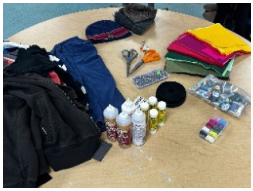
of low-tech, high-impact modification tools and materials that are easy to use, do not require advanced training and are immediately applicable to any garment: magnetic snaps, Velcro tapes, adaptive elastics, easy-grip zipper pulls, fabric shears, and assorted fabrics and clothing for patches and extensions (Figure 1). c. Guided Hacking & Iteration: Working with a base garment (e.g., jeans, button-up shirts, t-shirts), each hacker identified what they wanted to change/add about their garment. Facilitators acted as technical support to execute the hackers ideas. The process was inherently iterative; a hacker could add Velcro, try it on, and then decide to also open a seam for a greater range of motion, mirroring the agile, feedback-driven development seen in successful product innovation.
Figure 1: Samples of low-tech modification tools and materials.
The three phases of the workshops stands in contrast to more common workshop activities such as sketching or idea prioritization, thereby
generating a distinct form of embodied knowledge. According to Strickfaden and Thomas (2022), facilitators must remain aware of their own assumptions to ensure they are truly supporting the user’s vision rather than imposing their own. Our workshops created a space where facilitators and users dissolve together into genuine collaboration.
FOUR TAKE-AWAYS FROM THE FASHION HACKING WORKSHOPS The workshops revealed that hacking as a method generates value across four interconnected dimensions: empowerment, knowledge generation, innovative output, and skill sharing within a community.
Democratizing Design and Fostering Agency The first and most immediate outcome is the democratization of the design process. Providing accessible tools and legitimizing garment modification as a valid design act dismantled the perceived expertise gap between users. Hackers realized they could directly manipulate any garment to suit their needs, without mediation. This fostered a profound sense of agency and empowerment. One hacker remarked while decorating their shorts, “I did not know I was allowed to change how they look.” This aligns with the broader goal of inclusive design to restore independence and dignity, particularly for people with disabilities.
Generating Embodied Knowledge The hacking process served as an intense generator of tacit, embodied knowledge that emerged not through interview responses, but through the act of doing and making. Facilitators observed hackers identifying nuanced needs in real time: the precise grip placement accommodating limited hand strength, the amount of extra fabric required for a seated posture, or the sensory preference for a specific garment finish. This knowledge is often too granular and situated to be communicated verbally in a traditional research interview, but becomes glaringly evident in the context of hands-on alteration. This supports findings from other co-creation projects, where the collaborative making process surfaces unarticulated needs and priorities (Vuohijoki, Ihalainen, & Virkki, 2023; Benz et al., 2024).
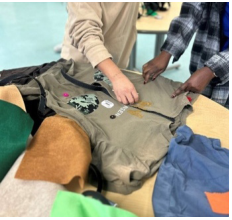
Producing Specialized and Personal Innovations The most tangible takeaway of fashion hacking is the innovative concepts that were both aesthetic and personal. The solutions move beyond adding generic, clinical adaptive features, instead representing a bespoke integration of function, identity, and aesthetic preference. This synthesis is illustrated in Figures 2-4 as hackers transformed standard garments into personalized artifacts. One hacker added a Velcro closure to the shirt front (Figure 2) to create an accessible opening for donning and doffing. However, the aesthetic
Hacking as a Co-Creation Method for Specialized Soft Product Design 235 transformation of the garment’s silhouette also reframed the adaptation as a deliberate design detail.
Figure 2: The process of adding a Velcro closure to a t-shirt.
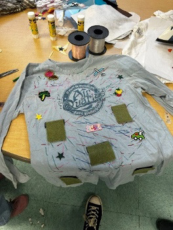
Demonstrating hacking’s capacity to address nuanced, embodied needs, another hacker showed their sense of fun and colour on their garment through the use of fabric pens (Figure 3). They said they loved lots of colours on their clothes, but could not find them on the market in a way they could connect with.
Figure 3: The addition of colourful patterns and patches.
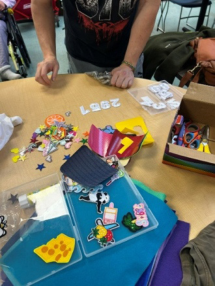
One poignant story exemplifies how hacking can facilitate wearable storytelling and emotional processing. A hacker selected a button-down shirt to modify. The first functional step involved cutting and refolding the shirt’s sleeve to improve its ease of use and fit. The next step was a more reflective act of personalization. The hacker requested that ‘patch numbers’, mimicking those used in correctional facilities, be affixed to the shirt’s front (Figure 4). These numbers corresponded to their brother’s badge number during incarceration. This act transformed the garment from a simple shirt into a tangible artifact of memory, relationship, and resilience. It was no longer just an adapted shirt but a wearable testament to a family’s journey, embodying a complex story of love, struggle, and identity that standard fashion or adaptive clothing could never anticipate.
Figure 4: A hacker using hacking as a form of artifact memory.
These examples demonstrate that hacking facilitates user-authored solutions in which practical necessity and personal meaning are inextricably linked, yielding innovations as individual as the hackers themselves.
Skill Sharing and Community Building Think of a fashion hacking workshop session not as a formal classroom, but more like a lively community workshop or a really good afternoon spent with crafty friends. Everyone comes in with their own unique knowledge, and the magic happens when they start sharing it. There is no expert standing at the front of the room giving a lecture. Instead, people learn by getting involved in the process. When someone is struggling to cut their shirt, the person next to them who just mastered it helps by showing them how it is done. There were instances where individuals with disabilities demonstrated to facilitators a clever way to use a design tool, thereby teaching the designer about adaptation.
As skills and knowledge are exchanged through the hacking processes, so too are personal narratives. The practical act of hacking a garment, of diagnosing clothing problems and collaboratively engineering a solution creates an effective context for vulnerability and trust. Hackers see their own daily frustrations and creative triumphs reflected in others, fostering a profound sense of belonging and mutual understanding. The solitary struggle to find clothing that fit both body and identity became a shared project through laughter, encouragement, and the quiet satisfaction of solving a problem together.
COMPARATIVE SUMMARY Elaborating on the value of fashion hacking, this summary highlights the shift from the traditional medical model to user-led co-creation for creating specialized soft products. Hacking as co-creation represents a fundamental shift in the dynamics among researchers-participants and teachers-makers.
Table 1: Comparative summary for three design paradigms for specialized soft products.
Table available in the original PDF paper.
Aspect Traditional / Medical Model
Participatory Co-Design
Hacking as User-Led Co-Creation
User Role Passive recipient, patient
Active informant, participant, collaborator
Lead expert, innovator, executor, maker, guide, user/expert
Designer Role Problem-solver, expert Facilitator, translator, synthesizer
Technical supporter, tool-provider, ally
User interviews, observed behaviors
Primary Knowledge Source
Embodied experience enacted through material practice
Clinical guidelines, ergonomic studies, based on physical impairments Output Focus Universal functionality, safety, ease of care, co-dependence
Improved functionality integrated with user- stated preferences, dependence and independence
Deeply personalized integration of function, identity, and aesthetics, independence, interdependence
Table 1 shows a progression from a top-down, medical model (users are a passive recipient), to a participatory approach that values user input, to user-led co-creation where disabled individuals become lead experts and makers with designers shifting to roles as allies and technical supporters. The outcome shifts from standardized functionality toward a deeply personalized integration of identity and aesthetics, fostering independence and interdependence within a community.
DISCUSSION AND IMPLICATIONS Hacking workshops demonstrate the value of user-led co-creation extending far beyond the generation of novel product ideas. Its primary contribution is epistemological and methodological.
Validating Embodied Expertise Fashion hacking acknowledges deep, intimate knowledge of individual bodies, daily routines, and social interactions as valuable resources in the design process. This aligns with the concept of engaging people as ‘user/ experts’ (Ringaert, 2001) who provide expertise with the aim of affecting designed things. By working with people to highlight, support and enhance their embodied expertise, this shifts the locus of authority from the designer’s studio to users’ lived experiences, a principle central to effective community- based participatory research.
Bridging the Personal and the Scalable A critical question arising from fashion hacking is scalability. While each hacked garment is a one-of-a-kind artifact, the design principles and insights it embodies are highly scalable. The nuanced understanding of how a closure’s strength interacts with fabric drape and dexterity, or how a seam modification
affects thermal regulation for a seated user, is invaluable information for professional designers and many brands. Hacking workshops can thus function as a dense, rich form of research that highlights users’ needs and expectations that could inform more inclusive mass production.
Implications for Design Practice and Education For the fashion and soft product industry, this research is a call to support, rather than appropriate, user’ innovation. Brands can create open-source adaptation guides, sell modification kits, or host community hacking events. This work argues for design education curricula that teaches how to design for and facilitate for/with others. Emphasis is placed on the necessity of including people with disabilities not just as subjects but also as co-researchers and peer facilitators, as demonstrated in co-design studies such as ours by von Busch, (2009), and Benz et al. (2024).
CONCLUSION
Hacking, reconceptualized as a structured co-creation method, offers a pathway for designing specialized soft products. By lowering technical barriers and centering people’s embodied knowledge, it effectively democratizes the design process. The method moves the study of adaptive fashion beyond a framework of accommodation and toward a future of user-led innovation and personal meaning-making that honors the long-time tradition of hacking within the disability community (Barry et al., 2024).
Hacking does not require technical complexity to be profound. As shown by the hacker who transformed a shirt with a simple sleeve alteration and meaningful numbers, the most powerful innovations often stem from the simplest adaptations that evoke memory, affirm identity, or process emotion. For individuals whose needs and narratives are frequently bypassed and silenced (Venkatesan, 2025), and marginalized by mass production, this act of material reclamation is a form of empowerment. The value lies not in the sophistication of the stitch, but in the agency of the act and the depth of the personal connections it embodies. The resulting innovations are a testament to the creativity and expertise characteristic in the disability community, waiting to be unlocked not by more sophisticated professional design, but by simpler, more accessible tools of creation.
Future research may lie in conducting longitudinal studies of hacking practices, developing more advanced yet accessible modification toolkits, and formalizing frameworks for translating one-off hacks into scalable design insights. Eventually, embracing hacking as co-creation means recognizing that the most inclusive design may not be a perfectly prefabricated garment, but the agency and tools to make any garment one’s own. Fashion hacking is a practice that validates that personal significance can be sewn into what people wear, one simple, intentional modification at a time.
ACKNOWLEDGMENT
We wish to extend our sincere gratitude to the members and staff of Chrysalis, an Alberta Society for People with Disabilities, and the Nina Haggerty Centre for the Arts. Their invaluable partnership, insightful contributions, and enthusiastic participation were foundational to this research. Earlier parts of this work were funded by a Social Sciences and Humanities Research Council of Canada (SSHRC) Insight Grant #435-2019- 1231.
REFERENCES
Barry, B., Nesbitt, P., De Villa, A., McMullin, K., & Dumitra, J. (2023). Re-Making Clothing, Re-Making Worlds: On Crip Fashion Hacking. Social Sciences, 12(9), 500. https://doi.org/10.3390/socsci12090500 Barry, B., Nesbitt, P., & Strickfaden, M. (2024). Multi-sensory methods: Toward a
crip methodology in fashion studies. International Journal of Fashion Studies, 11(1), 81–109. https://doi.org/10.1386/infs_00104_1 Benz, C., Scott-Jeffs, W., McKercher, K. A., Welsh, M., Norman, R., Hendrie, D., Locantro, M., & Robinson, S. (2024). Community-based participatory-research through co-design: Supporting collaboration from all sides of disability. Research Involvement and Engagement, 10(1), 47. https://doi.org/10.1186/s40900-024- 00573-3 Cripping Masculinity. (n.d.-a). Toronto Metropolitan University (TMU). Retrieved
February 14, 2026, from https://www.torontomu.ca/design-technology-lab/ projects/cripping_masculinity/ Cripping Masculinity: Designing Fashion Utopias -. (n.d.-b). Retrieved February 14, 2026, from https://tangledarts.org/whats-on/cripping-masculinity-designing- fashion-utopias/ Duman, S. (2020). Integration of Hacking Mindset and Practice to Industrial Design
Education. 8, 137–149. Fritsch, K., Hamraie, A., Mills, M., & Serlin, D. (2019). Introduction to Special Section on Crip Technoscience. Catalyst: Feminism, Theory, Technoscience, 5(1), 1–10. https://doi.org/10.28968/cftt.v5i1.31998 Germaine, C., & Wake, P. (2025). Curious Games: Game Making, Hacking and
Jamming as Critical Practice. Behavioral Sciences, 15(10), 1415. https://doi. org/10.3390/bs15101415 Hamraie, A. (2017). Building Access: Universal Design and the Politics of Disability.
University of Minnesota Press. https://doi.org/10.5749/j.ctt1pwt79d Jun, G. (2024). Fashion, Disability, and Co-design: A Human-Centered Design Approach (1st ed.). Bloomsbury Publishing Plc. https://doi.org/10.5040 /9781350299573 Kafai, S. (2021). Crip Kinship: The Disability Justice and Art Activism of Sins Invalid.
(1st ed.). Arsenal Pulp Press. Kidd, L. K. (2006). A Case Study: Creating Special Occasion Garments for Young Women with Special Needs. Clothing and Textiles Research Journal, 24(2), 161–172. https://doi.org/10.1177/0887302X0602400209 Klepp, I. G., & Bjerck, M. (2014). A methodological approach to the materiality of
clothing: Wardrobe studies. International Journal of Social Research Methodology, 17(4), 373–386. https://doi.org/10.1080/13645579.2012.737148 Kukiełko, K. (2024). Adaptive Fashion. Clothing as a Tool for the Inclusion of People with Disabilities. Podstawy Edukacji, 17, 119–128. https://doi.org/10.16926/ pe.2024.17.09
Maciejko, M., Iberbuden, A., & Lecuna, A. (2025). Co-creating sustainable fashion: A participatory approach for involving users in the design process. Fashion Highlight, (SI1), 84–93. https://doi.org/10.36253/fh-3124 Manzini, E. (2015). Design, When Everybody Designs: An Introduction to
Design for Social Innovation. The MIT Press. https://doi.org/10.7551/ mitpress/9873.001.0001 Rana, Md. R. I., McBee-Black, K., & Swazan, I. S. (2024). Adaptive apparel for people with disabilities: A systematic literature review and future research agenda. International Journal of Consumer Studies, 48(3), e13057. https://doi. org/10.1111/ijcs.13057 [RE]MAKING THE UNMADE: Cripping Identities Through Disabled Everyday
Clothing. (n.d.). Anne Lambert Clothing and Textiles Collection. Retrieved February 14, 2026, from https://clothingtextiles.ualberta.ca/cripping1/ Robey, K. L., Beckley, L., & Kirschner, M. (2006). Implicit Infantilizing Attitudes About Disability. Journal of Developmental and Physical Disabilities, 18(4), 441– 453. https://doi.org/10.1007/s10882-006-9027-3 S. Venkatesan. (2025). Beyond barriers: A narrative review of disability and fashion.
World Journal of Advanced Research and Reviews, 26(3), 1843–1863. https://doi. org/10.30574/wjarr.2025.26.3.2321 Schenkman, L. (2024, June 3). Adaptive fashion’s inclusivity problem | Fashion Dive.
Fashion Dive. https://www.fashiondive.com/news/adaptive-fashion-inclusivity- problem/717681/ Scrivener, S. A. R., Ball, L. J., & Woodcock, A. (Eds.). (2000). Collaborative Design.
Springer London. https://doi.org/10.1007/978-1-4471-0779-8 Strickfaden, M., & Thomas, J. (2022). Designing in the wild: Problem-solving for specialized apparel and soft products. In Proceedings of the 13th International Conference on Applied Human Factors and Ergonomics (AHFE 2022). https:// doi.org/10.54941/ahfe1002012 Sustainability Directorey. (2025, April 26). Participatory Design Ethics → Term.
Fashion → Sustainability Directory. https://fashion.sustainability directory.com/ term/participatory-design-ethics/ Von Busch, O. (2008). Fashion-able. Hacktivism and engaged fashion design. Von Busch, O. (2009). Engaged Design and the Practice of Fashion Hacking: The Examples of Giana Gonzalez and Dale Sko. Fashion Practice, 1(2), 163–185. https://doi.org/10.2752/175693809X469148 Watson, A. F., Blanco, J., Hunt-Hurst, P., & Medvedev, K. (2010). Caregivers’
Perceptions of Clothing for People with Severe and Profound Intellectual Disabilities. Perceptual and Motor Skills, 110(3), 961–964. https://doi. org/10.2466/pms.110.3.961-964
LISTED IN THE AHFE DIGITAL BOOKSTORE CATALOGUE
Explore the complete digital volume
Interdisciplinary Practice in Industrial Design
Read this individual research paper free through the original publisher, or explore the full digital proceedings book.
ISBN 978-1-964867-98-4
Explore this ISBN in the AHFE Bookstore ↗Listed in the July 2026 bookstore catalogue; search by ISBN to confirm current availability · Digital book purchase optional