Inés Alvarez-Icaza Longoria, Sergio Navarro Tuch, Rogelio Bustamante-Bello, Arturo Molina, Ariel Lopez Aguilar (2022). Responsive and Flexible Systems for the Non-Typical User: A Design Process to Observe the Outliers. In: Design for Inclusion. AHFE Open Access, vol. 45, pp. 15–23. https://doi.org/10.54941/ahfe1001865
The concept “non-typical users” comprises people who experience significant digital gaps that alienate them from the benefits of technology. This issue is commonly experienced as unsatisfying interactions with technological products or devices that show not flexible possibilities as a core feature. Accordingly, this research contemplates including the needs and priorities of the non-typical users as design requirements for technological devices. The outcome of applying these considerations might allow a deeper understanding of the best way for companies and designers to cope with present changes and challenges towards a more sustainable and inclusive future. The findings will assemble a design methodology that considers usability issues, providing alternatives for the design team.
Digital gaps, the differential ability to access data and digital technolo- gies (World Economic Forum, 2021), have been under the spotlight in many fields: economic, technological, educational, and social. Scholars and researchers have discussed its causes and consequences, trying to locate it in time, space, and context. In the last years and even more, since 2020, because of the COVID-19 pandemic, the attention has been drowned to address this issue defined by the UN Deputy Secretary-General, Amina Mohammed, as “the new face of inequality” (UN News, 2020). Several studies show that it correlates with other divisions and inequalities, such as poverty, illiteracy, lack of skills, age, gender, ubiquity, etc.
Governments, companies, education institutions, and civil society have taken several actions and commitments to bridge the digital gap. The Fourth Sustainable Development Goal aims to “ensure inclusive and equitable qua- lity education and promote lifelong learning opportunities for all.” Specifi- cally, Target 4.5 focuses on eliminating disparities in education and ensuring
equal access to vulnerable groups, including persons with disabilities, indi- genous peoples, women, and those who “require particular attention” (The 2030 Agenda for Sustainable Development, 2015). Nonetheless, acknowled- ging the impact that Information and Communication Technologies (ICTs) can have on a person’s life (Vercruysse & Reid, 2018), there are still concrete actions that can be taken to tackle the inequalities caused by lack of indivi- dual skills and digital illiteracy in specific population groups: older adults, people with disabilities, indigenous peoples, and in some parts of the globe, women.
Due to the conditions mentioned earlier, non-typical technology users (Alvarez Icaza et al., 2020) often experience trial-and-error processes to thrive in the technological devices’ usage and interaction. Eventually, this process might lead to a better comprehension of the device, through which a person would receive the benefit of a product or service. However, cru- cial information about the user’s needs is generated during this process, and currently, it gets lost because products and systems do not collect this data. For people who experience a significant digital gap or those who will suffer from it in the following years, this information generated during the process of understanding a technological device might be the answer. This research proposes to use that data to guide a better comprehension of human-device interactions, to be applied when designing Smart, Sensing, and Sustainable Products and Service Systems (S3PSS).
It is expected that the recorded information should lead to design gui- delines for technological device features and capabilities identification. At the same time it will offer alternatives to solve the issue of customizing the system’s response according to the diversity of need and capabilities within the users.
FRAMEWORK The recovered information from a human-device interaction could be a valu- able source for the improvement of Products and Service Systems (PSS) (Wang, 2019) with the capacities of being Smart Sensing and Sustainable (S3) (Miranda, Pérez-Rodríguez, et al., 2017). Usually, this information is dismis- sed or ignored as a non-typical interaction: an outlier. And those interactions are because they might cause a sense of inadequacy or insufficiency in the user. Although, when they occur, some of them will cause a person to quit using the device, some others might ask for help to continue the interaction, and many will abandon the task.
The industrialized era has taken standard production as the shared priority for the last years (Meng, 2017). Therefore, technological devices are desi- gned for a false majority, the typical technology user. Even though for many years, the digital gap appeared to be a problem only in developing countries (Lopez-Sintas et al., 2020), and not affecting “the majority” or a “standard technology user,” it is clear now that is an issue with an impact in an increa- sing number of people and regions. Those who might suffer a digital division due to their location, age, gender, cognitive condition, or even education can be found in developed and developing countries (Adler-Milstein, 2021).
Responsive and Flexible Systems for the Non-Typical User 17
Consequently, public policies are shifting (Visvizi et al., 2018) from a rigid, standardized perspective to one focused on access and integration. Our vision is integrating non-typical technology users in the design considerations and requirements for products and services in the 4.0 industry (Hermann et al., 2016; Ibarra et al., 2018; Nunes et al., 2017; Oztemel & Gursev, 2020; Wang, 2019), to transform the technological production intentions and scopes for a more inclusive approach.
METHOD
Since 2020, a project to design a Smart, Sensing, and Sustainable Product and Service System (S3PSS) have been developed with pre-grade Industrial Design and Engineering students at Tecnologico de Monterrey. A first approach, Project I, looked for a potential solution to provide the senior population in Mexico City with an emotional and physical health monitoring service. The exercise focused on a sample of 35 adults from 64 to 87 years old, distribu- ted in 13 Mexican cities. The monitoring took place from April to June 2020, using a recording with instructions and questions about their health condi- tion, simulating an automated system. The objective was to determine if the information generated could better understand human-device interactions when designing S3PSS.
The findings from that project were the antecedents for the following deve- lopments. They showed three main pathways for the work to follow in the subsequent stages: a) Non-typical users are exist in both sides of the service, the provider and the customer; b) the system’s self-adaptable features of a service should emerge on demand, without confusing the user; and c) Recor- ding data from the users’ interactions and behavior can be transformed into design guidelines for the next design iteration.
The next research stages follow the structure of a multi-case instrumen- tal study (Stake, 2006) as a qualitative methodological approach. Following Stake’s definition (1996) a case study has a context and specific limits. This document presents three projects presented as a multi-case study in the higher education context. Each case is a group of students in pre-grade programs in Industrial Design or Engineering programs at Tecnologico de Monterrey. The students are guided with a design brief to design an interactive technological device. The findings from every case are used in the next one to refine the design process in the search of a better way to produce the desired results: A Smart, Sensing and Sustainable interactive device that is designed to offer a service for older citizens. The device should allow the user to gain abilities and skills through the mediation (Boy, 2019) of what the user can offer and what the device requests to perform efficiently. In that sense, the device should also offer autonomy and supervision, which should appear as adjustments and behaviors recording when the interactions take place.
In 2021 as Project II (performed from February to June), four propo- sals were crafted by interdisciplinary teams of pre-grade Industrial Design and Engineering students (Alvarez-Icaza et al., 2021). They were asked to design interactive devices that should provide a service in urban pharmacy stores, to collect the health records of urban Mexican older adults. For the
design methodology, students were requested to choose a method from two specific resources: Vijay Kumar’s “101 Design Methods” (2012) and Hugh Dubberly’s “How do you Design” (2005), to avoid inducing the students in a specific approach for the design problem-solving. At the same time, we wanted to ensure the application of validated methods as a framework for the Project. The proposed outcome was obtaining information about the available design methodologies to corroborate the need to approach the design guidelines for self-adaptable S3PSS for non-typical users. As a trans- disciplinary study, this challenge contributes to determining the design and integration of product feature elements as a flexible-technology-integration proposal (Boy, 2019).
After the interdisciplinary group project was accomplished, we decided to test the depth and differences in the results when the problem was presen- ted to a group of merely engineering students. The Project III development allowed us to test the methodologies and tools applied during a standard Mechatronic Design pre-grade course and compare it to the S3PSS previous proposals (from Project II). The students received the same design brief as the interdisciplinary teams for implementation as a starting point.
The student proceeded with the first phase from the briefing: understan- ding the user. The indication was to research their clients’ conditions, context, and abilities to identify key terms. Complex Thinking competencies are substantial in this process due to the need to analyse and comprehend the overlapped layers of information. Students must integrate the collected data from reality and a broad vision of the observed phenomenon to understand their decision implications. The competency of complex thinking comprises various thinking skills that provide the person with tools to address these types of situations with an integrated and holistic approach (Vázquez-Parra, et al., 2022).
The next phase was identifying the user needs comparing existing soluti- ons to determine the relevance ratings for each requirement; to achieve this, the students used the Quality Function Deployment (QFD) tool (Chan & Wu, 2002; Moubachir & Bouami, 2015). The needs’ importance ranking led to another research step: finding the alternatives to cover the requirements, using tools such as brainstorming, analog products analysis, Design Thin- king approaches (Brown, 2009; Leinonen, T. and Durall, 2014), and TRIZ analysis (Ekmekci & Nebati, 2019). With the information from the previ- ous exploration, the students built a matrix of options used in the following phase as the Relation and Solutions Matrix to assemble and evaluate the compatibility of the multiple alternative solutions.
Once the solutions were assembled, the teams generated an initial sketch which the clients evaluated. The clients’ feedback was discussed to determine the possible alternatives from the Relations Matrix to add or substitute. The students used these modifications to generate the final provide. This third iteration, developed in six proposals focused on software or hardware solu- tions, allowed us to reach findings of the tools and methods combination to generate more inclusive and self-adaptable interphases designed for older adults.
Responsive and Flexible Systems for the Non-Typical User 19
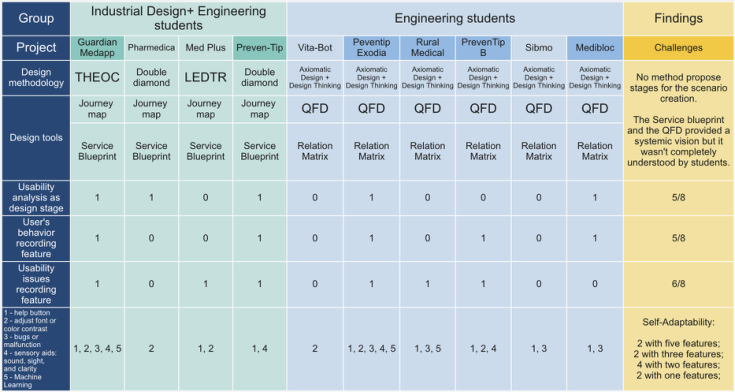
Figure 1: Features and capabilities obtained in Projects II and III.
FINDINGS Projects II and III provided information about the design process and the difficulties observed in the student’s proposal. The outcomes were analyzed based on the used methodology and tools and the product’s features and characteristics. Every solution attended a potential non-typical user as the primary requirement. From the analysis, it was clear that the possibility of obtaining the desired spectrum of features was not achievable for every work- group. Figure 1 shows the six projects (highlighted in the chart) that were able to respond with a solution, including a Usability Analysis as a design stage; a feature that would record both the user’s behavior and the device’s answer; and a Self-adaptability feature in any of the five possibilities: 1-help button; 2-adjust font or color contrast; 3-bugs or malfunction; 4-sensory aids: sound, sight, clarity; and 5-Machine Learning capabilities.
From the presented qualitative analysis and the Project’s description, it was found that students struggled to visualize scenarios where older adults wouldn’t find their way for the device operation. Some tools such as the Service Blueprint and the QFD allowed better systemic visualization, but it wasn’t the case for every proposal. The students constantly related the pro- duct’s potential to their own experience and the capabilities people they know have. It was observed that it was necessary to use a moment to prefigure the self-adaptability opportunities and use it for the data recording. Without these pieces of information, it wouldn’t be possible for them to include the correspondent features in their proposals.
We have profiled five design stages to be applied in a subsequent iteration with a new group of engineering students to cover that breach. Project IV will pursue the outcomes described in Table 1, to be determined by the students during the design process. It is expected for the proposals to keep the capa- bilities of responding autonomously, recording information about the user, and promoting a sustainable functionality, reducing energy waste (Miranda,
Table 1. The proposed design process and stages for Project IV.
Table available in the original PDF paper.
Stage Desired outcome Usability analysis Users’ and Stakeholders’ profile, needs, and capabilities Analogue’s comparison Available technology and its applications Brief definition Features and requirements identification Data recovering portrayal User’s behavior recording feature Flexible integration The device’s interphase’s adaptable or self-adaptable
Pérez, et al., 2017). At the same time, it must develop a level of mediation between the user’s capabilities and the device’s features, allowing the system to understand and respond to those capabilities (Camara Dit Pinto et al., 2021). The initial brief will remain the same used in previous iterations. It will be observed if the students are able to reach the desired design configuration of the interactive device. Its main purpose will be kept the same: to provide a health record service in urban pharmacy stores for Mexican older adults. This data should be secured by an agency providing privacy and secrecy rights of users while assembling an up-to-date database for the policy and decision- making in the country. It is expected from students to follow the proposed design process with the five stages and the proposals will be evaluated using the tool showed in Figure 1. The outcome will confirm, or not, if by following those generic stages the desired configuration is reached. If not, there will be an opportunity to generate tools and eventually a method to include these considerations in an innovative design process for S3PSS.
In either case, students will build complex thinking competency through the process. By offering them visualization tools and resources, they are expe- cted to observe the overlapped layers of data represented by the variety of users’ behaviours and the matching devices’ functionalities and features.
CONCLUSION
We anticipate that when applying the design tools and stages mentioned in the previous section, it would be possible to shape a framework for the flexible and inclusive features and characteristics of S3PSS. Applying this fra- mework should assist students from engineering and industrial design fields identify critical components towards responsive and flexible systems for the non-typical user. So far, results have demonstrated that the focus of the available methods, processes and tools are not sufficient to design for the outliers, because they belong to a standardized perspective that serves mas- sive productions and neglects diversity. These affirmations have no intention of declaring that we should get rid of the methods we have been using for more than a century. However, there might be a different, maybe better, way to approach diversity and to serve the individuals that have been falling on the undesirable side of the digital gap.
Project IV results will be the third iteration in the search for a design methodology configuration that pursues to promote better and more flexi- ble results in the design of the technological devices. The effective interactions
Responsive and Flexible Systems for the Non-Typical User 21
between non-typical users and devices are expected to be beneficial for those who have experienced digital gaps, resulting in capabilities and trust in the advantages technology can bring to peoples’ livelihoods. In this sense, this research contribution is offering alternative design processes for the design practice. For many years, we have been facing adequacy as an inconvenient and a liability for companies’ production, this research proposes to find a different approach to bridge the digital gap without affecting efficiency and increasing capabilities among the marginalized citizens. We aim to provide a valuable resource to cope with present changes and challenges towards a more sustainable and inclusive future.
The limitations of the research are due to the application scope. As the Project takes place in an educational environment, every result lies in the abstract conceptual universe and have not been tested in a real environment with real users. However, the findings and procedures showed that participa- ting volunteers in Project I and II offered close-to-reality results and valuable hints to continue the research on a thorough track.
For future work, the Project IV findings will be tested in different context closest to industry and with experienced design practitioners. Therefore, the next step will be assembling a toolkit, including the presented stages, as an open resource and ask for professionals in the design field to apply it and offer feedback. At the same time, we wish to propose a digital tool that will faci- litate the decision making through the design process. Comparing the results and observing the outcomes it is needed to understand how the behavior and perceptions are changing among non-typical users through time.
ACKNOWLEDGMENT
The authors wish to acknowledge the financial and technical support of Writing Lab, Tecnologico de Monterrey, Mexico, in the production of this work.
REFERENCES
Adler-Milstein, J. (2021). From Digitization to Digital Transformation: Policy Priorities for Closing the Gap. In JAMA - Journal of the American Medical Association (Vol. 325, Issue 8). https://doi.org/10.1001/jama.2020.27014 Alvarez Icaza, I., Molina, A., & Bustamante-Bello, R. (2020). Connected Plat-
forms for the Non-typical User: Design Methodology to Observe the Outliers. https://doi.org/10.17706/ijcce.2020.9.3. 122–133 Alvarez-Icaza Longoria, I., Molina, A., & Bustamante-Bello, R. (2021). Smart and Connected Systems for the Non-typical User: Design Methodology to Observe the Outliers. In Lecture Notes in Networks and Systems (Vol. 260). Springer International Publishing. https://doi.org/10.1007/978-3-030-80829-7_31 Boy, G.A. (2019) From rigid to flexible – From virtual to tangible an evolution of
human-centered design, 824 Advances in Intelligent Systems and Computing 54. https://doi.org/10.1007/978-3-319-96071-5_6 Brown, T. (2009). Change by design: how design thinking transforms organizations and inspires innovation / (IDEO, Ed.). Harper Business.
Camara Dit Pinto, S., Masson, D., Villeneuve, E., Boy, G., & Urfels, L. (2021).
From Requirements to Prototyping: Application of Human-System Integration Methodology to Digital Twin Design. Proceedings of the Design Society, 1. https: //doi.org/10.1017/pds.2021.423 Chan, L. K., & Wu, M. L. (2002). Quality function deployment: A literature review. European Journal of Operational Research, 143(3). https://doi.org/10. 1016/S0377-2217(02)00178-9 Dubberly, H. (2005). How do you design? A compendium of models (Dubberly
Design Office, Ed.). http://www.dubberly.com/articles/how-do-you-design.html Ekmekci, I., & Nebati, E. E. (2019). Triz Methodology and Applications. Procedia Computer Science, 158. https://doi.org/10.1016/j.procs.2019.09.056 Hermann, M., Pentek, T., & Otto, B. (2016). Design principles for industrie 4.0
scenarios. Proceedings of the Annual Hawaii International Conference on System Sciences, 2016-March, 3928–3937. https://doi.org/10.1109/HICSS.2016.488 Ibarra, D., Ganzarain, J., & Igartua, J. I. (2018). Business model innovation through Industry 4.0: A review. Procedia Manufacturing, 22, 4–10. https://doi.org/10. 1016/j.promfg.2018.03.002 Johnson, K. E., & Stake, R. E. (1996). The Art of Case Study Research. The Modern
Language Journal, 80(4). https://doi.org/10.2307/329758 Kumar, V. (2012). 101 Design Methods: A Structured Approach for Driving Innovation in Your Organization. Wiley. http://0-search.ebscohost.com.millenium.itesm .mx/login.aspx?direct=true&db=nlebk&AN=481805&site=eds-live Leinonen, T. and Durall, E. (2014). Design Thinking and Collaborative Learning
/ Pensamiento de diseño y aprendizaje colaborativo. Comunicar, 21(42). https: //doi.org/10.3916/C42-2014-10 Lopez-Sintas, J., Lamberti, G., & Sukphan, J. (2020). The social structuring of the digital gap in a developing country. The impact of computer and internet access opportunities on internet use in Thailand. Technology in Society, 63. https://doi. org/10.1016/j.techsoc.2020.101433 Meng, G. (2017). Nonstandardization Based on Standardization. https://doi.org/10.
2991/aece-16.2017.19 Miranda, J., Pérez, R., Borja, V., Wright, P., & Molina, A. (2017). Sensing, smart and sustainable product development (S 3 product) reference framework. Internatio- nal Journal of Production Research, 57, 1–22. https://doi.org/10.1080/00207543. 2017.1401237 Miranda, J., Pérez-Rodríguez, R., Borja, V., Wright, P. K., & Molina, A. (2017).
Integrated Product, Process and Manufacturing System Development Reference Model to develop Cyber-Physical Production Systems - The Sensing, Smart and Sustainable Microfactory Case Study. IFAC-PapersOnLine, 50(1), 13065–13071. https://doi.org/https://doi.org/10.1016/j.ifacol.2017.08.2006 Moubachir, Y., & Bouami, D. (2015). A new approach for the transition between QFD phases. Procedia CIRP, 26. https://doi.org/10.1016/j.procir.2014.07.172 Nunes, M. L., Pereira, A. C., & Alves, A. C. (2017). Smart products development
approaches for Industry 4.0. Procedia Manufacturing, 13, 1215–1222. https://do i.org/10.1016/j.promfg.2017.09.035 Oztemel, E., & Gursev, S. (2020). Literature review of Industry 4.0 and related technologies. Journal of Intelligent Manufacturing, 31(1), 127–182. https: //doi.org/10.1007/s10845-018-1433-8 Stake, R. E. (2006). Multipe Case Study Analysis. In Computational Methods and
Function Theory (Vol. 14, Issues 2–3).
Responsive and Flexible Systems for the Non-Typical User 23
The 2030 Agenda for Sustainable Development. (2015). Sustainable Development Goal 4 (SDG 4). La Asamblea General Adopta La Agenda 2030 Para El Desarrollo Sostenible. https://sdg4education2030.org/the-goal UN News. (2020). Global perspective Human stories. https://news.un.org/en/story
/2021/04/1090712 Vázquez-Parra, J. C., Castillo-Martínez, I. M., Ramírez-Montoya, M. S., Millán, A., (2022). Development of the Perception of Achievement of Complex Thin- king: A Disciplinary Approach in a Latin American Student Population. Education Sciences 12, 289. doi: 10.3390/educsci12050289 Vercruysse, J., & Reid, F. (2018). World Economic Forum. The Fourth Industrial Revolution Can Close the Digital Divide. This Is How. https://www.weforum.org/agenda/2018/09/how-do-we-close-the-digital-divi de-in-the-fourth-industrial-revolution/ Visvizi, A., Lytras, M. D., Damiani, E., & Mathkour, H. (2018). Policy making for
smart cities: innovation and social inclusive economic growth for sustainability. Journal of Science and Technology Policy Management, 9(2). https://doi.org/10. 1108/jstpm-07-2018-079 Wang, Y. (2019). Development and Implementation of Intelligent Mathematics Teaching System Based on Individualized Learning Model. Proceedings - 2019 International Conference on Intelligent Transportation, Big Data and Smart City, ICITBS 2019, 417–420. https://doi.org/10.1109/ICITBS.2019.00109 World Economic Forum. (2021). Error 404: Barriers to Digital Inclusivity. Reports. http://reports.weforum.org/global-risks-report-2021/error-404-barriers -to-digital-inclusivity/
LISTED IN THE AHFE DIGITAL BOOKSTORE CATALOGUE
Explore the complete digital volume
Design for Inclusion
Read this individual research paper free through the original publisher, or explore the full digital proceedings book.
ISBN 978-1-958651-21-6
Explore this ISBN in the AHFE Bookstore ↗Listed in the July 2026 bookstore catalogue; search by ISBN to confirm current availability · Digital book purchase optional