Daniel Isaac Ruiz Cruz, Sergio Navarro Tuch, Ariel Lopez Aguilar, Rogelio Bustamante-Bello, Lili Marlene Camacho Bustamante (2023). Humanitude: first step towards the creation of a voice-bot companion for persons with dementia. In: Health Informatics and Biomedical Engineering Applications. AHFE Open Access, vol. 78, pp. 131–141. https://doi.org/10.54941/ahfe1003464
During the last decade, the life span of the world has been incremented year by year, which comes with a higher probability of suffering from an illness related to aging. An example of this is dementia or Alzheimer’s disease, which causes a progressive decline in various cognitive functions. The costs of living with these types of diseases can destroy a family’s economy if there is no early treatment and detection. This article will aim to develop a protocol to obtain data from interviewing people with cognitive-related questions. This data will form a training corpus to help the development of a neural network that can give a dementia pre-diagnosis. Subsequently, the neural network can be used to program an adaptative companion voice-bot for people with dementia. This will focus on the conversation pillar of Humanitude, a care methodology that can be applied to persons with dementia. The development of this protocol would lead to the creation of one of the few Spanish-based training corpus available for detecting dementia. It is an important step toward developing new tools that can make an early pre-diagnosis or serve as an alternative caregiving solution for people with this condition. Furthermore, this project can lead to the creation of different research whose solutions use Spanish as its main language.
During the last decade, the human life expectancy of the world has been incremented year by year, leading to a tendency that may never appear to cease as people get to live longer lives (Oeppen J, 2002). At this rate, people born in the 2000s in developed countries will have higher chances to live up to their 100th birthday (Christensen et al., 2009). Nonetheless, is inevitable to develop some type of disease that needs a long and expensive treatment, like diabetes, hypertension, or psychiatric illnesses (Katz, 1992). This may lead to an unseen scenario where a country will be in the necessity to invest a high portion of its national budget in public health, due to most of its population may be older than 65 years with some kind of illness or disease to be treated (Prince et al., 2015).
Many chronic diseases and illnesses deteriorate the elderly quality of life, making longevity almost a malediction and the cause of increasing the cost of living. An example of this is dementia or Alzheimer’s disease (AD), which causes a progressive decline in various cognitive functions such as memory, language attention, or problem-solving, among others (Subramanyam Ralla- bandi and Seetharaman, 2023). The costs of this illness can represent a year’s global expense by up to $604 billion US dollars (Wimo et al., 2013). It repre- sents a big burden to the economies of entire families and countries (‘2020 Alzheimer’s disease facts and figures’, 2020), but an early diagnosis of this type of illness can delay the degenerative process and reduce the treatment costs (Association, 2018).
PROJECT BACKGROUND It is important to understand the different characteristics of linguistics in pati- ents with dementia, before analyzing the development of a technological tool that gives an early diagnosis. One type of solution is the development of a voice bot that can make a pre-diagnosis of a patient with dementia. It is needed to take into consideration the language, colloquialisms, and cultural background to correctly fulfill the task (Liang et al., 2022). Although, it is also vital to take into consideration how it is traditionally diagnosed using speaking tests. This will create a reference on which the effectiveness of the algorithm will be measured, and a good starting point to base its training.
Starting with the detection and recognition of dementia, there is no spe- cific test to successfully diagnose a patient’s cognitive state (Ames, 2020). Different types of linguistic tests have been proven to give the doctor a good reference by how the persons express themselves, given the fact that, “lan- guage and memory functions are closely related since linguistic functioning requires memory functions” (Szatloczki et al., 2015). The diversity of the applied tests creates a richer panorama to match the person’s symptoms to his or her current stage \cite{b15}. For this reason, artificial intelligence algo- rithms will only be used as another diagnosis tool, that may help doctors improve the detection process.
In the interest of preventing and giving a premature diagnosis, diverse types of tools have been used, not only for the detection of dementia but also for other medical reasons. Voice-bots and chat-bots are the type of technology that has the versatility to be focused on multiple medical tasks (Cleres et al., 2021; Daniel and Cabot, 2021; Caldarini, Jaf and McGarry, 2022). For example, during the covid-19 pandemic, various voice- bots were developed to function as a companion for people with anxiety (Mieleszczenko-Kowszewicz et al., 2022). Also, the use of chat-bots as a first interaction for medical consultation has proven to give good results despite being in its early stages (Bérubé et al., 2021). Finally, virtual assistants, like Amazon Alexa or Google Home, have become great companions for elderly people with dementia (Zubatiy et al., 2021). By using the commands, the individuals use their cognitive language part of the brain, resulting in a good therapy to slow down the degenerative process (Zubatiy et al., 2021).
Humanitude: First Step Towards the Creation of a Voice-Bot Companion 133
STATE OF THE ART When focusing on analyzing the way people with dementia speak, it is impor- tant to remember that linguistics has several areas of study, like phonology, semantics, naming, syntax, and narrative discourse (Reilly, Troche and Gros- sman, 2011). By taking into consideration all the areas mentioned before, only multi-layer neural networks are capable of analyzing all of them with efficiency (Daniel and Cabot, 2021). Analyzing linguistics (Reilly, Troche and Grossman, 2011) and acoustics (Pappagari et al., 2021) together, the accuracy of the pre-diagnosis can be maximized (Luz et al., 2021). Hence, well- managed training data is vital for the development of a trustworthy neural network (Tran, Ahamed Khan and Sridevi, 2020). Fortunately, “Dementia- Bank” contains hundreds of audio recordings and transcripts, intended to be a starting point to train dementia’s neural networks (Wahlforss and Jonasson, 2020). Additionally, English Pitt Corpus is a commonly used data set of tran- scripts and audio files, which standards for data recollection are still used (Balagopalan et al., 2020). It compiled the information of a diverse group of participants who were tested in three areas: Cookie, fluency, and recall (Corey-Bloom and Rafii, 2017). The cookie test, also known as the Cookie Theft picture, measures the diverse vocabulary and time taken by the indivi- dual to describe a photo in detail (Appointments et al., 2011); the fluency test consisted of measuring the ability of the subject to relate words to specific themes or uses (Stegmann et al., 2022); and finally, the recall test consisted of telling a small story or sentence to the person, to see how many portions or details of the story he or she can remember (Liu, Yuan and Tang, 2022). All three tests gave enough verbal information to correctly identify dementia based on the results. The AI algorithm can be trained whether is voice or text recognition since the data set contains both scripts and audio files.
Though this type of intelligent algorithm exists, the programmatic and correct training to fulfill the goal of giving a pre-diagnosis of dementia is a challenging task \cite{b51}. Knowledge about linguistics, locally used words, grammar patterns, and cultural backgrounds, along with others, are funda- mental to correctly develop such algorithm (Liang et al., 2022). Currently, there are various projects focused on this matter, which confirms the feasibi- lity of the development and research in pre-diagnosis algorithms. Because of this tendency, the focus of this report will be to explore the feasibility of crea- ting a Spanish-based language algorithm for the detection and pre-diagnosis of the different stages of dementia.
TOOLS AND TECHNOLOGIES IMPLEMENTED The existing technologies that were used in this project are an external microphone, Microsoft Azure, Audacity Software for Windows 10 operating system, and Dementia Bank Database. These technologies are essential to the correct implementation of the methodology created, and the success of the protocol. In the case of the Dementia Bank Database, it will be used to store and share the audio and transcripts collected by the protocol implementation.
Meanwhile, the purpose of the other technologies mentioned before will be described further in the report.
Regarding the tools implemented, the most important one is the protocol developed and described in this report, but the bank of questions for the inte- rviews and the transcript format guidelines provided by Dementia Bank were also used. Firstly, Computerized Language Analysis (CLAN) was the protocol implemented to correctly format the transcripts collected in the interviews. This will help to easily study and analyze conversational interactions, langu- age learning, or language disorders in dementia (MacWhinney, 2017). On the other hand, the bank of questions and the protocol itself will be thoroughly described in the next section of the report.
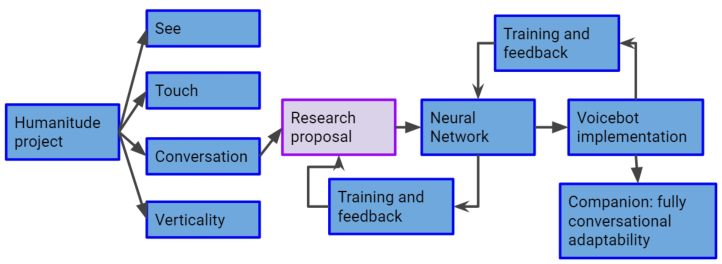
DEVELOPMENT In synthesis, the proposal will aim to develop a protocol to obtain data from interviewing people with cognitive-related questions. The protocol will ensure that the audio and transcripts will be relevant and carefully treated. The data will form a training corpus with the aim of helping the development of a neural network that can give dementia pre-diagnosis. This will be the first step towards the creation of a voicebot that can function as a companion for people with dementia. Furthermore, taking into consideration the humani- tude care methodology, this voicebot will be part of the conversational pillar, by talking with a person with dementia while the same bot is adapting to the level of conversation. Nevertheless, due to time limitations, this study will only focus on the first step of the whole development process (Figure 1).
RESEARCH PROPOSAL DESCRIPTION What this research is looking for is the creation of a vast corpus with clean data, that can be used to train deep learning algorithms. The algorithms will be able to make a pre-diagnosis of dementia using Spa- nish as its main language. This will represent the creation of the first Spanish-speaking corpus, for training, within “Dementia Bank”. The cor- pus will aim to stipulate the training bases as the Pitt corpus has done for the English speakers community. There are currently only two corpora
Figure 1: Humanitude project diagram.
Humanitude: First Step Towards the Creation of a Voice-Bot Companion 135
in Spanish published on “Dementia Bank”, however, their data cannot be used nor can help the training of a neural network due to its own nature.
In addition, although the creation of the corpus is the main objective, in the long term, the creation of a voice companion who can adapt his conversation depending on the state of dementia of the person with whom he speaks would be sought, which is the ultimate goal. This would make patients feel accom- panied and constantly force their brains to work, which could slow down its degenerative process.
RESEARCH PROPOSAL PROCEDURE
1) Target population: As the Pitt corpus, the target population will be per- sons between the ages of 60 to 75 years old. Given the fact that the first visible symptoms are seen around this age (Abbott, 2011), is easier to find volunteers that match the necessities of the project. The necessities and requirements for the participants’ selection process will be discus- sed in this section. Nevertheless, as our ultimate goal is the creation of a companion voice-bot, the final user will be elderly people older than 60 years. For this reason, the data collected will need to be representa- tive of the final user population to correctly train the algorithms. The number of persons needed will be 400 people between 60 and 75 years old, divided by: 200 dementia-diagnosed persons, 150 cognitively heal- thy people, and 50 persons with an inconclusive dementia diagnosis. This number was selected because it is needed to have a huge amount of distinct data to train a neural network (Dudek-Dyduch, Tadeusiewicz and Horzyk, 2009). Also, with this amount of data, is easier to edit it to make more versions of it by changing the tone, rhythm, volume, etc (Kavzoglu, 2009). 2) Implemented tools: Now, talking about the tools that will be used to collect and build the corpus, the resources required are going to be as simple as a computer, a microphone, and a Microsoft Azure Account. It is also important to mention that the protocol (Annex A) will be the most important and main tool to be used. Regarding the computer, a laptop with a windows operating system will be enough to save and record the audio obtained from the interviews. By taking into conside- ration another audio-related corpus (Gaugler et al., 2016), the minimum requirement from the microphone will be an analog to digital conver- ter of 24 bits and 48 kHz (Singh and Pati, 2018). These specifications will lead to a clear voice recording and an easier way to process or edit the audio if necessary (Sahidullah et al., 2016) with the help of “Auda- city” (Open source software). Finally, the Microsoft Azure account will be used to convert the audio to text using the “Azure: speech-to-text” service. It is important to establish that this service is not free and the costs will depend on the amount of use. 3) Data recollection method: Firstly, in order for a person to be con- sidered to participate in the study, they need to fulfill the following requirements:
a) Cognitive healthy group: Any gender, age between 60 and 75 years, consent contract signed, and more than 24 points in the Mini-Mental State Examination (MMSE), previously applied by an expert (De Beaman et al., 2004). b) Dementia-diagnosed group: Any gender, age between 60 and 75 years, consent contract signed, either by them, a legal guardian, or a relative, and dementia diagnosis report signed by a medical specialized professional.
c) Inconclusive dementia diagnosis: Any gender, Age between 60 and 75 years, consent contract signed, and less than 23 points in the Mini-Mental State Examination (MMSE), previously applied by an expert (De Beaman et al., 2004).
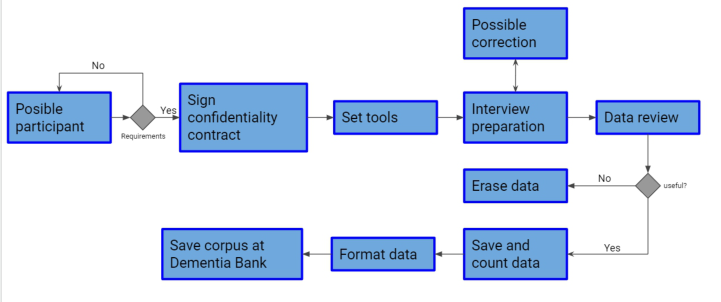
Once the volunteer requirements are reviewed and approved, they will be informed about the purpose of the interview and will be asked to sign the informed consent. Subsequently, a room or a closed place will be adapted to be able to carry out the interview, by locating a table with chairs for all the participants and preparing the recording and computing instruments. Once the room and the instrumentation are ready the patient’s interview will begin, which will be carried out by a health professional. There will be a protocol supervisor which labor is to supervise that the questions used are the same as established and that the recording devices work correctly. At any point, the patient, legal guardian, or relative may request to interrupt or terminate the interview for any of the volunteer’s health or comfort. If the interview is ter- minated, the recorded audio will be deleted, so that person’s data will not be taken into consideration for the total amount group’s population to be inte- rviewed. On the other hand, if the interview is completed, it will be clarified again how their answers will be used and the session will end. Furthermore, the audio will be analyzed to determine their validity, as well as the transcript made in Azure speech-to-text service. In the case that the audio does not meet the minimum standards, the file will be discarded, and the interview will not be taken into account for the total proposed population count.
ANALYSIS AND RESULTS DISCUSSION After completing the protocol and all the documents related to it, some areas can be improved before putting it to the test. One of them is the translation and adaptation of a cognitive test is a key factor for the correct behavior and success of the protocol. In the beginning, there was no intention of following a format or a set of rules to translate the questions of the Pitt corpus. Neverth- eless, the advice of an expert was to research existing translation protocols. The “PISA translation and adaptation guidelines” (Contractors, 2021) are the international standard regarding this matter, but, unfortunately, due to the time limit that exists to finish this project, the correct translation was left as a future implementation. The correct adaptation and translation are vital, so the answers received in Spanish give the same information as if they were answered in English. For now, the direct translation done by the head resea- rcher can be used for the first real implementations, but for the collection of the real data, the correct adaptation and translation must be the number one priority.
Humanitude: First Step Towards the Creation of a Voice-Bot Companion 137
Figure 2: Protocol recollection data process.
Also, as mentioned before in the possible setbacks, the recruitment pro- cess of possible candidates may be a difficult problem to solve. Furthermore, because of the literal translation of the questions, the data collected could not be functional as a training dataset. It is important to establish that the questions proved to be useful in English, but some parameters may be lost by applying them in Spanish. This can only be noticed once the corpus is completed, so the translation and adaptation are highly recommended before starting the interview process. Further, there can exist some biased respon- ses if the adaptation guidelines are not fully taken into account (Contractors, 2021). Finally, the real data discussion will be done when the protocol can be put to the test, and it receives feedback. The validated volunteers will form part of the first interviews, which will be vital to evaluate the protocol’s first interactions. It is important to remember that the data collection and protocol implementation can be alterable to fill unexpected requirements. If necessary, adjustments may be implemented as a first iteration fix, so acting accordingly to the data collected and the possible feedback of the participants is a high priority.
CONTRIBUTIONS AND CONCLUSION The development of this project is a crucial step towards developing new tools that can make an early pre-diagnosis or serve as an alternative caregiving solution for people living with dementia. As previously mentioned in this report, there exist some projects that have the same goal, but they are in the very early stages. Also, the solutions that were tested and whose results are promising, are only available to English speakers. Even though English is one of the most spoken languages around the world, Spanish is also an important language with millions of speakers (Garcia-Montero et al., 2022) that will be left apart by these technological advances.
Moreover, this protocol represents an important advance in making one of the few Latin-American-Spanish-based, if not only one, training corpus available. At the moment, there are only two other corpora uploaded on
Dementia Bank, but their purpose is only to have a registry of some conver- sations with people that live with dementia. In addition, these corpora are not in Latin Spanish which is useless for the people of Latin America that have different expressions and cultural backgrounds. This new corpus will serve as the Latin-Spanish version of the Pitt corpus, which could be used in a future iteration of this research or by other researchers around the globe.
Furthermore, this project can lead to the creation of different research whose solutions use Spanish as its main language. With the impulse of the Spanish-speaking scientific community, the advances made in any sci- entific field will also be available for Spanish speakers. This will mean that the benefits that come with the research field would be at the reach of a different sector of the global population. By including a more diverse research field in terms of language, that may come with diffe- rent cultural backgrounds, more ideas can be put on how to solve today’s problems.
In conclusion, this protocol is the first brick in the building of an enormous project that can help people that live with dementia and the people around them. This first step is the most important, because, without a good training dataset, the development of deep learning algorithms could be full of errors and time wasted. Hence, if this research fulfills the expected results, could mean a huge advance for the Spanish-speaking community.
REFERENCES
‘2020 Alzheimer’s disease facts and figures’ (2020) Alzheimer’s and Dementia, 16(3), pp. 391–460. Available at: https://doi.org/10.1002/alz.12068. Abbott, A. (2011) ‘Dementia: A problem for our age’, Nature, 475(7355 SUPPL.).
Available at: https://doi.org/10.1038/475S2a. Ames, D. (2020) ‘Tests Used in Diagnosing Dementia’, Dementia Australia [Preprint].
Available at: https://www.dementia.org.au/national/about-dementia/how-can-i-fi nd-out-more/tests-used-in-diagnosing-dementia. Appointments, M. et al. (2011) Encyclopedia of Clinical Neuropsychology, Encyclopedia of Clinical Neuropsychology. Available at: https://doi.org/10.1007/978-0- 387-79948-3. Association, A. (2018) ‘2018 Alzheimer’s disease facts and figures’, Alzheimer’s and
Dementia, 14(3), pp. 367–429. Available at: https://doi.org/10.1016/j.jalz.2018. 02.001. Bérubé, C. et al. (2021) ‘Voice-based conversational agents for the prevention and management of chronic and mental health conditions: Systematic literature review’, Journal of Medical Internet Research, 23(3), pp. 1–14. Available at: https://doi.org/10.2196/25933. Balagopalan, A. et al. (2020) ‘To BERT or not to BERT: Comparing speech and
language-based approaches for Alzheimer’s disease detection’, Proceedings of the Annual Conference of the International Speech Communication Association, INTERSPEECH, 2020-Octob, pp. 2167–2171. Available at: https://doi.org/10. 21437/Interspeech.2020-2557. Caldarini, G., Jaf, S. and McGarry, K. (2022) ‘A Literature Survey of Recent Advances in Chatbots’, Information (Switzerland), 13(1). Available at: https://doi.org/10. 3390/info13010041.
Humanitude: First Step Towards the Creation of a Voice-Bot Companion 139
Christensen, K. et al. (2009) ‘Ageing populations: the challenges ahead’, The Lancet, 374(9696), pp. 1196–1208. Available at: https://doi.org/10.1016/S0140- 6736(09)61460-4. Cleres, D. et al. (2021) ‘Lena: A Voice-Based Conversational Agent for Remote Pati-
ent Monitoring in Chronic Obstructive Pulmonary Disease’, CEUR Workshop Proceedings, 2903. Contractors, C. A. (2021) ‘Pisa 2021 Translation and Adaptation’, (March 2019). Corey-Bloom, J. and Rafii, M. S. (2017) ‘The natural history of Alzheimer’s disease’, Dementia, Fifth Edition, pp. 453–469. Available at: https://doi.org/10.1201/ 9781315381572. Daniel, G. and Cabot, J. (2021) ‘The Software Challenges of Building Smart
Chatbots’, Proceedings - International Conference on Software Enginee- ring, pp. 324–325. Available at: https://doi.org/10.1109/ICSE-Companion52605. 2021.00138. De Beaman, S. R. et al. (2004) ‘Validation of a modified version of the Mini-Mental State Examination (MMSE) in Spanish’, Aging, Neuropsychology, and Cognition, 11(1), pp. 1–11. Available at: https://doi.org/10.1076/anec.11.1.1.29366. Dudek-Dyduch, E., Tadeusiewicz, R. and Horzyk, A. (2009) ‘Neural network ada-
ptation process effectiveness dependent of constant training data availability’, Neurocomputing, 72(13–15), pp. 3138–3149. Available at: https://doi.org/10. 1016/j.neucom.2009.03.017. Garcia-Montero, L. et al. (2022) El español en el mundo. Gaugler, J. et al. (2016) ‘2016 Alzheimer’s disease facts and figures’, Alzheimer’s and Dementia, 12(4), pp. 459–509. Available at: https://doi.org/10.1016/j.jalz.2016. 03.001. Karlekar, S., Niu, T. and Bansal, M. (2018) ‘Detecting linguistic characteristics of
Alzheimer’s dementia by interpreting neural models’, NAACL HLT 2018 - 2018 Conference of the North American Chapter of the Association for Computational Linguistics: Human Language Technologies - Proceedings of the Conference, 2, pp. 701–707. Available at: https://doi.org/10.18653/v1/n18-2110. Katz, S. (1992) ‘Alarmist demography: Power, knowledge, and the elderly population’, Journal of Aging Studies, 6(3), pp. 203–225. Available at: https://doi.org/10.1016/0890-4065(92)90001-M. Kavzoglu, T. (2009) ‘Increasing the accuracy of neural network classification using refined training data’, Environmental Modelling and Software, 24(7), pp. 850–858. Available at: https://doi.org/10.1016/j.envsoft.2008.11.012. Kigka, V. I. et al. (2018) ‘A Machine Learning Approach for the Prediction of the
Progression of Cardiovascular Disease based on Clinical and Non-Invasive Ima- ging Data’, Conference proceedings :... Annual International Conference of the IEEE Engineering in Medicine and Biology Society. IEEE Engineering in Medi- cine and Biology Society. Annual Conference, 2018, pp. 6108–6111. Available at: https://doi.org/10.1109/EMBC.2018.8513620. Liang, X. et al. (2022) ‘Evaluating voice-assistant commands for dementia detection’, Computer Speech and Language, 72(1), p. 101297. Available at: https://doi.org/ 10.1016/j.csl.2021.101297. Liu, N., Yuan, Z. and Tang, Q. (2022) ‘Improving Alzheimer’s Disease Detection
for Speech Based on Feature Purification Network’, Frontiers in Public Health, 9(March), pp. 1–9. Available at: https://doi.org/10.3389/fpubh.2021.835960. Luz, S. et al. (2021) ‘Detecting cognitive decline using speech only: The ADReS- Sochallenge’, Proceedings of the Annual Conference of the International Speech Communication Association, INTERSPEECH, 6, pp. 4211–4215. Available at: https://doi.org/10.21437/Interspeech.2021-1220.
MacWhinney, B. (2017) ‘MacWhinney, B. (2017). Tools for analyzing talk part 2: The CLAN program’, (2000). Majumder, S., Mondal, T. and Deen, M. J. (2019) ‘A Simple, Low-Cost and
Efficient Gait Analyzer for Wearable Healthcare Applications’, IEEE Sensors Journal, 19(6), pp. 2320–2329. Available at: https://doi.org/10.1109/JSEN.2018. 2885207. Mieleszczenko-Kowszewicz, W. et al. (2022) ‘Tell Me How You Feel: Designing Emotion-Aware Voicebots to Ease Pandemic Anxiety In Aging Citizens’, pp. 1–16. Available at: https://arxiv.org/abs/2207.10828. Oeppen J, V. J. W. (2002) ‘Broken Limits to Life Expectancy’, Science, 296(5570),
pp. 1029–1031. Pappagari, R. et al. (2021) ‘Automatic detection and assessment of Alzheimer Disease using speech and language technologies in low-resource scenarios’, Proceedings of the Annual Conference of the International Speech Communication Association, INTERSPEECH, 6(June), pp. 4206–4210. Available at: https://doi.org/10.21437/ Interspeech.2021-1850. Prince, M. J. et al. (2015) ‘The burden of disease in older people and implications
for health policy and practice’, The Lancet, 385(9967), pp. 549–562. Available at: https://doi.org/10.1016/S0140-6736(14)61347-7. Reilly, J., Troche, J. and Grossman, M. (2011) ‘Language Processing in Dementia’, The Handbook of Alzheimer’s Disease and Other Dementias, pp. 336–368. Available at: https://doi.org/10.1002/9781444344110.ch12. Sahidullah, M. et al. (2016) ‘Robust speaker recognition with combined use of acou-
stic and throat microphone speech’, Proceedings of the Annual Conference of the International Speech Communication Association, INTERSPEECH, 08–12-Sept, pp. 1720–1724. Available at: https://doi.org/10.21437/Interspeech.2016-1153. Singh, M. and Pati, D. (2018) ‘Linear prediction residual based short-term cepstral features for replay attacks detection’, Proceedings of the Annual Conference of the International Speech Communication Association, INTERSPEECH, 2018-Septe (9), pp. 751–755. Available at: https://doi.org/10.21437/Interspeech.2018-1128. Stegmann, G. et al. (2022) ‘Automated semantic relevance as an indicator of cogni-
tive decline: Out-of-sample validation on a large-scale longitudinal dataset’, Alzheimer’s & Dementia: Diagnosis, Assessment & Disease Monitoring, 14(1), pp. 1–10. Available at: https://doi.org/10.1002/dad2.12294. Subramanyam Rallabandi, V. P. and Seetharaman, K. (2023) ‘Classification of cognitively normal controls, mild cognitive impairment and Alzheimer’s dise- ase using transfer learning approach’, Biomedical Signal Processing and Control, 79(November 2021), pp. 1–9. Available at: https://doi.org/10.1016/j.bspc.2022. 104092. Szatloczki, G. et al. (2015) ‘Speaking in Alzheimer’s disease, is that an early sign?
Importance of changes in language abilities in Alzheimer’s disease’, Frontiers in Aging Neuroscience, 7(OCT), pp. 1–7. Available at: https://doi.org/10.3389/fnag i.2015.00195. Tran, D. C., Ahamed Khan, M. K. A. and Sridevi, S. (2020) ‘On the Training and Testing Data Preparation for End-to-End Text-to-Speech Application’, 2020 11th IEEE Control and System Graduate Research Colloquium, ICSGRC 2020 - Proceedings, (August), pp. 73–75. Available at: https://doi.org/10.1109/ICSGRC 49013.2020.9232605. Wahlforss, A. and Jonasson, A. A. (2020) ‘Early dementia diagnosis from spoken
language using a transformer approach’, Alzheimer’s & Dementia, 16(S11), p. 43445. Available at: https://doi.org/10.1002/alz.043445.
Humanitude: First Step Towards the Creation of a Voice-Bot Companion 141
Wimo, A. et al. (2013) ‘The worldwide economic impact of dementia 2010’, Alzheimer’s and Dementia, 9(1), pp.1–11.e3. Available at: https://doi.org/10.1016/j.jalz .2012.11.006. Zubatiy, T. et al. (2021) ‘Empowering dyads of older adults with mild cognitive
impairment and their care partners using conversational agents’, Conference on Human Factors in Computing Systems - Proceedings [Preprint]. Available at: http s://doi.org/10.1145/3411764.3445124.
LISTED IN THE AHFE DIGITAL BOOKSTORE CATALOGUE
Explore the complete digital volume
Health Informatics and Biomedical Engineering Applications
Read this individual research paper free through the original publisher, or explore the full digital proceedings book.
ISBN 978-1-958651-54-4
Explore this ISBN in the AHFE Bookstore ↗Listed in the July 2026 bookstore catalogue; search by ISBN to confirm current availability · Digital book purchase optional