Edwin Irwin, Richard Ackermann, David Taylor, Edward Obrien (2022). Early Intervention to Reduce Falls in Community-Active Seniors: A Pilot Study. In: Human Factors in Aging and Special Needs. AHFE Open Access, vol. 38, pp. 127–135. https://doi.org/10.54941/ahfe1001672
Falling remains one of the chief causes of injury and reduced lifespan among people over 65 years of age. Clinical practice guidelines for primary care physicians instituted in 2004 have improved surveillance of seniors at significant risk of falling, resulting in a reduction in the annual prevalence of falls in people over 65, but still leaving more than one in 4 seniors subject to falling every year. Our research used a modified version of the multi-factorial risk screening (MFRS) and biomechanical measures of gait function, together with monthly follow-up over a 12-month period, to investigate the extent to which therapeutic intervention before patients enter the clinical fall-risk algorithm will reduce the risk of falls. A sample of 30 subjects were recruited in 3 age groups (65-74, 75-84, and 85+), and were randomly assigned to 3 treatment groups: control (initial data and MFRS with follow-up); managed (MFRS and biomechanical risk reported to subject, with follow-up); and mitigated (MFRS and biomechanical risks reported to geriatrician, with physical therapy and follow-up). Follow-up involved asking about falls, exercise type, and weekly exercise duration each month. MFRS and biomechanical measures were repeated after 12 months for the mitigated and managed groups.Physical therapy reduced the odds of falling by 8% among the youngest cohort, by 10% in the middle cohort, and by 3% in the oldest cohort, as measured by the logistic regression of MFRS scores. The mitigated group as a whole showed 16% lower prevalence of falling than the managed group. The mitigated group also maintained improved post-therapy gait mechanics by the end of the follow up period.In comparison, the managed group showed decreased gait function by the end of the follow up period. Managed subjects, who were given detailed reports about their risk of falling and how to reduce it, showed only modest changes in their overall risk of falling over the course of the year. Stratification of subjects into groups that exercised <90 minutes per week and >=90 minutes per week equally divided each of the three treatment groups. Reported exercise had no impact on fall risk. Problems with statistical power and exercise classification limited our ability to draw valid conclusions about the impact of exercise on the risk of falling in each sub-group.Our results indicate that use of a simple, clinically validated, multi-factorial risk assessment can identify people 65 and older who are at risk of falling before their physicians would otherwise recognize this. Targeted physical therapy can significantly reduce the risk of falling among this group. A more proactive clinical approach can prove more effective long-term than simply offering options for exercise, even when patients understand their risk of falling. Future work needs to investigate the dose-response and resilience of the response of specific types of exercise on gait biomechanics in different age groups.
Falling is a common cause of morbidity and reduced lifespan among older adults, and the risk increases with age. Between 30% and 40% of adults over 65 experience a fall every year, with 40% of these requiring medical attention. Falling is the leading cause of injury in older adults, and the third highest cause of death in people over 85, which has led to public health interest in reducing the impact of falls (Bergen, et al, 2016).
Clinical practice guidelines recommend annual screening of older adults for fall risk. The first-level screening is to ask the patient if he/she has fallen recently. More detailed screening and interventions are indicated if the fall led to injury, or if the patient feels unsteady or worried about falling (Phelan, et al 2015). While implementation of this algorithm has modestly reduced the prevalence of falling, a Cochrane review suggested it did not significantly reduce the individual risk of falling (Gillespie et al., 2012).
The risk of falling is multi-factorial, increases with age, and is measu- rable with statistical significance from the second decade of life using a multi-factorial risk screening (MFRS) tool (Abbott, 2009). This implies that prescriptive mitigation of risk for older patients before they experience their first fall with injury may reduce their individual risk of falling.
Biomechanical tests have been used to precisely measure physical factors associated with falling risk. For example, stride length (the distance from heel strike to heel strike on one side during normal gait) – measured as a percent of height – is inversely related to fall risk, as is step cadence (Winter, et al 1990). Other powerful measures include normalized variability of stride time (Hausdorff, et al 2001), and dynamic lateral base of support (Maki, 1997).
Biomechanical tests require expensive labs and expertise not available to most physicians. On the other hand, the MFRS is a clinically relevant and affordable tool that primary care practices could readily implement for mea- suring fall risk before older patients first fall. This type of test is common among physical therapists for screening seniors for fall risk, but primary care physicians do not commonly use such tools.
In this study, we want to determine if early identification and mitigation of fall risk can reduce falls in community-active seniors. We raised three research questions:
1. Is education sufficient to reduce falls for “low-risk” patients?
H1: providing one group of subjects information on their risk of falling will reduce their odds of falling more than a control group without any information.
2. Is MFRS sensitive enough to detect changes in risk for low-risk patients?
H2: MFRS will correctly classify patients at risk of falling compared to biomechanical assessment, and will reflect biomechanical changes after mitigation.
3. Will targeted physical therapy reduce the risk of falls more than patient education?
H3: patients receiving physical therapy to mitigate their risk of falls will have reduced odds of falling beyond those of a similar group who are only informed of their degree of risk.
Methodology
Community-active seniors were recruited from a geriatric medicine practice, from wellness centers, from co-workers, and other sources. Subjects were included in the study who were at least 65 years old, ambulatory without the use of assistive technology, and who lived independently. Subjects were excluded for terminal illness or dementia, if they lived in a skilled nursing facility or other supported living environment, or if they required assistive technology for mobility. All subjects provided informed consent, as monito- red by the Mercer University and Medical Center of Central Georgia Joint Institutional Review Board (IRB #H1308685).
Early Intervention to Reduce Falls in Community-Active Seniors: A Pilot Study 129
Subjects were randomly assigned to one of three treatment groups:
1. Control – assessed initially using the MFRS. No intervention was offe- red, but subjects were followed by telephone every month for falls and exercise 2. Risk-Managed – assessed initially using the MFRS and biomechanical analysis, then given reports detailing their fall risk. These subjects were encouraged to discuss the results with their personal physicians. They repeated the MFRS and biomechanical testing at the end of a year. 3. Risk-Mitigated – after the initial risk assessment, a physical therapy inte- rvention was tailored to the identified risk areas. Change in risk was measured immediately after the physical therapy intervention. Risk was measured a final time at 12 months.
Subjects were segregated into 3 age groups: 65-74 years, 75-84 years, and ≥85 years. Despite considerable effort we were not able to recruit enough subjects in the oldest group, so only the first two age cohorts were rando- mized into the three treatment groups. The 5 oldest subjects were randomly assigned to either the mitigated or managed group.
Demographic data, clinical data, and fall history were collected. All subje- cts underwent initial analysis of fall risk using the MFRS (Abbot, 2009). This is a clinical screening tool that measures fall risk, with higher scores indica- ting a lower risk of falling. Three modifications were made to the MFRS: 1) the scores were summed over all tests rather than just documenting pass/fail; 2) elimination of the dynamic vestibular test, which Abbott found to offer little information about risk; and 3) elimination of the eyes-closed balance tests, which we considered risky to administer.
All subjects were contacted every month for 12 months to document their activity levels and the number of falls they experienced. Fall severity was classified as mild if it resulted, at most, in bruising or abrasion that did not require medical treatment. Falls of moderate severity required medical trea- tment on an outpatient basis, with no limitation in activities of daily living. Severe falls were those requiring hospitalization and/or limited activity. Acti- vity was documented by asking subjects the number of minutes per week they had exercised that month, and what kind of exercise they engaged in.
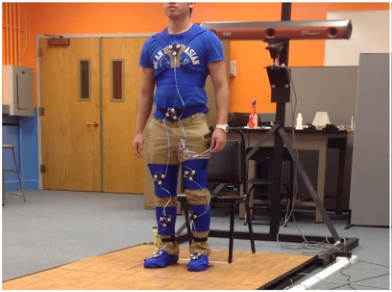
Mitigated and managed subjects were assessed in the biomechanics lab, using three 3D Investigator motion capture sensors and three True Impulse force plates (Northern Digital, Inc., Waterloo, Canada). Figure 1 illustrates the testing apparatus. The motion capture sensors were positioned along a 24-foot walkway. An armless chair was positioned at the start of the walkway, where the subjects sat at the beginning of the study, with their feet resting on the initial force plate. The other two force plates were positioned along the walkway such that ground reaction forces during at least one stride would be measured during each test. The top surfaces of the force plates were finished like, and level with, the walkway to encourage a normal gait.
Optical marker sets were attached to each subject’s torso, pelvis, thighs, shanks, and feet. The 3D Investigator motion capture system uses active infra- red markers for position measurement that are each labeled and tracked by
Figure 1: Showing a student subject instrumented with 8 rigid bodies, each having 3 markers attached.
a central controller. Three markers were mounted on each of 8 rigid bodies, which were strapped to each body segment of interest and labeled and tra- cked individually by the controller. The rigid bodies precisely locate their 3 markers with respect to each other to allow the 3D Investigator to transform the rigid body positions to a global coordinate system, with which the system can track the position and orientation of each monitored body segment. All body segment positions and rotations were logged at a rate of 60 Hz. Force plate data was logged at 300 Hz and filtered with a 10 Hz Butterworth filter. Only the force plate frames matching the 60 Hz body segment data were used for biomechanical analysis.
Subjects began by sitting in the chair with their backs against the backrest and both feet resting on the force plate. An indicator light at the end of the walkway turned green, which signaled the subject to stand. The light turned red after 5 seconds to indicate the subject should stand as still as possible. When the light turned green again after 20 seconds, the subject walked 20 feet at a normal pace, turned 180 degrees, walked back to the starting position, turned 180 degrees again, and sat down. This was repeated until at least three consistent data sets were obtained.
Biomechanical risks were assessed and reported by the biomedical engi- neer (first author). Custom Matlab software provided analysis of segmental motion from the motion capture data: average stride length as a percentage of stature, step cadence, average stride time, normalized variability of stride time, stance time as a percentage of stride time, and dynamic lateral base of support. Measurements more than 1 standard deviation below normal for age group was flagged in the report. In addition, the engineer assessed foot velocity, pelvic rotation, and ground reaction forces to elicit information on power and coordination within the kinematic chain. Recommendations for physical therapy were targeted to areas of weakness and heightened risk of trips or other falls.
Results
Thirty four adults over 65 years were recruited for the study. Four left the project before the final follow up, leaving a total of 30 (14 men, 16 women).
Early Intervention to Reduce Falls in Community-Active Seniors: A Pilot Study 131
Table 1. Subjects recruited for the study.
Table available in the original PDF paper.
65-74 75-84 85+ TOTAL CONTROL MALE 2 2 0 4 FEMALE 1 2 0 3 MANAGED MALE 3 2 1 6 FEMALE 2 3 2 7 MITIGATED MALE 3 1 0 4 FEMALE 1 3 2 6 TOTAL 12 13 5 30
Table 2. Summary of MFRS scores and fall history for age groups 1 and 2 only.
Table available in the original PDF paper.
Median MFRS and Falls per Treatment Group #Subjects Initial Mitigated Final #Fallers
None of the participants reported falling in the previous 12 months. Table 1 shows a breakdown of subjects in the study. A one-way ANOVA comparing the 3 treatment groups by age group for gender, body mass index, fall-risk factors, and initial MFRS score showed all treatment groups were comparable within each age range.
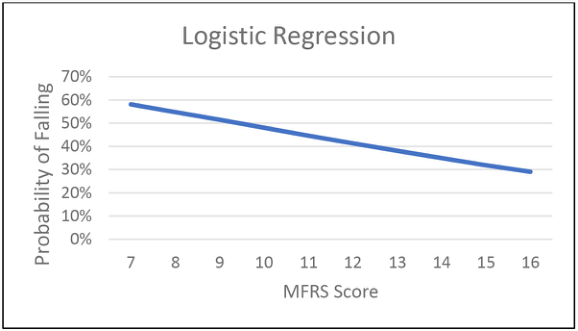
Twelve of the 30 subjects (40%) experienced falls during the 12-month follow up, with two experiencing multiple falls. Only one fall was classified as having moderate severity, and none involved more serious injury. Table 2 shows a summary of the MFRS data and fall history for subjects in age groups 1 and 2. Only 25% of mitigated subjects fell, compared to 41% of age- matched peers. Logistic regression of the number of fallers relative to initial MFRS score allows interpolation of the change in fall risk. Figure 2 shows a graph of the logistic regression line. This graph shows that an MFRS score of 9 corresponds to 51% odds of falling during 12 months. Each step increase in MFRS score decreases the odds of falling by approximately 3%.
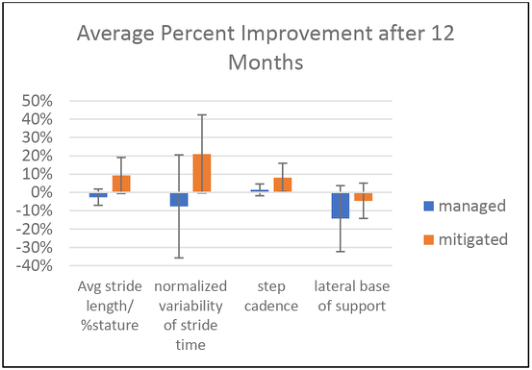
A comparison of MFRS scores, seen in Table 3, shows the mitigated trea- tment group experienced significantly reduced odds of falling immediately after physical therapy (OR 76%) though the extent of this effect varied among age sub-groups. The MFRS scores decreased by the final assessment, though the biomechanical measures showed continued protection against falls. Figure 3 shows a histogram of the percent improvement from start to finish among four major biomechanical measures for both the mitigated and managed treatment groups. Student’s T-test of the values between treatment groups for step length, variability, and cadence showed statistical significa- nce in the comparison (p=0.006, p=0.01, and p=0.033, respectively). Lateral base of support did not show statistical significance (p=0.164).
The managed treatment group showed relatively constant risk of falling after 12 months (OR 87%). The biomechanical results in Figure 3 verify the
Figure 2: Graph of the probability of falling within 12 months, based on MFRS score.Table 3. Comparison of MFRS scores across groups over time.
Table available in the original PDF paper.
Median MFRS by Treatment Group and Age Decade Initial Odds of After PT Odds of Final Odds of Falling Falling Falling
difference in gait performance between the two treatment groups, indicating MFRS was able to correctly assign risk levels.
In order to investigate any differential impact on fall risk due to exercise, the entire sample frame was stratified by average number of exercise minutes per week (see Table 4). A cut-point at 90 minutes per week of total exercise divided the sample frame into equal groups of patients, with 15 reporting >= 90 minutes of exercise per week and 15 with less than 90 minutes. There were 6 fallers in each group (40%), indicating reported exercise offered limited or no explanatory bias.
DISCUSSION
This pilot study highlights the need for a more proactive approach to preven- ting falls in community-active seniors. Falls may mark the onset of physical and functional decline (Florence et al., 2018). Even active, healthy seniors bear significant risk of falling, but that is generally only clinically identified after having fallen hard enough to inflict injury and/or fear of falling. None of
Early Intervention to Reduce Falls in Community-Active Seniors: A Pilot Study 133
Figure 3: Histogram of biomechanical measures comparing start-to-finish improve- ments in gait function between treatment groups. Whisker plots show standard error of measurement.Table 4. Stratification of subjects by minutes of exercise per week.
the subjects who participated in this study were considered frail, yet only 2 of the subjects in the sample frame were found to have no significant biomech- anical risk of falling. No subjects had had been identified as at-risk of falling by their personal physicians and had not received treatment or guidance to reduce their risks of falling.
We found prescribing physical therapy reduced the odds of falling for the overall group of mitigated subjects by 16% as measured by MFRS, with pro- tection still measurable in their gait performance with statistical significance at the end of the 12- month follow up. We also found that MFRS was able to correctly measure positive and negative changes in the risk of falling, though the sensitivity of the scores was less than that provided by the biomechanical measures.
Additionally, simply providing feedback to older adults about their bio- mechanical risk factors for falling had little to no effect on the risk-managed group’s risk of falling. Small positive changes were measured in the MFRS
scores for that group from start to finish, but this was not reflected in the biomechanical measures, nor in the percentage of fallers.
Finally, though exercise has been documented to be a powerful modulator of falls in active seniors (Shubert, 2011), our results did not show a significant effect on the measured risk nor on the outcome. We hypothesize this may be due to limited guided exercise (Sherrington et al., 2019), together with subjective reporting bias.
More research is needed to understand both the types of exercise and the dose-response required to maintain the protective effects of therapy. More research is also needed to investigate how the provision of fall mitigation therapy should be tailored to accommodate differences in the response of each age group to therapy. Our post-therapy MFRS and the biomechanical tests both show age-related decrements in the response to intervention. More research is also needed to refine the sensitivity of MFRS scores to risk, since Abbot (2009) only validated the MFRS for subjects through age 79.
This study had several limitations. First, we were unable to recruit enough patients over age 85 years to provide statistically significant data regarding the response to intervention for the oldest subjects. Second, modifications to the MFRS likely reduced the sensitivity of the scoring. Finally, the control group was not asked to return for follow-up MFRS measurement. This redu- ced our ability to compare changes in measured fall risk between those who had no information on fall risk (controls) and those who were given detailed information (managed).
ACKNOWLEDGEMENT
This research was supported by an Academic Initiatives Monetary Fund Grant provided by Mercer University.
REFERENCES
Abbott, C. C. (2009). Community multidimensional fall risk screening. Community Multidimensional Fall Risk Screening. University of Missouri. Retrieved from https://acces.bibl.ulaval.ca/login?url=https://search.ebscohost.com/login.asp x?direct=true&db=rzh&AN=109857293&lang=fr&site=ehost-live Bergen, G., Stevens, M. R., & Burns, E. R. (2016). Falls and Fall Injuries Among
Adults Aged ≥65 Years — United States, 2014. MMWR. Morbidity and Mortality Weekly Report, 65(37), 993–998. https://doi.org/10.15585/mmwr.mm6537a2 Florence, C. S., Bergen, G., Atherly, A., Burns, E., Stevens, J., & Drake, C.
(2018). Medical Costs of Fatal and Nonfatal Falls in Older Adults. Journal of the American Geriatrics Society, 66(4), 693–698. https://doi.org/10.1111/jgs.15304 Gillespie, L. D., Robertson, M. C., Gillespie, W. J., Sherrington, C., Gates, S., Clemson, L. M., & Lamb, S. E. (2012). Interventions for preventing falls in older people living in the community. Cochrane Database of Systematic Reviews, (9), CD007146. https://doi.org/10.1002/14651858.CD007146.pub3 Hausdorff, J. M., Rios, D. a., & Edelberg, H. K. (2001). Gait variability and fall risk
in community-living older adults: A 1-year prospective study. Archives of Phy- sical Medicine and Rehabilitation, 82(8), 1050–1056. https://doi.org/10.1053/ap mr.2001.24893
Early Intervention to Reduce Falls in Community-Active Seniors: A Pilot Study 135
Maki, B. E. (1997). Gait changes in older adults: Predictors of falls or indicators of fear? Journal of the American Geriatrics Society, 45(3), 313–320. https://doi.org/10.1111/j. 1532–5415.1997.tb00946.x Phelan, E. A., Mahoney, J. E., Voit, J. C., & Stevens, J. A. (2015). Assessment and
management of fall risk in primary care settings. The Medical Clinics of North America, 99(2), 281–293. https://doi.org/10.1016/j.mcna.2014.11.004 Sherrington, C., Fairhall, N. J., Wallbank, G. K., Tiedeman, A., Michaleff, Z.
A., Howard, K., … Lamb, S. E. (2019). Interventions for preventing falls in older people living in the community. Cochrane Database of Systematic Reviews, 9(1), CD007146. https://doi.org/10.1002/14651858.CD012424.pub2.www.coch ranelibrary.com Shubert, T. E. (2011). Evidence-Based Exercise Prescription for Balance and Falls Prevention. Journal of Geriatric Physical Therapy, 34(3), 100–108. https://doi.org/10.1519/jpt.0b013e31822938ac Winter, D., Patla, E., Frank, J. S., & Walt, S. E. (1990). Biomechanical walking pattern
changes in the fit and healthy elderly. Physical Therapy, 70(6), 340–347.
LISTED IN THE AHFE DIGITAL BOOKSTORE CATALOGUE
Explore the complete digital volume
Human Factors in Aging and Special Needs
Read this individual research paper free through the original publisher, or explore the full digital proceedings book.
ISBN 978-1-958651-14-8
Explore this ISBN in the AHFE Bookstore ↗Listed in the July 2026 bookstore catalogue; search by ISBN to confirm current availability · Digital book purchase optional