Brian Peacock, Chui Yoon Ping, Samuel Low, Phang Chun Kai, Loh Sok Khim (2022). The Employment of Senior Citizens in Singapore. In: Advances in Ergonomics In Design, Usability & Special Populations: Part III. AHFE Open Access, vol. 20. https://doi.org/10.54941/ahfe1001340
The employment of senior citizens is a global challenge of major proportions, and increasing apace. From the systems ergonomics perspective these challenges can be categorized and measured from physical, cognitive, social, affective, environmental or economic viewpoints. A series of studies is underway at SIM University, Singapore to evaluate the characteristics, capabilities, limitations and aspirations of senior citizens aged 55 – 75 with regard to their employment, and compare these with a cohort of younger counterparts. The first phase of this project measured physical capabilities including, size and shape, strength, speed, stamina, and motor skills. The results of these studies indicated that, whereas these variables showed some expected associations with age, they also showed very large individual differences, presumably related to disease, disuse, disinterest, inheritance and life history. The second phase of the study investigated the perceptions, using a Kano approach (must have, more the better and excitement categories), of older people with regard to their jobs on dimensions such as physical demands, technology demands, economics, relationships (with management, co workers and customers) and job environment. As predicted economic and relationship issues dominated the results, followed by physical and technology demands. The third phase was an objective approach to the physical and operational job demands using a “Job Physical Activity Sampling” approach. This analysis indicated widely varying sedentary and dynamic job demands. Finally guidelines are presented with regard to employment of elderly people to assure health, safety and satisfaction. These guidelines are categorized using a consensus based demand – strain model that addresses spatial, manipulation, environmental, manual materials handling and operational factors. Participants were also surveyed regarding their perceived fitness for work. The conclusion of the study was that age per se is not the main challenge; rather it is the correlates of age, such as disease, that stand in the way of gainful employment.
The employment of senior citizens is a global challenge of major proportions, and increasing apace. From the sys- tems ergonomics perspective these challenges can be categorized and measured from physical, cognitive, social, af- fective, environmental or economic viewpoints. However many people and organizations – academics, policy mak- ers, pundits and journalists are showing great interest in this topic that is sometimes described as a grey haired tsunami. Other more directly interested parties are also jumping on the bandwagon; these include the designers of products and services that may be either needed or wanted by older people. The health care industry is a major bene- fiter, due to the wide array of diseases and increasing prevalence of illnesses that require costly intervention. In par- ticular there are those metabolic disorders such as obesity, heart disease and diabetes that stem from long term life- style choices. Human Factors and Ergonomics has contributions to offer to the physical lifestyle elements of employment, transportation and recreation and the cognitive lifestyle elements of communication, computation and control, as all these functions present different challenges for elderly people. As in most situations that attract human factors practitioner attention, consideration must also be given to operational, social and affective issues as these commonly interact with physical and cognitive factors.
The physical, cognitive and behavioral deterioration associated with aging has been addressed for many decades by the medical, psychology and human factors communities (Anderson and Hussey, 2000.) The approaches to accom- modation of the aging population differ widely and include transportation, the cost of health care, employment, fam- ily economics, and so on. All of these broader issues are relevant to the ergonomics approach, however the more specific micro ergonomics aims of the present study are to compare the physical capabilities of elderly Singaporeans and their job demands using both objective (laboratory tests and worksite job analysis) and subjective (surveys of perceptions of job demands and personal fitness) methods. The employment of elderly (and other) people may be addressed using the Kano and Maslow models (Kano et al, 1984, Maslow, 1943,). The Kano model has traditionally been used for product and service evaluation (Hartono, 2013.) It articulates three characteristics of a product, service or, in this case, a job. The first is a basic “must have” feature – the product or service must fulfill its basic function; a job must provide minimal levels of remuneration, safety and security – the lower levels of the Maslow hierarchy of human needs. The second Kano level is a one dimensional factor –the more the better. In the case of a job, remuner- ation may still be important, but intrinsic content, opportunities for advancement and social interactions would also make a job more attractive. The highest level of the Kano and Maslow models are those features of a job that pro- vide esteem among colleagues, a personal feeling of fulfillment and excitement. The Kano approach suggests that these factors are dynamic – a feature of a product, service or job that is now exciting may become a basic expecta - tion as time passes. In the present investigation attention is paid to individual physical, cognitive (knowledge and ex- perience), operational and social capabilities and expectations.
Employment of elderly people is important both from the individual’s viewpoint and that of society at large. In Sin- gapore, as in most developed countries the cost of unemployed older citizens rests with personal savings, the family or social welfare. Much has been said about the inevitable decline in physical, sensory and cognitive abilities of older people (Jones and Rikli, 2002.) However, as in most areas of ergonomics application, the issue is clouded by considerable individual variability. This variability is due to correlates of age such as disease and disuse on the one hand and experience and engagement on the other. These factors may have genetic underpinnings or simply be a matter of opportunity and motivation. A result of this complexity is that it is difficult to generalize usefully about the employment of elderly people; the focus should rather be on particular limitations, such as vision and hearing, strength, endurance, mobility or aversion to new technology. The classification of “elderly” is also a very fuzzy and sometimes arbitrary concept, and different societies and organizations grapple continually with the establishment of a “retirement age.”
Ergonomics has, for many decades, been applied to the analysis and design of products and work with due regard to human capabilities and limitations. There are numerous publications, education and training courses, analysis tools and standards applicable to various populations, including the elderly (Kroemer et al, 2001, Fisk et al, 2004). How- ever, many of these analyses and tools are esoteric; that is they require expert interpretation and implementation, and do not penetrate into the communities where they are most needed. Also, whereas much is known about the aging process, there are relatively few easy to use and reliable guidelines for product and work designs for the elderly, and particularly for elderly Singaporeans. The application of ergonomics methods to job analysis and design will im- prove the match between older workers and their job demands. The intended outcome of this work is to increase the number of elderly Singaporeans that are motivated and capable of participating in the workforce by appropriate workplace, equipment, procedures and job designs.
Kroemer et al (2001) systematically described the elderly as a “special population” and described changes in vision and hearing, strength, stamina, speed and motor skills. He continued by articulating basic interventions regarding work place design, tool selection and management of work – rest schedules. Kroemer articulated a broad set of physical and cognitive impairments, described a range of intervention opportunities and rated these on various crite- ria such as effectiveness and acceptability for use by the physically impaired. Fisk et al (2004) took a classical hu- man factors approach to the design of products – the things that older people use for work or entertainment. They suggested that “dexterity and strength change negatively with age. Speed declines. Vision and hearing may be im- paired. Older adults are more likely to suffer cognitive decline that may make them slower and more error – prone in mapping their actions to devices.” They also highlighted the generational differences regarding computer and mobile technology use – older people who do not grow up with the information rich information technology may be slow to catch up, may not explore the many features and functions or may even reject the device altogether because of understanding and usability problems. This Fisk et al perspective is mainly product centered, although there is reference to the mediating effects of context.
Traditional ergonomics dogma deals with human variability by percentile accommodation. This approach may have some merit in such things as one dimensional anthropometry but the approach is naïve at best in the context of com- plex performance accommodation. Likewise the philosophy of “universal design” (Erlandson, 2008), although laud- able, does not acknowledge the reality of individual differences in motivation and ability. The fact that a highly mo- tivated handicapped person may climb Mt Everest does not mean that all similarly handicapped people could or should. The concept of percentile accommodation should be replaced by a human factors contribution to flexible de- sign, adaptability, adjustability and realistic accommodation.
Peacock et al (2013) investigated the physical boundaries of aging through analysis of age based athletic records ob- tained from the World Masters Athletics website. The data were from sixteen athletic events including sprinting, hurdles, jumping, throwing and long distance running. The rational for this approach is that the world record holder for a particular age is unlikely to be hampered by confounding factors of disease, disability, disinterest or disuse; thus the age based (cross sectional) record truly represents the boundary of aging. The decline of this boundary is approximately linear between the ages of 40 and 70 with a rate of around 1% per year; thereafter the rate of decline is greater and a quadratic model provides a slightly better fit. There is a large amount of literature on the decline in physical abilities (strength, speed, stamina and motor skills) with age (Grubb, 1998). Generally speaking the re- ported declines vary between 0.5 and 2% per year. (Figure 1.)
Womens 400 meter World Records %
Mens Outdoor 1 Mile World Record %
Equations and mathematical formulas are available in the original paper PDF.
Figure 1: Typical results for world records in athletics using a baseline at age 35. It should be noted that the decline in ability is approximately 1% per year. (World Masters Athletics data) These observations support the work of Stehl and Yates (2001) who investigated the declining capabilities of physi- ological subsystems as people aged. This issue of rate of decline is inevitably clouded by individual variability. Cross sectional athletic records represent a boundary; individuals will start out at some percent less than the record and the decline may be more or less, depending on individual or sample selection.
Figure available in the original PDF paper.
The aim of this present study is to draw on the rich background of ergonomics analysis and accommodation of el- derly people to the ongoing challenge of employment of this cohort in Singapore.
METHODS
Phase 1: Subjective Data Collection and Subject Recruitment The initial approach to a cohort of working adults (N = 83) aged between 55 and 75 was by word of mouth and through community centers. In addition 58 members of an occupational biomechanics class (aged between 22 and 55) volunteered to participate in the measurement phase. Subjective measures of job demands using a questionnaire was developed as an adaptation of the KANO model to job demands evaluation (Matzler, 2004), the ILO Interna- tional Classification of Function, the Finnish “Workability Index” and the recent draft Singapore Workplace Health and Safety Ergonomics Programme Guidelines. This screening tool was used to draw an initial subjective picture of working adults and their job demands in Singapore. Volunteer participants were requested to attend a laboratory ses- sion (described in Phase 2) to assess their physical capabilities and to allow research team members to visit their place of work to evaluate their job demands (as described in Phase 3). Volunteers were given a letter to their super- visor requesting permission to conduct the job evaluations.
Phase2: Laboratory Data Collection.
A total of 138 subjects (52 Female, 86 Male) participated in the laboratory phase. They were all currently employed. 83 of these subjects were volunteers from the community, the rest were members of a biomechanics class at UniSIM. Participants were introduced to the various pieces of equipment at the different data collection stations and briefed on the tasks that they are required to perform. Participants were then asked to read and sign a consent form and encouraged to ask further questions.
Equipment and Procedures A custom designed anthropometry rig facilitated the standard measurement of body segments with replications to enhance the reliability of the data. Full grasp, pinch grip and lifting dynamometers were used for strength measure- ment (Mathiowetz, Kashman et al., 1985). The Minnesota Manual Dexterity Test was used to measure dexterity (Desrosiers, Johanne, et al., 1997). Lower back and hamstring flexibility was measured using the Modified Back- Saver sit-and-reach procedure (Hui and Yuen, 2000).The subject is required to sit with one leg straight along a bench and reaching as far forward horizontally as possible. Shoulder flexibility was measured using a “back scratch” test, in which the subject touches their fingers behind their back with one shoulder laterally rotated and the other me- dially rotated (Jones and Rikili, 2002). A “get up and go” test was used to measure speed (Podsiadlo and Richard- son, 1991); in this test the subject stands up from a chair, walks around another chair placed two meters away and returns to his / her original seated position. Finally stamina was measured using the 6-minute walk test (American Thoracic Society, 2002) as the distance walked in six minutes up and down a 30 meter course.
Analysis The data were analyzed using linear regression on age. For convenience of interpretation the data were converted to percentages of the best performance of the subject cohort. It is recognized that the rate of decline will be different for different individuals and that a non linear decline is likely, especially noticeable among the older subjects. An- other reason for applying these standardization procedures is that the particular test procedure and particular sample will vary from other reported data; hence the most meaningful comparative parameter across many tests and samples is the slope of the linear decline.
Phase 3: Field assessment
The investigator obtained consent from the participant and their manager for a visit to his/her workplace to conduct an analysis of the participant’s job. Still photographs and video recordings were taken of the participant at work, again with permission of the participant and company management. It was emphasized that the recordings are confi- dential, and maintained and analyzed by the project team until the completion of the project, and then destroyed.
The following objective and subjective data were then collected: o Workspaces: access, reach, fit, location and frequency / importance / sequence of use of materials, equipment and tools. o Working postures: temporal patterns of sitting, standing, squatting, bending, twisting, reaching using an activity sampling approach (JPAS) – Job Physical Activity Sampling, developed from the Physical Work Stress Index, (Chen et al, 1989 ). Particular attention is paid to sedentary work, including habitual postures and opportunities for postural relief o Working movements: temporal and spatial patterns of walking, climbing, obstacle negotiation etc using activity sampling. o Manual materials handling: Characteristics of loads lifted, transferred, held, manipulated, carried, pushed and pulled, frequencies and shift durations using the NIOSH Lifting Equation approach o Energy demands: Estimates of daily energy load using activity sampling of postures, movements and activities, and the Borg Scale of subjective energy demands o Environment: assessment of the visual, auditory and thermal environment using a checklist. o Manipulation: description of manipulation tasks with focused attention on postures, loads and frequencies, us- ing the ACGIH Hand Activity Level analysis tool o Temporal Factors: These factors interact with most of the other factors; they include task cycle, duration, pac- ing, frequency and work rest schedules o Social and Organizational Factors: Assessment of selection, training and assignment, shift durations, quality and productivity requirements, reporting, autonomy and supervisor, customer and colleague interactions will be ob- tained by interview and focus group methods.
Surveys A survey questionnaire was presented to each of the participants, using Survey Monkey, with the following content: Demographics, physical impairments affecting work, personal evaluation of fitness for work and likes and dislikes about their work. Each of the questions invited an ordinal response plus commentary. A second survey was devel- oped to assess the participants’ views regarding spatial, materials handling, manipulation, environmental and opera- tional aspects of their work. This survey complemented an objective analysis of these factors using a “job physical activity sampling” approach (JPAS), in which ordinal values were assessed, using direct observation and video records; eleven samples over an hour (every five minutes) were taken as the underlying work was not cyclical. These data points were averaged to assess overall physical workload and successive samples were differenced to as- sess variability in physical workload.
Phase 4 Job Interventions After reviewing, evaluating and discussing the data from the subjective, laboratory and field phases the project team members recommended interventions, if warranted, to improve job outcome quality, productivity, health, safety and satisfaction. These interventions are based on established ergonomics practices for workplace, tool, equipment, task and job design. The job design approach used the data obtained from the objective job analyses with consensus cut offs, based on the human factors literature, for the spatial, materials handling, manipulation, environmental and op- erational variables based on the conservative consideration that these subjects would generally be less physically capable than younger cohorts. The recommendations for change, using engineering or operational interventions stemmed directly from these analyses.
RESULTS
Table 1 shows the anthropometric dimensions of the cohort.
Table 1: Anthropometric measures (cm, kg)
Figure2 shows the negative relationships between age and stature, and age and weight. Younger participants are generally taller and heavier than their older counterparts. The trend is about .26 cm per year for height and about .29 kg per year for weight. These observations are comparable with previous anthropometric studies of the local popula- tion (Peacock et al, 2012,Tan et al, 2009).
Stature (cm) vs Age
Weight (kg) vs Age
200
150
180
100
160
50
140
0 10 20 30 40 50 60 70 80 90100 120
0 10 20 30 40 50 60 70 80 90 100 0
Figure 2: Regression Analysis of Stature and Weight on Age
Figure available in the original PDF paper.
Figure 3 shows that the deterioration of shoulder mobility with age (3.7%) is much greater than lower back and hip flexibility, however there is considerable variability in these flexibility measures as indicated by the R 2 values. These flexibility issues are expected to have important effects on the ability to carry out physical tasks.
Back Scratch vs Age
Reach (cm) vs Age
Figure 3: Flexibility as measured by the Back Scratch and Reach tests
Figure available in the original PDF paper.
Figure 4 shows the relationship between speed and age using the get up and go test in which a seated subject stands up, walks around another chair placed one meter away and then returns to his seat. The performance score reflects the percentage decline in speed and stamina when compared with those of the fastest participants.
Stamina - Six Minute Walk Test % Max Distance vs Age
Speed - Get up and Go Test % Max Speed vs Age
0 10 20 30 40 50 60 70 80 90 100 0
0 10 20 30 40 50 60 70 80 90 100 0
Figure 4: Regression Analysis of % Decline in Speed (Get up and Go test) and Stamina (6 minute walk test) on Age The dexterity test involved picking and placing a series of blocks – the Minnessota Block test. This standardized test has been widely validated, although care had to be taken to ensure a consistent method among subjects. There were only very small decrements in performance observed.
Figure available in the original PDF paper.
Placing Test % Max Speed vs Age
Figure 5: Regression Analysis of % Decline in Placing (dexterity) Test Time on Age Three strength measures were conducted – a leg lift, a full hand grip and a pinch grip (Figures 6, 7). The grip mea- sures are reported for the preferred hand. The back lift was notable because of the very wide variation in perfor- mance – some subjects were only able / prepared to lift a few kilograms. The average age related decline was about 1.3 % per year.
Figure available in the original PDF paper.
Leg Lift % Max
Figure 6: The Association Between Age and a Bent Knee – Straight Back Leg Lift as a Percentage of Maximum The hand and pinch grip observations are shown as the average of three trials with the left and right hands as a per - centage of the maximum grip force of the study cohort. The average annual decline was about 0.9%.
Figure available in the original PDF paper.
Figure 7: The Relationship Between Age and Hand and Pinch Grip
Figure available in the original PDF paper.
Fitness for Work Survey The survey of the subjects’ perceived fitness for work was carried out on the same occasions as the laboratory physi- cal measurements were taken. The first set of questions, based on the International Classification of Function (http://www.who.int/classifications/icf/en/), asked whether and to what degree the participants had physical ailments that interfered with their ability to work. A total of 107 subjects, aged 55 – 75, participated in this survey although some subjects did not respond to some questions. Table 2 shows the number of respondents who indicated some de- gree of limitation. It is seen that the majority of respondents indicated that they had none or mild limitations.
Table 2: Participants response to the question “Do you have any physical ailment that interferes with your ability to work?”
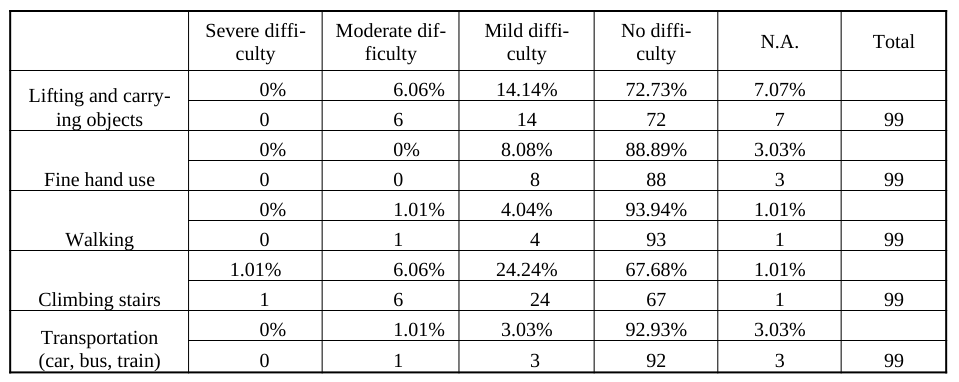
The majority of respondents when asked about physical daily activities indicated that they had no difficulty, al- though notably climbing stairs and lifting had the greatest numbers of “Mild” or “Moderate” difficulty (Table 3)
Table 3: Numbers of respondents who indicated some level of difficulty with their current job or daily activities.
Kano Evaluation of Motivation to Work
Table 4 contains counts of synonyms in the open ended questions “What do you like about your job?” “What aspects of your job are exciting?” and “What do you dislike about your job?” Relationship issues dominated the positive responses and occurred quite frequently in the “dislikes”. Job content and demands were also mentioned frequently along with the indication of ‘keeping active”. As expected money matters were mentioned quite frequently. Notably many respondents did not offer any “dislikes.”
Table 4: Counts of synonyms of words associated with the question regarding “likes”, “excitement” and “dislikes” As expected the physical capabilities of the employees in this study varied considerably. It should be noted also that this study only applied to working adults and did not account for the changes in employment rates among aging pop- ulations, sometimes due to physical / disease limitations, sometimes due to technology and training barriers and sometimes due to socio-economic situation.
Table available in the original PDF paper.
DESIGN FOR ELDERLY EMPLOYEES The general aim of job design is that the majority of the otherwise qualified cohort should not face unreasonable (physical) barriers. Thus there are two principles to be addressed – first articulation of the variability among the ca- pabilities and limitations of the target cohort on relevant dimensions and second the policy decisions regarding the level of accommodation. The first principle is addressed by measurement and statistical inference; the second, policy decision, should be made by a consensus of stakeholders, including the employees, managers and representatives of the regulatory authorities.
Figure 8: A representation of the relationship between a physical “stressor” and the probability of “strain” in normal and elderly populations Measurement of human one-dimensional or complex capabilities and limitations may be represented as an ogive (Figure 8) that represents the relationship between a physical (designable) demand, such as lifting, and the percent of people incapable of meeting that demand. The design policy then may be to accept jobs for which more than 90% are capable, implement engineering controls for jobs for which less than say 10% are capable and to institute admin- istrative / operational controls, such as selection and training, restricted work hours or increased staffing levels for the intermediate levels. In most situations context may also play an important part. It should be noted from the upper curve that older people will be capable of coping with lower stress levels. A fuzzy model approach, depicted by the “Normal” variation around the cut off points, may improve the validity of this conceptual model. The analogy of ve- hicle speed limits is pertinent: 70 km/h may be acceptable on the highway, but 30 km/h is appropriate in a built up area; these standards may change in contexts such as fog or ice or for different kinds of vehicle. The standards do not change formally for drivers of different abilities, although older drivers are often more cautious and slow down to obtain more information processing time, often to the consternation of younger drivers.
Figure available in the original PDF paper.
The speed limit analogy is pertinent with regard to the process of setting physical job design standards. There are physical, operational, contextual and human variables to be considered. This leads to a second complication: the re- sponsibility for change on individual dimensions may rest with different stakeholders. Using the example of manual materials handling, such as aviation baggage handling, and the familiar NIOSH lifting guidelines, it may be seen that a product designer or customer may be responsible for the load (the suitcase), a facilities design engineer for the workplace and a supervisor for the work rate. The easiest and most common administrative intervention will be for the supervisor to deal with staffing levels, personnel selection and work rate. On occasion the supervisor and his en- gineering colleagues may be able to change the workplace, perhaps by installing racks and lifting aids. It may be feasible to change the load by regulation or economic intervention as in the example of airline baggage. Composite indices, such as the NIOSH lifting equation must be decomposed to identify the optimal intervention focus from the space, force and time domains.
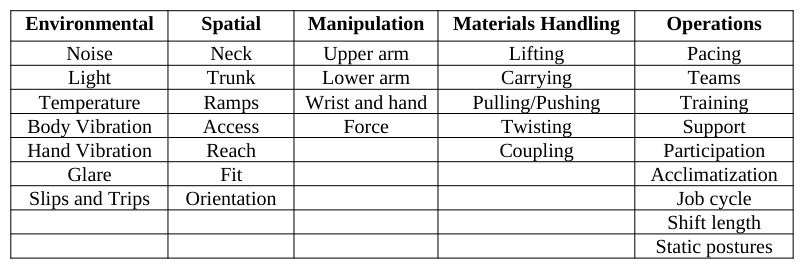
Given these complexities of job design standards a process has been developed to guide the various stakeholders in job analysis and task intervention based on the concepts presented in Figure 8. The independent variable may be any engineering or administrative design variable, or combination of variables. The four dependent ranges are “Red” – engineering controls must be implemented as that variable, even when all other conditions are ideal, is beyond the capability of most of the cohort (elderly Singaporeans); “Orange” – engineering or administrative controls should be implemented such as job aids or increased staffing levels because this stressor will interact with other conditions to create an intolerable situation; “Yellow” – administrative controls, such as increased staffing levels, job rotation or rest breaks should be implemented because this stressor may interact with other conditions to create an intolerable situation; “Green” - the individual stressor is generally tolerable for most of the cohort of elderly Singaporeans, un- der most operational contexts. A rule of thumb for management intervention could be that all “reds” must be ad- dressed and that no more than three “oranges” or five “yellows” should be permitted. The cut off points for each of the variables should be developed by a consensus of employees, managers and Human Factors specialists with due reference to the technical literature. The individual variables that are considered for job design or intervention are shown in Table 5. This approach has been implemented in the form of a job intervention application for iPad tablets.
Table 5: Variables addressed in the job analysis and design applications
CONCLUSIONS
This investigation of the physical capabilities of elderly (currently employed) Singaporeans indicated that there was generally some deterioration in physical capabilities, but that there was wide individual variation. The age based rate of decline for the various tests was between 0.2% and 1.5% per year. Analysis of the responses to the subjective sur- vey questions highlighted relationship, activity and financial “likes” with some negative responses to operational and physical issues, including working hours and workload. It should be noted that the “likes” were not necessarily those intrinsic factors articulated by Herzberg (1966). Other less formal findings related to access to the worksite, al- though most of the subjects who attended the laboratory sessions travelled by public transport, which usually in- volved at least one overhead pedestrian bridge. Another social issue concerned mobility and job choice; many of the subjects, because of education and training issues had less choice and therefore resorted to local opportunities that were within their physical and experience capabilities. There were some “dislikes” related to physical workload, and one popular elderly cleaner complained that she had to give up her job, because she had to “be on her feet all day.” The job intervention and evaluation phases of the project are ongoing.
REFERENCES
American Thoracic Society. (2002), “ATS Statement: Guidelines for the Six-Minute walk test.” Am J Respir Crit Care Med Vol
166. pp 111–117, 2002 Anderson, G. F. and P. S. Hussey (2000). "Population aging: a comparison among industrialized countries." Health Affairs 19(3):
13. Baker, A. B., Y. Q. Tang, et al. (2001). "Percentage Decline in Masters Superathlete Track and Field Performance With Aging."
Experimental Aging Research 29(1): 19. Contini, R., R. Drillis, and M. Bluestein, (1963) “Determination of body segment parameters,” Human Factors, 5 (5) Desrosiers, Johanne, et al. (1997) "The Minnesota Manual Dexterity Test: reliability, validity and reference values studies with healthy elderly people." Canadian Journal of Occupational Therapy 64.5, 270-276. Erlandson, R.F. (2008) Universal Design for Products, Services and Processes CRC Press Fisk, A. D., W. A Rogers, N Charness , S. J. Czaja and J Sharit, (2004) “Designing for Older Adults,” CRC Press, Grubb, H. J. (1998). "Models for Comparing Athletic Performances." Journal of the Royal Statistical Soci 47(3): 13. Hartono, M, Tan Kay Chuan and B, Peacock (2013), Applying Kansei Engineering, the Kano model and QFD to services, Int. J.
Services, Economics and Management, Vol. 5, No. 3 Herzberg (1966), “Work and the nature of Man,” New York, Thomas Hill, A. V. (1925). "The Physiological Basis of Athletic Records." The Scientific Monthly 21(4): 20. Hui, S.S and Yuen, P.Y. (2000) “Validity of the modified back-saver sit-and-reach test: a comparison with other protocols.” Med Sci Sports Exerc. 32(9):1655-9. Jones C.J., Rikli R.E., (2002) “Measuring functional fitness of older adults,” The Journal on Active Aging, pp. 24–30. Kano, K.H., Hinterhuber, H.H., Bailon, F. and Sauerwein, E. (1984) “How to delight your Customers”, Journal of Product and
Brand Management, Vol. 5, No. 2, pp.6–17. Kroemer, K., H Kroemer and K Kroemer-Elbert, (2001) “Ergonomics: How to Design for Ease and Efficiency,” Prentice Hall Lee, W. K. M. (1999). "Economic and Social Implications of Aging in Singapore." Journal of Aging & Social Policy 10(4): 20. Maslow, A. H., (1943) “A Theory of Human Motivation,” Psychological Review, Vol 50(4), 370-396. Mathiowetz V, Kashman N, Volland G, Weber K, Dowe M, Rogers S. (1985) “Grip and pinch strength: normative data for adults.” Arch. Phys. Med. Rehabil. 66(2):69-74. Netz, Y. and E. Argov (1996). "Gender Differences In Physical Fitness In Old Age." Perceptual and Motor Skills 83(1). Peacock B, Ng Yuwen and Tan Kay Chuan, (Not So) Perfect Ageing, IHFE, San Francisco 2012 Peacock B, Transportation for all Ages, Keynote Address Southeast Asian Network of Ergonomics Societies (SEANES) confer-
ence on 9-12 July 2012, Langkawi, Malaysia. Peacock, Tong Xin, Chui Yoon Ping, Low Wai Ping, Tan Kay Chuan and M Hartono, Drillis and Contini Revisited,. IHFE, San Francisco 2012 Podsiadlo D, Richardson S. The timed "Up & Go': a test of basic functional mobility for frail elderly persons. Journal of
American Geriatrics Society. 1991 ;39:142-148. Tan, K. C., Hartono, M and Kumar, N (2010), Anthropometry of the Singaporean and Indonesian populations, International Journal of Industrial Ergonomics 40, (757-766) Sehl, M. E. and F. E. Yates (2001). "Kinetics of Human Aging: I. Rates of Senescence Between Ages 30 and 70 Years in Healthy
People." Journal of Gerontology 56A(5): 11. WMA (2011). "World Masters Athletics Records." Retrieved July, 2011, from http://www.world-masters-athletics.org/records.
LISTED IN THE AHFE DIGITAL BOOKSTORE CATALOGUE
Explore the complete digital volume
Advances in Ergonomics In Design, Usability & Special Populations: Part III
Read this individual research paper free through the original publisher, or explore the full digital proceedings book.
ISBN 978-1-4951-2108-1
Explore this ISBN in the AHFE Bookstore ↗Listed in the July 2026 bookstore catalogue; search by ISBN to confirm current availability · Digital book purchase optional