Te-Hsiu Suna, Rong-He Linb, Mei-Lin Liub, Fang-Chih Tienb, Yi-Tsong Panc (2018). Automated Musculoskeletal Disorders Assessment Using OWAS and Kinect. In: Advances in Physical Ergonomics and Human Factors: Part II. AHFE Open Access, vol. 2. https://doi.org/10.54941/ahfe100052
Workers musculoskeletal occupational injury is closely related to worker's job status and posture. Short-term or long-term excessive exercise and poor posture may cause temporary or permanent musculoskeletal hazards, affect workers physical health. OWAS is a comomly used evaluation tool for working postures disorders assessment. It requires an ergonomics expert to evaluate through the musculoskeletal disorders risk table. Using OWAS evaluation system not only can provide injury prevention but also can calculate various influence of injury. However, this evaluation requires an expert to monitor an operator for a long period of time, which is tedious and high cost. This objective of this paper is to build an automated musculoskeletal disorders assessment system using the Microsoft Kinect with the OWAS system scuh that the related working postures disorders can be easily explored. The proposed system uses Kinect skeleton tracking system to collect worker’s skeleton information including head, hands, wrists, elbows, shoulders, trunk, hips, knees and foot (20 knots). By means of a self-developed algorithm, the system can automatically record, analyze, and assesse the joint positions and angles between joints such that the posture of a worker can be identified based on OWAS coding system. The proposed system was implemented using C# under Window 7 platform with Microsoft Kinect SDK. A set of experiments was conducted to verify and validate the Kinect skeleton tracking system and self-developed algorithms. The experimental results show that the proposed system effectively recorded and estimated the posture of workers such that manpower and resources are saved and the potential of job hazard can be explored.
Workers musculoskeletal occupational injury is closely related to worker's job status and posture. Short-term or long-term excessive exercise and poor posture may cause temporary or permanent musculoskeletal hazards, affect workers physical health. Li and Buckle (1999) emphasized that the level of exposure to physical workload is normally assessed with respect to its intensity or magnitude, repetitiveness and duration of work. The need for identifying the degree of exposition to biomechanical load has led to the development of specific ergonomic risk screening analysis related to the work tasks to minimize the risk of overload or occupational diseases (EAWS, 2013). Many approaches, including observational methods, instrumental or direct methods, self-reports and other psychophysiological methods, have been studied for assessing exposure to the risks associated with work-related musculoskeletal disorders, or identifying potentially hazardous jobs or risk factors for a certain task. Among them, OWAS (Ovako Working Posture Assessment) is one of the simple observational method, which was developted in a Finland steel industry company in 1973. It is a comomly used evaluation tool for working postures disorders assessment. This system has an ergonomics expert to evaluate posture of a worker through the musculoskeletal disorders risk table. Using OWAS evaluation system not only provide injury prevention but also can calculate various influence of injury. OWAS identifies the most common work postures for the back (four postures), arm (three postures) and leg (7 postures), and the weight of the load handled (three categories). Whole body posture is described by these body parts in a four digit-code. These 252 postures have been classified into four action categories indicating needs for ergonomic changes (OWAS). A software had been developed by Tampere University of Technology to speed up the identification process. However, this evaluation still requires an experienced expert to observe a subject for a long period of time, which is tedious and cost demanding (Karhu et al., 1977; Karhu et al., 1981).
Kinect is a newly developed tool for 3D body information extraction. Pixels in its depth image, which extracted by a depth camera, indicate 3D depth information in the scene, instead of a measure of intensity or color. Kinect camera gives a 640x480 image at 30 frames per second with depth resolution of a few centimeters. This depth camera offers several advantages over traditional intensity sensors, including working in low light levels, giving a calibrated scale estimate, being color and texture invariant, and resolving silhouette ambiguities in pose. Research using Kinect is widely developed recently. Gonzalez-Jorge (2013), conducting a metrological geometric verification for both Kinect and Xtion, showed that these two systems could be used in many engineering applications when the measurement range was short, and accuracy requirements were not very strict. Clark et al. (2012) compared the Kinect against a multiple-camera 3D motion analysis system in 20 healthy subjects during three postural control tests. Their experiment result showed these two instruments had comparable inter-trial reliability and excellent concurrent validity. Tong et al. (2012) presented a multiple-Kinect scanning system for capturing 3D full human body models with three Kinects. Among them, two Kinects were used to capture the upper part and lower part of a human body respectively without overlapping region, and a third Kinect was used to capture the middle part of the human body from the opposite direction.
This objective of this study is to build an automated musculoskeletal disorders assessment system based on the OWAS system using the Microsoft Kinect scuh that the related working postures disorders can be easily explored. The proposed method, experimental result, and conclusions are discussed in the following sections.
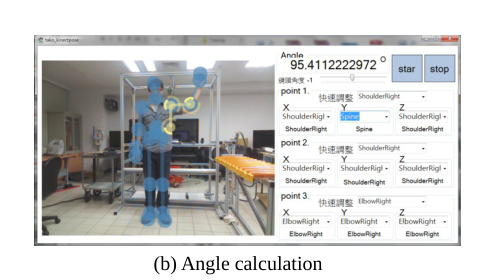
PROPOSED METHOD This study presents an automated musculoskeletal disorder assessment system, which adopts Microsoft Kinect to extract the 3D body information and uses self-developed rule to identify working postures. The assessing exposure method to the risks associated with work-related musculoskeletal disorders is based on OWAS. Basically, OWAS encodes the working posture into a four digit code by identifying the most common work postures including four postures of back (trunk), three postures of upper limbs, and seven postures of lower limbs, and weight of the load handled. This study evaluates the 3D position of back, arms, and legs, but the weight of load handled is input dynamically by users. We first used Microsoft Kinect SDK to derive the 3D coordinate of each knot (joint) as shown in Figure 1(a), and calculated the angles (Figure 1(b)) between related knots by mean of cosine function, and then posture identification is done by self-developed rules. The detail of posture identification is described in the following subsections
(a) Definition of joints (Knots) (b) Angle calculation
Figure 1. Knot and angle calculation in Kinect
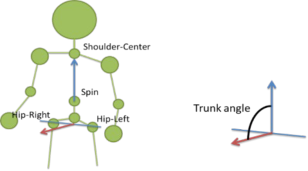
Back Working Posture Identification Four postures of back, including straight, bend forward, twist, bend and twist, are defined in OWAS. The trunk angle, which determining the bending or straight posture, is defined by the angle between the connected segment of Hip-Right and Hip-Left joints, and the connected segment of Spine and Shoulder-Center joints as shown in Figure 2(a). When the trunk angle is larger than a pre-defined value, this posture is identified as a bend forward condition. On the other hand, the twist angle is defined as the horizontal angle between the vector formed by the Hip-Right and Hip-Left joints, and the vector formed by the Spine and Shoulder-Right joints as shown in Figure 2(b). The bend and twist posture is defined as both bending and twisting condition happens.
(a) Bending forward (b) Twist
Figure 2. Back posture definition Upper Limb Working Posture Identification
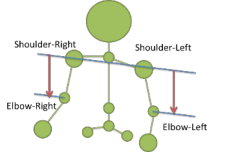
Three postures of hands (upper limbs) to be determined are: both hands below shoulder, single hand below shoulder, and both hands above shoulder. They are identified by comparing the position of Elbow and Shoulder joints as shown in Figure 3(a), (b) and (c).
(a) Both hands below shoulder (b) Single hand below shoulder (c) both hand above shoulder
Figure 3. Posture identification of upper limbs
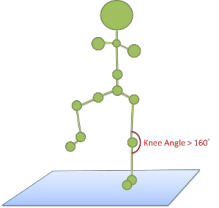
Lower Limb Working Posture Identification OWAS defines seven different working posture for lower limbs including: sitting, stand, standing with single straight leg, standing with single bending leg, standing with two bending legs, standing with single bending leg, kneeing, and walk. At first, we determined the bending or straight condition by calculating the knee angle between Hop and Ankle joints as shown in Figure 4(a). When the knee angle is greater than a threshold angle (such as 160 degree), the worker is identified as standing condition. The posture of standing with single or both legs were determined by calculating the distance between the Ankle joint to the ground as shown in Figure 4(b). The posture of sitting is simply determined by computing the distance between hip and knee joints. If the distance is less than a pre-defined value (such as 20 cm), the worker is identified as a sitting posture as shown in Figure 4(c). For the kneeing posture, we calculate the distance, AK-distance, between one knee joint to the angle joint of the other leg, and the distance, Hip-distance, from the Hip-center to the ground at the same time. When the AK-distance is less than a pre-defined distance (such as 10 cm) and Hip-distance is less than a certain ration (such as 40%) of the worker height, the posture of the worker is identified as a kneeing as shown in Figure 4(d).
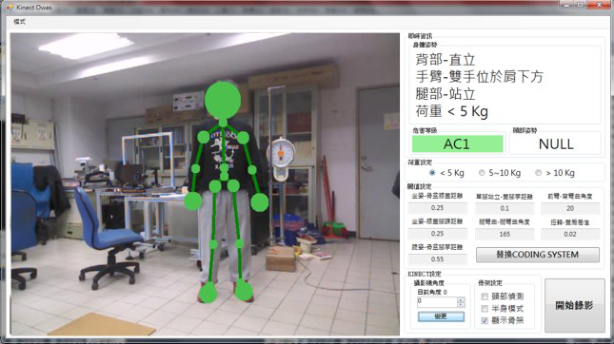
IMPLEMENTATION The proposed system was implemented in C# under Windows 7 platform with Kinect for Windows SDK 1.6. The program interface is shown in Figure 5. The OWAS coding logic was programmed into the system, so the posture code showed immediately when a posture was identified. The posture of back, upper limb, and lower limb were displayed on the upper right of the screen. Our system also provides a recording function, so the users can play back to a specific point and input the loading of the worker (default as 5 kg).
Figure 5. The program interface of proposed system
Implementation of Back Posture Identification After entering the pre-defined values of system (75 degree for trunk angle and 15 degree for twisting), the proposed system was verified with different subjects. Figure 6 shows the system identified different postures of back for a subject.
(a) Straight (b) Bend
(c) Twist (d) Bend and Twist Figure. 6 Four postures identification of back
Implementation of Upper Limb Posture Identification The identification of upper limb postures mainly focus on detecting the relative position of arm to shoulders of workers. The experiment results show the proposed system can properly identify three different conditions of arms as shown in Figure 7(a), (b), and (c).
(a) Both arms below shoulder (b) Single arm above shoulder
(c) Both arms above shoulder
Figure. 7 Three upper limb postures identification
Implementation of Lower Limb Posture Identification Six different lower limb postures are defined in OWAS. After a few trial and error experiment, we defined the parameters as Knee angle =160 degree, AK-distance=10 cm, Foot distance=20 cm, and Hip-distance= 40% of worker’ height. The result of six posture identification of a subject is shown in Figure 8.
(a) Stand (b) Knee
(c) Stand with one leg straight (d) Stand with one leg bends
(e) Stand with both legs bend (f) Sit Figure. 8 Six lower limb postures identification
System Validation The proposed system was validated by means of comparing the assessment of different tasks with OWAS experts. Two tasks, painting, and wood processing (Figure 9), were conducted in the lab and recorded by the proposed system. Twenty-five OWAS experts watched the tape and assessed each task, while the proposed system assessed the operation frame-by-frame and automatically give the coding sequence. The evaluation result are shown in Figure 10, which shows the posture coding sequence for both OWAS experts and the proposed system. This experiment shows the proposed generated similar profiles of the coding result, but has more details by conducting a frame-by- frame assessment. However, the proposed system did make some wrong decision because the Kinect skeleton tracking system may be affected by the occlusion of knots, complex working environment, and different lighting conditions.
(a) Painting operation (b) Wood processing
Figure. 9 Two validation experiments
(a) Coding of painting by human (upper) and proposed system (lower)
(b) Coding of wood processing by human (upper) and proposed system (lower) Figure. 10 Comparison of working assessment by proposed system and human
CONCLUSIONS
This study presnets an automated musculoskeletal disorders assessment system using the Microsoft Kinect with the OWAS system scuh that the related working postures disorders can be easily explored. The proposed system used the Kinect skeleton tracking system to collect worker’s skeleton information. By means of a self-developed algorithm, the system automatically recorded, analyzed, and assessed the joint positions and joints angles such that the posture of a worker was identified based on OWAS coding system. Using the Microsoft Kinect with OWAS for assessment of working posture, the proposed system provides the major benefits includes: low cost, time-saving, portability, markerless, and widespread availability of the system while giving comparable accuracy in measuring.
REFERENCES
Clark, R.A., Pua, Y.-H., Fortin, K., Ritchie, C., Webster, K.E., Denehy, L., Bryant, A.L. (2012), “Validity of the Microsoft Kinect for assessment of postural control,” Gait & Posture, Volume 36, pp. 372–377. Ergonomic Assessment Work-Sheet, Fondazione ERGO-MTM, Italia, August 2, 2013. Gonzalez-Jorge, H., Riveiro, B., Vazquez-Fernandez, E., Martinez-Sanchez, J., Arias, P. (2013), “Metrological evaluation of
Microsoft Kinect and Asus Xtion Sensors,” Measurement, Volume 46, pp. 1800–1806. Karhu, O., Kansi, P. and Kuorinka, I. (1977), Correcting working postures in industry. A practical method for analysis. Applied Ergonomics, Volume 8, No. 4, pp. 199–201. Karhu, O., Harkonen, R., Sorvali, P., Vepsalainen, P. (1981), “Observing working postures in industry: examples of OWAS
applications, “Applied Ergonomics, Volume 12, No. 1, pp. 13-17. Li, G, Buckle, P. (1999), “Current techniques for assessing physical exposure to work related musculoskeletal risks, with emphasis on posture-based methods,” ERGONOMICS, Volume. 42, No. 5, pp. 674 – 695. Tong, J., Zhou , J., Liu, L., Pan, Z., and Yan, H. (2012), ”Scanning 3D Full Human Bodies Using Kinects,” IEEE
Transactions on Visualization and Computer Graphics, Volume 18, No. 4, pp. 643-650.
LISTED IN THE AHFE DIGITAL BOOKSTORE CATALOGUE
Explore the complete digital volume
Advances in Physical Ergonomics and Human Factors: Part II
Read this individual research paper free through the original publisher, or explore the full digital proceedings book.
ISBN 978-1-4951-2105-0
Explore this ISBN in the AHFE Bookstore ↗Listed in the July 2026 bookstore catalogue; search by ISBN to confirm current availability · Digital book purchase optional