Mahmut Ekşioğlu, N. Kaan Öztürk, Orkun Şirin (2018). Save the Musicians! The Ergonomics of the Drumming. In: Advances in Physical Ergonomics and Human Factors: Part II. AHFE Open Access, vol. 2. https://doi.org/10.54941/ahfe100073
Drumming is a highly repetitive and demanding physical art nearly played in all music styles. Drummers use both two hands and feet during playing. Due to this fact, the musicians in the drumming profession are facing the risks of developing musculoskeletal pain and injury in the hands, wrists, elbows, shoulders, ankles as well as low back and neck areas. Especially, wrists, ankles and back are the most risky parts. To reduce the risks involved and improve the drumming performance, the drummer´ workstation set up, instruments and the method of performing need to be evaluated and redesigned according to the ergonomics principles. In this pilot study, a sample of eight drummers are surveyed for bodily discomfort/pain and injury. Findings indicate that the seating posture of drumming is the most critical ergonomics related issue. Low back, neck, and shoulders as well as ankles and wrists are at risks due to the awkward and/or static joint postures. Following the survey results, the drummer´s workstation set up, instruments and performing methods are evaluated and recommendations are provided.
Instrumental musicians are a special risk group for repetitive motion injuries. To be a master player of any musical instrument requires years of intense and continuous practice. Different instruments take different tolls on the body. Professional or amateur, musicians are suffering pain and injury due to performance of the musical instruments. Back and neck problems, aching hands, painful joint swelling, among other ailments are part of the price musicians are paying to be performers. Perhaps no group of musicians has been more prone to career-threatening injury than percussionists, and the demands for speed, power, control, and endurance are only increasing (Workman, 2006). For example, Phil Collins revealed he would never drum again due to 2009 spine injury (http://www.squidoo.com/ErgoMusician). There are a number of books on the musicians’ injuries and treatment methods that one can refer for more detailed information (e.g.; Horvath, 2010; Workman 2006; Rempel & Bach, 1998; Norris & Torch, 1993).
Up to date, the musculoskeletal issues of musicians are studied by some non-ergonomist professionals, such as physicians and physical therapists. The authors believe it is long overdue for ergonomists to show the deserved attention to this partly undiscovered area to ease the burden of the performing artists. In this study, the drummers´ health complaints are surveyed for a sample of drummers, the drumming art is examined based on ergonomics principles and recommendations are provided.
BACKGROUND
Injuries of Drumming The drumming injuries occur due to incorrect use of body during drumming. High repetitions, poor body mechanics, awkward postures, unnatural movements, prolonged performance without adequate rest are the main causes. Body motions with resistance cause wear and tear which may lead to pain and injury. One form of resistance is the friction caused by rubbing one tissue against another. Friction leads to injury (e.g.; Horvath, 2010; Workman 2006).
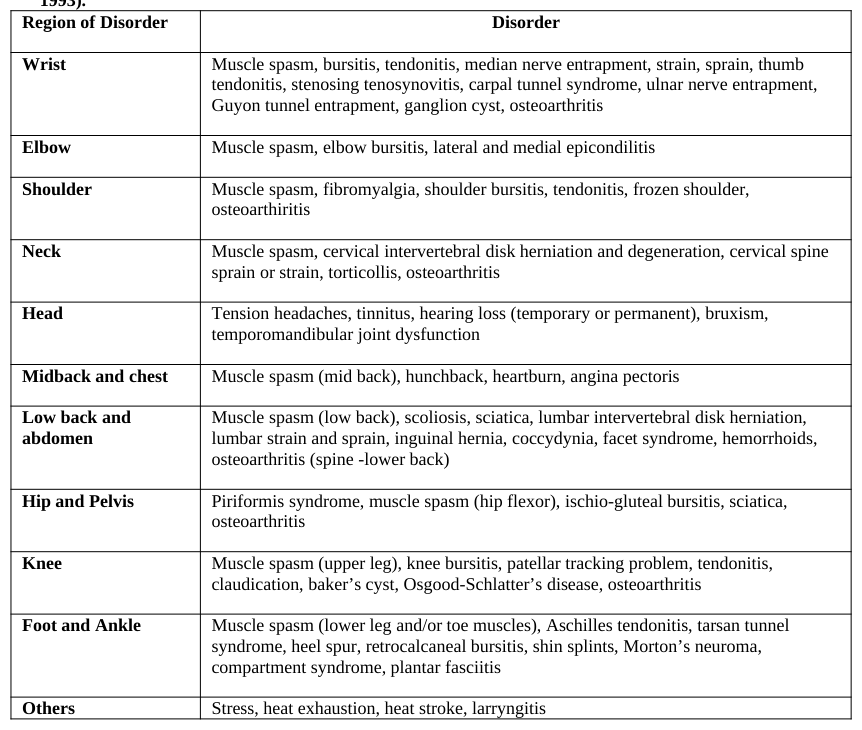
The most common injuries to drummers are repetitive strain injuries resulting from performing the same movement over and over again. Unfortunately, the repetitive motions are what drumming is all about. The other issues are due to poor body mechanics, awkward and static postures assumed during the performance. Soft tissue (muscle, tendon, ligament and bursae) injuries are the most common type. These include muscle spasm, bursitis, tendonitis, strain, sprain, thumb tendonitis, stenosing tenosynovitis, carpal tunnel syndrome, ulnar nerve entrapment, Guyon tunnel entrapment, ganglion cyst, elbow bursitis, so on. The other injuries include low back and neck injuries and pain, and hearing loss. Table 1 shows a list of these injuries by body region. Below the causes of only some of these injuries are covered partly based on the reviewed literature (e.g.; Horvath, 2010; Chasin, 2009; Workman 2006; Rempel & Bach, 1998; Norris & Torch, 1993).
Muscle spasm on hand and wrist: Prolonged constant movement of the muscles in a similar manner depletes them and causes them to freeze up. The musicians using too much rotation of wrist especially in the traditional grip and mallet playing or tight thumb grip may be the cause.
Focal dystonia in the hand and wrist: This Neurological movement disorder may be caused by too much thumb and wrist while playing snare or drum set.
Carpal tunnel syndrome: Pressure on median nerve as it goes through the carpal tunnel. Possible causes are long- term misuse of wrist, sudden increase in speed, practice time, or stick size, tighter heads, change in instrument setup, and so forth.
Neck injuries/pain: Often occurs due to over-use from postural stresses or due to frank spraining or straining of the tissues of the neck.
Sciatica: Tingling and numbness in the leg(s) due to the compression of sciatic nerve caused by the injury to back as a result of prolonged awkward sitting, large and prolonged back bending, heavy lifting, so on.
Tinnitus: It is a condition in which the brain fails to filter out “unneeded” sounds in an effective way. It forces the sufferer to notice these sounds, which often results in discomfort. Those who suffer from tinnitus often experience a noticeable increase in stress and/or anxiety, which results in detrimental effects to sleep, among other things. One of the causes of the tinnitus is overly loud sounds.
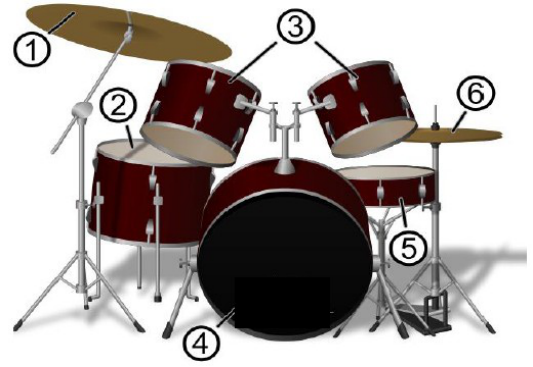
The Drum Kit Components, Set up and Use Standard parts of a drum kit are cymbal, hi-hat, snare drum, bass drum, toms, floor tom, tom-tom stands, bass drum pedals and drum thrones (Figure 1). Based on musical style, personal preference, financial reasons and mobility, it is possible to make some arrangements for drum kit components. The standard diameter sizes are: bass drum (56 cm), snare drum (36 cm), toms (30 and 33 cm), bass drum (56 cm) and floor tom (40 cm).
Figure 1. Parts of a standard drum set: (1) ride cymbal, (2) floor tom, (3) toms (2 components), (4) bass drum, (5) snare drum, and (6) hi-hat.
Stick Control and Hand-Arm Posture The drummer plays all of the components of drum kit with sticks, except bass drum. That is, drumming performance mainly is done by stick control, so if the drummer cannot use sticks correctly and effectively, drumming performance is weak. In order to use sticks correctly and effectively drummers should benefit from ergonomic principles. In order to apply ergonomics principles correctly, the constraints in stick control need t o be determined. The stick control involves the following:
All fingers are used in stick control.
Thumb and first finger are the basic fingers that apply force to the stick and other fingers support them. The
Suggested average distance between the end of the stick and the middle of the first finger is 28 cm.
Two sticks must form an angle.
Stick dimension may differ according to the type of music that drummer will play or according to the drummer’s choice. However standard sticks (length: 40 cm and dia.: 2 cm), which can be used in all music types, are the commonly used sticks. There are basically three playing styles with sticks (Figure 2):
German Style: Figure 2a shows the position of hands in German style. In this style, wrists are used in ulnar deviation while forearms are in pronation. These postures are tiresome and injurious to the wrists and elbow (Rempel and Bach, 1998).
French Style: Figure 2b shows the position of hands in French style. In this style, forearm is in semi-pronated position. Stick control in this posture involves repetitive ulnar and radial deviations of wrist.
American Style: Figure 2c shows the position of hands in American style. This is a style between German and French Styles. However it is closer to German Style. American Style is the most suggested style for drummers. It is also the most used style whole around the world by drummers. American Style is more ergonomically correct style and any injury is less likely if drummer applies it correctly.
Figure 2. The three playing styles with sticks for drummers: (a) German style, (b) French style and (c) American style
Figure available in the original PDF paper.
Criticality of Snare Drum Height The snare drum is the most frequently used component of the drum kit. All components of drum kit have adjustable height. Generally speaking, drummers set the height of hi-hat, ride, crash and toms according to snare height. So if the drummer sets height of snare wrongly, the heights of other components will also be set wrongly. This evidence shows adjusting snare height is critical for the ergonomic set up of the drum kit. Ideally, the top of the snare should be slightly below the elbow height when the drummer beats snare with sticks.
METHOD
Drumming art involves the following main MSD risk factors. These are high repetition, awkward posture, and pinching. High repetition is due to upper extremity joint motions, shoulder, elbow and especially the wrist. Awkward postures occurs at wrist elbow and shoulder joints as well. Back and neck are the other areas where awkward static postures occur. Excessive pinching may occur in stick control. In this study, the drummer’s art is investigated mainly for postural aspects. Seating posture, each of the joint postures and stick control are examined.
Based on the interviews and a discomfort survey of eight young male amateur drummers (between 20 to 30 years of age with 2 to 5 years drumming experience) using a body discomfort map soon after performance indicated that the drummers are having light to mild discomforts and pain in various parts of their bodies, especially at low back, neck, wrist and ankle areas. Some of them also complained of hearing problems.
Considering the the results of the discomfort survey and interview, a postural evaluation of drumming workstation and performance is carried out with respect to ergonomics principles. High repetition is already a known risk factor of MSDs of drummers. Hence, it was not considered for further investigation.
RESULTS AND DISCUSSION
In the following, the identified issues with the drumming postures are presented with discussions.
Posture of Wrist and Forearm for Stick Control The use of sticks in German style places the wrists in ulnar deviation while forearm in pronation. The use of sticks in French style positions the wrists in ulnar and radial deviations. Accompanied by high repetition these postures are very injurious especially to the wrists. American style, as preferred by many drummers, should be used to reduce the burden. This style places the forearms and wrists in neutral posture.
Posture for snare playing The observed eight drummers sit in varying postures. Some lean slightly back some lean forward and some in the middle as illustrated in Figure 3. Since the drummer seat does not have a back rest, sitting in leaning back (back in extension) position without back support causes too much tension in the back (Figure 3a). While playing in this posture, it is hard to beat center of the snare and it causes the drummer to have extended arm reaches tensing the shoulder and upper back area. Sitting in hunched over (back flexion) position also tenses the back muscles (Figure 3b). While playing this posture it is also hard to beat center of the snare and it cause the drummer to have awkward elbow, shoulder and neck postures as well. Both sitting postures may be the main causes of the complained low back, neck and shoulder problems by the drummers. With a seat without backrest, the least stressing posture is the middle position --sitting straight without tension (Figure 3c). This should be accompanied with occasional backward and forward motions to avoid static posture. However, further improvement is suggested in the “Recommendations” section.
Drummers make too many moves during play. As it is mentioned before snare is the component which is used most frequently and it is the center of the drum. So the drummer should set the posture according to the snare. When posture is neutral for snare, drummer will minimize the likelihood of being in awkward posture while playing with all components. Drummer should change the neutral body posture only occasionally (free posture) to reduce static posture during playing. If they must, they should also move or twist their body in very small angles only. Drummers should reach toms, hi-hat and ride without back twisting. That is, all components must be in the easy arm reach. These reaches should not cause body and neck bending. Arrangements of the drum set should be positioned so that most of the arm reach should be in the normal reach envelope and occasional reach for the maximal reach envelope. As a general rule, we can state that “Correct posture for playing snare is the correct posture for playing drum.”
Figure 3. Common postures assumed by the drummers: (a) leaning backward, (b) slouched posture and (c) middle posture
Figure available in the original PDF paper.
Posture for hi-hat playing Hi-hat is at the left and in the front. Drummers move body to front and left and use right arm to reach the hi-hat. This causes awkward posture of back, neck and extended arm reaches which may contribute to the low back, neck and shoulder problems (Figure 4a). If the seat has swivel mechanism and the drummer sit straight without tension, then the risks may be minimized (Figure 4b). Hi-hat can also be placed closer to the front of the body.
Figure 4. (a) A typical posture and (b) recommended posture of hi-hat playing
Figure available in the original PDF paper.
Posture for Ride Playing Drummers sometimes change their neutral posture during beating the ride. Just because ride is at the front and right of the snare, drummers move to the front and right. This cause awkward body posture (Figure 5a). Figure 5b shows the recommended posture of ride playing.
Figure 5. (a) An observed and (b) recommended posture for beating the ride
Figure available in the original PDF paper.
Posture for Playing Toms and Floor Tom Since toms and floor tom is close to the snare it is not difficult to play them for drummers in general. And there is no common mistake during the play of toms. However, if they are placed far away, too high, too right or left from the correctly set snare, then playing them may cause awkward back, neck and shoulder postures. The drummer must keep the neutral postures of the joints during beating all toms.
Posture of Feet for Pedal Kicking Drum is a very complex instrument that you use two hands and two feet simultaneously. Drummer’s feet stay on pedals. The right pedal controls bass drum and left pedal controls hi-hat. When drummer presses right pedal bass drum plays and when drummer presses left pedal two cymbals on hi-hat opens. Some drummers press incorrectly to the pedals (Figure 6a and 6b). Common mistake is completely contacting to the pedal with feet. Drummers must press pedals very quickly so if a drummer’s foot contacts completely to the pedal, front leg muscles will be strained. On the other hand, heel up position uses large thigh muscles and it is not stressful for the legs but back. For an ergonomically correct sitting, feet should firmly be grounded. There is a trade-off here. The best compromise could be the alternating between heel up and heel down for pedal kicking. More on this is provided in “Recommendations” section.
RECOMMENDATIONS In drumming art, everyone has own style and set up. However, to help drummers to play their art at peak performance with ease and reduce the risks of discomfort, pain and injury, the following guidelines are provided based on the ergonomics principles of working posture.
1) High repetition: High repetition is the most important risk factor for drumming injuries. However, due to the nature of the art, repetition cannot be reduced while performing. The only feasible suggestions we can make are: (i) perform at neutral postures. Because a risk factor combined with another risk factor dramatically increases the risk of injury (that is, high repetition at an awkward posture increases the risk exponentially); (ii) take frequent breaks during practice. Take one or two days off per week to rejuvenate the body. In addition, warmup before playing, and stretch before playing and during the breaks. These will reduce the effect of high repetition risk factor.
2) Seating posture: The seat of the drummers does not have a back support. So hunching over or leaning backward are the main risk factors for back related problems. For a seat without a backrest, the best seating posture would be the relaxed erect posture: The drummers should not hunch over but sit straight as much as they can but not too sraight that tenses the body. Muscles should be relaxed. However, a proper back support (i.e., a back rest) fully supporting the low back area below elbow height) without sacrificing the performance of the drummer would improve the situation dramatically. Seat should be adjustable and height should be adjusted so that hips are slightly higher than the top of the knees. Thighs go downhill slightly and will come up to about parallel to the floor when the leg is raised on the toes for pedal kicking. Seat should have a swivel mechanism to allow easy full body rotation to eliminate back twisting motions.
3) Placement of the components: As a general rule, the components should be positioned so that they will not require excessive reach or raising the arms. Keep their heights as close as possible to the elbow height and mid- sagittal plane. Keep the instruments between the belly button and mid-chest height for hand playing. And horizontally, they should span at most 90o angle centered at mid-sagittal plane. Place the component in a circular manner symmetrically about the mid-sagittal plane. Position the most frequently used components closer and easily reachable place (at or near front of the body). For example, if hi-hats are used more often than the toms, the hi-hats should be given the priority in positioning. The high placed components such as ride, hi- hat and toms should be at the same height and the surfaces should have the same angle towards the drummer to reduce excessive reach and awkward back posture. The component placement should also avoid the hand movements crossing the body.
4) Snare set up: The snare should be placed so that the beads of the sticks are landing a little bit past dead center when the arms are hanging loosely at the side. Proper position for the snare is in between the legs and the height of the snare center should be slightly lower than elbow height.
5) Feet and pedals: Pedals should be positioned where one’s feet want to go comfortably. Do not twist your ankles in any direction for the use of pedals. The bass drum to stay in-line with the leg so that the energy goes straight to the drum and so that there’s no lateral torque on the pedal hinge. Heel down technique places greater strain on the front muscles of the lower leg and causes front leg pain. Heel up technique which allows the use of large thigh muscles to press the pedal, although is more comfortable for the foot and leg, will stress the back. Occasional alternation between heel up and heel down techniques may be a better approach. In both techniques, toes hit the bass drum. For a further improvement: pedals can be designed so that they can be played by both heel kick (pivoting on the front of sole) and toe kick (pivoting on the heel) in rotation to share the work. Pedal resistance force should be low so that playing them does not require excessive foot strength. Another improvement in the pedal design could be made so that it would allow neutral ankle posture with firmly grounded foot while kicking the bass drum..
6) Sticks and stick control: Prefer to use American style which allows forearms in relaxed posture and reduces the risk of wrist deviations. Do not grip the sticks harder than necessary and allow them to move freely to reduce wrist deviations. Learn to use fingers, wrist and elbow equally with loose grip and relax the hand just before the stick strikes the drum. Do not try so hard to control the sticks allow them to do the work. Flip the stick and let it swing, bouncing independently of your hand. Try not to bend wrists in any direction. Reduce your speed as frequently as possible. Select the stick size that fits you the best. The re-design of the sticks should also be considered. As a general rule, bend the sticks not the wrists. However, there would possibly be a resistance to this radical change! Sticks handles with rubber grip material should also be considered to reduce the pressure on the fingers and improve the stick control.
7) Upper arms, forearms, wrists and hand postures: Hands should not go above shoulder height while playing the higher placed components such as ride cymbal. If this is done frequently, one could begin to experience numbness or tingling in fingers, as well as experience shoulder fatigue, neck and mid-back muscle spasms. Keep elbows at about 90o angle and try to keep them at your sides much as possible. If one must, range of elbow flexion should be kept between 60 to 100o. Do not supinate or pronate forearm. Keep wrists aligned with the forearm as much as possible. Try not to bend wrists in any direction. Let the impulse come from the large muscles of the shoulder and upper arm to minimize stress at the wrists. Shoulder angle should be at most between 20o flexion to 20o extension and naturally abducted (~15o).
8) Neck posture: Neck should not be in extension and bend sideways or rotate. Neck felexion should not exceed 10o flexion.
9) Hearing loss: Hearing protection is required. Ask a professional to measure the noise level and determine the corresponding safe daily exposure duration, even with hearing protection. Reduce your exposure time per day.
10) Listen to your body before you continue playing: Before the pain or injury occurs, there are a number proceeding signs such as stiffness, shaking, awkwardness, so on. When you feel one of these signs, stop playing. Take frequent breaks while playing and do stretching exercises during breaks. Do not continue to play when you are hurt.
11) Training on the correct use of body: The training of the drummers about the correct body mechanics is also essential. Motion economy and the least resistance are the guiding principles. Move without resistance. This is essential to reduce the injury risks.
12)Warm up, stretch, relax and breathe easily: Warming up and stretching are important before playing to reduce the risk of causing or aggravating an injury. Don´t be tense, relax and breathe deep and smoothly in and out during practice and playing.
If the drummers follow these recommendations, most likely that the risks of discomfort and injuries will be reduced and they will perform at their peak.
CONCLUSIONS
Ergonomics analysis of the drumming art is performed mainly from the postural aspects. Improper body postures of back, neck, arms, wrists, and ankles are determined with respect to the principles of ergonomics of working posture. Findings indicate that the seating posture is the most critical ergonomics related issue. Neck, and shoulders as well as ankles and wrists are also at high risks due to the awkward joint postures and high repetition. Hearing loss is identified another important problem for the drummers to be focused on.
The ergonomics guidelines are provided for the proper set up of the instruments and correct use of the body to reduce the discomfort and risk of injuies as well as increasing the playing performance.
The authors hope that this study will bring the ergonomics issues of the musicians to the attention of the ergonomists for the further investigations on the musculoskeletal disorders and performance of the musicians. The ergonomic design of musical instruments, ergonomic set up of the instruments and ergonomics of playing methods are the main potential research areas that need to be focused on.
REFERENCES
Chasin, M. (2009). “Hearing Loss in Musicians”. Plural Publishing Inc. Horvath, J. (2010), “Playing Less Hurt: An Injury Prevention Guide for Musicians”. Hal Leonard. Norris, R. and Torch, D. (1993). T”he Musician's Survival Manual: A Guide to Preventing and Treating Injuries in Instrumentalists”. Mmb Music Rempel, D. and Bach, J.M. (1998), “Effects of forearm pronation/supination on carpal tunnel pressure”. The Journal of Hand
Surgery, 23 (1), 38-42. Workman, W. (2006 ), “The Percussionists' Guide to Injury Treatment and Prevention: The Answer Guide to Drummers in Pain.”
Routledge,Taylor & Francis
LISTED IN THE AHFE DIGITAL BOOKSTORE CATALOGUE
Explore the complete digital volume
Advances in Physical Ergonomics and Human Factors: Part II
Read this individual research paper free through the original publisher, or explore the full digital proceedings book.
ISBN 978-1-4951-2105-0
Explore this ISBN in the AHFE Bookstore ↗Listed in the July 2026 bookstore catalogue; search by ISBN to confirm current availability · Digital book purchase optional