Hsin-Chieh Wu, Chin-Ting Lin, Min-Chi Chiu, Yu-Cheng Linc (2018). Usability Evaluation for Driving with the Joystick and Mechanical Hand Controllers. In: Advances in Physical Ergonomics and Human Factors: Part I. AHFE Open Access, vol. 1. https://doi.org/10.54941/10043
For lower limb disabled driving a car, mechanical manual controllers are mostly used to control the brake and accelerator. However, the joystick is mostly used to drive an airplane; is seldom used in driving a car. This study was aimed at evaluating usability of the joystick-style controller and mechanical manual controller for the lower-limb disabled driving a car. 20 participants were divided into experimental and control groups (10 persons for each group). The experimental group was lower limb disabled and the control group was non-disabled. Each subject performed driving simulator experiment with these two hand controllers, respectively. Driving performance, physiological load and subjective evaluation data were collected during the experiment. Both groups had significantly better driving performance with the joystick-type hand controller than that of the mechanical manual one. They also had significantly lower physiological load (percent of maximal heart rate) with the joystick-type hand controller than that of the mechanical manual one. However, they had similar subjective assessment between these two controllers. This study provides an advanced investigation for applying joystick in driving a car. But, further experiment should be conducted in the real road for confirming safety and efficiency.
The car is a common transportation tool in the world. The brake and accelerator of a car are generally designed to be operated by a foot. It is not difficult to learn driving in the driving school for normal people. But for the lower limb disabled person, it is difficult to go to the driving school. In addition, the lower limb disabled people cannot use foot pedal to accelerate or stop, they need manual controllers to drive a car. Taking America as an example, 11.9% of the people are disabled and 6.8% of them are ambulatory disability (Erickson, et al., 2012). These lower limb disabled persons also require driving ability to enhance their life quality (Kiyono, et al., 2001).
Generally, the mechanical manual controllers are attached to the brake and accelerator for controlling a car by hands. As we know, the joystick is operated by a hand and mostly used to drive an aircraft; is seldom used in driving a car. It is not clear whether a joystick can be operated more easily and effectively by the lower limb disabled people to drive a car. This study was therefore aimed at evaluating usability of the joystick-style controller and mechanical manual controller for driving a car.
This study applies virtual reality (VR) technology in developing a handicapped use Virtual Driving Training System (VDTS) that can let lower-limb disabled person practice driving with a hand control indoor. This project was performed for two years. The first-year research focused on establishing a virtual driving training environment and designing interaction interface of the driving simulator. The second-year research focused on evaluating two different manual controllers including horizontal handle (mechanical manual controller) and vertical joystick. The main purpose of this paper is to find a more suitable manual controller for lower limb disabled person to drive a car.
METHODS
Subjects Ten lower limb disabled persons were invited to be the experimental group, and ten non-disabled adults were treated as the control group for the experiment. The subjects were 18 years old or above and qualified for the driver's license examination, and they could not have color blindness.
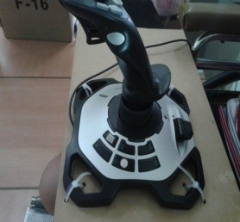
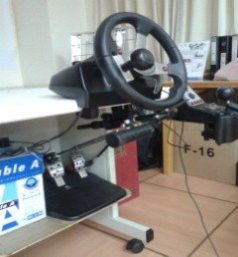
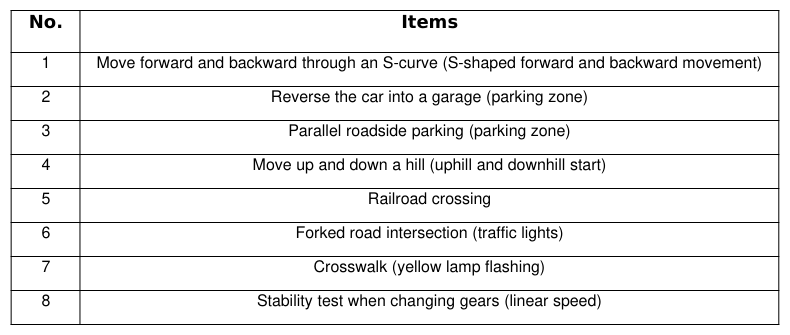
Equipments The equipments for this experiment included a desktop computer (ASUS), a portable projector (TOSHIBA TDP- T91), a projection screen (120 cm long and 120 cm wide), a throttle and brake (Logitech G25), a joystick (Figure 1), a steering wheel and a mechanical manual controller (in which a push forward represented stepping on the gas, while pressing down represented pushing on the brake, as shown in Figure 2). The virtual scene was constructed using Virtools Dev 4.0 according to the scale of an actual driving training class using 3D Max. The test items in this study were coincident with the actual road test items used in Taiwan to test basic driving skills. There were eight simulated driving training items, as shown in Table 1.
Figure 1. The used joystick in this studyFigure 2. The used mechanical manual controller in this studyTable 1: Driving training items.
Experimental Design This experiment used a virtual driving training system to compare the differences between using mechanical manual controller and the joystick for both non-disabled persons and the disabled. To familiarize subjects with the operation of the tested controllers, they practiced each controller for 30 min. After practice, a virtual road test was carried out with the two tested controllers respectively, and the driving performance, physiological load and subjective evaluation data were collected during the experiment. The driving performance assessment included completion time and number of violations. The physiological load was measured and presented in percent of maximal heart rate. The subjective evaluation is the ratings of satisfaction for using the tested controller.
RESULTS
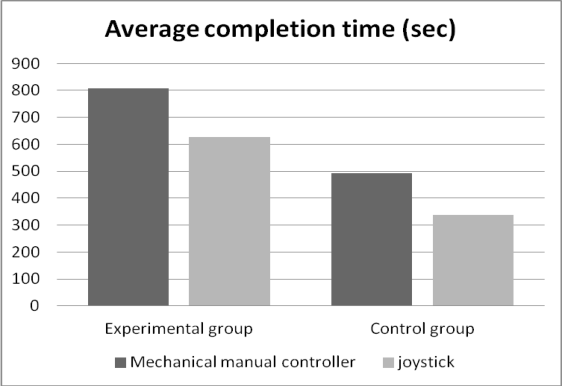
The average completion time for the tested two controllers is shown in Figure 3. The average completion time spent by the experimental group (lower limb disabled) was 806.5 sec with the mechanical manual controller; and it was 626.3 sec with the joystick. For the control group (non-disabled), the average completion time was 491.8 sec with the mechanical manual controller; and it was 337.6 sec with the joystick. Both the non-disabled and the disabled subjects had less completion time with the joystick as compared with that of the mechanical manual controller. The analysis of variance (ANOVA) results showed that the participants took significantly less time with the joystick than that with the mechanical manual controller (p < 0.05). It means that the joystick can be operated more easily than the mechanical manual controller. Further, the experimental group took significantly more time to complete the virtual road test than the control group (p < 0.05).
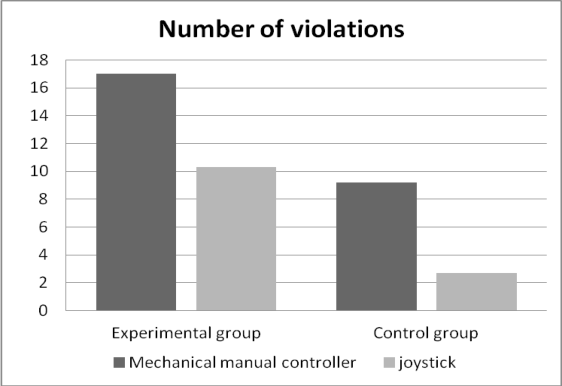
The average number of violations for the tested two controllers is shown in Figure 4. The experimental group (lower limb disabled) violated 17 times with the mechanical manual controller and violated 10.3 times with the joystick. For the control group (non-disabled), the average number of violations was 9.2 times with the mechanical manual controller; and it was 2.7 times with the joystick. Both the non-disabled and the disabled subjects had less number of violations with the joystick as compared with that of the mechanical manual controller. The analysis of variance (ANOVA) results showed that the participants violated significantly less times with the joystick than that with the mechanical manual controller (p < 0.05). It means that the joystick can be operated more effectively than the mechanical manual controller. Further, the experimental group violated significantly more times in the virtual road test than the control group (p < 0.05).
The measured physiological load results (in percent of maximal heart rate) indicated that the participants had significantly less physiological load with the joystick than that with the mechanical manual controller (p < 0.05). However, the subjective ratings of satisfaction data show that there were no significant differences between the joystick and the mechanical manual controller (p > 0.05).
Figure 3. The average completion time between the tested two controllersFigure 4. The number of violations between the tested two controllers
CONCLUSIONS
To sum up the aforesaid results, the driving performance and physiological load were improved significantly using the joystick as compared with the mechanical manual controller. But the participants did not felt significantly more satisfaction for using the joystick. This may be due to that the joystick is usually considered as an input device for computer games but not considered as a controller for driving a real car. We think further research should be conducted to test the safety and efficiency of using the joystick to drive a real car.
REFERENCES
Erickson, W., Schrader, S., and Lee, C. (2012), “2010 Disability Status Report, United States”, Employment and Disability Institute at the Cornell University ILR School, New York.
Kiyono, Y., Hashizume, C., Matsui, N., Ohtsuka, K., Takaoka, K., (2001) “Car-Driving Abilities of People With Tetraplegia” Arch Phys Med Rehabil , Volume 82 No. 10. pp.1387-1392.
LISTED IN THE AHFE DIGITAL BOOKSTORE CATALOGUE
Explore the complete digital volume
Advances in Physical Ergonomics and Human Factors: Part I
Read this individual research paper free through the original publisher, or explore the full digital proceedings book.
ISBN 978-1-4951-2104-3
Explore this ISBN in the AHFE Bookstore ↗Listed in the July 2026 bookstore catalogue; search by ISBN to confirm current availability · Digital book purchase optional