Yu-Cheng Lin, Hsiao-Ting Lu, Hsin-Chieh Wu (2019). The Study of Work Ability for the Staff of Chain Hair Salons in Central Taiwan. In: Advances in Safety Management and Human Factors. AHFE Open Access, vol. 5. https://doi.org/10.54941/ahfe100167
With the social development and economy improvement in Taiwan, people are pursuing a better life quality. The “better life quality” maybe means a self-satisfied life style for most of young people in Taiwan. They pay more attention and spend more money and time on their appearance, just like their hair styles and dressing. The growing rate of number of employees in styles hair industry is about 2% per year. Musculoskeletal disorders and chemicals exposure are the major factors to affect the working ability for the employees in hair-styling industry. However, the situation becomes worse because of the rise and development of chain hair salons and prolonged working time. The purpose of this study is to investigate the work ability with the Work Ability Index Questionnaire for staff working at chain hair salons in central Taiwan, including supervisors, hair stylists and assistants. According to the result of Work Ability questionnaire, overall Work Ability Index (WAI) is 35.14 and the work ability category is “moderate”. If the gender is considered, the WAI for male and female are 37.26 and 33.8, and their work ability categories are “good” and “moderate” respectively. If the job position is considered, only the work ability category for supervisors/branch manager is good. There are significant differences of work ability between job positions and gender. Thus, the present situation of work ability for these hair-styling staff in central Taiwan is evident and related improvement suggestions are made.
With the social development and economy improvement in Taiwan, people are pursuing a better life quality. Actually, for most Taiwanese young people “a better life” means a self-satisfied life style. They spend more time and money on their appearance, just like hair style, makeup and dressing. Thus, the “beauty economy” becomes more and more important. Hairdressing is a major part of beauty service industry. The number of labor in hairdressing industry is 31231 (0.14%) in 2010 and the growing rate of number of employees in styles hair industry is about 2% per year. The employees’ working time is almost 12 hours per day. They have to contact various chemicals when dyeing or perming and breath in various solvents. Furthermore, long standing work, poor posture and repetitive hand/upper limb activity are also serious problem for them. Thus, occupational injuries and diseases, such as occupational allergies, asthma, carpal tunnel syndrome, lower back pain, etc., may be occurred. Leino (1999) investigated the reasons of changing or leaving job for the hairdressing employees and found the number of leaving job due to musculoskeletal disorders is 2.8 times than the general population, especially the elbow and wrist musculoskeletal disorders. According to the investigation result announced by Institute of Labor, Occupational Safety and Health (2006), the growth rate of work pressure is almost 100% from 1994 to 2004. Wu (2009) considered work pressure is one of the important reasons that cause fatigue and depression, and it affect people’s work ability.
Good work ability or not is based on the dynamic process constructed by work conditions, personal characteristics and social interaction (Ilmarinen and Costa, 2000; Ilmarinen, 2001). The Work Ability Index (WAI) is an instrument used in clinical occupational health and research to effectively assess work ability during health examinations and workplace. It is determined on the basis of the answers to a series of questions which take into consideration the demands of work, the worker’s health status and resources. There were various surveys to study the work ability in different occupations (Marqueze, 2008; Tuomi, 2001). Tuomi (2001) proposed the concept architecture of work ability of elderly. Applying these concepts architecture is able to clearly understand how to improve the working ability of elderly. Radkiewicz and Widerszal-Bazy (2005) considered WAI is an internationally practical measurement indicator with good reliability and validity.
The staff in train hair salons is divided into three levels, assistant, stylist and supervisor/manager. The work content of assistant is most tedious, including shampoo, blow dry, environmental maintenance, tea service and support. Is often takes years to promote to stylist if an assistant is good in learning and test. Hair stylist, the core people in salons, provide haircut, perming and dyeing hair, hair styling, hair care and other technical services. The stylists and assistants who are poor performance may often resign their work because the salary is based on their business achievement. The supervisor/manager is responsible for the operation and management of the branch of chain hair salon.
In Taiwan, there are few studies about service industry to discuss the work ability or occupational injuries, especially for hairdressing industry. They have long been neglected. However, it is very important to realize the work ability of employees in hairdressing industry due to the special occupational characteristics. In order to understand the status of work ability of staff working in chain hair salons, this study tried to collect and analyze the work ability data with the work ability questionnaire.
METHOD
Subjects According the population characteristic, the clustering proportional sampling method was applied. Nineteen chain hair salons in central Taiwan were sampled. Finally, 93 valid questionnaires were made, including 19 supervisors or managers, 52 stylists and 22 assistants.
Questionnaire The formal work ability questionnaire applied in this study was based on the WAI developed by Finnish Institute of Occupational Health and modified according to the opinions by academics and experts.
RESULTS
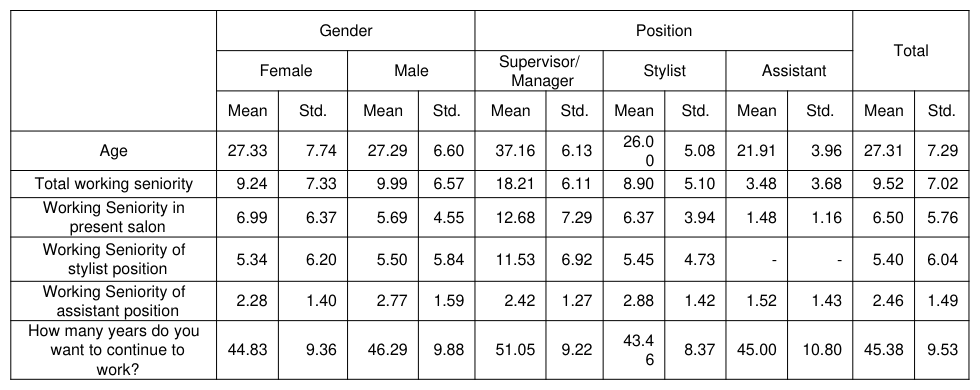
The sample subjects include 35 males and 58 females. Seventy-three subjects graduated from senior high school, 11 subjects graduated from university and 6 ones graduated from junior high school. Sixty subjects were unmarried. Other basic data was summarized in Table 1.
Table 1: Basic data summation of the staff of chain hair salons in central Taiwan.
Result of Work Ability Questionnaire and WAI
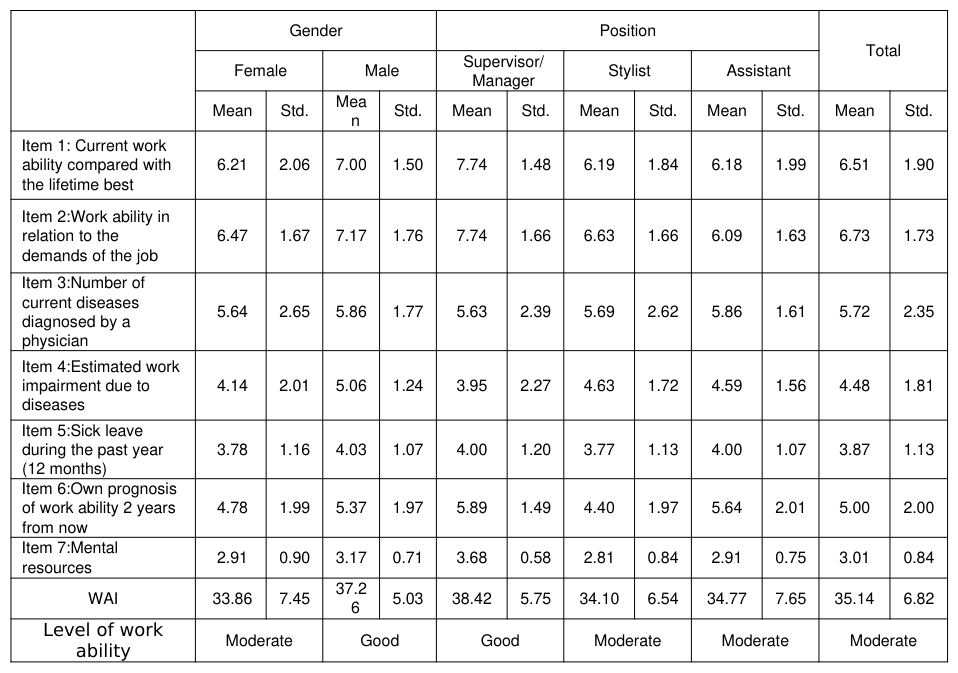
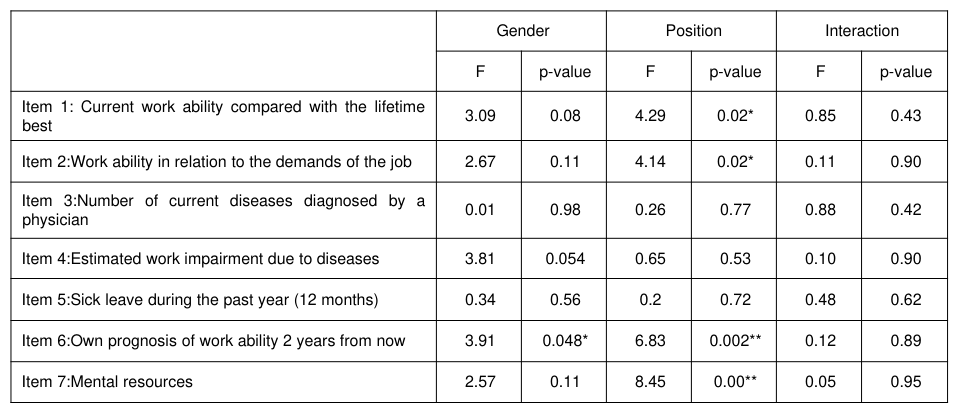
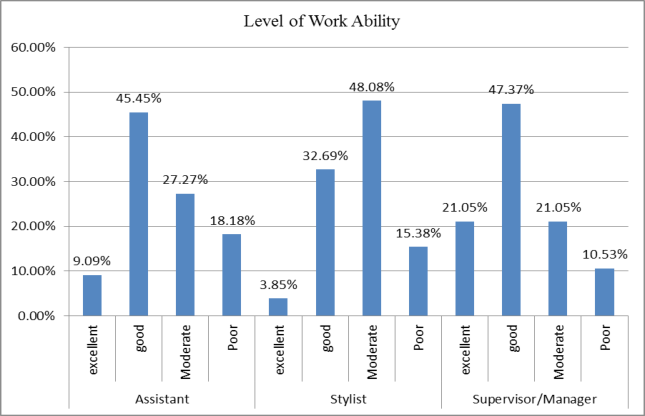
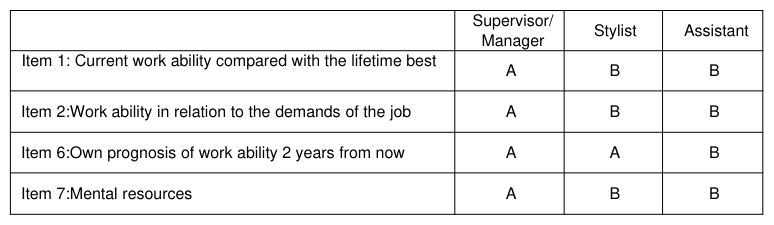
Table 2 lists the score results of 7 items in WA questionnaire. The ANOVA result in relation to the 7 items was listed on Table 3. According to the ANOVA, Item 6 showed significant difference on gender. Item 1, Item2, Item 6 and Item 7 were statistically significant on position. WAI is a summary measure of the seven items. The score depicts the worker's own concept of his/her work ability. Level of work ability and the objectives of any measures deemed necessary are classified as poor restore work ability (7-27 scores), moderate improve work ability (28-36 scores), good support work ability (37-43 scores) and excellent maintain work ability (44-49 scores). The WAI and level of work ability are also shown in Table 1. Chou (2009) researched the work ability of nurses and physical therapists In Taiwan. She found their average WAI is 37.2 and 57% of subject's level of work ability was good and excellent. After comparing this study with Chou's research, the overall work ability of staff of hairdressing industry was worse than nurses and physical therapists and should be improved, especially for assistants and stylists. Figure 1 illustrates the level of work ability divided by position. The proportions from poor to moderate categories of stylist and assistant were 63.43% and 45.45% respectively. However, the proportion of excellent and good work ability of supervisor/manager was up to 68.42% Further Duncan test was made to realize the work ability differences between positions. Table 4 lists the Duncan test results of Item 1, 2, 6 and 7. There were obvious differences between supervisor, stylist and assistant. Significant high score for manager meant his had better ability in that Item. Longer work time, few salary and unlikely promotion in few years might be the reasons that assistant got worst scores in these items.
CONCLUSIONS
This study found that the average WAI of staff of chain hair salons in central Taiwan was 35.14 and the level of work ability was only moderate improve work ability. The WAI of female and male were 37.26 and 33.83 respectively and significant gender difference existed. In terms of position, the WAI of supervisor/manager was 38.42, while those of stylist and assistant were 34.10 and 34.77 respectively. There was significant difference between positions. Only supervisor/manager could reach the level of good support work ability. In comparison with other studies, the work ability of staff of chain hair salon in central Taiwan should be improved.
Table 2: The list of scores of the 7 items, WAI and level of work ability.Table 3: The ANOVA result in relation to the 7 items of work ability.Figure 1. Level of work ability divided by positionTable 4: The Duncan test results.
REFERENCES
Chou, M.C., Suen, M.W., Lin, Y.C. (2009), “Evaluating Work Ability and Quality of Life for Clinical Nurses and Physicians in Taiwan”, 2009 Conference on Next Generation Industrial Engineering and Management. Ilmarinen, J., Costa, G. (2000), “Aging of the Working Population in the European Union”, Med. Lav., Volume 91 No.4, pp.279-
295. Ilmarinen, J. (2001), “Aging and Work”, Occupational Environmental Medicine, Volume 58, pp.546-552. Leino T., Tuomi, K., Paakkulainen, H., Klockars, M. (1999), “Health Reasons for Leaving the Profession as Determined among Finnish Hairdressers in 1980–1995”, International Archives of Occupational and Environmental Health, Volume 72 No. 1, pp. 56-59. Marqueze, E.C., Voltz, G.P., Borges, F.N.S., Moreno, C.R.C. (2008), “A 2-Year Follow-up Study of Work Ability among
College Educators”, Applied Ergonomics, Volume 39, pp.640-645. Radkiewicz, P., Widerszal-Bazy, M. (2005), “Psychometric Properties of Work Ability Index in the Light of Comparative Survey Study”, International Congress Series, Netherland: Elsevier, 1280, pp. 304-309. Tuomi, K., Huuhtanen, P., Nykyri, E., Ilmarinen, J. (2001), “Promotion of Work Ability, Quality of Work and Retirement”,
Occupational Medicine, Volume 51, pp. 318-324.
LISTED IN THE AHFE DIGITAL BOOKSTORE CATALOGUE
Explore the complete digital volume
Advances in Safety Management and Human Factors
Read this individual research paper free through the original publisher, or explore the full digital proceedings book.
ISBN 978-1-4951-2100-5
Explore this ISBN in the AHFE Bookstore ↗Listed in the July 2026 bookstore catalogue; search by ISBN to confirm current availability · Digital book purchase optional