Yan An Lin, Ming-Lang Yeh, Yu-Cheng Lin (2026). From Simple Auditory Inspection to Acoustic Feature Extraction of Drone Brushless Motors. In: Human Factors in Robots, Drones and Unmanned Systems. AHFE Open Access, vol. 218, pp. 136–142. https://doi.org/10.54941/ahfe1007686
As the application of Unmanned Aerial Vehicles (UAVs) continues to expand globally, the operational health of propulsion components such as brushless motors is critical for ensuring flight safety. Traditional inspection typically relies on manual auditory diagnostics; however, this method is inherently subjective. Because human hearing sensitivity fluctuates across different frequencies, significant discrepancies often exist between objective sound pressure levels and human perception—especially at frequency extremes. Consequently, the reliability and consistency of such auditory-based fault detection are frequently scrutinized. This research establishes an objective, multi-dimensional acoustic feature extraction framework to provide scientific, quantified data that supports human judgment, thereby enhancing diagnostic accuracy. The methodology integrates time-domain, Envelope Analysis, and Time Synchronous Averaging (TSA) techniques to extract key signal features. Analysis of a specific audio sample revealed a signal dominated by intense high-frequency noise peaking at 5,871.09 Hz, exhibiting sharp impulsive characteristics with a Crest Factor (CF) of 4.23. Following TSA processing, asynchronous noise was attenuated by approximately 84.3%, successfully isolating a periodic impact signal at 40.28 Hz, which is precisely synchronous with the shaft rotation speed. The resulting CF of 3.31 confirms the presence of regular, persistent impacts, suggesting potential bearing looseness. The proposed framework effectively isolates weak, fault-related signals from high-intensity noise environments. These objective, quantified results provide a robust scientific basis to assist operators in making more consistent and precise assessments of UAV health. Future research will focus on expanding the experimental dataset and integrating machine learning models to develop a fully automated diagnostic system.
As the applications of unmanned aerial vehicle (UAV) technology continue to expand across commercial and industrial sectors, ensuring flight safety has become a paramount issue. Within the hardware architecture of a UAV, the operational status of the propulsion system directly dictates flight
From Simple Auditory Inspection to Acoustic Feature Extraction 137 stability, with brushless DC (BLDC) motors serving as the most critical core components affecting aviation safety. However, during the stages of practical maintenance and routine inspection, current preliminary diagnostic methods still rely heavily on the subjective auditory experience of technicians.
Although acoustic signals have been proven to contain rich equipment health information in the field of industrial predictive maintenance, human- based diagnosis faces two major challenges. First, the sensitivity of the human auditory system to different frequencies is non-linear; interference from environmental noise and non-linear auditory perception often limit the efficiency of manual diagnosis (Ye et al., 2024). This physiological limitation leads to a significant discrepancy between the actual sound pressure level and the perceived loudness by the human ear, with perceptual distortion being most severe in extreme low-frequency and high-frequency regions. Second, the acoustic signatures of UAVs are extremely complex, encompassing tonal noise generated by propellers and mechanical noise from motor operation. The superposition of multiple sound sources makes traditional subjective diagnosis exceptionally challenging (Sinibaldi & Marino, 2013).
Consequently, relying solely on auditory perception for fault judgment is not only limited by the operator’s personal experience and psychological state but also struggles to maintain diagnostic consistency and reliability in variable environments. To address these limitations, the development of automated analysis tools capable of precisely identifying specific fault patterns—such as symmetrical or asymmetrical faults in BLDC motors—has become an urgent requirement in the current maintenance field (Andrioaia & Gaitan, 2024).
Based on the aforementioned issues, this study aims to establish an objective and multi-dimensional framework for acoustic feature extraction and analysis. Through scientific and quantitative methods, traditional vague subjective sensory judgments are transformed into measurable and comparable digital indicators. This framework not only provides credible data support for human auditory diagnosis but also aspires to enhance the consistency and accuracy of status monitoring for UAV propulsion systems, thereby comprehensively strengthening the overall safety of flight missions.
Development of an Acoustic Quantitative Tool to Support UAV Diagnostic Decision-Making In the maintenance workflow of UAV propulsion systems, operators often face the daunting challenge of transitioning from subjective, vague sensory experiences to objective, data-driven decision-making. Traditional diagnostics rely heavily on the auditory acuity of personnel; however, the human auditory system’s response to different frequencies is non-linear and highly susceptible to interference from psychological states and environmental noise. To establish a scientific tool capable of supporting human decision- making, this study utilized MATLAB to develop a quantitative framework specifically designed for the acoustic characteristics of brushless motors. To ensure data representativeness and avoid transitional abnormal noise during motor startup, the system precisely captured a stable operation interval from
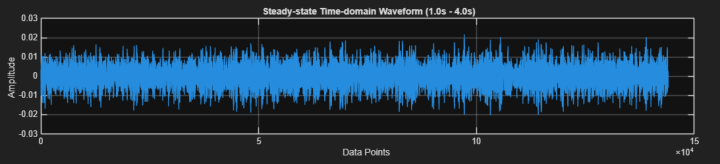
1.0 to 4.0 seconds for in-depth analysis. At an ultra-high sampling frequency of 48,000 Hz, a total of 233,472 high-density amplitude data points were acquired within this interval (Figure 1), providing a solid raw database for subsequent precision statistics.
Figure 1: Steady-state time-domain waveform of the UAV brushless motor signal (1.0–4.0 s).
Time-domain feature extraction is a core step in constructing a “digital fingerprint” for motor health. Research indicates that time-domain features such as the Crest Factor (CF) and Root Mean Square (RMS) exhibit high sensitivity in the early fault detection of BLDC motors, effectively capturing minute abnormal pulses generated by rotating components (Prieto Estacio et al., 2023). The quantitative results of this experiment showed an RMS value of 0.0051, indicating that the average energy release of the motor during stable operation is extremely low, aligning with the energy baseline for normal operation. However, relying solely on RMS values often overlooks structural defects hidden beneath a low-energy background.
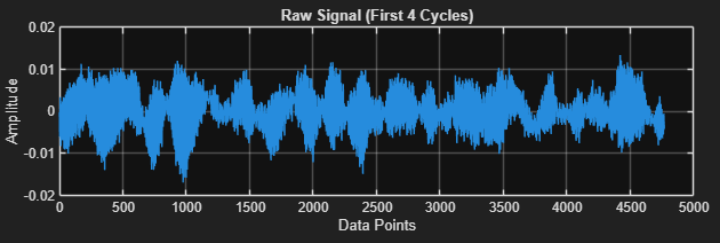
Therefore, this study specifically introduced multi-dimensional numerical cross-validation, utilizing the Crest Factor as a key indicator for anomaly identification. The experimentally measured Crest Factor reached as high as 4.2347. In signal processing theory, the Crest Factor is a critical metric for measuring the impulsive characteristics of a signal. For an ideal sinusoidal signal, the ratio of its peak value to its RMS value is constant at √2 ≒ 1.414. This value represents an extremely uniform distribution of signal energy and is often regarded as the baseline reference for non-impulsive, smooth rotating machinery. The 4.2347 measured in this experiment is significantly higher than the range of a standard sine wave (approx. 1.414) or general random Gaussian noise. These quantitative indicators provide direct physical evidence of the presence of regular and sharp impacts within the signal (Figure 2), which typically correspond to minor spalling or striking of bearing components.
From the perspective of Human Systems Integration (HSI), these digitized indicators effectively compensate for the physiological limitations of human auditory perception. Due to the masking effect of high-frequency noise, subtle clicking sounds are easily overlooked in practical environments. By transforming acoustic features into specific quantitative values (e.g., CF = 4.23), this tool significantly reduces the cognitive workload of operators. Diagnostics no longer depend on subjective descriptions of “how it sounds” but can instead provide standardized maintenance recommendations based
From Simple Auditory Inspection to Acoustic Feature Extraction 139 on the degree to which data deviates from statistical thresholds. Such a data-oriented decision support tool is key to ensuring that human-machine integrated systems maintain consistency and accuracy in judgments under high-pressure operational environments.
Figure 2: Raw acoustic signal over four cycles showing dominant high-frequency noise and sharp impulsive spikes.
A Human Systems Integration Fault Modeling Framework Integrating Time-Synchronous Averaging and Envelope AnalysisHSI To further assist operators in accurately identifying the root causes of mechanical failure amidst complex and powerful background interference, this study adopts a layered Human Systems Integration (HSI) modeling architecture that combines envelope analysis with Time-Synchronous Averaging (TSA). The core function of this architecture lies in constructing a robust digital filtering and modeling layer to thoroughly isolate weak, fault- related periodic signals from dominant random environmental noise.
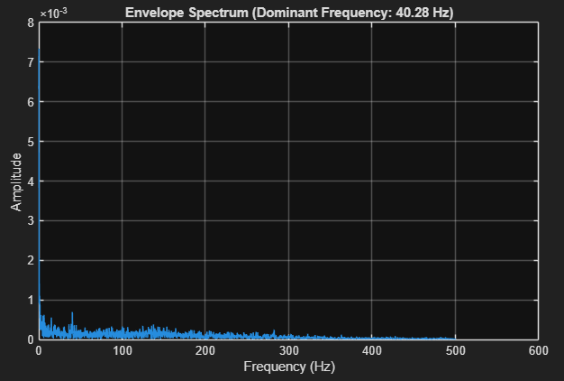
Initially, this study applies envelope analysis techniques to perform demodulation on resonance frequency bands containing high-frequency features, thereby extracting underlying low-frequency fault fingerprints. The analysis successfully identified a peak frequency of significant diagnostic value: 40.28 Hz (Figure 3). This frequency possesses high physical correlation, as it precisely corresponds to the repetition rate of the high-frequency impulses (CF = 4.23) identified in the aforementioned time-domain analysis. This indicates that a specific location within the motor (such as a bearing defect point or a loose component) generates approximately 40 physical collisions per second, synchronized with the motor shaft’s rotational speed. This mathematical causal link transforms vague abnormal sounds into concrete physical modeling events, effectively helping operators intuitively understand the severity of the fault.
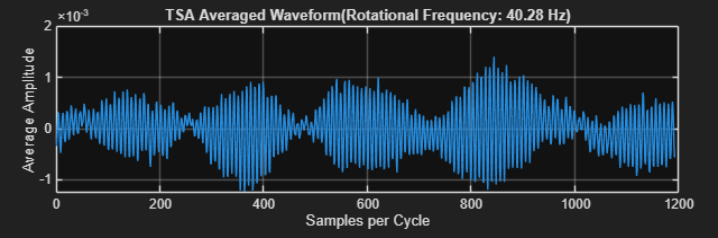
To verify the continuity of this signal and exclude sporadic interference, the study further introduces TSA technology to suppress non-correlated noise that is asynchronous with the rotational speed. Experimental data shows that after TSA processing, the energy of asynchronous noise significantly decayed by approximately 84.3%, optimizing the RMS value from the original 0.0051 to 0.0008. Despite the substantial filtering of background
energy, the post-reduction TSA crest factor remained high at 3.31 (Figure 4), far exceeding the baseline for a normal motor. To align with the human- centric manufacturing trends of Industry 5.0, by combining digital signal processing with data stream monitoring, the system can convert raw audio into visualized or numerical diagnostic indicators, significantly reducing the cognitive workload of operators and enhancing decision accuracy (Aradi & Varga, 2025).
Figure 3: Envelope spectrum of the acoustic signal with a dominant frequency at 40.28 Hz.Figure 4: TSA averaged waveform highlighting the periodic impact patterns with rotational frequency.
Within the HSI framework, this non-random impulse pattern, which remains resilient even after intensive filtering, conveys a clear diagnostic conclusion to the operator: the fault is not environmental noise but a “periodic mechanical impact” fully synchronized with the motor’s operation, pointing to potential risks of bearing looseness or structural defects. In low-speed or variable-speed environments, TSA and resampling techniques can effectively overcome the effects of rotational speed fluctuations, thereby accurately extracting periodic features related to bearing defects
From Simple Auditory Inspection to Acoustic Feature Extraction 141 (Van Hecke et al., 2016). This modeling process, which simplifies complex signals into specific spectral peaks, is a key step in strengthening decision quality within human systems integration. This framework not only achieves precise fault feature modeling but also significantly enhances the operator’s ability to identify critical risks against complex industrial backgrounds. By combining the clear waveforms after TSA noise reduction with specific peaks in the envelope spectrum, operators can perform predictive maintenance in a scientific manner, ensuring the structural integrity and flight safety of UAVs during high-intensity missions.
CONCLUSION
This study has successfully developed an acoustic diagnostic and analysis framework for UAV brushless motors based on the core concept of Human Systems Integration (HSI). By integrating multi-dimensional methods including time-domain analysis, envelope analysis, and Time-Synchronous Averaging (TSA), the system demonstrates superior signal processing capabilities, accurately isolating weak and periodic potential fault signals from the high-intensity noise background of a single audio file.
Experimental results confirm that digitized characteristic indicators can effectively compensate for the physiological limitations of traditional human auditory diagnosis regarding frequency sensitivity and subjective judgment. By transforming abstract acoustic signals into scientific quantitative data—such as reducing asynchronous noise by 84.3% in RMS through TSA, detecting a repetition frequency of 40.28 Hz via envelope analysis, and identifying significant impulsive multiples in the Crest Factor—this framework successfully identifies impact features that are persistent and synchronized with the rotational speed. Based on the synthesis of various analytical data, it is determined that the UAV propulsion component exhibits subtle and regular impact sounds, suggesting that the source of mechanical anomaly may be related to bearing looseness.
The objective quantitative indicators established in this study not only provide a solid scientific basis for operators but also effectively reduce diagnostic errors caused by variations in individual subjective experience. This significantly enhances the consistency, accuracy, and reliability of maintenance judgments.
However, certain limitations remain in the current study:
1. Lack of a standardized database: Due to variations in acoustic data generated by different combinations of engines, brushless motors, and propellers, a cross-platform standardized baseline database for precise comparison has not yet been established. 2. Real-world prediction discrepancy: A degree of predictive uncertainty may still exist between the diagnostic system’s findings and the actual physical damage.
Future research will focus on expanding the sources of test samples to cover a more diverse range of component combinations, thereby enriching
the standardized database. Furthermore, there are plans to integrate this feature extraction framework with deep learning models to develop an intelligent UAV diagnostic system with automated early warning and real-time monitoring capabilities, achieving fully automated predictive maintenance for aviation safety.
ACKNOWLEDGMENT
The authors would like to express their most sincere gratitude to their advisors for their insightful professional guidance and rigorous academic mentorship throughout the course of this research. Their invaluable expertise in the fields of mechanical diagnostics and signal processing has been instrumental in the construction of the analytical framework and the theoretical substantiation of this study.
Furthermore, we extend our heartfelt thanks to all colleagues and members of the research team. The team demonstrated exceptional technical support and collaborative spirit during the collection of UAV motor test data and the execution of complex MATLAB data simulation and analysis, ensuring the integrity and accuracy of the experimental data. The objective quantitative acoustic analysis framework established in this study is not only a result of the team’s collective efforts but is also intended to serve as a scientific and valuable evaluation benchmark for the future application and development of Human Systems Integration in the field of UAV predictive maintenance.
REFERENCES
Andrioaia, D.A. and Gaitan, V.G. (2024) ‘Finding fault types of BLDC motors within UAVs using machine learning techniques’, Heliyon, 10(10), p. e30251. Aradi, A. and Varga, A.K. (2025) ‘Servo Motor Predictive Maintenance by Kafka
Streams and Deep Learning Based on Acoustic Data’, Engineering Proceedings, Győr, Hungary. Prieto Estacio, R.S., Bravo Montenegro, D.A. and Rengifo Rodas, C.F. (2023) ‘Dataset of audio signals from brushless DC motors for predictive maintenance’, Data in Brief, 50, p. 109569. Sinibaldi, G. and Marino, L. (2013) ‘Experimental analysis on the noise of propellers
for small UAV’, Applied Acoustics, 74(1), pp. 79–88. Van Hecke, B., Yoon, J. and He, D. (2016) ‘Low speed bearing fault diagnosis using acoustic emission sensors’, Applied Acoustics, 105, pp. 35–44. Ye, T., Peng, T. and Yang, L. (2024) ‘Review on Sound-Based Industrial Predictive
Maintenance: From Feature Engineering to Deep Learning’, Mathematics, 12, p. 256.
LISTED IN THE AHFE DIGITAL BOOKSTORE CATALOGUE
Explore the complete digital volume
Human Factors in Robots, Drones and Unmanned Systems
Read this individual research paper free through the original publisher, or explore the full digital proceedings book.
ISBN 978-1-964867-94-6
Explore this ISBN in the AHFE Bookstore ↗Listed in the July 2026 bookstore catalogue; search by ISBN to confirm current availability · Digital book purchase optional