Enrico Occhipinti, Daniela Colombini (2018). Trends in Management of Risks Associated to Biomechanical Overload Based on New ISO Technical Report. In: Advances in Physical Ergonomics and Human Factors: Part I. AHFE Open Access, vol. 1. https://doi.org/10.54941/10036
When studying WMSDs, several risk factors of different nature (mechanical, organizational, psychosocial, individual) are considered to be significant in general models of risk assessment and management and for epidemiologic purposes. As a consequence an “holistic” approach to their prevention was confirmed specially at international and national level when planning guidelines and interventions. On the other side there is a strong request, from OSH agencies and operators, for developing “simple” tools for risk assessment and management. ISO technical standard on “Ergonomics and Biomechanics” adopt a general approach to risk assessment and management according to four basic steps: hazard identification; risk estimation; detailed risk evaluation; risk reduction. ISO has defined a number of technical standards in the field of “physical ergonomics” regarding working postures, load manual handling, repetitive manual work (ISO 11226 and 11228 series) that in some manner take into account the contemporary presence of several risk factors. As a reaction to request from many practitioners, ISO has now completed a special application document (ISO TR 12295) to better clarify application procedures of the methods reported in such standards.
WMSDs are mainly caused by working activities involving load manual handling (or manual materials handling), heavy physical job, awkward postures, upper limb repetitive movements or exertions, vibrations. Moreover, the risk for WMSDs can increase versus high working paces, low job satisfaction, high job demand and working stress. On the other side it is well known that for each of the above general conditions (LMH, heavy physical work, awkward postures, repetitive movements) manifold working risk determinants are to be considered in an integrated way and organizational factors (pace, duration, break, task rotation) play a basic role in determining the overall exposure level.
When studying WMSDs, several determinants of different (mechanical, organizational, psychosocial, individual) nature considered to be significant in general models of risk genesis, assessment and management and for epidemiologic purposes. As a consequence an “holistic” approach to their prevention was confirmed especially at international and national level when planning guidelines and interventions.
However, nearly opposed to such a requirement and just considering the widespread diffusion of WMDSs and Physical Ergonomics I (2018) related manifold causal factors (mechanical, organizational, psychosocial) at many workplaces, operators and national and international agencies involved in prevention have been increasingly asking for simple tools for assessment and management of specific risk to be used also by unskilled workers in developed and developing countries.
ISO, after defining a number of technical standards of “physical ergonomics” of working postures, load manual handling, repetitive manual work (ISO 11226 and 11228 series) (ISO 2000, 2003, 2007a, 2007b), has now completed a special application document (ISO TR 12295) to better clarify application procedures and modalities of the methods reported in such standards (ISO, 2014). This application document has a dual scope:
1) To provide all users, and particularly those who are not experts in ergonomics, with criteria and procedures to identify the situations in which they can apply the ISO standards and eventually apply a "quick assessment" procedure to easily recognize activities that are "certainly acceptable" or "certainly critical" in order to apply risk reduction measures.
2) To provide users who have sufficient experience in ergonomics with details and criteria for applying the risk assessment methods proposed in the original standards of the series especially when analysing so called “multiple/complex manual task”. In fact one relevant problem is to apply simple risk evaluation methods (in the standard) when several tasks with a “biomechanical overload” are performed all together in the same period of time (i.e a shift). To this aim no many proposals exist but some simplified solution could be addressed with reference to both multiple lifting tasks (variable or sequential lifting tasks) using adaptations of the RNLE and multiple repetitive tasks using defined procedure applying the OCRA checklist.
Hence the presentation of the main contents of TR ISO 12295 leads to defining the main issue that will be tackled in this paper: how to start from an holistic approach to WMSDs prevention and get to use simple tools also by unskilled people. In other words: how to simplify complexity?
PROPOSAL General issues
The proposals presented here are aimed at simplifying complexity and are based on two basic criteria:
1. acting with a step-by-step approach (by levels) using first basic tools and then progressively more complex tools only if actually necessary for prevention purposes.
2. taking always into account the overall issues and the presence of manifold risk determinants at every step (even if with different degrees of in-depth examination).
It is to be remarked that such proposals were mainly developed in the frame of the WHO/IEA collaboration project (WHO, 2010) for the “toolkit for MSD prevention” strongly involving EPM research unit as the coordinator of IEA TC on MSD and also as an integral part of CC/OMS at the Clinica del Lavoro Luigi Devoto of Milan. However they also arise from other converging requests such as for ISO TR 12295, applying the ISO 11228 series standards.
With reference to the first criterium, it is well known for example that the above mentioned ISO technical standards adopt a general approach to risk assessment and management according to four basic steps: hazard identification; risk estimation; detailed risk evaluation; risk reduction This approach is largely shared in the practice by prevention operators and anyhow is fully corresponding to all the purposes mentioned here, being helpful in detailing the present proposal. As a consequence the proposed strategy in the use of evaluation tools envisages the following levels:
1. BASIC LEVEL: Addressed to preliminary identification of the main hazards (or problems) associated with working condition and priority identification via “Key Enters”. Ideally this level concerns all the possible hazards (or problems) in the field of ergonomics, industrial hygiene and occupational medicine. This paper however will be focused on key issues regarding hazards (or problems) for the musculoskeletal system. This level can be operated also by unskilled staff with limited education and training.
2. FIRST LEVEL: Focused on risk factors for WMSDs and consisting of a “quick assessment” of identified hazards (via Key Enters). This level can be operated also by unskilled staff with a minimum education and training.
3. SECOND LEVEL: As a result of the first level, recognized risk estimation tools are used (mainly from international standards or guidelines). Such tools should be able to adequately consider the main risk determinants. This level can be operated only by staff with some specialist education and training.
Beyond the second level, if the study (finalized to subsequent stages of preventive measure adoption) needs more details, reference can be made to more analytical methods proposed by standards or literature. Detailed methods however have to be used only upon circumstances by skilled and trained staff..
Entry level It is aimed at checking the existence of a working hazard/problem (hazard identification) - in this particular case for WMSDs – and whether a further analysis is necessary.
As for WMSDs risk factors, there are several proposals of key enters to identify crucial conditions (or hazards).
Adopting criteria and definitions provided by (ISO and CEN) international technical standards on this subject (CEN 2003 and 2007, ISO 2000,2003,2007a and 2007b), Table 1 reports the “key enters” representing the basic (entry) level of hazard identification for the consequent application of related ISO standards.
Table 1: Key enters to the evaluation of biomechanical overload as considered in ISO 11226 and
Table available in the original PDF paper.
11228 (parts 1-2-3)
First level (Quick assessment) This level consists in quickly checking the presence of potential hazard conditions (for WMSDs) via simple quali/quantitative questions. It is essentially aimed at identifying in a simplified way, three possible outputs: 1) acceptable (green): no actions are needed; 2) critical (very red): it is urgent to re-design the workplace or the work process; 3) a more in-depth investigation is needed through a detailed estimation or assessment via second level tools.
Such level, especially if aimed at quickly checking acceptable conditions, is often explicitly present in the mentioned international technical standards.
On the other hand, for quick assessment of surely critical conditions, it is possible to apply definitions and criteria inherent in the methods recommended by standards setting the presence of one or more extremely problematic elements. Such are for example values of weights lifted beyond the maximum recommended value, extreme load lifting areas, extremely high action frequencies with upper limbs, presence of repetitive maximal strength demands.
As to the specific purposes of this level, the ISO Application Document helps us to outline the questions quickly checking predictable acceptability and surely critical conditions.
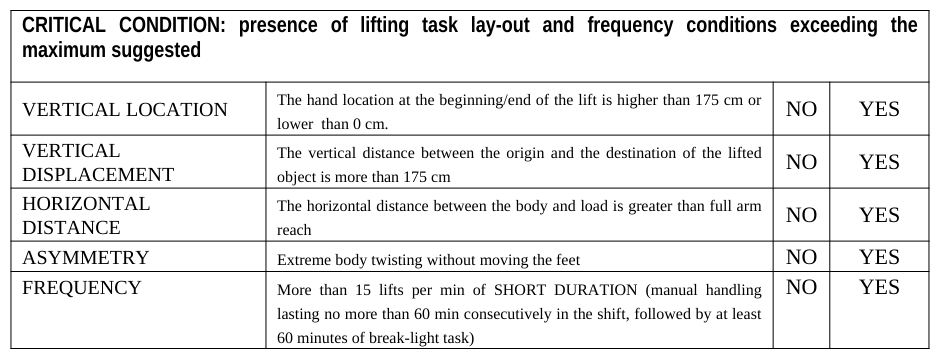
Tables 2 and 3, as an example, shortly report the criteria respectively for a quick “acceptability” and “criticality” assessment of manual lifting as from ISO 11228-1 standard.
Table 2: Quick assessment for manual lifting activities: check of an acceptable condition (green area)
Table available in the original PDF paper.
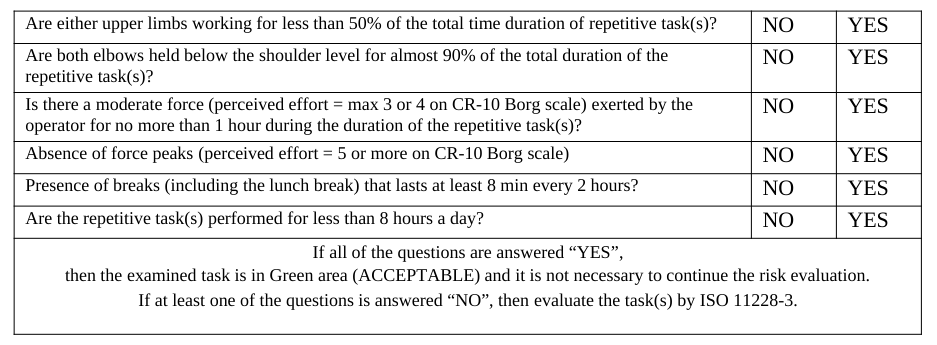
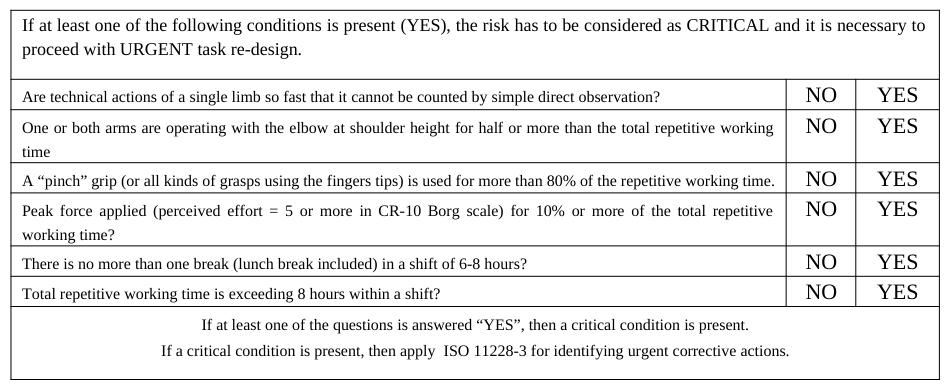
Table 4 and Table 5 report questions for quick assessment of “acceptable” and “critical” conditions for upper limbs repetitive movement (from ISO 11228-3). Similar tables identifying both “acceptable” conditions and “critical” conditions regarding push/pull actions and static postures are given in TR ISO 12295. They are skipped here for space reasons.
As already clarified, quick assessment is aimed at identifying, in a simplified way, the existence of acceptability and criticality conditions respectively, with a potential biomechanical overload of the musculoskeletal system. When these conditions (either of them) are fulfilled, it is not necessary to make a more detailed estimation of exposure level (second level). Instead, when none of the two conditions clearly emerges (maybe in most cases), it is necessary to make a simplified risk assessment (estimation).
It is emphasized that the use of the quick-assessment method is best completed using a participatory approach involving workers in the enterprise. Such involvement is considered essential to identify effectively priorities for dealing with the different hazard and risk conditions and, where necessary, to identify effective risk reduction measures.
Once hazards have been identified (by key enters and quick assessment), except for a possible more detailed risk analysis, simple intervention procedures and concrete solutions for limiting the main risk determinants could be suggested and encouraged according to priorities
Table 3: Quick assessment for manual lifting activities: check of a surely “critical” condition (“very” red area)Table 4: Quick assessment for repetitive task(s) of the upper limbs - Acceptable conditions Are either upper limbs working for less than 50% of the total time duration of repetitive task(s)? NO YESTable 5: Quick assessment for repetitive task(s) of the upper limbs - Critical conditions If at least one of the following conditions is present (YES), the risk has to be considered as CRITICAL and it is necessary to proceed with URGENT task re-design.
Second level (simple risk estimation) At this level, as a consequence of operational outcomes provided by previous level, exposure (or risk) estimation is to be made considering one or more potential biomechanical overload conditions of the musculoskeletal system. With this view, appropriate and recognized risk estimation methods and tools are to be used as from qualified literature or better international standards and guidelines. Such tools should be able to appropriately consider the main risk determinants.
Several literature reviews could be useful to this purpose. Here we may only shortly refer to some recent works such as
“Systematic review of observational methods assessing biomechanical exposures at work” by a reputed panel experts from Scandinavian countries (Takala et al., 2010), whose details are fully reported at http://www.ttl.fi/en/ergonomics/workload_exposure_methods/pages/default.aspx .
A toolbox produced by the Occupational Health and Safety Council of Ontario (OHSCO) of Canada and in particular from chapter “More on In-depth Risk Assessment Methods” (OHSCO, 2008), whose details are reported at http://www.esao.on.ca/downloads/MSD.aspx Apart from this, we are here definitely oriented towards the proposals and methodologies included in international technical standards (in particular ISO) since they have already been chosen at international level for method validity and applicability. Basically, one may refer to the example of methods revised and proposed by ISO 11228-3 concerning assessment and management of high frequency repetitive manual activities. A special information enclosure attached to this standard, after declaring to assume as a general reference model the one pro-posed by a consensus document produced by the IEA TC on WMSDs (Colombini et al., 2001), proposes, selects and discusses the detailed risk estimation and assessment methods of upper limb biomechanical overload better reflecting that consensus document and the same standard goals.
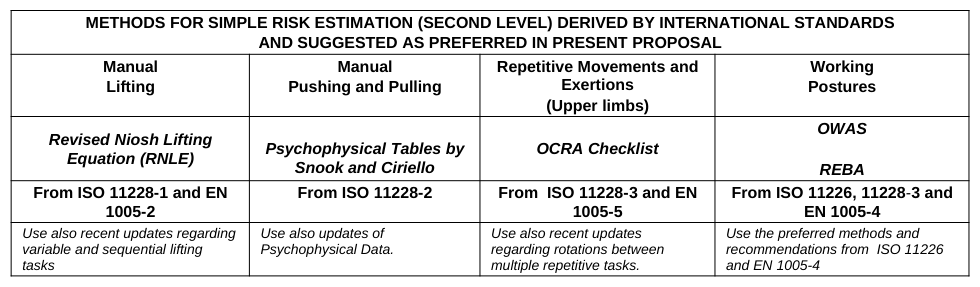
Considering this very short review of second level methods for risk estimation and evaluation, the preference on methods suggested by technical standards on the subject is confirmed as reported in Table 6, considering the different conditions of potential biomechanical overload of musculoskeletal system.
This choice is strengthened by the options coming from the “Application document” for ISO 11228 series and ISO 11226 standard. Actually this document confirms:
usefulness of RNLE method of NIOSH also in view of assessing, if strictly necessary in a simplified way, complex (variable and sequential) lifting activities, according to recent proposals in the literature (Colombini et al., 2012 ; Waters et al 2007) and translated into free applicative software that can be downloaded from dedicated websites (e.g. www.epmresearch.org ).
usefulness of OCRA checklist method to assess upper limb repetitive manual activities with particular reference to rotation conditions in several repetitive tasks according to the techniques reported in ISO 11228-3 standard and further developed by authors for so called infrequent rotations (Occhipinti et al., 2008). In this case as well applicative software are available to be freely downloaded from website www.epmresearch.org.
In ISO TR 12295 details and criteria are given for applying the risk assessment methods proposed in the original standards of the series especially when analysing so called “multiple/complex manual task”. In fact one relevant problem is to apply simple risk evaluation methods (in the standard) when several tasks with a “biomechanical overload” are performed all together in the same period of time (i.e a shift or in a week). To this aim some simplified solution are addressed with reference to both multiple lifting tasks (variable or sequential lifting tasks) using adaptations of the RNLE and multiple repetitive tasks using defined procedure applying the OCRA checklist..
The use of above methods for complex (repetitive or lifting) tasks, though aided by simple and easily accessible software, looks like an advanced second level to be tackled only by people with a sufficient training degree in basic techniques. Physical Ergonomics I (2018)
It is also worth recalling that beyond the second level, more detailed risk assessment methods are available, both observational ones (e.g. the OCRA index method, that is the Preferred method in ISO 11228-3) and instrumental ones (e.g. electromyographic techniques combined with electrogoniometric recordings and analysis of 3D movement). Such techniques are to be used when the study (addressed to subsequent stages of preventive measure adoption) strictly needs more in-depth details and are for experts’ use only; their examination however is outside the scope and logics of the present proposal.
Table 6: Main methods for second level, suggested in this proposal for “risk estimation”, as derived from different international standard.
Details regarding the RNLE adaptations for analysing multiple lifting tasks For correctly studying manual lifting, it is primarily necessary to define task characteristics according to the criteria given below:
MONO TASK (defined as single-task by NIOSH) are defined as tasks involving the lifting of only one kind of object (with the same load) using always the same postures (body geometry) in the same lay-out at origin and destination. In this case the “traditional” Lifting Index (LI) computational procedure could be followed, as also substantially reported in ISO 11228-1.
COMPOSITE TASK (defined as multi-task by NIOSH) are defined as tasks involving lifting objects (generally of the same kind and mass) using different geometries (collecting and positioning from/on shelves placed at several heights and/or depth levels). Practically each individual geometry is a task “variant” and takes the name of “subtask”. In this case the Composite Lifting Index (CLI) computational procedure could be applied as presented in the Applications Manual for the Revised NIOSH Lifting Equation (Waters et al., 1994). It is to be underlined that no more than 10-12 variants or subtasks could be considered by this procedure.
VARIABLE TASK is defined as a lifting task in which both the geometry and load mass vary in different lifts performed by the worker(s) in the same period of time. The VLI (Variable Lifting Index) is suggested for assessing these complex types of lifting tasks (Colombini et al., 2012)
SEQUENTIAL TASK is defined as a job in which the worker rotates between two or more Mono task and/or Composite task and/or Variable task during a work shift (each task lasting no less than 30 min consecutively). In this case the Sequential Lifting Index (SLI) computational procedure could be followed (Waters et al. 2007).
Details of these procedures are given in the references quoted.
The new procedure for variable tasks maintains the original NIOSH criteria, via simplifications in data collection and new dedicated software (see www.epmresearch.org) . This revised procedure is not "mandatory" but could be considered as a “guideline” to all potential users on how to adequately collect and manipulate relevant data to produce the final output. The VLI procedure should be used in complex lifting tasks such as may be found in warehousing, baggage handling, supermarket, and certain service jobs where the mass of the load is being lifted and the geometry of the lift (e.g., horizontal reach, vertical height, etc.) may vary between each lift.
Details regarding the OCRA Checklist OCRA Checklist is one of the method/tools suggested in ISO 11228-3 for the purposes of “simple risk estimation” (Occhipinti and Colombini, 2006). Since the OCRA checklist is based on the same general framework, criteria and definition of the “Consensus Document” assumed as a reference in ISO 11228-3 and the OCRA index method assumed as preferred for method 2, it seems useful to briefly report an updated description of the tool.
The OCRA checklist is useful to quickly identify the presence of the main risk factors for the upper limbs and classify the consequent exposure. It is therefore recommended for the initial screening of several workstations in an enterprise featuring repetitive tasks, whilst the complete OCRA index is useful for the (re)design or in-depth analysis of workstations and repetitive tasks.
The analysis system suggested with the OCRA checklist starts with assigning the coded scores for each of the main risk factors (number of working hours without recovery period, frequency, force, posture) and for the additional factors. For each risk factor several scenarios are presented and for each scenario a score is suggested (ranging from 0 to maximum as the potential risk increases). The sum of the partial scores (for each risk factor: frequency, force, posture, additional factors) obtained in this way produces a partial final score. To obtain the final exposure value, two multipliers must be applied to calibrate the partial final score, considering both the net duration of repetitive work and the presence of hours without adequate recovery. This procedure allows estimating the actual exposure in different levels (absent, borderline, light, medium and high). The OCRA checklist describes a workplace and estimates the intrinsic level of exposure if the workplace is used for the whole of the shift by one worker. This procedure makes it possible to quickly find out working at which workplaces generate a significant exposure level.
In the next stage, it is possible to estimate the exposure indexes for the operators considering their rotation through the different workplaces. From an operative point of view, if the operator/s work(s) in two or more workplaces implying repetitive tasks (multiple task), to obtain the specific exposure index (OCRA Checklist score) of that operator/s it is necessary to distinguish two different scenarios (Occhipinti et al., 2008):
1) Rotation among repetitive tasks has a frequency of almost once every 90 minutes In this case the time weighted average approach should be preferably used, employing the following formula: Checklist final score = [(sc. A x %PA) + (sc. B x %PB) +….+(sc. N x %PN)] x duration multiplier where:
“score A”, “score B”, etc., are the checklist scores obtained for the various workplaces (tasks) on which the same operators work, and %PA, %PB, etc., represent the percentage time duration of the corresponding repetitive tasks with respect to the overall duration of all repetitive tasks considered during one shift.
duration multiplier = multiplier given by the total net duration of all repetitive tasks (A+B+…+N) in the shift. 2) Rotation among repetitive tasks has a frequency of less than once every 90 minutes In this case the “worst condition” approach should be used, employing the following formula:
Equation reproduced from the original PDF.
where:
1,2,3,…,N = repetitive tasks ordered by their exposure levels (1= highest) considering respective continuous duration multipliers (Dumi from Table C.7);
Dumi = duration multiplier for taski real continuous duration;
Dumtot = duration multiplier for total duration of all repetitive tasks;
∆ score1 = score of task1 considering Dumtot - score of task1 considering Dum1;
K = (score 1 max * FT1) + (score 2 max * FT2) +…+( score N * FTN); (score 1 max)
score i max = score of task i considering Dumtot;
FTi = Fraction of Time (values from 0 to 1) of taski with respect to the total repetitive time.
Whilst in the industrial sectors tasks rotate often in a similar way every day and consequently the previous procedures could be easily applied, in some productive sectors (agriculture, construction, cleaning, supermarket, Physical Ergonomics I (2018) etc.) exposure assessment is much more complex being characterised by the presence of several tasks over periods longer than a typical working day (weekly, monthly, yearly turnover).
For example in agriculture turnover is typically yearly. Each month of the year is characterized by different processing, each including different tasks.
Some working situations clearly show a weekly rotation pattern of repetitive tasks, for example tasks carried out in kitchens (especially for food preparation in business or school canteens), for some organizational models of cleaning, supermarkets, etc.
Studies are reported to organize models for assessing such situations where tasks rotate within weeks, months or a year. In general those studies are based on the use of the Checklist OCRA and on adaptations of the two multitask analysis approaches (average and complex) that have been previously presented.
The general procedure for studying such situations is based on the use of the Checklist OCRA and on adaptations of the two multitask analysis approaches (average and complex) that have been previously presented. It implies 3 operating stages:
1) Completing a preliminary organizational study to establish the kind of turnover: the periodicity of the different repetitive tasks as repeated in time (daily or weekly or monthly or yearly). 2) Defining the risk level “intrinsic” in each task, using the OCRA checklist. Intrinsic level means ascribing to the repetitive task a net duration of 440 minutes/shift with 2 breaks, 8-10 minutes each, and a lunch break of at least 30 minutes. 3) Applying specific mathematical models (adaptations of average or complex approach) considering intrinsic values as well as organizational patterns (duration, frequency and sequences) of individual tasks under study.
The choice of the most predictive model will necessarely be based on the collection of relevant epidemiological data. The preliminary data collected seem to confirm a better validity of the “worst condition” approach (OCRA Multitask Complex).
Also for these situations and procedures, applicative software are available to be freely downloaded from website www.epmresearch.org.
CONCLUSIONS
Using a step by step approach and tools validated by experience allow to tackle the challenge of simplifying complexity in WMSDs prevention also in difficult situations such as small companies, craftwork, and in developing countries. For these targets however some issues are still missing such as:
- promotion of WMSDs prevention plans by national or regional authorities - improved basic knowledge of operators - shared spreading of tools and related software. - development of a database system dedicated to prevention and freely accessible also to non-experts. Besides, whatever the application level – even if basic – of evaluations and interventions, the impact of organizational issues (frequency, duration, break, rotations, etc) in WMSDs assessment and prevention is to be emphasized. These issues are quite relevant in determining WMSDs risk and have to be carefully considered at least to the same extent as the more traditional mechanical factors (force, loads, postures, vibrations). Finally, last but not least, great attention was focused in this document on risk identification and estimation. Actually these are the grounds for any preventive and risk reduction action regarding biomechanical overload on the musculoskeletal system. Risk reduction being our ultimate goal, collecting, spreading and sharing good practice experience is to be considered as a substantial part of the toolkit initiative for WMSDs prevention.
REFERENCES
CEN (2003), “EN 1005-2. Safety of machinery - Human physical performance - Part 2: Manual handling of machinery and component parts of machinery”. CEN (2007), “EN 1005-5. Safety of machinery - Human physical performance - Part 5 Risk assessment for repetitive handling at
high frequency”. Colombini, D., Occhipinti, E., Delleman, N., Fallentin, N., Kilbom, A., Grieco, A. (2001), “Exposure assessment of upper limb repetitive movements: a Consensus Document, in International Encyclopedia of Ergonomics and Human Factors, W. Karwowski (Ed.),London:Taylor and Francis. pp. 52-66 Colombini, D., Occhipinti, E., Alvarez-Casado, E., Waters, T. (2012), “Manual lifting: a guide to the study of simple and
complex lifting tasks”.CRC Press.Taylor and Francis Group. Boca Raton. ISO (2000), “ISO 11226. Ergonomics — Evaluation of static working postures”. ISO (2003), “ISO 11228-1. Ergonomics - Manual handling - Lifting and carrying”. ISO (2007 a), “ISO 11228-2. Ergonomics - Manual handling - Pushing and pulling”. ISO (2007 b), “ISO 11228-3. Ergonomics - Manual handling - Handling of low loads at high frequency”. ISO (2014), “ISO TR 12295. Ergonomics — Application document for ISO standards on manual handling (ISO 11228-1, ISO 11228-2 and ISO 11228-3) and evaluation of static working postures (ISO 11226)”. In press. Occhipinti, E., Colombini, D. (2006), “A Checklist for Evaluating Exposure to Repetitive Movements of the Upper Limbs Based
on the OCRA Index” in International Encyclopedia of Ergonomics and Human Factors second edition, W. Karwowski (Ed.), Boca raton: CRC Press - Taylor and Francis. pp. 2537-2541 Occhipinti, E., Colombini, D., Occhipinti, M. (2008). “Metodo Ocra : messa a punto di una nuova procedura per l’analisi di compiti multipli con rotazioni infrequenti”. La Medicina del Lavoro; Vol.99 (3): pp 234-241 Occupational Health and Safety Council of Ontario (OHSCO) (2008), “Part 3c - More on In-depth Risk Assessment Methods”.
Musculoskeletal disorders prevention series n.5159A. Takala, E.P., Pehkonen, I., Forsman, M., Hansson, G.Å., Mathiassen, S.E., Neumann, W.P., Sjøgaard, G., Veiersted, K.B., Westgaard, R.H., Winkel, J. (2010), “Systematic evaluation of observational methods assessing biomechanical exposures at work”. Scand. J. Work Environ. Health ; Vol.36(1):pp 3-24. Waters, T.R., Putz-Anderson, V,, Garg, A. (1994). “Applications manual for the Revised NIOSH Lifting Equation”.
DHHS(NIOSH) Publication No. 94-110. National Institute for Occupational Safety and Health, Centers for Disease Control and Prevention. Cincinnati, Ohio, 45226. Waters, T.R., Lu, M.L., Occhipinti, E. (2007), “New procedure for assessing sequential manual lifting jobs using the revised NIOSH lifting equation”. Ergonomics; Vol. 50(11): pp 1761-1770. WHO (2010). “Healthy workplaces: a model for action: for employers, workers, policymakers and practitioners”.
World Health Organization. ISBN 9789241599313.
LISTED IN THE AHFE DIGITAL BOOKSTORE CATALOGUE
Explore the complete digital volume
Advances in Physical Ergonomics and Human Factors: Part I
Read this individual research paper free through the original publisher, or explore the full digital proceedings book.
ISBN 978-1-4951-2104-3
Explore this ISBN in the AHFE Bookstore ↗Listed in the July 2026 bookstore catalogue; search by ISBN to confirm current availability · Digital book purchase optional