Franziska Braun, Oliver Schweizer (2026). Designing for Less and Longer: An Operational Framework for Lifecycle Governance, Control and Resource Efficiency. In: Human Systems Engineering and Design (IHSED2026): Future Trends and Applications. AHFE Open Access, vol. 237, pp. 555–564. https://doi.org/10.54941/ahfe1008195
The transition from a recycling-based economy to a circular economy requires more than isolated improvements in materials, energy efficiency or end-of-life treatment. Especially in the early stages of product development, the fuzzy front end, interdisciplinary teams of engineers and product designers face high uncertainty while making decisions that strongly shape the product system. Existing approaches provide valuable support for lifecycle-oriented analysis or selected circular design strategies but still lack an integrative and practical framework that enables interdisciplinary teams to reflect on the current product system and derive actionable design directions. This paper addresses this gap by proposing an operational framework for circular product design grounded in the derived guiding principle of “Less and Longer”. The framework combines lifecycle thinking, multidimensional evaluation and a control-oriented perspective in a Circular Design Matrix supporting early-stage decision-making in circular product development. It facilitates interdisciplinary collaboration and supports reflective, creative dialogue among technical and creative disciplines. The Circular Design Matrix assess the product system across seven dimensions and five lifecycle phases with “control” as an enabling layer for a strategic re-design. Embedded in a collaborative framework, the approach was explored in an initial evaluation using three product cases: smartphones, washing machines and child car seats. The findings indicate that the framework is particularly valuable in interdisciplinary workshop settings, where it supports structured reflection, the identification of optimization potential and an iterative, holistic reconsideration of the product system from a circular economy perspective.
The transition from a recycling-oriented economy towards a circular economy is fundamentally reshaping product development. Whereas earlier sustainability efforts often focused on isolated improvements, such as material substitution or end-of-life recycling, these measures alone are no longer sufficient; circular economy requires more comprehensive strategies that extend product lifetimes and address circularity across the entire lifecycle
Received May 15, 2026 Revised June 27, 2026 Accepted July 10, 2026 Available online September 25, 2026
556 Braun and Schweizer (Bocken et al., 2016). Circular product design requires a broader rethinking of products, their functions, their value propositions and their trajectories across multiple life cycle phases. Rather than optimizing individual parameters within an existing product logic, companies are increasingly challenged to redesign products as part of broader system. This shift is particularly challenging in early product development, where key decisions shape the product architecture, material section, production logic and future pathways of use, value retention and recovery. At the same time, early- stage development is characterized by high uncertainty due to incomplete information and limited predictability regarding future use conditions as well as technical and economic feasibility (Song et al., 2019). As a result, organizations often struggle to translate the abstract ambition of circularity into actionable design decisions. The challenge lies not only in identifying what should be improved but in understanding how products must be rethought across their entire life cycle to enable ecological and economic value. A particular difficulty in this context is that circular strategies (e.g. Repair; Recycle; Remanufacture) often extend beyond the design of the product itself. Their implementation depends not only on technical product characteristics but also on whether companies are able to maintain sufficient influence over products, components and resource flows throughout the life cycle. In practice, however, this influence is frequently lost once a product is sold. As a result, many circular strategies remain limited in practice despite being technically feasible. This highlights that circular product design is not solely a matter of material choice or engineering but also of physical, informational and systemic control. Against this background, there is a growing need for decision support that helps to navigate the complexity of circular product design in a structured and actionable way. Product development teams require approaches that go beyond general principles and support the systematic exploration of a meaningful creative solution space for circular innovation. Such a solution space must reveal where opportunities for redesign exist, where optimization is possible and necessary, where new capabilities are required and where more radical interventions may serve as levers for sustainable and circular innovation. At the same time, this solution space cannot be defined in abstract terms alone. It must be grounded in a systematic reflection on existing product logic, capabilities and organizational constraints. Only by assessing the current scope for action across the full product life cycle is it possible to identify realistic transformation pathways and derive relevant directions for product development. This suggests that circular product development must address two objectives at once: reducing resource input, energy consumption, waste and unnecessary complexity, while extending product lifetime, value retention, resource circulation and use intensity. To capture this dual objective, this work develops the guiding principle of “Less and Longer”. Translating this principle into early-stage product development, however, requires an operational framework that supports interdisciplinary teams in systematically assessing products across lifecycle phases and identifying actionable innovation potentials.
The research question addressed in this paper is therefore as follows: How can the scope for action across all phases of the product life cycle be systematically captured in early-stage product development to identify innovation potential and support circular design decisions?
Designing for Less and Longer: An Operational Framework 557 To address this question, the paper proposes an operational guide for circular product design in the form of an actionable framework. It’s conceived as a practical and reflective tool that enables interdisciplinary teams to systematically analyze their starting conditions, assess circularity- and sustainability-related potentials across the product life cycle and structure the exploration of new solution spaces. By linking strategic reflection with operational design support, the approach aims to reduce uncertainty in the early phases of development and support companies in moving from incremental sustainability measures towards a more comprehensive circular product logic.
LITERATURE REVIEW
The current state of knowledge on circular product design can be divided into two areas, both with a focus on the early phase of product development: first, general procedures and methods for optimizing product design during the design phase, taking the product lifecycle into account; and second, tools that provide practical support in this regard.
Reflection and Re-Design Along Product Life Cycle Phases A first relevant line of research links circularity in early product development to lifecycle-oriented reflection. Barros and Laursen (Barros and Laursen 5th and 6th September 2024) address the challenge of integrating Life Cycle Assessment (LCA) into early-stage product development and explicitly highlight the mismatch between the analytical logic of LCA and the abductive, exploratory character of the fuzzy front end. Their contribution shows how the categorization of SWOT factors (Strength; Weaknesses; Opportunities; Threats) according to life cycle stages and circular design methods can support the transition from analysis to concept development. In this way, lifecycle reflection becomes more actionable for redesigning processes. However, the approach remains primarily an educational and exploratory bridge between LCA and design thinking. It supports reframing and insight generation, but it does not yet provide a compact and transferable framework that interdisciplinary teams can use systematically to reflect an existing product lifecycle and derive specific development decisions in practice. A second important contribution is provided by Klose and Fröhling (Klose and Fröhling, 2025) who propose a new circular economy conception for sustainable product design. Their work links circular strategies to four areas of decision with one overarching area and three additional areas located along the life cycle stages of production, use and end of life. The approach moves beyond generic circular economy principles and introduces a more design-relevant lifecycle structure for the generation and selection of sustainable design alternatives. At the same time the approach remains primarily conceptual. While it structures decision areas along the lifecycle and supports design reasoning, it does not yet take the form of a practical reflection instrument that interdisciplinary product development teams can directly apply as a shared working tool in early-stage projects.
A second stream of literature focuses more explicitly on operationalization and decision support. The Paper “Design for circularity in manufacturing industries” (Pruhs et al., 2024) discusses how to operationalize design for circularity in manufacturing industries through a decision-support method for industrial product development. Unlike descriptive circular strategies, this approach considers the full product lifecycle and the interplay between business models and ecodesign. This makes the work highly valuable for structuring circular design decisions in industrial contexts. At the same time, its main orientation is toward decision support in manufacturing industries and toward the technical integration of circularity into product development processes. Less attention is given to the collaborative reflection needs of interdisciplinary teams in the very early stages, where the task is not only to choose among defined options but first to understand and reflect the existing product lifecycle and open up a broader redesign space. Rexfelt and Selvefors (2024) provide a complementary perspective by mapping the landscape of circular design tools. Their review synthesizes 65 circular design tools and groups them into five main tool families: Circular activators, Circular prompters, Circular analysts & advisors, Circular flow visualizers and Circular design enrichers. The study shows how extensive the existing tool landscape for circular product design already is and supports companies in selecting appropriate tools to, for example, extend the lifetime of their products. At the same time, it highlights how heterogeneous and fragmented the tool variety in the field of circular product development remains. The mere existence of numerous tools does not automatically translate into practical applicability. For early-stage development teams, the challenge lies not only in gaining access to tools but also in the absence of an integrative working format that reduces complexity and supports orientation.
Overall, the existing approaches provide valuable support either for lifecycle-oriented analysis, for conceptualizing circular design or for operationalizing selected circular strategies. Nevertheless, they do not yet offer a sufficiently practical and integrative framework that enables interdisciplinary teams in the early stages of product development to do two things simultaneously: first, to systematically reflect the existing product lifecycle across relevant phases; and second, to derive specific directions for redesign, optimization, capability building, or more radical innovation from that reflection.
METHODOLOGY
Against this background, the paper addresses the identified gap by proposing an operational framework for circular product design in early-stage product development. To operationalize this framework, the Circular Design Matrix is developed as a structured analytical and decision-support tool. Its application follows a systematic, stepwise procedure that enables the evaluation and development of circular product systems across multiple dimensions and lifecycle phases. The guiding principle of “Less and Longer” forms the conceptual foundation of the proposed framework, as it captures two complementary sustainability logics that are essential for circular product design.
Designing for Less and Longer: An Operational Framework 559 The “less” dimension reflects established strategies of resource efficiency and dematerialization, aiming to minimize material use, energy consumption, waste generation and system complexity. These approaches are consistent with circular economy strategies that prioritize resource reduction and efficiency improvements (Bocken et al., 2016). The “longer” dimension focuses on extending product lifetime and maintaining value over time. Extending product lifetimes has been identified as one of the most effective strategies for reducing environmental impacts, as it preserves the embedded energy and materials within products (Cooper, 2005). By combining these two perspectives, the framework moves beyond traditional circular economy approaches that often emphasize end-of-life strategies. Instead, it positions sustainability as a balance between input reduction and value retention across the lifecycle. To operationalize the principle of “Less and Longer”, the product system is conceptualized along seven dimensions, derived from a literature review of the key factors shaping circular product design (Rotondo et al., 2025).
Lifetime: Lifetime refers to the duration of product use and circulation within the system. It reflects not only technical durability but also usage patterns, maintenance, and relevance over time (Cooper, 2005).
Material: The material dimension considers the type, quantity and circularity of resources used. Material selection plays a critical role in both environmental impact and product durability (Stoneham, 2009).
Energy: Energy demand across the lifecycle is a key factor in environmental performance. Both production and use-phase energy consumption must be considered (Hauschild et al., 2018).
Waste: The waste dimension addresses the generation and recovery of residual flows, including both production waste and end-of-life outcomes.
Complexity: Product complexity is a critical but often overlooked factor influencing reliability, repairability and lifetime. Increasing complexity tends to increase failure probability and reduce maintainability (Karl T. Ulrich, Steven D. Eppinger, 2016).
Value: Value is understood as a multidimensional construct, including functional and emotional aspects. Emotional attachment has been shown to significantly influence product lifetime and user behavior (Haines-Gadd et al., 2018).
Control: Control refers to the ability to maintain influence over products and resource flows across the lifecycle. This dimension extends beyond traditional design considerations and captures the systemic conditions required for circularity.
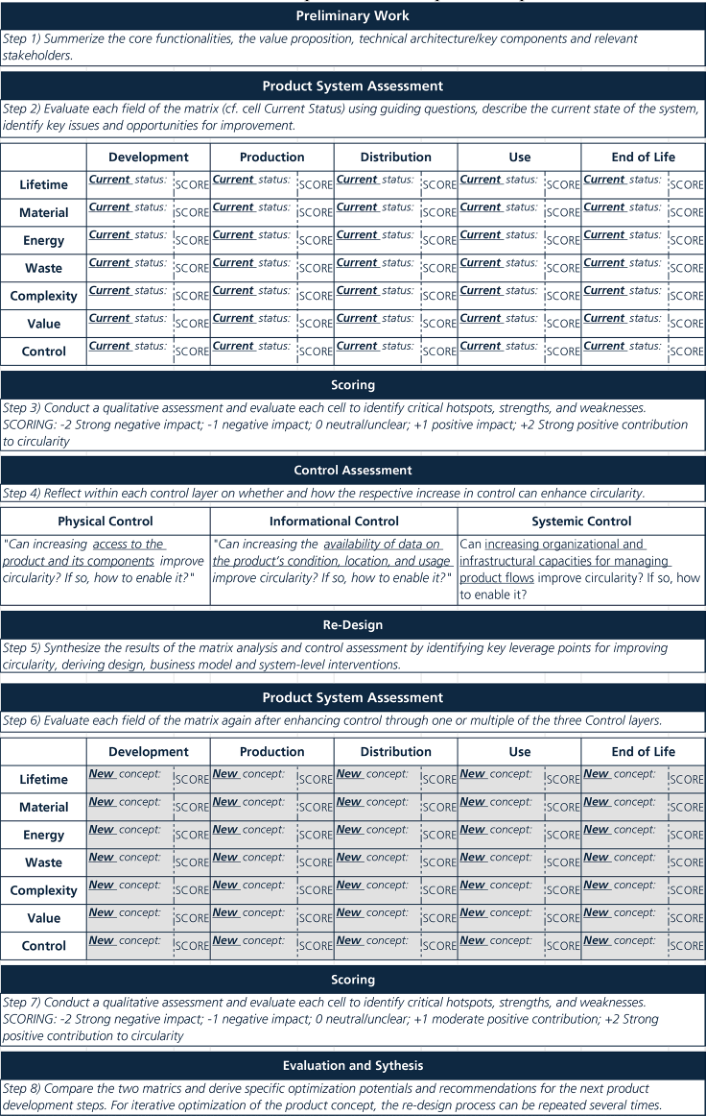
To enable a holistic and systematic decomposition of the product, the seven dimensions are mapped as a matrix across five lifecycle phases: Development, Production, Distribution, Use and End-of-Life. This results in a Circular Design Matrix, which structures the evaluation of product systems (s. Figure 1). Each field of the matrix is systematically evaluated using guiding questions. These questions address:
- resource inputs and efficiency (e.g., material and energy use) - lifetime and durability aspects - waste generation and recovery potential - complexity and system dependencies - value creation and user relevance - control over products and resource flows For each field, the current state of the system is described and key issues, inefficiencies or opportunities for improvement are identified. This step is primarily qualitative and exploratory, allowing for comprehensive assessment even in the absence of detailed quantitative data. The evaluation factors are aligned with the logic of a SWOT analysis. This framing draws on the interpretation by Barros and Laursen (Barros and Laursen 5th and 6th September 2024), who bridge multi-criteria requirements from LCA with divergent forms of decision support in the fuzzy front end. To identify strengths, weaknesses, and optimization potential, each cell is qualitatively evaluated as part of a collaborative assessment process and assigned a score ranging from −2 (strong negative impact) to +2 (strong positive impact). This makes it possible to identify critical hotspots and the interdependencies between individual variables across dimensions and lifecycle stages.
The matrix is supplemented by the integration of “control” as both an evaluation dimension and an overarching enabling layer. In conventional linear systems, the transfer of ownership to the user typically results in a loss of control over products and resource flows. This limits the ability to implement circular strategies such as reuse or repair. Research on reverse supply chains and product-service systems highlights the importance of maintaining influence over products throughout their lifecycle (Guide and van Wassenhove, 2009). Building on this perspective, control is conceptualized along three dimensions and added as a layer to the matrix: Physical Control: Physical control refers to access to the product itself, including the ability to retrieve, maintain or reintroduce it into the system. Mechanisms such as leasing, take-back systems and product-service models support physical control (Tukker, 2015).
Informational Control: Informational control refers to access to data on product condition, location and usage. Emerging approaches such as digital product passports and IoT-based monitoring enable increased transparency across the lifecycle (Langley et al., 2023).
Systematic Control: Systemic control refers to the broader organizational and infrastructural conditions that enable circularity, including business models, service ecosystems and reverse logistics networks (Guide and van Wassenhove, 2009).
The control layers are used to systematically reflect on which type of increased control can generate which kind of circular effects in each dimension and lifecycle stage. The reflection process is conducted through interdisciplinary team discussion, allowing trade-offs and interdependencies to be systematically examined with the support of the matrix across the entire product logic. Through this reflective and iterative process, a potential new product system is gradually developed, represented in a corresponding
Designing for Less and Longer: An Operational Framework 561 matrix and evaluated using the same scoring approach. By comparing the two matrices, specific optimization potentials and recommendations for the next product development steps can be derived.
Figure 1: Circular design assessment framework.
EVALUATION As a first exploratory step toward examining the applicability of the matrix, three products from different product categories were analysed and assessed.
In the first case of smartphones, high material value and technical complexity are contrasted by limited post-sale control, which constrains recovery despite the availability of recycling technologies. This highlights physical control and the dimension of complexity as key levers for improving circularity in product redesign. It also becomes evident that actual user value should be weighed against the material, energy and complexity burdens associated with the product. In other words, potential overfunctionality should be critically questioned in subsequent development steps, which can in turn be formulated as a design recommendation concerning trade-offs. The second case examined a washing machine. In this case, higher serviceability and partial control through maintenance and repair can be observed, yet systematic return and refurbishment structures are still often lacking. This reveals innovation potential particularly in the layer of systemic control and in the dimensions of lifetime and value. Accordingly, design briefing recommendations can be derived for a return and refurbishment strategy as well as for design for service. In addition, the findings suggest business model recommendations with a particular focus on systemic control in service design and informational control through maintenance histories and condition diagnostics to enable more efficient refurbishment and take-back processes. The third case focused on child car seats. These illustrate that, in safety-critical products, circularity depends not only on physical return flows but also on reliable usage and condition data, underlining the importance of informational control for safe reuse. For example, child car seats should not be reused after a car accident. However, proof of accident and usage history is currently hardly available, which significantly limits the potential for reuse in a second life. Informational control can therefore be identified here as a decisive lever, alongside systemic control through ownership and return-flow logics. For a design briefing, this leads to recommendations for design for safety assessment as well as for business models such as leasing, deposit, or buy-back schemes, particularly in combination with manufacturer- or partner-based networks that manage inspection and redistribution. In this way, the child car seat can be reconceived more strongly as a controlled system rather than as a one-time sold standalone product.
The analysis clearly indicated that the effectiveness of circular strategies is strongly influenced by the degree of control that can be maintained throughout the product lifecycle. Moreover, it emphasized that meaningful improvements in circularity require a strategic reconfiguration of individual dimensions in consideration of their interdependencies, as well as the effective alignment of these dimensions with suitable control layers.
RESULTS AND CONCLUSION In conclusion, this work has proposed an operational framework for circular product design that integrates lifecycle thinking, multidimensional evaluation, and control mechanisms under the guiding principle of “Less and Longer.” By introducing a matrix-based structure and explicitly positioning control as
Designing for Less and Longer: An Operational Framework 563 a central enabling factor, the framework contributes to a more holistic and actionable understanding of circular product design. The findings highlight that circularity is not merely a question of product architecture or isolated design improvements. Rather, the practical implementation of circular strategies depends strongly on the degree of control that can be maintained across the lifecycle. In this sense, control emerges as a critical factor in determining whether circular strategies can be translated from theoretical potential into practical application. Furthermore, the matrix was found to support interdisciplinary teams by structuring reflection, guiding discussion across disciplinary perspectives and making trade-offs and interdependencies explicit. In doing so, it helps teams strategically derive a creative solution space for circular product development rather than relying on isolated or ad hoc design measures.
DISCUSSION
The results underline that product lifetime and circularity are shaped not only by technical characteristics but also by behavioral, emotional and systemic factors. Circular product design must therefore be understood as a socio-technical design challenge that extends beyond engineering decisions to include lifecycle governance, business models and information flows. In this regard, the proposed framework helps bridge the gap between abstract circular design principles and practical development. However, future research should further validate the framework in industrial contexts and examine how its dimensions, particularly the control layer, can be translated into measurable indicators and integrated into established development processes.
ACKNOWLEDGMENT
The authors would like to thank all colleagues and practice partners who contributed valuable insights and feedback during the development of this research. Their perspectives helped to sharpen both the conceptual foundation and the practical relevance of the proposed framework.
REFERENCES
Barros, Mario/Laursen, Linda Nhu (5th and 6th 2024). LCA and Design Thinking: How to integrate Life Cycle Assessment in Early Stage Product Development? In: Proceedings of the International Conference on Engineering and Product Design Education, EPDE 2024, 26th International Conference on Engineering and Product Design Education, 5th and 6th September 2024. The Design Society, 217–222. Bocken, Nancy M. P./Pauw, Ingrid de/Bakker, Conny/van der Grinten, Bram (2016).
Product design and business model strategies for a circular economy. Journal of Industrial and Production Engineering 33 (5), 308–320. https://doi.org/10.1080/ 21681015.2016.1172124. Cooper, Tim (2005). Slower Consumption Reflections on Product Life Spans and the “Throwaway Society”. Journal of Industrial Ecology 9 (1-2), 51–67. https://doi. org/10.1162/1088198054084671.
of Closed-Loop Supply Chain Research. Operations Research 57 (1), 10–18. https://doi.org/10.1287/opre.1080.0628. Haines-Gadd, Merryn/Chapman, Jonathan/Lloyd, Peter/Mason, Jon/Aliakseyeu, Dzmitry (2018). Emotional Durability Design Nine—A Tool for Product Longevity. Sustainability 10 (6), 1948. https://doi.org/10.3390/su10061948. Hauschild, Michael Z./Rosenbaum, Ralph K./Olsen, Stig Irving (2018). Life Cycle
Assessment. Cham, Springer International Publishing. Karl T. Ulrich, Steven D. Eppinger (2016). Product Design and Development. New York, McGraw Hill Education. Klose, Svenja Anja/Fröhling, Magnus (2025). A new circular economy conception
for sustainable product design. Journal of Industrial Ecology 29 (2), 546–560. https://doi.org/10.1111/jiec.13620. Langley, David J./Rosca, Eugenia/Angelopoulos, Marios/Kamminga, Oscar/Hooijer, Christa (2023). Orchestrating a smart circular economy: Guiding principles for digital product passports. Journal of Business Research 169, 114259. https://doi. org/10.1016/j.jbusres.2023.114259. Pruhs, Annika/Kusch, Anina/Woidasky, Jörg/Viere, Tobias (2024). Design for
circularity in manufacturing industries–operationalisation and decision support. Resources, Conservation and Recycling 202, 107376. https://doi.org/10.1016/j. resconrec.2023.107376. Rexfelt, Oskar/Selvefors, Anneli (2024). Mapping the landscape of circular design tools. Resources, Conservation and Recycling 209, 107783. https://doi. org/10.1016/j.resconrec.2024.107783. Rotondo, Benedetta/Bakker, Conny/Balkenende, Ruud/Arquilla, Venanzio (2025).
Integrating Circular Economy Principles in the New Product Development Process: A Systematic Literature Review and Classification of Available Circular Design Tools. Sustainability 17 (9), 4155. https://doi.org/10.3390/su17094155. Song, Young-Woo/Herzog, Michael/Bender, Beate (2019). Understanding the Initial Requirements Definition in Early Design Phases. Proceedings of the Design Society: International Conference on Engineering Design 1 (1), 3751–3760. https://doi. org/10.1017/dsi.2019.382. Stoneham, Marshall (2009). Materials and the Environment: Eco-informed
material choice. Materials Today 12 (9), 47. https://doi.org/10.1016/S1369- 7021(09)70255-X. Tukker, Arnold (2015). Product services for a resource-efficient and circular economy – a review. Journal of Cleaner Production 97, 76–91. https://doi.org/10.1016/j. jclepro.2013.11.049.
FIND THE COMPLETE VOLUME IN THE AHFE DIGITAL BOOKSTORE
Explore the complete digital volume
Human Systems Engineering and Design (IHSED2026): Future Trends and Applications
Read this individual research paper free through the original publisher, or explore the full digital proceedings book.