Wang Yueren, Beibei Sun (2026). A Hybrid MCDM Framework for Industrial Robot Appearance Evaluation Based on BWM-CRITIC Combined Weighting and VIKOR Ranking. In: Human Systems Engineering and Design (IHSED2026): Future Trends and Applications. AHFE Open Access, vol. 237, pp. 158–167. https://doi.org/10.54941/ahfe1008156
To address the evaluation and selection of industrial robot appearances, this study constructs a hybrid multi-criteria decision-making (MCDM) framework. Initial evaluation criteria are derived from users’ perceptual impressions, systematically organized using the KJ method under the paradigm of Kansei Engineering, and hierarchically structured based on Donald Norman’s three-level theory of emotional design. To overcome the limitations of single weighting techniques, this study adopts a dual-perspective weighting strategy: subjective weights reflecting expert judgments are obtained via the Best-Worst Method (BWM), while objective weights are generated using an improved CRITIC method integrated with information entropy, which accounts for the contrast intensity, conflict, and information utility inherent in the evaluation data. The two sets of weights are further fused into a final combined weight vector using the maximizing deviation method. Finally, the VIKOR ranking method is employed to comprehensively evaluate and rank four representative industrial robot design schemes. The validation results demonstrate that the proposed BWM-CRITIC combined weighting approach, coupled with VIKOR ranking, effectively balances subjective cognitive judgments and objective mathematical characteristics. Therefore, the proposed framework provides a robust and implementable tool for the screening and evaluation of industrial robot appearance designs, with potential extensions to other product form evaluation domains.
With the rapid development of intelligent manufacturing and Industry 4.0 technologies, industrial robots have become a core component of modern production systems. Traditional industrial robot design primarily focuses on structural performance, operational accuracy, and manufacturing efficiency (Bogue, 2018). However, as industrial products increasingly exhibit emotional and semantic features, users’ perceptual cognition and aesthetic expectations of industrial robot appearance have gradually become an important consideration in design (Huang and Rust, 2021).
Received May 15, 2026 Revised June 15, 2026 Accepted July 4, 2026 Available online September 25, 2026
A Hybrid MCDM Framework for Industrial Robot Appearance Evaluation 159 Compared with traditional industrial equipment, contemporary industrial robots often operate in collaborative or semi-open environments, where their visual appearance directly influences users’ trust, sense of safety, professional perception, and emotional acceptance (Beer et al. 2014; Desmet and Fokkinga, 2020). Therefore, appearance and form design has increasingly become a critical factor affecting product competitiveness and brand recognition (Hassenzahl, 2010).
Most existing studies on industrial robot evaluation focus on engineering performance, human factors, and intelligent control (Siciliano and Khatib, 2016), whereas systematic research on form and appearance evaluation remains relatively limited. In addition, traditional appearance evaluation methods often rely heavily on expert subjective judgment, which can result in inconsistent and less objective results (Creusen and Schoormans, 2005). To address this issue, multi-criteria decision-making (MCDM) methods provide an effective quantitative framework for the comprehensive analysis of multiple evaluation factors (Triantaphyllou, 2000).
Among existing MCDM methods, the Best-Worst Method (BWM) has attracted significant attention due to its fewer pairwise comparisons and higher consistency. Compared with the Analytic Hierarchy Process (AHP), the BWM reduces the number of required comparisons while producing more reliable weight results (Rezaei, 2015). Recent studies have further improved the consistency analysis and reliability assessment of the BWM framework (Rezaei, 2020). Meanwhile, the CRITIC method can determine objective weights based on the contrast intensity and conflict among evaluation criteria (Diakoulaki et al., 1995). However, the traditional CRITIC method fails to fully consider the effective information content of the data. Therefore, this study introduces information entropy into the CRITIC framework to enhance the reliability of objective weighting.
To further balance subjective perception cognition and objective mathematical characteristics, this study adopts a combination weighting strategy based on deviation maximization. Finally, the VIKOR method is employed to rank the industrial robot design schemes. The VIKOR method is particularly suitable for compromise decision-making problems involving conflicting criteria, as it simultaneously considers group utility and individual regret (Opricovic and Tzeng, 2004).
The proposed approach integrates perceptual cognition and quantitative decision-making techniques, providing a systematic tool for evaluating industrial robot design. It also offers a valuable reference for the appearance evaluation of other industrial product designs.
EVALUATION CRITERIA SYSTEM CONSTRUCTION Based on Norman’s emotional design theory and recent developments in Kansei engineering research (López Pérez et al., 2021), user’s cognitive perception of industrial robot appearance is decomposed into three levels: the visceral level (aesthetic appeal), the behavioral level (functional perception), and the reflective level (emotional connotation) (Norman, 2004). Through a review of relevant literature on Kansei engineering and analysis of online
160 Wang and Sun user comments, 64 pairs of affective semantic adjectives were initially collected. The KJ method was subsequently employed to classify and refine these adjective pairs, which were further condensed into 36 representative pairs. A questionnaire survey was then conducted, and cluster analysis was performed on the valid survey data. Four core perceptual dimensions were ultimately extracted, namely professionalism, technological sense, sense of reliability, and exquisiteness.
By combining the above perceptual dimensions with design attribute indicators from industrial design aesthetics, ergonomics, and product semantics theories, a three-level hierarchical evaluation system was established, as presented in Table 1. All ten evaluation indicators belong to the benefit-type and constitute the final evaluation criteria set, denoted as C1–C10.
Table 1: Evaluation index system for industrial robot styling.
Table available in the original PDF paper.
Evaluation Goal Standardized Level Indicator Level C1 Form Coordination A1 Evaluation of appearance quality of industrial robots
SUBJECTIVE WEIGHTING USING BEST-WORST METHOD The BWM determines criteria weights through structured pairwise comparisons between only the most important (best) and least important (worst) criteria, which effectively mitigates judgment inconsistency and reduces cognitive workload of decision-makers (Rezaei, 2015). In this study, a panel of five experts specializing in industrial design and robotics was recruited to conduct criterion evaluation. Each expert independently selected the best and the worst indicators from the ten established evaluation criteria. Based on a 1-9 rating scale, the Best- to-Others vector a a a B1 B2 n B B ( , , , ) A = [Equation or mathematical symbol available in the original paper PDF] and the Others-to-Worst vector a a a T 1W 2 n W W W A ( , , , ) = [Equation or mathematical symbol available in the original paper PDF] were constructed. The optimal criterion weights corresponding to each expert’s evaluation were obtained by solving the following linear programming model:
ξ ξ s.t. ,
min w a w j B Bj j
(1) ξ
w a w j
, j jW W w w 1, 0 j j
Equations and mathematical formulas are available in the original paper PDF.
The consistency ratio CR = /CI ξ was adopted to verify the consistency of expert judgment. All calculated CR values were lower than the threshold of 0.1, indicating the high consistency and reliability of the collected evaluation data. The averaged subjective weights aggregated from all expert evaluations are reported in Table 2.
OBJECTIVE WEIGHTING USING IMPROVED CRITIC METHOD The traditional CRITIC method determines objective weights by considering the standard deviation (reflecting contrast intensity) and correlation (representing conflict degree) among evaluation criteria (Diakoulaki et al., 1995). To overcome the limitation of underestimating the effective information content in the traditional approach (Ponhan and Sureeyatanapas, 2022), this study incorporates information entropy into the CRITIC framework to improve its accuracy.
First, the original decision matrix is normalized using the min-max normalization method. For each criterion j , its contrast intensity is represented by standard deviation jσ . The conflict measure j R of criterion j is computed based on the Pearson correlation coefficient jkr between criteria j and criteria k, as shown in Equation (2):
Subsequently, the information entropy je of each criterion is calculated, and its information utility is defined as 1− je . The improved comprehensive information amount j C of criterion is formulated in Equation (3): · ·(1 ) j j j j C R e σ = − (3)
Finally, the objective weight of each criterion is obtained by normalizing the comprehensive information amount j C , which is expressed in Equation (4):
obj
C w
(4)
j j n C j j
Based on the valid questionnaire data collected from 30 respondents, the calculated objective weights of all evaluation criteria are listed in Table 2.
COMBINED WEIGHTING BASED ON MAXIMIZING DEVIATION To integrate the advantages of both subjective and objective weighting methods and overcome the inherent limitations of relying on a single weighting approach, the maximizing deviation method is adopted to determine combined weights (Wang and Zhang, 2022). Let
T sub,1 sub,2 sub sub,n (w ,w W , ,w ) = … denote the subjective weight vector derived from the BWM, and T obj,1 ob o o j,2 bj,n bj (w W , w , ,w ) = [Equation or mathematical symbol available in the original paper PDF] denote the objective weight vector from the improved CRITIC method. The combined weight vector is defined as com sub obj W W W , = α + β where α and β are non-negative
combination coefficients satisfying 2 2 1 α + β = . To maximize the discrimination among the alternatives, the total deviation of all evaluation values under the combined weights is used to construct the following optimization model:
n m m
, | |
( ) ( ) sub obj
j j ij ik j i k D w w u u α β α β
α β α β
[Equation or mathematical symbol available in the original paper PDF] = + − [Equation or mathematical symbol available in the original paper PDF][Equation or mathematical symbol available in the original paper PDF] + = ≥ ≥ [Equation or mathematical symbol available in the original paper PDF] where ij u is the normalized evaluation value of the i-th alternative under the j-th criterion, m is the number of alternatives, and n is the number of evaluation criteria.
Solving the optimization model (5) yields the optimal combination coefficients α and β, as shown in Equation (6):
α
(6)
β
= [Equation or mathematical symbol available in the original paper PDF][Equation or mathematical symbol available in the original paper PDF] − + − [Equation or mathematical symbol available in the original paper PDF] Subsequently, the combined weight for each criterion is normalized to ensure that the sum of all combined weights equals 1. Using the subjective weights from BWM and the objective weights from the improved-CRITIC- method, the optimal combination coefficients are computed as 0.6873 α = , 0.7264 β = , and the final combined weights of all evaluation criteria are reported in Table 2. The total deviation under the combined weights (18.76) is significantly higher than that under the subjective weights alone (12.34) or the objective weights alone (10.82), confirming the effectiveness of the proposed weight fusion method in enhancing the discrimination ability of the evaluation system.
Table 2: Weights of evaluation criteria derived from different methods.
The combined weights reveal that C8 (Technological sense) and C1 (Form coordination) are the two most critical evaluation attributes, collectively accounting for more than 31% of total importance. This indicates that technological appeal and harmonious form significantly influence user perception of industrial robots.
VIKOR-BASED EVALUATION AND SCHEME SELECTION The VIKOR method is a compromise ranking approach that quantifies group utility and individual regret to derive an optimal compromise solution (Opricovic and Tzeng, 2004). Using the combined weight vector j w (obtained from the maximizing deviation method) and the original decision matrix
ij x , the positive ideal solution jf * and negative ideal solution jf - are first determined for each benefit-type criterion. The group utility iS and individual regret i R corresponding to the i-th alternative are computed as:
f x R max w f f
* j ij i j * - j j j
Subsequently, the VIKOR index i Q for each alternative is calculated using:
- * - * (1 ) i i i
i i R max R = . The parameter v = 0.5 is adopted to assign equal weight to group utility and individual regret, ensuring a balanced consideration of both factors inthe evaluation process.
CASE STUDY To validate the effectiveness and applicability of the proposed hybrid MCDM framework, four representative heavy-duty industrial robot products currently available on the global market were selected as evaluation alternatives. These selected robots are from mainstream manufacturers in Europe and China with similar functional positioning and application scenarios, which ensures the feasibility of appearance-oriented comparative evaluation. Meanwhile, these products exhibit distinct differences in styling characteristics and industrial design language, making them suitable case samples for industrial robot styling evaluation research.
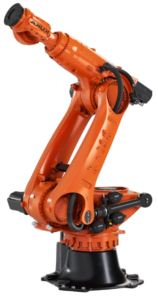
The four evaluation alternatives are defined as follows: Scheme A: ABB IRB 4400 Scheme B: ESTUN ER700-2800 Scheme C: KUKA KR 300 R2800-2 Scheme D: SIASUN SR210A-210 The appearance of the four industrial robot schemes are illustrated in Figure 1.
(a) ABB IRB 4400a (b) ESTUN ER700-2800
(c) KUKA KR 300 R2800-2 (d) SIASUN SR210A-210
Figure 1: Appearance of the four evaluated industrial robot schemes (adapted from the official websites of ABB, ESTUN, KUKA, and SIASUN).
A Hybrid MCDM Framework for Industrial Robot Appearance Evaluation 165 To reduce potential brand cognition bias during the evaluation process, all evaluators were instructed to focus exclusively on the appearance characteristics of the industrial robots, including form, structure, color, and visual perception, rather than brand preference, technical performance, or market reputation. In addition, all product images were standardized in terms of background, size, resolution, and display angle to improve visual consistency and evaluation reliability.
A group of evaluators scored each alternative against the ten established evaluation criteria using a 7-point Likert scale. The average scores of the evaluators constituted the original decision matrix, which is presented in Table 3.
Table 3: Original decision matrix (average scores).
Using the formulas presented in Equation (7) and Equation (8), the group utility values ( iS ), individual regret values ( i R ), and VIKOR index values( i Q ) for each evaluation alternative were calculated. The results are summarized in Table 5.
Table 5: i S , iR , and i Q values for each alternative.
Table available in the original PDF paper.
B 0.3571 0.0984 0.0000 C 0.3990 0.0995 0.0838
D 0.6389 0.1565 1.0000
According to the calculated i Q values presented in Table 5, the initial ranking of the evaluation alternatives is Scheme B (Q = 0.0000) > Scheme C (Q = 0.0838) > Scheme A (Q = 0.5777) > Scheme D (Q = 1.0000). To determine whether a unique compromise solution exists, the VIKOR method requires verifying two conditions (Opricovic & Tzeng, 2004):
1. Acceptable advantage: Q( ( ) 2 A ) - Q( ( ) 1 A ) ≥ 1/(m-1), where ( ) 1 A and ( ) 2 A are the alternatives with the first and second smallest Q values, respectively, and m is the number of alternatives. 2. Acceptable stability: The alternative ranked first in the Q index must also be the best-performing alternative according to either the group utility S or the individual regret R (or both).
In this study, m = 4, so 1/(m-1) = 1/3 ≈ 0.3333. Since Q(Scheme C ) - Q(Scheme B) = 0.0838 < 0.3333, Condition 1 (acceptable advantage) is not satisfied. Condition 2 (acceptable stability), however, is satisfied because Scheme B ranks first in both the group utility S (S = 0.3571) and the individual regret R (R = 0.0984).
When Condition 1 is not met, the VIKOR method does not identify a single optimal compromise solution but instead returns a set of acceptable compromise solutions. This set includes all alternatives whose Q value differs from the best Q value (i.e., Q value of Scheme B) by less than 1/(m-1). In this case, the set of acceptable compromise solutions includes Scheme B (Q = 0.0000) and Scheme C (Q = 0.0838), as the difference between their Q values (0.0838) is lower than the threshold of 0.3333. Therefore, both Scheme B and Scheme C are considered acceptable compromise solutions, with Scheme B exhibiting a marginal overall advantage over Scheme C.
CONCLUSION
This study proposes a hybrid Multiple-Criteria Decision-Making (MCDM) framework for industrial robot styling evaluation, integrating Kansei engineering, Norman’s three-level emotional design theory, BWM, the improved CRITIC method, the maximizing deviation weighting method, and the VIKOR method. The constructed three-level evaluation criteria system covers aesthetic, functional cognitive, and emotional imagery dimensions, providing a user-centered and structured theoretical basis for industrial robot appearance assessment. The combined weighting approach adopted in this study effectively balances subjective expert judgment and objective data characteristics, overcoming the limitations of single weighting methods, while the VIKOR method delivers reliable compromise ranking for conflicting design criteria.
Case validation conducted on four representative industrial robot schemes confirms the feasibility and effectiveness of the proposed framework, with Scheme B and Scheme C identified as optimal compromise solutions. This hybrid MCDM method offers a practical quantitative tool for industrial robot styling selection and can be extended to appearance evaluation of
A Hybrid MCDM Framework for Industrial Robot Appearance Evaluation 167 other industrial products. Future work will incorporate fuzzy logic and additional evaluation indicators to further enhance the comprehensiveness and adaptability of the model.
ACKNOWLEDGMENT
The authors would like to thank the experts and evaluators who participated in the questionnaire surveys and scoring sessions.
REFERENCES
Beer, J.M., Fisk, A.D. and Rogers, W.A. (2014). Toward a framework for levels of robot autonomy in human-robot interaction. Journal of Human-Robot Interaction, 3(2), pp. 74–99. Bogue, R. (2018). Growth in e-commerce boosts innovation in the warehouse robot
market. Industrial Robot: An International Journal, 45(6), pp. 703–709. Creusen, M.E.H. and Schoormans, J.P.L. (2005). The different roles of product appearance in consumer choice. Journal of Product Innovation Management, 22(1), pp. 63–81. Desmet, P.M.A. and Fokkinga, S.F. (2020). Beyond Maslow’s Pyramid: Introducing
a typology of thirteen fundamental needs for human-centered design. Multimodal Technologies and Interaction, 4(3), 38. Diakoulaki, D., Mavrotas, G. and Papayannakis, L. (1995). Determining objective weights in multiple criteria problems: The CRITIC method. Computers & Operations Research, 22(7), pp. 763–770. Hassenzahl, M. (2010). Experience Design: Technology for All the Right Reasons.
San Rafael, CA: Morgan & Claypool. Huang, M.H. and Rust, R.T. (2021). A strategic framework for artificial intelligence in marketing. Journal of the Academy of Marketing Science, 49(1), pp. 30–50. López Pérez, O., Murillo, C. and González, A.G. (2021). Systematic Literature
Reviews in Kansei Engineering for Product Design—A Comparative Study from 1995 to 2020. Sensors, 21(19), 6532. Norman, D.A. (2004). Emotional Design: Why We Love (or Hate) Everyday Things.
New York: Basic Books. Opricovic, S. and Tzeng, G.H. (2004). Compromise solution by MCDM methods: A comparative analysis of VIKOR and TOPSIS. European Journal of Operational Research, 156(2), pp. 445–455. Ponhan, K. and Sureeyatanapas, P. (2022). A comparison between subjective and
objective weighting approaches for multi-criteria decision making: A case of industrial location selection. Engineering and Applied Science Research, 49(6), pp. 763–771. Rezaei, J. (2015). Best-worst multi-criteria decision-making method. Omega, 53, pp. 49–57. Rezaei, J. (2020). A Concentration Ratio for Nonlinear Best Worst Method.
International Journal of Information Technology and Decision Making, 19(3), pp. 891–907. Siciliano, B. and Khatib, O. (2016). Springer Handbook of Robotics. Cham: Springer. Triantaphyllou, E. (2000). Multi-Criteria Decision Making Methods: A Comparative Study. Dordrecht: Springer. Wang, X. and Zhang, L. (2022). A Combined Weighting Model Based on Maximizing
Deviation for Multiple Attribute Decision-Making. Advances in Materials Science and Engineering, 2022, 7679851.
FIND THE COMPLETE VOLUME IN THE AHFE DIGITAL BOOKSTORE
Explore the complete digital volume
Human Systems Engineering and Design (IHSED2026): Future Trends and Applications
Read this individual research paper free through the original publisher, or explore the full digital proceedings book.