Mingqi Li, Beibei Sun (2024). Evaluation of Styling Design of Heavy-duty Industrial Robots Based on Comprehensive Integration Weighting Method. In: Intelligent Human Systems Integration (IHSI 2024): Integrating People and Intelligent Systems. AHFE Open Access, vol. 119, pp. 590–600. https://doi.org/10.54941/ahfe1004524
This paper proposes a method for evaluating and screening the appearance design solutions of industrial robots. Firstly, the kansei engineering theory and KJ method is used to collect users' perceptual imagery vocabulary of the appearance of industrial robots, which is used as the evaluation indexes of the appearance design solutions. Secondly, the analytic hierarchy process is used to construct a hierarchical structure to calculate the subjective weights of the 12 evaluation indexes. Thirdly, the entropy weight method is introduced to calculate the objective weights of the 12 evaluation indexes, because the subjective weights reflect the designer's degree of emphasis on the 12 evaluation indexes instead of the actual needs of the users. Finally, the combined weights are calculated using the comprehensive integration weighting method. In order to obtain the scores of the three schemes for each indicator and to weight them to obtain a composite score for each scheme, the questionnaire survey method is used. This study shows that the appearance scheme evaluation and screening method using comprehensive integrated weighting method to calculate the weights of evaluation indexes and weight them to get the total score of each scheme can be applied in the field of appearance design of heavy-duty industrial robots, which can provide a reference for the evaluation of appearance schemes of other types of industrial robots.
Industrial robots are industrial devices with multiple degrees of freedom, which can rely on their own power to perform specific action commands under complex working conditions (Jian, 2021). The widespread use of industrial robots can increase the level of automation and efficiency of product lines. Since the 1950s, industrial robots have been widely used in various fields such as logistics, machinery, electronics, chemical industry and aerospace, etc. The design of industrial robots needs to make a balance between mechanical function and industrial aesthetics. The styling design of industrial robots needs to make a balance between mechanical function and industrial aesthetics. How to design aesthetically pleasing industrial robotic
Evaluation of Styling Design of Heavy-Duty Industrial Robots 591
products while satisfying the premise of mechanical functions has become the next growth point in the industrial robotics field. In other words, products with good industrial aesthetics should be able to adapt to the human-machine environment of the workplace and interact well with the operator. For the styling design of industrial robots, most domestic companies’ product styling design stays in the achievement of mechanical functions, but they fail to take into account the aesthetics of the product shape, the design of the workspace and the coordination of the color environment. What’s more, the styling of domestic industrial robots is not simple enough, resulting in poor usability and low product competitiveness. The industrial robotics field abroad has a long history of development. From a brand perspective, the companies with the largest market share of industrial robots are dominated by Japan and Europe, such as KUKA Robotics, FANUC Robotics, YASKSWA Robotics and ABB Robotics. They are mainly used in the automotive and electronics industries for precision tasks (Lin, 2022). From a product styling perspective, foreign industrial robot products have better product styling. For example, ABB industrial robots are designed to be more minimalist, the extensive using of curves not only spread the load but also conveying a sense of power, using orange for larger loads industrial robot to bring a sense of strength, and white for smaller loads industrial robot to bring a sense of calmness and neatness (Yanhong, 2008). In summary, China’s industrial robotic prod- ucts need to improve the quality of styling design, and further consider the human-machine environment in which the product is located, so as to design industrial robotic products that are more in line with the physiological and psychological characteristics of users.
PRODUCT STYLING DESIGN In terms of industrial aesthetics, the beauty of industrial products has two distinctive features, namely the “formal beauty” of the product in its exter- nal sensual form and the “technical beauty” of the product in the harmony and order of its internal structure. For the formal beauty of the prod- uct, the styling design of industrial robots should follow the design of ten product design principles which are Proportion and scale, symmetry and balance, stability and lightness, rhythm and cadence, harmony and con- trast, unity and variety, dominance and emphasis. For the technical beauty of the product, the styling design of industrial robots should follow six product design principles which are functional beauty, structural beauty, craftsmanship beauty, material beauty, comfort beauty and specification beauty (Jianning, 2004). The styling design of industrial robots belongs to the category of large-scale mechanical product design, which can adopt the methods of analysis and enumeration, bionic creation, fine addition and de- complication to optimize the design of the appearance of industrial robots (Jianning, 2017).
From the perspective of human factors engineering, colour conditioning has a wide range of applications in workspace design, plant and production equipment colour application, visual management, etc. In addition, colour
592 Li and Sun
conditioning can be directly applied to the human psyche and is not lim- ited by time and space. Based on the theoretical knowledge of industrial aesthetics and ergonomics, and combined with the product styling designed by ABB, KUKA, FUNUC and other industrial robotics, three initial options for product styling are designed.
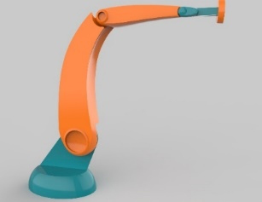
SCHEME A The scheme adopts the de-complication method for product styling opti- mization. We designed concave styling on the big arm and small arm of the industrial robot, eliminated the snap structure for wire harness storage, used the form of virtual space uniformly at product junctions, and simplified the product styling to create specification beauty of the product. The styling design of the base is referred to the design elements of the KUKA Robot, which fully reflects the unity and change, transition and echo of the law of form beauty. The connection between the base and the big arm, the big arm and the small arm highlights the unity of styling, and the transformation of the base to the big arm highlights the change in styling, which gives people a sense of calmness and rich visual aesthetics. In terms of colour, orange is cho- sen as the main tone, lime green as an auxiliary colour. Orange is a warm tone and symbol of a good harvest, which can make the operator feel excited and happy, and lime green brings the workers a feeling of calmness and neatness (Min, 2005). As shown in Figure 1.
Figure 1: Rendering picture of scheme A.
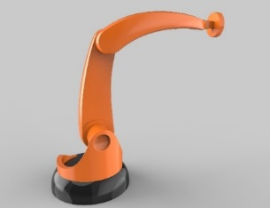
SCHEME B The scheme adopts the method of de-complication and bionic creation for product styling optimization. Industrial robot arm design references the phys- iological curve of the muscle, apart from this, we changed flat surfaces into curved surfaces in the original scheme. This design enhances the industrial aesthetics of the product and is more in line with the user’s visual movement patterns. What’s more, orange is changed as the main color, and black as the secondary color to emphasize the base of the product. Black color gives people a dignified and stable visual impression, such a product color scheme reduces the visual center of the product and relieves the user’s visual fatigue (Su, 2020). As shown in Figure 2.
Evaluation of Styling Design of Heavy-Duty Industrial Robots 593
Figure 2: Rendering picture of scheme B.
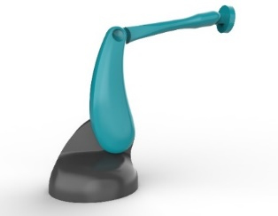
SCHEME C The scheme adopts the de-complication method and the limit method for product styling optimization. The base of the industrial robot is redesigned, and the big arm and the base are fused in form, which highlight the formal beauty of the product’s transition and echo, and the harmony and contrast. Cyan is adopted as the main color, which can reduce the visual center of grav- ity to convey a sense of stability according to the theory of color psychology. As shown in Figure 3.
Figure 3: Rendering picture of scheme C.
PERCEPTUAL IMAGERY SPATIAL CONSTRUCTION In order to accurately obtain users’ perceptual understanding of industrial robots, a total of two experts from a robotics company and four experts in the field of mechanical design and industrial design were invited to conduct a brainstorming session in order to collect respondents’ perceptual imagery of industrial robots to describe the vocabulary. The KJ affinity diagram method is a method proposed by Professor Jiro Kawakita of Tokyo Institute of Technology to collate cluttered information, the main content of which is to analyze the different hierarchies between words based on the correla- tion between words, and the method can collate cluttered vocabulary into a hierarchically structured framework of information (Kunifuji, 2016). In this step, the vocabulary obtained from brainstorming is collated into hierarchi- cal structures using the KJ method, as shown in Table 1. In the hierarchical structure, the adjectives are divided into three categories: “appearance”,
594 Li and Sun
“modelling style” and “brand impression”, which constitute the criterion layer of the hierarchical structure, and all the adjectives of perceptual imagery are corresponded to each of the three criterion layers, so as to construct a semantic space of perceptual imagery, which are as follows: exquisite, percep- tual, high-quality, rich, tough, simple, futuristic, safe, high-end, professional, innovative and reliable.
Table 1. Hierarchy of industrial robot modelling evaluation.
COMPREHENSIVE INTEGRATED WEIGHTING METHOD The analytic hierarchy process and entropy weighting method are used to determine the weights of 12 groups of evaluation indexes. Firstly, the sub- jective weights of 12 groups of evaluation terms are calculated by analytic hierarchy process. Secondly, the objective weights of 12 groups of styling evaluation terms are calculated by entropy weighting method, and then the combined weights of the subjective and objective weights are calculated by comprehensive integrated weighting method. Finally, the scores of the three solutions under each group of evaluation indexes are obtained by question- naire, and the solution with the highest weighted total score is the optimal appearance styling solution for industrial robots, so as to complete the selection of schemes.
CALCULATION OF SUBJECTIVE WEIGHTS The steps that need to be carried out to calculate the weights of indicators by the analytic hierarchy process are: (1) Establishment of the hierarchi- cal structure (2) Establishment of the judgement matrices for the criterion and indicator levels (3) Consistency test for the judgement matrices (4) Calculation of the subjective weights for the indicator levels.
ESTABLISHMENT OF THE HIERARCHY STRUCTURE In the hierarchical structure, the appearance quality of industrial robots (A1) is the general objective of the hierarchy. The appearance realism (B1),
Evaluation of Styling Design of Heavy-Duty Industrial Robots 595
modelling style (B2) and brand impression (B3) are the criterion layer of the hierarchy, and the three indicators in the criterion layer correspond to four sub-indicators, which make a total of 12 pairs of perceptual imagery vocab- ulary as the bottom evaluation indicators of the hierarchical structure (C1, C2,...C12).
ESTABLISHMENT OF THE JUDGEMENT MATRICES In this step, we compare the indicators at the same level of the hierarchy two by two to get the relative importance of the indicators. Firstly, A number of experts in the field of industrial robot design were recruited to distribute an “Expert Score Sheet”, in which the experts indicated the relative importance of two indicators in the same tier using 1, 2, 3,···7 and its reciprocal. The scales and definitions of the judgement matrix are shown in Table 2. Next, the average of all expert ratings is taken to establish the judgement matrix for “appearance”, “styling” and “brand impression” in the criterion layer and the indicator layer. The judgement matrix is constructed as shown in equation (1). Where n is the order of the judgement matrix. Because of space constraints, the four judgment matrices are not shown in this paper.
[Equation or mathematical symbol available in the original paper PDF]
[Equation or mathematical symbol available in the original paper PDF]
Equations and mathematical formulas are available in the original paper PDF.
1 a2n . . . ann
Table 2. Scaling and definition of judgment matrices.
Table available in the original PDF paper.
Scaling Definition 1 Equal importance of the two indicators compared to each other 3 Compared to the two indicators, the row indicator is slightly more important than the column indicator 5 Compared to the two indicators, the row indicator is much more important than the column indicator 7 Compared to the two indicators, the row indicator is extremely important compared to the column indicator 2, 4, 6 The relative importance of the two indicators falls between the two scales mentioned above. Reciprocal Degree of importance of a column indicator over a row indicator compared to two indicators
CALCULATION OF SUBJECTIVE WEIGHTS The eigenvalues and eigenvectors of each judgement matrix are calculated by equation (2). If the judgement matrix A is a consistency matrix, the eigenvec- tor corresponding to the maximum eigenvalue (λmax) of each indicator is the weight vector WAHP.
596 Li and Sun
CONSISTENCY TEST FOR JUDGEMENT MATRICES To perform the consistency test of the judgement matrix, we need to calcu- late the Consistency Index (CI) of the judgement matrix and the Consistency Ratio (CR) of the judgement matrix respectively. when the CR of the judge- ment matrix is less than or equal to 0.1, we consider that this judgement matrix has good consistency. CI and CR are obtained from equation (3) and equation (4), where λ is the maximum eigenvalue of the judgement matrix, n is the order of the judgement matrix, RI is the Average Consistency Index, and the values of RI are shown in Table 3. The calculation shows that the four judgement matrices have good consistency. The subjective weights of the indicators are shown in Table 4.
Table 3. RI.
Table available in the original PDF paper.
Matrix Order 0 1 2 3 4 5 RI 0 0 0.52 0.89 1.12 1.26
CALCULATION OF OBJECTIVE WEIGHTS Entropy weight method is born from the basic principles of information the- ory. Information is a measure of the degree of order of the system. If the indicator is more informative, then the lower the information entropy, the greater the role of the indicator in the comprehensive evaluation and the higher the weight of the indicator. Entropy weight method is an objective assignment method that assigns weights to different evaluation indicators by
Evaluation of Styling Design of Heavy-Duty Industrial Robots 597
calculating the information entropy and entropy weight of the evaluation matrix. The calculation steps of entropy weight method are: (1) data stan- dardization (2) normalized evaluation matrix (3) calculation of information entropy and entropy weight.
In the analysis hierarchical process, the designer relies on his own design experience and expert advice to establish the judgement matrix, so the weights are more in line with the designer’s own understanding of the prod- uct, but this will lead to a lack of objectivity in the styling design, which is contrary to the “user-centered” design guidelines. In order to overcome the limitations of the analysis hierarchical process, this study introduces the entropy weighting method to calculate another set of weights for 12 groups of indicators, and then obtains the combined weights of the evaluation indicators of industrial robot styling through the comprehensive integration weighting method.
SCORING BY QUEATIONNAIRE SURVEY METHOD Questionnaire survey is an important tool for market research. Question- naire survey method requires the researcher to prepare a series of questions according to the purpose of the study and analyze the information gathered to develop conclusions. Using this methodology, formatted information can be obtained from survey respondents for user requirements mining and product development (Liping, 2019).
In this study, six experts in the field of mechanical design and industrial design were selected as survey respondents, and a questionnaire was prepared to allow the six respondents to rate each of the 12 indicators for each of the three scenarios, resulting in a rating scale for the three scenarios. As shown in Table 5.
DATA STANDARDIZATION There are 12 evaluation indicators in this topic, and the evaluation matrix is normalized to obtain the normalization matrix R, which is calculated as
598 Li and Sun
equation (5) and (6) (Liping, 2019). Where i is the column indicator, j is the row indicator, max (ri) is the maximum value of the jth row, min (rj) is the minimum value of the ith column, m is the number of appearance programs, n is the number of evaluation indicators, and the normalized evaluation matrix of the indicator layer is shown in Table 6.
CALCULATE INFORMATION ENTROPY AND ENTROPY WEIGHT Next, the Information Entropy Ej of each indicator is calculated as in equa- tions (7) and (8). The Information Entropy Ej of the 12 indicators is shown in Table 7.
Next, the Information Entropy Ej is used to calculate the Information Util- ity Value Dj and Entropy Weight Wj of each indicator, and the resulting entropy weight is the objective weight of each of the 12 evaluation indicators. The calculation formula is shown in equation (9) and (10), and the Informa- tion Utility Value Dj and Entropy Weight Wj of the 12 indicators are shown in Table 8.
Evaluation of Styling Design of Heavy-Duty Industrial Robots 599
CALCULATION OF COMBINED WEIGHTS The hierarchical analysis method used in this topic is a subjective assignment method, the disadvantage of which is that it overemphasizes the subjectiv- ity of the designer; the entropy weight method is an objective assignment method, the disadvantage of which is that it fails to reflect the importance attached by the decision makers to different indicators (Yu, 2016). There- fore, the comprehensive integrated assignment method is used to calculate the combined weight of the two groups of weights to make up for the shortcomings brought by the single assignment method, and the calcula- tion formula is as equation (11) (Yu, 2016). Where WAHP is the indicator weights obtained through hierarchical analysis, WEntropy is the indicator weights obtained through entropy weighting, k is the ordinal number of indi- cators (k = 1,2,3...12), and n is the total number of indicators (n = 12). The combined weights of the indicators were calculated as shown in Table 9 (Yu, 2019).
The scores obtained from the questionnaire (as shown in Table 5) were weighted to obtain an overall score. Scheme A scored 7.45 points, Scheme B scored 7.07 points, and Scheme C scored 6.3 points, making A the best scheme.
600 Li and Sun
CONCLUSION
This paper proposes a screening method for heavy-duty industrial robot product design solutions, collecting perceptual vocabulary through brain- storming and categorizing the vocabulary with the KJ method so as to construct a hierarchical structure for evaluating industrial robot styling solu- tions. On the basis of hierarchical analysis and entropy weight method, the score of each scheme based on evaluation indexes is obtained by using com- prehensive integration weighting method, and the scheme selection is realized by comparing the scores. Apart from this, this paper proposes an evaluation system for heavy-duty industrial robots, which is conducive to subsequent designers to design industrial robot products based on this evaluation system. Moreover, the creative thinking method is fully used to create the appearance of heavy-duty industrial robots.
ACKNOWLEDGEMENT
The authors of this paper are very grateful to six experts from the field of mechanical design and industrial design for providing sample questionnaire.
REFERENCES
H. Yanhong, D. (2008) “A study of the psychosemantic characteristics of colour information and the effects of “hidden” colour information on mood and cognition”, Fourth Military Medical University. L. Jian, L. Xiaojie, J. (2021) “Feature-driven industrial robot modelling based on
structural optimisation”, in: Mechanical Design, pp. 133–139. M. Hongyu, D. (2019) “Research on the design innovation path of product aesthetic value”, Wuhan University of Technology. Q. Ming, Z. Feng, J. (2005) “On the psychological construction of colour in product
design”, in: Packaging Engineering, pp. 198–200. S. Jianning, J. Pingyu, Z. Bin, J. (2004) “A study of perceptual engineering and its application to product design”, in: Journal of Xi’an Jiaotong University, pp. 60–63. S. Jianning, L. Zhijun, W. Peng, J. (2017) “Research Progress of Product Family
Styling Design Methods Based on Perceptual Imagery”, in: Mechanical Design, p. 34. S. Kunifuji, (2016) “A Japanese Problem-Solving Approach: The KJ Ho Method”, 8th International Conference on Knowledge, Information, and Creativity Support Systems, Japan. S. Su, Z. Song, R. Wei, S. Gu, M. Chu, (2020) “Research on Design Method of Color
Matching in Commanding Cabin Based on Color Perception”, in: Advances in Neuroergonomics and Cognitive Engineering. W. Lin, (2022) “Development of artificial intelligence robot industry in the era of big data”, IEEE 10th Joint International Information Technology and Artificial Intelligence Conference, Chongqing, China. Y. Liping, J. Chunhua, J. (2019) “An evaluation method for academic journals that
takes into account the coordinated development of the factorial geometric average method”, in: Intelligence Magazine, pp. 194–199. Y. Yu, J. (2016) “Evaluation of empowerment methods in multi-indicator integrated evaluations”, in: Statistics and decision-making, pp. 17–19.
LISTED IN THE AHFE DIGITAL BOOKSTORE CATALOGUE
Explore the complete digital volume
Intelligent Human Systems Integration (IHSI 2024): Integrating People and Intelligent Systems
Read this individual research paper free through the original publisher, or explore the full digital proceedings book.
ISBN 978-1-958651-95-7
Explore this ISBN in the AHFE Bookstore ↗Listed in the July 2026 bookstore catalogue; search by ISBN to confirm current availability · Digital book purchase optional