Anqi Tong, Xinyun Li (2026). System Design-Driven Service Experience Design for ADHD Children's Families: Integrating Hardware and Software Solutions—The Case of “Heart Bridge”. In: Usability and User Experience. AHFE Open Access, vol. 232, pp. 208–218. https://doi.org/10.54941/ahfe1008049
Attention Deficit Hyperactivity Disorder (ADHD) is a common neurodevelopmental disorder in children, characterized by core symptoms of inattention, hyperactivity, and impulsive behaviors. Although family-centered behavioral interventions have been proven effective in practice, they currently face widespread challenges including insufficient motivation for child participation, tedious training processes, and a lack of professional guidance and support for parents. Therefore, based on the system design theory, this study aims to construct a collaborative intervention service system named "Heart Bridge". This system strives to integrate such core elements as medical professional guidance, daily family implementation, maintenance of children's training motivation, and community emotional support, so as to explore an innovative path for improving the effectiveness and sustainability of family-based interventions for ADHD.
With the rapid advancement of urbanization and technology, Attention Deficit Hyperactivity Disorder (ADHD) has become an increasingly prevalent childhood condition affecting children’s physical and mental development. A meta-analysis estimates the global prevalence of ADHD to be approximately 5%. (Polanczyk et al., 2007) Since the etiology of ADHD remains unclear, diagnosis is primarily based on the individual’s overt behavioral manifestations, (Linlin, 2018) including inattention, hyperactivity, and impulsivity. These symptoms exert significant negative impacts on children’s physical and mental development, academic performance, and social adaptation. In several OECD countries, students with a formal ADHD diagnosis are eligible for supportive services within the educational system. Taking Iceland as an example, its education system explicitly mandates the provision of targeted assistance and special educational services for children
System Design-Driven Service Experience Design for ADHD Children’s Families 209 with ADHD to facilitate their comprehension and mastery of curriculum content. Driven by the implementation of the Healthy China 2030 Initiative, (Lin and Xiaoying, 2025) national attention to mental health has continuously intensified. Concurrently, the maturation of artificial intelligence and big data technologies, the widespread adoption of smart wearable devices, and the rising health awareness among consumers have created unprecedented opportunities to address ADHD-related challenges through digital means.
Although the effectiveness of family-centered behavioral interventions has been validated clinically and in practice, such interventions face pervasive challenges in real-world implementation, including low participation motivation among children, monotonous training procedures, and a lack of professional guidance and social support for parents. Consequently, behavioral intervention training has not been genuinely integrated into the daily family life of children with ADHD, constraining the overall quality and outcomes of ADHD behavioral intervention. Against this background of domestic and international research and in response to the behavioral intervention needs of individuals with ADHD, this paper addresses the following research questions: (1) How to optimize the design of behavioral intervention training content
based on children’s interests and preferences to ensure its appropriateness and attractiveness, thereby improving children’s willingness to participate and their training adherence? (2) How can parents support the treatment of children with ADHD in daily life? (3) How to promote the precise alignment of clinicians’ intervention protocols with the individual conditions of children with ADHD and the needs of the family context?
Based on system design theory, this study aims to develop a software- hardware coordinated, multi-stakeholder service system for children with ADHD. The system delivers gamified intervention training to stimulate children’s interest, extend their attention span, and thereby enhance the efficacy of ADHD behavioral interventions.
Related Work
The intervention paradigm for ADHD has evolved from pharmacological monotherapy to a comprehensive model emphasizing behavioral therapy, family training, and school-based support. Min proposed a parent training program grounded in systems theory for treating preschool ADHD, which enhances positive parent-child interactions, increases ADHD children’s interest in dyadic engagement, improves the efficacy of parental behavioral interventions, and consequently exerts positive effects on symptom reduction. (Feng et al., 2023) Wang Bing demonstrated that behavioral therapeutic interventions yield significant improvements in emotional regulation and impulsive behaviors among adolescents with ADHD. Following treatment, patients exhibited enhanced emotional states, manifesting reduced aggression,
210 Tong and Li impulsivity, and disruptive conduct. (Bing et al., 2025) Characterized by high engagement and absence of somatic adverse effects, behavioral therapy effectively ameliorates social functional deficits and behavioral patterns in ADHD pediatric patients (Xue, 2023).
In recent years, the application of digital technologies in ADHD intervention has proliferated. Training delivered via mobile applications and gamified protocols enables children to conduct home-based intervention exercises, motivates active participation among ADHD patients, enhances attentional and executive functions, facilitates symptom remission, prolongs sustained attention duration, and improves concentration levels. (Yongzheng, 2022) However, the majority of existing applications lack personalized design considerations, neglect the roles of parents and medical professionals, and fail to establish connectivity between data collection and clinical intervention protocols.
Regarding the application of hardware-software collaborative design, numerous research cases have been documented both domestically and internationally. Zhao Zixian developed a wearable health steward based on on-site posture detection analysis and Internet of Things technology for fall state detection, thereby providing health monitoring and real- time emergency response services for solitary elderly individuals, as well as patients with cardiovascular and cerebrovascular diseases and vertigo disorders. (Zixian, 2024) Shuai Wanjun designed a wearable cardiopulmonary monitoring system comprising a data acquisition device, wearable chest garment, and information management platform. This system enables medical monitoring of cardiopulmonary indicators during training or physical exercise, providing precise physiological information for health management. The proposed wearable intelligent device offers innovative digital intervention approaches for weight management among obese populations. By constructing a closed-loop system of “real-time monitoring—data feedback—behavioral regulation,” it demonstrates application potential in dietary recording and exercise promotion. (Wanjun et al., 2024) Dai Jingya proposed that immersive VR combined with somatosensory trackers and wearable exoskeleton-assisted walking robots exhibits greater advantages compared to conventional rehabilitation training when applied to neurosurgical patients with akinesia. This approach effectively enhances patients’ balance function and motor performance, alleviates psychological stress, improves emotional states, facilitates the enhancement of activities of daily living, and consequently improves overall quality of life (Jingya and Dongmei Tang, 2025).
Currently, hardware-software collaboration has demonstrated significant development trends in the digital health service domain; however, existing related products lack targeted design addressing the specific characteristics of children with ADHD, making them unable to satisfy the comprehensive requirements of both family-based daily intervention and clinical guidance from medical institutions.
System Design-Driven Service Experience Design for ADHD Children’s Families 211 Design Goals and Principles
Guided by the amelioration of core ADHD symptoms in children and the intervention requirements within family-based daily environments, this study aims to construct a collaborative intervention service system that integrates multiple resources and adapts to home application scenarios.
The service system design adheres to four fundamental principles: multi- stakeholder collaboration, scientific adaptation, child-friendliness, and data- driven optimization. These principles aim to simultaneously accommodate the needs and interactions among core stakeholders including physicians, parents, children, and community peers, ensure precise alignment between intervention content and practical scene operability supported by relevant professional theories, enhance children’s attention through cute IP characters and gamified training, and provide objective evidence for protocol adjustment and diagnostic evaluation through hardware-software collaborative collection of physiological and behavioral data.
Stakeholder Analysis and User Requirements User personas, as a commonly employed tool in service design, synthesize and characterize user attributes, pain points, and requirements, thereby providing foundational evidence for project development. This study conducted online questionnaire surveys with 50 parents of children with ADHD and selected 10 household samples for in-home interview investigations. Concurrently, 5 relevant physicians were interviewed. Based on preliminary research, this study constructed representative user personas: Xuanxuan, a 7-year-old male patient diagnosed with ADHD-C combined type, exhibiting typical hyperactive and attention-dispersed characteristics, specifically manifesting as restlessness, frequent fidgeting behaviors, and short interest maintenance duration, yet demonstrating adequate concentration capacity on high-interest topics. Li Xiaoyun, mother of Xuanxuan, a 35-year-old high-income professional with limited availability for family care, experiencing difficulty in identifying effective intervention methods for children with ADHD, consequently generating intense feelings of confusion and helplessness.Chen Lifeng, a 42-year-old child psychiatrist, whose daily workload is extremely demanding due to substantial time expenditure on repetitive explanatory consultations, completion of assessment scales, and manual documentation of condition changes.
Based on the aforementioned analysis, the core requirements for family- based behavioral intervention training for children with ADHD encompass the following three dimensions: (1) Parental-level pain points primarily involve the absence of systematic
professional guidance, rendering behavioral intervention difficult to implement within home environments. (2) Child-level pain points primarily involve the tedious and repetitive nature of conventional intervention modalities, predisposing children to
212 Tong and Li resistant emotions, insufficient training motivation, difficulty in attention maintenance, and absence of positive feedback. (3) Physician-level pain points primarily involve reliance on parental
recall and description of symptom changes, resulting in incomplete information; absence of objective data for quantifying treatment efficacy; and lack of automated tools to support continuous monitoring and management, leading to delayed adjustment of intervention protocols.
Based on questionnaire surveys and user interviews, this study analyzes the stakeholders within the family-system intervention framework for children with ADHD. Centering on children with ADHD and their parents, the framework is primarily structured into two components: (1) Core Users: Children with ADHD (aged 3–12 years) and their families,
who constitute the primary service recipients. (2) Internal System: Encompassing pediatric psychiatrists, intervention specialists, community peers, and intelligent hardware and software technology development teams. These stakeholders function as auxiliary training agents, addressing the training needs of children with ADHD for home-based intervention, protocol formulation, and social services, thereby providing systematic training services.
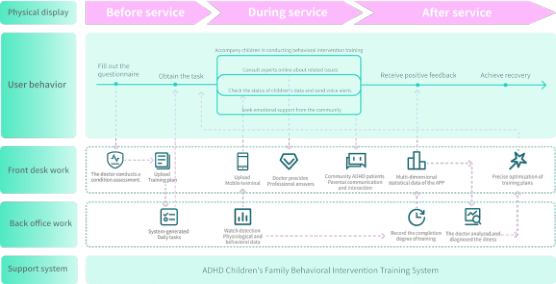
Service System Blueprint and Collaboration Mechanism Based on stakeholder analysis, this study constructs a service blueprint for the behavioral intervention training system for children with ADHD in home environments (as illustrated in Figure 1).
The service process of the behavioral intervention training system for children with ADHD in home environments can be divided into three phases: pre-service, during-service, and post-service. Pre-service: Physicians evaluate questionnaires completed by parents of children with ADHD and provide treatment protocols uploaded to the mobile terminal. The mobile terminal generates daily tasks, enabling parents to coordinate with their children with ADHD to complete training at home based on assigned tasks, thereby addressing the issue of parents’ lack of relevant professional knowledge. During-service: The system relies on the collaborative operation of four modules: the gamified training module embeds intervention objectives into parent-child games to enhance children’s engagement; the positive incentive module reinforces children’s motivation through points and badge mechanisms; the data collaborative monitoring module utilizes wearable devices to achieve progress tracking and lightweight interaction; and the community support module provides families with experience sharing and emotional support. Post-service: Based on multi-dimensional statistical data of patients, the system assists physicians in evaluating the symptomatic status of children with ADHD and enables data-driven precise adjustment of training protocols, thereby achieving dynamic optimization of the intervention process.
Figure 1: Service system blueprint.
The collaborative mechanism of the behavioral intervention training service system for children with ADHD in home environments is grounded in close cooperation among multiple stakeholders and effective integration of hardware and software, specifically encompassing: (1) Medical-Engineering Professional Collaboration; (2) Family Parent-Child Collaboration; (3) Community-Family Collaboration; and (4) Hardware-Software Collaboration.
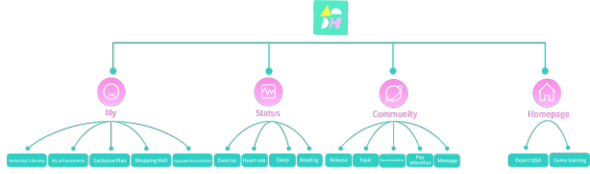
Software System Design Based on comprehensive analysis of user pain points, opportunity points, user requirements, and practical conditions, this project designed a mobile application suitable for children with ADHD, parents, and physicians, alongside a children’s smartwatch featuring data tracking functionality. Regarding information architecture, the APP interface primarily encompasses four core modules: Home, Community, Status, and Profile. This design thereby facilitates effective connectivity between family-based daily intervention and professional medical guidance, providing targeted functional support and services for different stakeholders, and consequently enhancing the professionalism and implementability of comprehensive ADHD intervention (as illustrated in Figure 2).
Figure 2: Information architecture.
This study designed four child-friendly IP characters—“Chongchong,” “Xiaoman,” “Xiaozhu,” and “Dongdong”—through visual and graphical interpretation of the four letters “ADHD.” Chongchong and Dongdong respectively correspond to traits of impatience, decisiveness,
214 Tong and Li recklessness, and hyperactivity, restlessness, and irritability, representing ADHD-HI (Hyperactive-Impulsive presentation). Xiaoman and Xiaozhu respectively correspond to traits of slowness, indecision, cautiousness, and daydreaming, distractibility, and curiosity, representing ADHD-I (Inattentive presentation). Bright colors more readily attract the attention of children with ADHD; therefore, high-saturation, high-brightness red, yellow, and green were selected as primary colors. The playful and cute visual language is integrated into the interface design of mobile applications and wearable devices, as well as training sessions, aiming to help children establish identity recognition, enhance the entertainment value of training, and thereby increase their willingness to cooperate throughout the training process (as shown in Table 1).
Table 1: Image design positioning.
Table available in the original PDF paper.
Characteristics of Personality
Symptom Manifestations
Color Extraction IP Name Design Prototype ADHD-HI Chong Chong
Impatient, decisive, rash
ADHD-I Xiao Man
Slow, indecisive, cautious
ADHD-I Xiao Zhu
Daydreaming, distraction, curiosity
ADHD-HI Dong Dong
Active, energetic, irritable
Personalized Training Plan Function: Prior to training initiation, the onboarding interface guides parents of children with ADHD through a questionnaire completion process. The questionnaire data is subsequently uploaded to the physician terminal. Based on parental responses, physicians conduct clinical assessments and, upon establishing fundamental understanding of the patient’s condition, formulate personalized training protocols and upload them to the mobile terminal. Parents then implement behavioral intervention training at home with their children with ADHD according to the prescribed protocols. Concurrently, parents can access detailed protocol information, track completion progress, and manually adjust protocols based on actual circumstances through the mobile application.
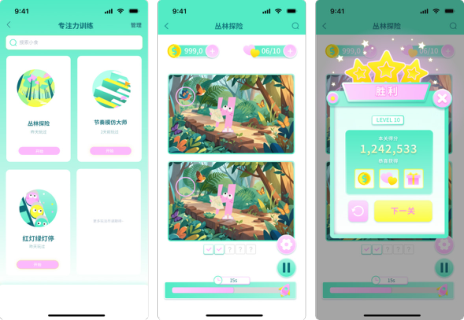
Gamified Training Function: As the core implementation carrier of the “Heart Bridge” service system, the gamified training module targets the improvement of core symptoms in children with ADHD. It transforms professional intervention training into a four-in-one game-based training model characterized by short duration, high interactivity, and strong
System Design-Driven Service Experience Design for ADHD Children’s Families 215 engagement, covering four key training dimensions: sensory integration training, attention training, executive function training, and emotional regulation training. Each dimension offers multiple mini-games for children to select from. Meanwhile, through IP companionship and positive reinforcement, children’s participation motivation and training persistence are maximized to ensure the effectiveness of intervention training. By integrating core intervention objectives such as attention, executive function, and emotional regulation into game scenarios, this function enhances the interest and concentration of children with ADHD, addresses the challenges of insufficient participation motivation among ADHD children and the difficulty of sustaining family-based interventions, and further alleviates the parenting anxiety of parents of children with ADHD (as illustrated in Figure 3).
Figure 3: Gamified training interface.
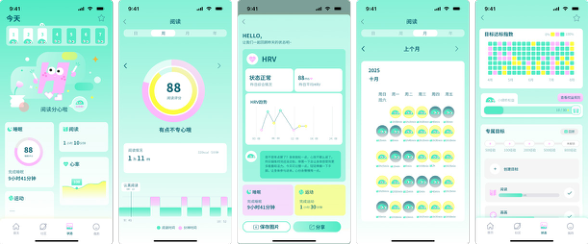
Data Tracking Module: Through the children’s smartwatch, physiological and behavioral data including sleep, heart rate, physical activity, and reading are monitored in real time. Data is synchronized and uploaded to the mobile terminal, with detailed status accessible for each module. For example, the reading module enables viewing of the child’s total reading time for the day, reading attention status, and reading time distribution. Through multi-dimensional statistical analysis of game training completion, views can be switched among weekly, monthly, and yearly dimensions, assisting parents and physicians in intuitively understanding children’s training implementation, status changes, and training efficacy. Simultaneously, based on consecutive days of completing daily training plans, positive feedback is provided to children with ADHD through a points-based progression system, further enhancing children’s training motivation and enthusiasm (as illustrated in Figure 4).
Figure 4: Data tracking interface.
Expert Support Module: Parents can freely select pediatric psychiatrists and ADHD intervention specialists for consultation through text, voice, and image formats, obtaining professional answers and guidance within a short timeframe. This module also provides extensive systematic ADHD knowledge articles, training guidelines, and other content to assist parents of children with ADHD in enhancing professional cognition and auxiliary training capabilities.
Community Empowerment Module: This module establishes a parent community for families of children with ADHD, featuring topic sections including training experience sharing and emotional mutual assistance. Parents can post parenting experiences, confusions, and feelings, engaging in interactive communication with other parents who share similar experiences. Simultaneously, the system curates and pushes high-quality shared content to foster a positive and supportive community atmosphere.
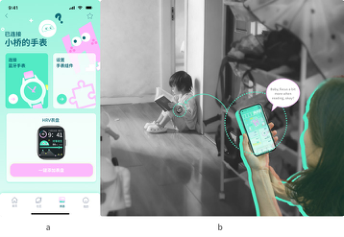
Mobile-Watch Collaboration Module: The smartwatch interface employs large-size icon design with high recognizability, conforming to children’s cognitive habits. Watch faces and components can be customized according to children’s preferences, enhancing their sense of belonging and willingness to use. Upon powering on the watch, parents complete device pairing through Bluetooth connection via the mobile APP (as illustrated in Figure 5a). The watch monitors and displays children’s physiological and behavioral data, synchronously uploading to the mobile terminal to assist parents in real-time monitoring of children’s status. When the watch detects states of distraction or hyperactivity in children and uploads this data to the mobile terminal, parents can send voice reminders to children through the mobile phone, urging them to develop focused habits (as illustrated in Figure 5b).
Figure 5: Collaboration between mobile devices and watches.
System Design-Driven Service Experience Design for ADHD Children’s Families 217 Hardware System Design
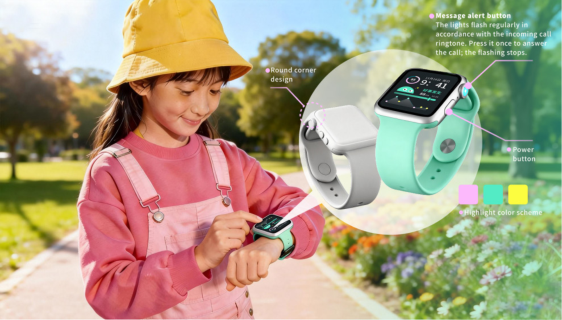
The dial edge adopts rounded-corner design without sharp edges, preventing injury from collisions. The main body of the dial utilizes high-saturation color schemes, echoing the primary color tones of the interface design, with three color options available: pink, green, and yellow, thereby enhancing children’s willingness to use. Three physical buttons are positioned on the side of the watch: power button, volume button, and message reminder button, cooperating with the touch screen to achieve core operations. The operation flow comprises tap-to-select, long-press-to-confirm, and left-right swipe to switch. The message reminder button features a light reminder function; when parents send voice reminders, the message reminder button flashes rhythmically accompanied by ringtone music. Pressing the button enables viewing of voice reminders. Through dual visual and auditory reminders, the possibility of children with ADHD missing messages due to attention dispersion is effectively reduced (as illustrated in Figure 6).
Figure 6: Bluetooth kids’ watch display.
CONCLUSION
Family is the primary setting for behavioral interventions for children with ADHD, and the key to improving intervention effectiveness lies in empowering parents and enhancing children’s training motivation. Based on this, this study takes systems design thinking as the entry point to explore the development of a family service system for children with ADHD, proposing a hardware-software integrated intervention model. By strengthening the collaborative communication among hospitals, families, and children, this model optimizes the behavioral intervention training process for ADHD children in the home environment. Future research can further improve the data collection accuracy of smart hardware, reduce the impact of wearing methods and environmental factors on data reliability through technological upgrades, and enhance the scientific basis for intervention plan adjustments, thereby better improving the hardware-software collaborative service system.
REFERENCES
Dai, J.Y., Tang, D.M. (2025). “Effect of immersive virtual reality technology combined with somatosensory tracker and wearable exoskeleton walking-assist robot rehabilitation exercise on akinesia patients”. Medical Equipment, 38(20): 64–67. Feng, M., Xu, J., Zhai, M., et al. (2023). “Behavior management training for
parents of children with preschool ADHD based on parent-child interactions: A multicenter randomized controlled, follow-up study”. Behavioural Neurology, 2023(1): 3735634. Guo, L.L. (2018). “Research progress on EEG biofeedback therapy for children with attention deficit hyperactivity disorder”. Chinese Journal of Special Education, (04): 53–59. Polanczyk, G., de Lima, M.S., Horta, B.L., et al. (2007). “The worldwide prevalence
of ADHD: A systematic review and metaregression analysis”. Am J Psychiatry, 164: 942–948. Qiu, Y.Z., Tan, Z.H., Zeng, X.Y. (2022). “Research on service design of familyassisted training for children with ADHD”. Design, 35(15): 62–64. Shuai, W.J., Zhao, S.L., Li, W.Z., et al. (2024). “Design and experimental study of
a wearable cardiopulmonary monitoring system”. Chinese Medical Equipment Journal, 45(04): 51–55. Wang, B., Zhu, G., Wang, X.H. (2025). “Improvement of behavioral therapy intervention on emotion and impulsive behavior in adolescents with attention deficit hyperactivity disorder”. Clinical Research, 33(03): 93–96. Yang, L., Zhang, X.Y. (2025). “Construction strategy of ‘one-stop’ student community
psychological education system in universities under the ‘Healthy China 2030’ strategy”. Ideological and Political Work in Universities, (01): 91–96. Zhao, X. (2023). “Study on the effect of sandplay therapy combined with cognitive behavioral therapy on children with ADHD”. Journal of Shanxi Health Vocational College, 33(4): 97–98. Zhao, Z.X., Liu, Z.P., Fu, Z.X., et al. (2024). “Wearable health steward based on
Internet of Things technology”. Internet of Things Technologies, 14(10): 100–104.
LISTED IN THE AHFE DIGITAL BOOKSTORE CATALOGUE
Explore the complete digital volume
Usability and User Experience
Read this individual research paper free through the original publisher, or explore the full digital proceedings book.
ISBN 979-8-950676-08-6
Explore this ISBN in the AHFE Bookstore ↗Listed in the July 2026 bookstore catalogue; search by ISBN to confirm current availability · Digital book purchase optional