Anjali Chauhan (2026). No-Trace Seating: A Probabilistic Design Approach to Reducing Visible Moisture Marks Through Passive Geometry. In: Human Factors and Ergonomics In Design. AHFE Open Access, vol. 210, pp. 260–265. https://doi.org/10.54941/ahfe1007447
Prolonged sitting often leads to moisture accumulation at the seat–skin interface, resulting in visible moisture marks on seating surfaces after an individual stands. While thermal comfort and perceived sweating during sitting have been widely studied, the formation of visible surface marks and their relationship to human–seat interaction remain largely unexplored in ergonomics and human factors research. Such marks may negatively affect perceived comfort, social confidence, and seating usability, highlighting the need for predictive and design-oriented solutions. This study introduces No-Trace Seating, a predictive modeling and ergonomic design framework aimed at estimating and reducing the likelihood of moisture mark formation during seated activities. The framework integrates human thermoregulation, textile microclimate behavior, contact-interface mechanics, and heat–mass transfer to identify key contributors to moisture accumulation at the seat–skin interface. Primary predictors include sitting duration, body mass index (BMI), contact-pressure distribution, seat and clothing vapor resistance, interface temperature gradients, and ambient humidity. These parameters are incorporated into a hybrid predictive approach combining a simplified physical moisture-balance model with a statistical classification method to estimate the probability of visible mark formation. The model enables both analytical understanding and practical assessment of seating conditions associated with increased moisture risk. To translate prediction into a design intervention, a ventilated seating concept is proposed. The design employs micro-airflow channels and high moisture-vapor-transmission-rate (MVTR) materials to enhance airflow and moisture dissipation at critical contact regions. Preliminary simulations indicate improved microclimate regulation and reduced predicted moisture accumulation compared to conventional seating materials.
Prolonged sitting is a common requirement across modern work, educational, and recreational environments. During seated activities, heat and moisture generated by the human body may become trapped at the seat–skin interface, particularly when seating surfaces restrict vapor escape. In some cases, this accumulation manifests as visible moisture marks on the seat surface after an individual stands. While frequently overlooked in ergonomic evaluation,
No-Trace Seating: A Probabilistic Design Approach to Reducing Visible Moisture 261 visible moisture traces can shape user perceptions of cleanliness, comfort, and social acceptability in shared seating environments. Existing research in ergonomics has primarily focused on thermal comfort, perceived sweating, and physiological responses during sitting. However, comparatively little attention has been given to the formation of visible moisture traces as a distinct outcome of human–seat interaction. Importantly, the visibility of moisture marks represents not only a physical phenomenon but also a perceptual and social factor affecting user experience.
Most seating solutions addressing moisture accumulation rely on material substitution, active ventilation, or absorbent layers. These approaches may increase cost, maintenance requirements, or energy use. This paper proposes an alternative approach: reducing moisture mark formation through passive geometric design, without changing seat material composition.
The objective of this study is to introduce a probabilistic modeling framework combined with ergonomic design exploration to predict and reduce visible moisture mark formation through surface geometry modification.
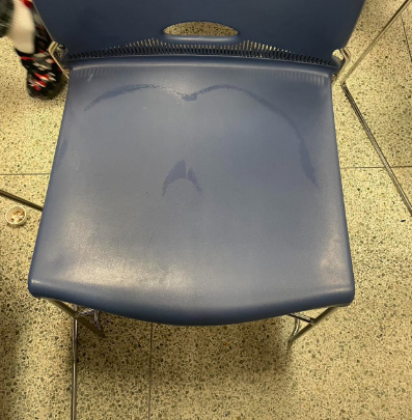
Figure 1: Result of no microclimate ventilation on a seat.
DEVELOPING HUMAN SYSTEMS BY INTEGRATION OF TOOLS TO SUPPORT SYSTEMS DESIGN Moisture accumulation at the seat–skin interface is influenced by multiple interacting factors, including body heat generation, perspiration rate, ambient temperature and humidity, clothing properties, contact pressure distribution, and seat surface characteristics. When moisture vapor is unable to dissipate efficiently, condensation or localized wetting may occur at the seat surface.
From a human factors perspective, visible moisture marks represent more than a thermal comfort issue. In shared seating environments such as gyms, classrooms, public transportation, and offices, visible marks may lead to discomfort, embarrassment, or perceived hygiene concerns. These
262 Chauhan perceptual effects can influence user satisfaction and seating usability even when physiological discomfort is minimal.
Current ergonomic evaluations often emphasize subjective comfort ratings or thermal sensation scales, which may not capture the visual and social implications of moisture mark formation. This gap highlights the need for design-oriented methods that explicitly consider visible outcomes of seated microclimate behavior.
METHODOLOGY
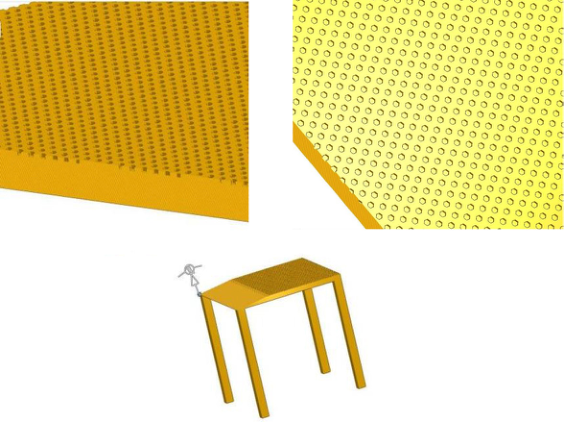
Design Intervention A micro-perforated seating surface was developed using computer-aided design (CAD) to enhance passive ventilation at the seat surface. The design introduces uniformly distributed micro-scale perforations intended to promote vapor escape while maintaining structural integrity and user comfort. No changes were made to seat material composition; only surface geometry was modified.
Multiple geometric configurations were explored to evaluate the effect of perforation size and distribution on moisture dissipation potential.
Figure 2: Proposed microclimate ventilation on a seat surface.
Probabilistic Modeling Moisture mark formation was modeled as a stochastic event using a Poisson- based framework. The Poisson process is appropriate for representing discrete events occurring over time under conditions of independence and constant average rate. In the context of seated microclimate behavior, localized moisture accumulation can be interpreted as the result of multiple small, independent contributions of perspiration and vapor condensation over time. While the exact physiological processes are continuous, the observable
No-Trace Seating: A Probabilistic Design Approach to Reducing Visible Moisture 263 outcome is visible moisture mark formation that can be approximated as a threshold-based event triggered by cumulative micro-events. Therefore, a Poisson formulation provides a simplified yet effective representation for comparing the relative likelihood of moisture mark occurrence across different seating configurations under controlled conditions.
Simulation Setup The simulation was conducted under controlled, literature-informed conditions to isolate the effect of seat geometry. Environmental parameters were assumed constant, with ambient temperature and humidity maintained within typical indoor ranges. Sitting duration was varied across a representative range to capture short and prolonged seating scenarios.
Two seating configurations were evaluated: (1) a conventional non-ventilated seat surface and (2) the proposed micro-perforated design. All non-geometric parameters were held constant between configurations, ensuring that observed differences in predicted moisture mark probability were attributable solely to surface geometry.
The probabilistic model was implemented using synthetic datasets generated to reflect realistic ranges of sitting duration and environmental exposure. Mean probability values were computed for both seating configurations and compared to estimate relative reduction.
RESULTS
Simulation results demonstrate a consistent reduction in predicted moisture mark probability for the proposed seating design compared to conventional seating. Across simulated sitting durations, the micro-perforated geometry exhibited approximately 40–45% lower probability of visible moisture mark formation. The reduction remained stable across varying environmental conditions, suggesting robustness of the geometric intervention. The computed mean probability values for conventional and proposed seating were approximately 0.16 and 0.09 respectively, corresponding to a relative reduction of approximately 40–45%.
DISCUSSION
During preliminary design exploration, several configurations were rejected due to impractical pore spacing or compromised seating comfort. The findings indicate that surface geometry alone can significantly influence moisture accumulation outcomes at the seat–skin interface. By facilitating passive vapor escape, micro-perforated designs reduce localized moisture buildup without reliance on material changes or active systems. Importantly, uniform perforation patterns may offer greater usability than localized designs, as seating posture and contact regions vary among users.
These results emphasize the role of physical design in addressing perceptual and social aspects of comfort that are often overlooked in traditional ergonomic evaluations.
264 Chauhan As outlined in Table 1, multiple interacting factors contribute to moisture accumulation at the seat–skin interface, reinforcing the need for design-based mitigation strategies.
LIMITATIONS AND FUTURE WORK This study is based on synthetic data informed by existing literature and does not include experimental human subject testing. Future work will involve controlled laboratory validation, expanded participant testing, and exploration of hybrid solutions combining geometry with surface treatments or textiles.
Table 1: Sample human systems integration test parameters (Folds et al. 2008).
Table available in the original PDF paper.
Limitations
Active System
Cost/ Complexity
Approach Material Change Required
Addresses Visible Marks
Absorbent fabrics
Yes No Partial Medium Saturation, hygiene issues Breathable textiles Yes No Partial Medium Limited effectiveness on hard seats
Yes Yes Yes High Power, cost, maintenance
Active ventilated seats Yes No Partial Medium Wear over time Moisture- wicking coatings
Proposed No-Trace Seating
No No Yes Low Requires physical validation
CONCLUSION
This paper presents a probabilistic, design-driven framework for reducing visible moisture marks on seating surfaces through passive geometric intervention. The proposed approach demonstrates that small design modifications can yield meaningful improvements in user experience without altering materials or increasing system complexity. The framework contributes to ergonomic seating research by linking prediction, perception, and design in the context of seated microclimate management.
ACKNOWLEDGMENT
The author would like to acknowledge their cat Mau first and foremost and the Applied Human Factors and Ergonomics (AHFE) Conference organizers for providing a platform to present early-stage, design-driven research. The author also acknowledges the learning resources, workshops, and academic
No-Trace Seating: A Probabilistic Design Approach to Reducing Visible Moisture 265 discussions that contributed to the development of the probabilistic modeling and design concepts presented in this work.
This research was conducted independently and did not receive direct external funding.
REFERENCES
Gagge, A. P., Stolwijk, J. A. J., & Nishi, Y. (1971). An effective temperature scale based on a simple model of human physiological regulatory response. ASHRAE Transactions, 77, 247–262. Havenith, G., & Fiala, D. (2016). Thermal comfort and thermoregulation during
sitting activities. Applied Ergonomics, 56, 32–40. ISO 7730 (2005). Ergonomics of the thermal environment — Analytical determination and interpretation of thermal comfort. International Organization for Standardization. McCullough, E. A., & Jones, B. W. (2002). A comprehensive database for estimating
clothing insulation. ASHRAE Transactions, 108(2), 433–444. Parsons, K. (2014). Human Thermal Environments: The Effects of Hot, Moderate, and Cold Environments on Human Health, Comfort, and Performance. CRC Press. Wang, F., Del Ferraro, S., & Yang, J. (2018). Investigation of seat surface microclimate
and moisture accumulation during prolonged sitting. Ergonomics, 61(6), 845–857. Zhang, H., Huizenga, C., Arens, E., & Wang, D. (2004). Thermal comfort during prolonged sitting. ASHRAE Transactions, 110(2), 1–13.
LISTED IN THE AHFE DIGITAL BOOKSTORE CATALOGUE
Explore the complete digital volume
Human Factors and Ergonomics In Design
Read this individual research paper free through the original publisher, or explore the full digital proceedings book.
ISBN 978-1-964867-86-1
Explore this ISBN in the AHFE Bookstore ↗Listed in the July 2026 bookstore catalogue; search by ISBN to confirm current availability · Digital book purchase optional