Maryna Zharikova, Stefan Pickl (2025). A Neural Network Approach to Modeling Human Behavior in Conflict Zones. In: Human Factors and Simulation. AHFE Open Access, vol. 180, pp. 12–22. https://doi.org/10.54941/ahfe1006384
This paper explores the multifaceted phenomenon of collaborationism, with a particular focus on its manifestation during the ongoing Russian aggression against Ukraine. Collaborationism, defined as the act of cooperating with occupying forces, poses significant challenges to national security, social cohesion, and international stability. By examining the socio-political, economic, and ideological factors that influence individual decisions to collaborate, this study provides a comprehensive framework for understanding and predicting collaborationist behavior in conflict zones.Leveraging extensive data collected from Ukraine, the research employs an innovative approach using neural networks to model the emergence of collaborationism. The study identifies key indicators that contribute to an individual's propensity to collaborate, including material well-being, ideological alignment, moral qualities, and exposure to trigger events such as economic hardship or coercion by occupying forces. These indicators are analyzed within a broader socio-political context, revealing complex interactions between pre-existing conditions and situational pressures. The use of neural networks allows for the development of predictive models capable of simulating human behavior in high-stress environments, thereby offering valuable insights for both academic research and practical applications in conflict management.The findings highlight the importance of understanding human factors in shaping collaborationist behavior. By integrating psychological, economic, and ideological variables into a unified framework, the research demonstrates how individuals' decisions are influenced by a combination of intrinsic beliefs and external pressures. The study also underscores the role of moral and ethical considerations, which can either mitigate or exacerbate the likelihood of collaboration, depending on the individual's perception of legitimacy and survival. These insights are critical for designing interventions aimed at reducing the occurrence of collaborationism and fostering resilience within vulnerable populations.From a simulation perspective, the paper presents a novel application of neural networks to model human behavior in conflict scenarios. By simulating the interplay between individual characteristics and environmental factors, the proposed framework provides a dynamic tool for predicting collaborationist behavior under varying conditions. This approach not only enhances our understanding of human behavior in conflict zones but also offers practical applications for policymakers, security agencies, and humanitarian organizations. For instance, the predictive models can be used to identify at-risk individuals or communities, enabling targeted interventions that address the root causes of collaborationism, such as economic deprivation or ideological polarization.The broader implications of this research extend beyond the Ukrainian context. As Europe faces growing internal and external threats, understanding the dynamics of collaborationism becomes increasingly relevant for enhancing national and international security frameworks. The study's findings emphasize the need for comprehensive strategies that address both the symptoms and underlying drivers of collaborationism, including socio-economic disparities, political instability, and ideological manipulation. By incorporating predictive modeling and simulation into security planning, governments and international organizations can develop proactive measures to strengthen societal resilience against occupation and coercion.In conclusion, this research bridges the gap between human factors, simulation, and security studies by providing a robust framework for analyzing and predicting collaborationist behavior. The integration of neural networks and human factors research offers a powerful tool for understanding the complex interplay of individual and environmental influences, paving the way for innovative strategies to mitigate collaborationism and enhance resilience in conflict-affected regions.
Collaborationism, defined as a political or social stance that supports cooperation with an occupying power or foreign government (Hoffmann, 1968; Armstrong, 1968; Pysmenskyi, 2020), has been a recurring phenomenon throughout history, manifesting in various forms across different countries and contexts. However, in contemporary times, the concept has gained particular significance in light of the Russian aggression against Ukraine, where collaborationism has emerged as a critical issue with far-reaching implications for national security and sovereignty of Ukraine, with far-reaching consequences for other countries (Pysmenskyi, 2020).
The temporary occupation of parts of Ukraine by the Russian Federation has led to the emergence of various forms of cooperation between local inhabitants and the occupying forces. Many collaborationists have been exposed, particularly those occupying leadership positions with access to classified information, decision-making authority, or influence over subordinates, but there are still many covert collaborators. These individuals often disseminate false information, distort ideas, and act covertly in the interests of the aggressor state. Covert collaborationism poses a grave threat, not only to individual institutions but to the overall security and sovereignty
A Neural Network Approach to Modeling Human Behavior in Conflict Zones 13
of the nation. As noted by Dolhoruchenko (2022), collaborationism undermines the state’s ability to defend itself and threatens its long-term stability.
The relevance of collaborationism extends beyond Ukraine due to the increasing use of hybrid warfare tactics, where state and non-state actors exploit local populations to destabilize governments and undermine sovereignty. This makes the issue particularly urgent in the context of modern geopolitical conflicts, where collaborationism can serve as a tool for aggressors to achieve their strategic objectives without direct large-scale military engagements. Addressing this issue is essential not only for Ukraine but also for the broader international community, as it highlights the need for resilience and unity in the face of external threats.
Scholars have identified several factors contributing to the spread of collaborationism. Hapelyuk (as cited in Lychova, 2023) highlights three key categories of factors that caused the spread of collaborationist behaviour in the temporarily occupied territories of Ukraine:
External factors: Long-term, planned preparation for occupation actions by the aggressor.
Internal factors: The socio-political development of the affected country, including systemic weaknesses and vulnerabilities.
Historical and ideological factors: Legacy influences, such as remnants of post-Soviet narratives and ideological attachments.
However, in reality, beyond these categories, there are many other factors contributing to collaborationism that require further study. The situation is far more complex, as these factors are interdependent and influence one another in multifaceted ways.
Collaborationism is not merely a national issue; it has broader implications for European security. As noted by Lychova and Komanetska (2023), collaborationism undermines the sovereignty and defense capabilities of affected countries, making it a crime against peace and security under international law.
STATE-OF-THE-ART AND THE GOAL OF THE PAPER Collaborationism, as a phenomenon, has been studied extensively in historical and political contexts, particularly in relation to World War II and recent events in Ukraine. However, the field of information sciences has largely neglected this topic, leaving a significant gap in understanding the role of modern data-driven methodologies and computational tools in analyzing and predicting collaborationist behavior.
Collaborationism has historically been analyzed in the context of World War II, focusing on material incentives as the primary motivator (Hoffmann, 1968; Armstrong, 1968). For example, the Gächter and Vidal-Anarisio’s model (cited in Kalishchuk, 2023) examines the emergence of collaborationism based on a comparison of personal material benefits with those offered by the aggressor country. Although such models are outdated for examining contemporary forms of collaboration, they are still used.
14 Zharikova and Pickl
However, the phenomenon of collaborationism has gained renewed attention in recent years, particularly in the context of Russia’s large- scale aggression against Ukraine. With the beginning of Russia’s large- scale aggression on February 24 in 2022, collaborationism became the subject of active interest of criminal lawyers as well (Kalishchuk, 2023; Lychova, 2023; Shaikan & Shaikan, 2021). There are several modern studies that consider psychological and motivational factors influencing collaborationism (Shymko et al., 2023; Shymko et al., 2024).
Thus, recent studies have explored the legal, psychological, and socio- political dimensions of collaborationism, with a particular focus on Ukraine. These works have provided valuable insights into the motivations and legal frameworks surrounding collaborationist behavior. However, while modern studies of collaborationism are based on the Ukrainian experience, most of the data on collaborationists collected in Ukraine remains underutilized. These datasets represent a unique opportunity to identify patterns and dependencies that could be applied not only in Ukraine but adapted to other countries facing similar threats to sovereignty and security. On top of it, much of recent research remains fragmented and focused on isolated aspects of this phenomenon. Collaborationism cannot be adequately explained by isolated or fragmented approaches that focus on a single dimension, as they fail to account for the full spectrum of conditions and motivations driving this behavior.
Moreover, there is a lack of research utilizing advanced methodologies, such as machine learning, to model and predict collaborationist behavior based on empirical data.
There are several critical gaps that remain unaddressed in the current research landscape:
Fragmentation of Studies: Existing studies are fragmented and focus on specific aspects of collaborationism, such as motivations, legal implications, or historical contexts. There is no comprehensive analysis of the root causes and conditions that foster collaborationism.
Underutilization of Data: Ukraine has amassed significant data on collaborationists, including biographical, career, and behavioral information, collected in public registries like the “State Traitors” database (https://www.chesno.org/traitors/) and Mirotvorets database. This data remains underutilized in research. On top of it, no studies have attempted to generalize or adapt Ukraine’s data for use in other national or regional contexts.
Neglect in Information Sciences: there are no comprehensive studies in the field of information sciences that analyze cause-and-effect relationships in the formation of collaborationism. Existing attempts are characterized by superficiality or focus on general conditions without leveraging advanced computational tools, such as machine learning and neural networks.
Ukraine presents a unique opportunity to address above mentioned gaps. The country has amassed a significant amount of data on collaboratuonists,
A Neural Network Approach to Modeling Human Behavior in Conflict Zones 15
including biographical information, career trajectories, and behavioral patterns. This data, combined with the availability of public registries such as the “State Traitors” database (https://www.chesno.org/traitors/) and Myrotvorets (https://myrotvorets.center/), provides a rich foundation for studying the conditions that foster collaborationism. By leveraging this data, it is possible to identify causal relationships, develop predictive models, and create templates for identifying potential collaborationists.
To address the above mentioned gaps, the proposed research introduces a set of hypotheses that reflect the need for a holistic approach, effective data utilization, and the application of advanced computational methods: H1: Comprehensive Analysis of Conditions influencing collaborationism. Collaborationism is influenced by a complex interplay of material, ideological, moral, and socio-political conditions, which must be identified and analyzed comprehensively to uncover the root causes and conditions fostering this behavior. Fragmented approaches fail to capture the full spectrum of influencing conditions.
H2: Data-Driven Insights. The extensive biographical, career, and behavioral data collected in Ukraine can be systematically analyzed to uncover previously overlooked templates that predispose individuals to collaborationism. Leveraging this underutilized data will provide a deeper understanding of the phenomenon.
H3: Generalizability Across Contexts. Predictive templates and models developed using Ukraine’s collaborationist database can be adapted to other contexts, with appropriate adjustments for local socio-political and historical conditions. This approach will enable broader application of findings beyond Ukraine.
H4: Machine Learning for Predictive Modeling. Advanced computational tools, such as machine learning and neural networks, can effectively analyze the cause-and-effect relationships in the formation of collaborationism. These tools can predict an individual’s propensity for collaborationism by identifying and quantifying the influence of key conditions.
To bridge the identified gaps in existing research and address the outlined hypotheses, this paper aims to develop a comprehensive approach to understanding and predicting collaborationism.
This will be achieved by analyzing the causal relationships between various conditions—such as material well-being, ideological beliefs, and personal qualities—and the likelihood of collaborationist behavior. The research aims to create adaptable templates and scenarios based on Ukrainian experience that can be applied across different countries and contexts to proactively address collaborationism.
Scientific research objectives of the research:
1) Identifying Key Conditions Influencing Collaborationism: Analyze statistical data from Ukraine to identify the material, ideological, moral, and socio-political conditions that contribute to the emergence of collaborationism. This step will leverage Ukraine’s experience to uncover the root causes and conditions fostering collaborationist behavior and identify the relationship between them.
16 Zharikova and Pickl
2) Developing a Self-Learning Neural Network Model: Design and implement a neural network capable of learning the dependencies between key conditions (indicators) an individual’s propensity for collaborationism. The model will classify individuals into categories based on their propensity for collaborationism. 3) Creating Predictive Templates: Utilize the trained neural network to develop predictive templates that describe how a person’s tendency toward collaborationism is influenced by specific sets of conditions. These templates will provide a structured, data-driven framework for understanding the interplay of conditions that foster collaborationism. 4) Building Scenarios for Collaborationism Formation: Based on the predictive templates, construct scenarios that illustrate how different combinations of conditions (indicators) might lead to the formation of collaborators. These scenarios will help policymakers and security experts identify and mitigate risks associated with collaborationism in real-world contexts.
The novelty of the proposed research lies in its holistic and data-driven approach to understanding and predicting collaborationism.
Unlike existing fragmented studies, this research integrates a comprehensive analysis of material, ideological, moral, and socio- political conditions to uncover the root causes and conditions that foster collaborationism (H1).
By leveraging extensive, underutilized biographical and behavioral data from Ukraine (H2), the research introduces a systematic method to identify previously overlooked patterns and templates that predispose individuals to collaborationist behavior.
Furthermore, the research advances the state-of-the-art by developing predictive models using cutting-edge machine learning techniques (H4), enabling the quantification of cause-and-effect relationships and the classification of individuals based on their propensity for collaborationism.
A key innovation is the adaptability of the predictive templates and scenarios. These tools will not only provide actionable insights for addressing collaborationism in Ukraine but will also be generalizable to other socio- political contexts worldwide, with appropriate modifications (H3).
CONCEPTUAL FOUNDATION Collaborationism does not emerge spontaneously; it is the result of a combination of factors that develop throughout an individual’s life. These factors, referred to as conditions, interact with external stimuli, referred to as triggering events, and are moderated by an individual’s threshold for responding to such an event.
This section outlines the theoretical framework of the research, transitioning from the formulation of its goals to the methodological approach.
The framework is built on a set of foundational conceptual terms— conditions, indicators, trigger events, trigger event weight, and trigger
A Neural Network Approach to Modeling Human Behavior in Conflict Zones 17
event threshold—underpin the project’s methodology. These terms have been specifically designed for this research and form the basis for understanding and predicting collaborationism.
Conditions are the underlying factors that shape an individual’s predisposition toward collaborationism. These factors create the foundation upon which collaborationist behavior can emerge. For this paper, we have identified three primary groups of conditions, but it is expected that this set will be expanded:
Material well-being.
Ideological and patriotic qualities.
Moral and ethical values.
Indicators are measurable variables that represent the conditions for an individual.
Examples of indicators of material well-being:
Monthly income level (measured in monetary units).
Access to basic necessities, such as the percentage of income spent on food, housing, and transportation.
Economic stability, measured by employment status (e.g., full-time, part- time, unemployed) or savings-to-expenses ratio.
Examples of indicators of ideological and patriotic qualities:
Biographical data, such as the number of years spent in influential positions under the USSR or the number of documented ties with entities in the aggressor country.
Susceptibility to propaganda, measured by the frequency of engagement with propaganda content (e.g., views, shares, or likes of specific posts or media from known propaganda sources).
Social media activity, such as the number of posts, comments, or shares expressing support for the aggressor country or anti-patriotic sentiments.
Examples of indicators of moral and ethical values:
Documented cases of career advancement through unethical means (e.g., the number of confirmed incidents of bribery or abuse of power).
Instances of abuse of official position, measured by the number of recorded complaints or investigations.
Patterns of corruption, such as the frequency of involvement in corruption-related legal cases or the number of reported bribes.
Indicators are derived from statistical and biographical data and serve as the inputs for the predictive model.
It is obvious that different types of conditions not only influence the propensity to collaborationism, but are also interconnected. For example, it is obvious that the level of income can influence the propensity to corruption, etc.
There is also an assumption that the conditions that shape a person’s propensity to collaborationism can also include a person’s intellectual
18 Zharikova and Pickl
abilities. There is a close connection between the intellectual level and corruption. More qualified workers are less inclined to bribes (Asongu, 2015). A trigger event is a material or financial reward offered by the occupying power that prompts an individual to consider collaborationism. Trigger events serve as the external stimulus that activates the individual’s predisposition to be a collaborator.
Examples include offers of monetary compensation, paid positions, or housing. Trigger events are characterized by their weight, which is quantifiable and often expressed in monetary terms.
Trigger event weight refers to the quantifiable value or significance of the trigger event, expressed in monetary terms. For example, the weight of a trigger event could be the amount of financial compensation offered or the perceived value of a position or resource being provided.
A trigger event is necessary for collaborationism to occur, but its effect depends on the individual’s predisposition, as defined by trigger event threshold.
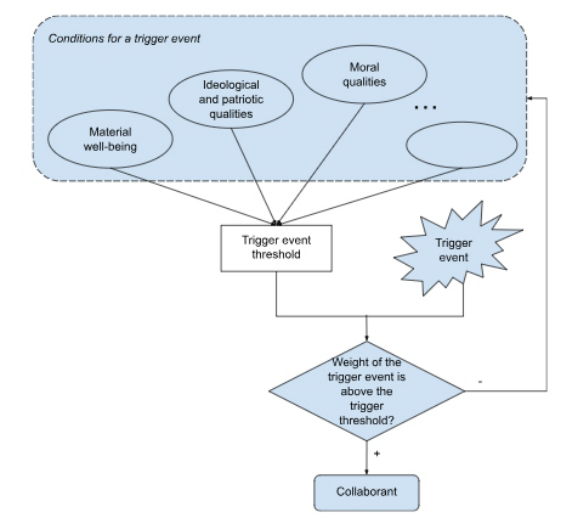
The trigger event threshold is a conceptual measure of an individual’s resistance to collaborationism. It represents the minimum reward or incentive, expressed in financial terms, that is sufficient for a person to agree to be a collaborator. This threshold is shaped by the above mentioned individual’s conditions: for instance, a person with low material well- being and weak moral values may have a lower threshold, making them more susceptible to collaborationism. Conversely, an individual with strong ideological and patriotic qualities may have a higher threshold, making them less likely to be a collaborator.
If the weight of the trigger event exceeds the individual’s trigger event threshold, collaborationism is more likely to occur. Obviously, the same trigger event will work for one person and not work for another, depending on their trigger event threshold.
Thus, a person’s transition to collaborationism is determined by a combination of conditions, trigger event, and trigger event threshold.
Building on these foundational conceptual terms, we can illustrate the interplay of conditions, indicators, trigger events, and thresholds through the following scheme for forming a collaborationist (Fig. 1).
Ukraine has accumulated a large volume of statistical data on collaborationists. It is proposed to use this data to identify indicators that reflect the conditions in which a person’s tendency to collaborationism is formed.
In this paper, we propose developing a neural network to self-learn the dependencies between indicators and tendency of person to collaborationism (expressed by the trigger event threshold). Neural network will classify people into classes with different levels of threshold.
Based on the trained neural network, it is proposed to develop templates for the dependence of a person’s tendency to collaborationism on the set of conditions (expressed by the indicators). These templates will allow playing out scenarios of forming the collaborationists and identify potential collaborationists not only in Ukraine, but also in any other European country.
A Neural Network Approach to Modeling Human Behavior in Conflict Zones 19
Figure 1: Scheme for forming a collaborationist.
METHODOLOGICAL APPROACH Building on the conceptual foundations, the paper proposes a formalized, data-driven methodology to analyze the relationships between conditions, trigger events, and collaborationist behavior. The key steps are as follows:
1) Data Collection:
Data Acquisition: Collect comprehensive datasets from Ukrainian databases on collaborators, including biographical data, career trajectories, and behavioral patterns. Ensure data transparency, accessibility, and compliance with ethical standards.
2) Data Preparation and Feature Engineering: collected data will be systematically processed and prepared for use in the neural network. This step involves:
Indicator Identification: Extract measurable variables (indicators) that represent conditions influencing collaborationism using methods such as text mining and structured data extraction techniques.
Correlation Analysis: Perform statistical analysis to identify relationships and interdependencies among indicators.
Data Cleaning and Normalization: Standardize the dataset to handle missing values, outliers, and inconsistencies. Normalize variables for uniformity, such as scaling income levels to a standard range.
Feature Selection: Identify and retain the most relevant indicators for training the neural network, ensuring optimization and removing redundant features.
20 Zharikova and Pickl
Dataset Structuring: Organize the cleaned and processed data into a structured format suitable for input into the neural network, with clear mappings between indicators and target variables.
3) Neural Network Development:
Model Architecture Design: Develop a neural network tailored to the project’s objectives. Define input features (indicators), target variables (trigger event thresholds), and classification categories.
Training and Optimization: Train the neural network using the prepared dataset. Conduct iterative testing and optimization to address challenges such as overfitting or insufficient data in specific categories.
Stakeholder Feedback: Organize consultations with stakeholders, including government agencies, local authorities, research institutions, and international partners. Collect suggestions and comments to refine the model structure, templates, and scenarios.
4) Template Development and Scenario Building:
Validation and Refinement: Validate the neural network using a subset of the dataset not used in training. Evaluate model performance using metrics such as precision, recall, and F1-score. Refine the model based on validation results.
Template Creation: Utilize the trained neural network to develop predictive templates. These templates will describe the dependencies between conditions (indicators) and the propensity for collaborationism.
Scenario Construction: Build scenarios illustrating how different combinations of conditions might lead to collaborationism. Simulate real-world situations to identify risk factors and vulnerable populations.
5) Validation and Adaptation:
Real-World Validation: Test the predictive templates and scenarios using real-world data from Ukraine to ensure accuracy and applicability.
Generalization: Adapt the templates and scenarios for use in other socio- political contexts, ensuring their relevance and applicability in diverse environments.
6) Stakeholder Engagement and Feedback Integration:
Ongoing Engagement: Throughout the project, maintain active collaboration with stakeholders, including government agencies, local authorities, research institutions, and international organizations.
Feedback Mechanisms: Organize regular online consultations (e.g., workshops, online meetings) to gather stakeholder input on model structure, templates, and scenarios.
Iterative Refinement: Incorporate stakeholder suggestions into the neural network development, template creation, and scenario building processes. This ensures the outputs are practical, actionable, and aligned with real- world needs.
A Neural Network Approach to Modeling Human Behavior in Conflict Zones 21
CONCLUSION
This research bridges the gap between human factors, simulation, and security studies by providing a robust framework for analyzing and predicting collaborationist behavior. The integration of neural networks and human factors research offers a powerful tool for understanding the complex interplay of individual and environmental influences. Future work will focus on refining the model and expanding its applicability to other geopolitical contexts.
The research will have direct implications for strengthening societal resilience and national security in Ukraine and beyond:
Enhancing societal awareness: By identifying the conditions and indicators that predispose individuals to collaborationism, the project will provide actionable insights for public awareness campaigns aimed at reducing vulnerability to propaganda and external manipulation.
Strengthening national security: The predictive templates and scenarios developed through the project will enable Ukrainian authorities and authorities of other countries to identify and mitigate risks associated with collaborationism, thereby reinforcing the country’s sovereignty and stability.
Building societal resilience: The insights generated will help both Ukraine and other European countries develop strategies to foster societal cohesion and resilience in the face of external threats, particularly in regions vulnerable to hybrid warfare tactics.
Through these contributions, the research will not only address immediate security concerns but also promote long-term social stability and unity.
REFERENCES
Armstrong, J. A. (1968). Collaborationism in World War II: The Integral Nationalist Variant in Eastern Europe. The Journal of Modern History, 40(3), 396–410. http://www.jstor.org/stable/1878147 Asongu, Simplice & Nwachukwu, Jacinta. (2015). The Incremental Effect of Education on Corruption: Evidence of Synergy from Lifelong Learning. Economics Bulletin. 35. 2288–2308. 10.2139/ssrn.2661448. Dolhoruchenko, K. O. (2022) Collaborationism as a Phenomenon of War and a
Scientific Concept in the Framework of Historical and Legal Studies. Scientific Bulletin of the International Humanitarian University, No. 56, pp. 16–18. doi: https://doi.org/10.32841/2307-1745.2022.56.4. Hetmanchuk, M. (2022) Modern Approaches to Highlighting the Nature, Causes, and Manifestations of Soviet Collaborationism During World War II (1939–1945). Chronicle of Volyn, Issue 27, pp. 142–148. Hoffmann, S. (1968). Collaborationism in France during World War II. The Journal of Modern History, 40(3), 375–395. http://www.jstor.org/stable/1878146. Kalishchuk, O. (2023) The Phenomenon of Collaborationism in the Legal System of
Ukraine: Historical Retrospective and Modern Challenges. Chronicle of Volyn, (28), 108–113. doi: https://doi.org/10.32782/2305-9389/2023.28.14.
22 Zharikova and Pickl
Lykhova, S., & Komanetska, V. (2023). Collaborationism in modern ukraine as a criminal-legal problem. Scientific Works of National Aviation University. Series: Law Journal “Air and Space Law”, 2(67), 210–215. https://doi.org/10.18372/ 2307-9061.67.17863 (in Ukrainian). Pysmenskyi, Yevhen (2020) Collaborationism in Modern Ukraine as a Criminal-
Legal Problem. Law of Ukraine, ISSN: 1026–9932, Issue: 2020/12. doi: 10.33498/louu-2020-12-116. Available at: https://pravoua.com.ua/ua/store/ pravoukr/pravo_2020_12/pravo_2020_12_s8/. Shaikan, A., & Shaikan, V. (2021) Legal Assessment and Speculation on the Topic of Collaborationism in Ukraine. Digital Dimension, SHS Web Conf., 100 (2021) 03001. doi: https://doi.org/10.1051/shsconf/202110003001. Shymko, V. & Babadzhanova, A. (2023) Probation of collaborationists in Ukraine: Exploratory research of personality trait contribution in social reintegration endeavor (January 4, 2023). Available at SSRN: https://ssrn.com/ abstract=4438185 or http://dx.doi.org/10.2139/ssrn.4438185. Shymko, V., & Babadzhanova, A. (2024). Exploring the Motivations and Personality
Traits of Pro-Russian Collaborationists in Ukraine. International Journal of Offender Therapy and Comparative Criminology, 0(0). https://doi.org/10.1177/ 0306624X241240707. Ukrainian database Myrotvorets (Peacemaker) https://myrotvorets.center/. Ukrainian database of state traitors https://www.chesno.org/traitors/.
LISTED IN THE AHFE DIGITAL BOOKSTORE CATALOGUE
Explore the complete digital volume
Human Factors and Simulation
Read this individual research paper free through the original publisher, or explore the full digital proceedings book.
ISBN 978-1-964867-56-4
Explore this ISBN in the AHFE Bookstore ↗Listed in the July 2026 bookstore catalogue; search by ISBN to confirm current availability · Digital book purchase optional