Yukari Semmyo, Kiho Yaoita, Yoshiaki Goto (2026). Transition of Universal Design in Japan's Construction Industry. In: Universal Design and Design for Inclusion. AHFE Open Access, vol. 209, pp. 90–97. https://doi.org/10.54941/ahfe1008022
We researched the changes in laws, private-sector practice, and education for human resource development related to universal design (UD) in Japan and identified future challenges. UD development began in 1980 with the Ministry of International Trade and Industry’s new housing project to define housing performance enabling lifelong living and to develop non-specialized equipment, systems, and construction methods. The 1994 Building Access Act was Japan’s first law based on UD. From 1987–1992, the Ministry of Construction’s technology project produced ergonomic research and a draft of housing design guidelines for an aging society, altering standard housing design. After the 1995 Great Hanshin Earthquake, barrier-free design was adopted in temporary disaster housing, accelerating UD adoption in equipment and private homes. A 2022 survey found 25 of 47 prefectures had UD guidelines, reflecting changing local government attitudes. A questionnaire of 22 private construction firms yielded 11 responses showing activities such as publishing research results and educational materials; some firms treat UD as a default specification. However, many municipalities and firms have discontinued staff training, despite the need for continuous “see, know, experience” education. To the efforts of private companies and organizations, as well as the enforcements of laws and regulations, UD has made progress in both construction and use, but there will be some issues in the future: advancing UD-related law beyond promotion, addressing overlooked users and situations since UD’s introduction, to new issues which were not recognized when UD was introduced to Japan will be necessary to adopt about new approaches.
Universal design (UD) means “design that anyone can use” and was proposed by Mace and others in their education for designers in the 1980s. There are similar concepts to UD such as Design For All and Inclusive Design in Europe. UD was introduced to Japan in the 1990s, but in Japan, still 1980, the Ministry of International Trade and Industry (at the time) was launching to a new housing development project with a similar meaning to UD. It has been about 30 years since the concept of UD was introduced to Japan and it has attracted attention again with the 2020 Tokyo Olympics and Paralympic Games.
Transition of Universal Design in Japan’s Construction Industry 91 The purpose of this study is to provide a comprehensive summary of how UD has developed and been practiced in the field of architecture since its introduction in Japan. In addition, as the social environment has changed significantly after the COVIT-19 pandemic, we will also consider the issues about the practice of UD today.
Definition of UD in Japan The first time the word UD can be identified is in the work of Mace published in 1985. Mace, who was said to have had a different view of the special treatment of architectural measures for people with disabilities, worked with architects, industrial designers, engineers, and researchers to compile and publish guidelines for designing for everyone to use without special specifications. These are the 7 principles of UD. Though there are several Japanese translations for those, the second edition of the 7 Principles of UD published that translated by Kose et al. is common in Japan (Building Research Institute 2026).
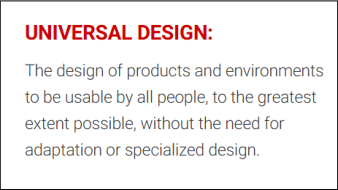
The definition of UD is written in the preamble of the 7 Principles of UD, and it is written as “to the greatest extent possible”. These words show that while recognizing the limitations of the times and circumstances, it is necessary to continuously improve and aim to improve the level, which is connected to the idea of “spiral up”. (NC State University College of Design 2026).
Figure 1: Definition of UD (NC State Univ. College of Design 2026).
Trends in Building Planning Laws and Regulations The development UD technologies for housing in Japan began in 1980 (Iwai, 2003) with the Ministry of International Trade and Industry’s new housing development project. That development and research was aiming to clarify the requirements for dwellings that everyone can continue to live in an ageing society, and to establish technologies such as equipment, systems, and construction methods that are not specially designed. And the results were reflected in pilot models and in the guidebook for enlightenment to design practitioners and end users.
In 1991, the general large-size project of Ministry of Construction played a particularly important role in converting dwelling design into BF. Based on the results, a draft of housing design guideline for an ageing society was prepared and reflected in the Public Housing Construction Standard. It is thought that the enactment of “the Law for Promoting Construction of
Buildings Accessible to the Elderly and Disabled Persons “Hart Build Act” in 1994 stated as a basic concept clearly that a society where people with disabilities can live comfortably for all and integrated promotion of measures to meet the needs of both people with disabilities and the elderly. Heart Build Act was the first law based on almost the concept of UD, which was said to promote BF in public facilities on the premise that everyone will inevitably grow old and have the possibility of having a disability.
The Great Hanshin-Awaji Earthquake in 1995 is also thought to have influenced the progress of UD. Ater this earthquake, many public dwelling units were built as disaster-recovery housing, and the pioneering efforts to convert them into BF assumed that the elderly and the disabled could live there. After that, handrails, safety step, and no floor level change were popularized in dwellings.
In the UD policy outline announced in 2005, efforts were promoted with a view to the entire town. The “Act on Promotion of Smooth Transportation, etc. of Elderly Persons, Disabled Persons, etc.” (Barrier-free New Act) was enforced in 2006 which considers the continuity of building and public transportation. This act promoted the development of the area centered on the station and the participation of related persons (users and residents) from the planning stage, as well as the strengthening of standards by local governments.
The 2020 Tokyo Olympics and Paralympic Games were built through workshops with the participation of the related person involved in the development plan with the goal of becoming the world’s best UD.
UD initiatives in the construction field of local government In 2022, We collected information on the websites of each local government and by email or telephone interviews in 47 prefectures nationwide and investigated the existence of guidelines related to UD, the title of their guideline, departments that have their jurisdiction over UD, and the timing of their enactment.
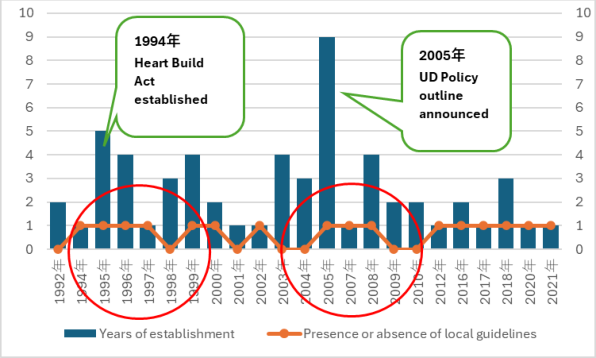
At the time of Miyata et al.’s survey in 2005(Miyata et al., 2007), there were only 7 prefectures that had UD guidelines, but it was confirmed that the number has increased to 25 prefectures (see Table 1.). The departments that have their jurisdiction over UD in each local government were broadly divided into welfare, architecture, and prefectural life. In addition, it was confirmed that the enactment of UD guidelines has increased before and after the enactment of laws or regulations or standards or social events (see Figure 2).
Table 1: Local governments with guidelines.
Table available in the original PDF paper.
Local Governments With Guidelines Number of Respondents This survey (2022) 25
Survey by Miyata et al. (2005) 7 Increase or decrease +18
Figure 2: Example of local UD guidelines establishment and social low et al.
There are several local governments that have changed their treatment and thinking of UD, such as the fact that UD specialized departments were established in the past, but the plans for various measures policies were reviewed and absorbed into other departments. It was also found that several local governments had already abolished the UD promotion guidelines.
It can be assumed that since the enforcement of the Barrier-free New Act, local governments across the country have made efforts to make individual facilities BF and regional BF and the development has progressed to a certain level. However, in the revised Barrier-free New Act, which came into full effect in 2021, showed the promotion of UD at a higher-level urban development that can be easy for everyone to move around BF nationwide, as indicated in the UD2020 Action Plan (Policy meeting 2026) and they have promoted public relations and awareness activities for citizens at the municipal level as a countermeasure against the emergence of problems due to lack of understanding of users.
Currently Status Of UD In Construction-Related Manufactures in Japan The efforts of private construction-related manufactures and organizations are also thought to have contributed significantly to the progress of UD. One of the housing companies that was conducting joint research with a national research institute published the results of its research and contributed to the publication of books for end-users by employees (Goto et al., 1994), reflection in housing design standards, and commercialization and dissemination of housing equipment and equipment.
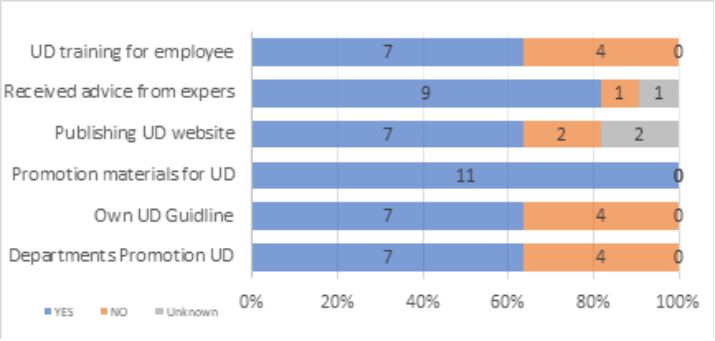
We conducted an e-mail questionnaire survey of 22 private manufactures involved in architecture that are considered to have pioneered research and product development on UD in Japan, which was presented at the UD International Conference (Kyoto) held in 2006. There were 11 respondents (50% response): housing companies, housing equipment companies, construction companies, and energy companies. 7 out of 11 respondents had departments promoting UD (see Figure 3). 7 respondents had their own UD guidelines (see Figure 3). 6 respondents had still had guidelines have set their own guidelines in response to the growing social need for UD.
In addition, it was found that all respondents had materials in the past to promote its UD in some way, and 7 of them still have promotional materials today, and it was found publish UD’s efforts on the web for end users (see Figure 3). 6 respondents said they would continue to proceed with UD in the future, and one of them continued to proceed as part of other plans. There were 3 respondents that said they would develop UD and promote new initiatives. Several respondents have commented that UD is a natural specification became common sense already, and the results confirm the progress of UD. However, one company that answered that it did not know what the future would do was actively working on UD before the Great East Japan Earthquake, but since then, its performance has been sluggish, and it is currently not working at all.
More than 90% of the respondents received expert advice or conducted joint research with experts (see Figure 3). Their main partners were universities and technical colleges.
In addition, about 70% of the respondents that responded were conducting employee training about UD (see Figure 3), and only 3 respondents are still conducting it, but one of them had conducted training to all employees for the released a new PR material in 2022. Other respondents that do not provide training may not need it because UD is already permeating the company.
Figure 3: Result of e-mail research about construction-related manufactures in Japan.
A Practical Example of UD in Recent Years As a practical example of UD, we evaluated the sports facilities that were the venues for the 2020 Tokyo Olympics and Paralympic Games (Tokyo, completed in 2019) with an original checklist. The survey items were three points: whether or not there was consideration to correspond to the 7 principles of UD, whether there was consideration for evacuation guidance in the event of a disaster in the Ministry of Land, Infrastructure, Transport and Tourism’s architectural design standards (revised in 2020) that took into account the smooth movement of the elderly and people with disabilities, etc., and the subjective impression of ourselves(see Table 2.)
It is a sports facility where an unspecified number of people from Japan and abroad gather. It was characterized by holding workshops with the
Transition of Universal Design in Japan’s Construction Industry 95 participation of the parties related people from the early stages (Sato, 2020). New elements were also incorporated, such as the installation of a calm- down space.
The survey results revealed that the design and construction incorporated the principles of universal design (see Figures 4 & 5).
Table 2: Original checklist for UD (Semmyo et al,2023.
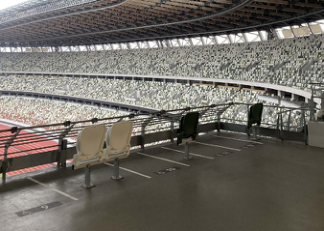
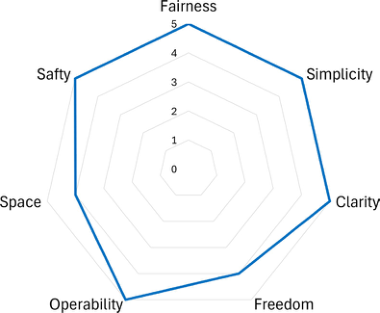
Figure 4: An example of sports facility;There is a large wheelchair space. (Photo by Semmyo, 2022).Figure 5: Basic evaluation.
Current Status of UD Education and Human Resource Development In a survey of construction-related manufactures, some people pointed out about UD the lack of experience of engineers involved in architectural planning. The staff training about UD, which used to be held in some municipalities, is no longer held in many municipalities. The same is true for private companies.
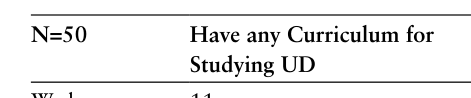
When we checked the status of UD learning at 50 private universities with architecture course in Japan using the curriculum information and syllabus published on each university’s website, only 11 universities were able to confirm the curriculum for studying UD(see Table3). Since there are not many universities that explicitly cover UD in their curriculum in university education, the key to penetrating UD in society will be whether architecture students can study UD during their time in school.
Table 3: Curriculum for studying UD (Semmyo, 2024).
Table available in the original PDF paper.
Equation reproduced from the original PDF.
Not 39
CONCLUSION
Through the efforts of private companies and organizations, as well as the enforcement of laws and regulations, UD has made progress in both construction and usability aspects and has become deeply ingrained in society. However, the following challenges are anticipated for the future.
First, while UD-related laws and standards began as promotion measures and have progressed, they must continue to spiral upward indefinitely. This spiral upward has no endpoint. However, once a certain level of effectiveness is deemed achieved, even national policy initiatives tend to cease. Earlier this year, the Cabinet Office BF/UD Ministerial Council has been closed. (Cabinet Secretariat and Cabinet Office in Japan 2026.
Buildings exist not just for a single moment but are used over long periods. Therefore, it is necessary to address issues arising during use, respond to changes over time, and pass down accumulated know-how. To sustain UD practices, foundational knowledge is essential. Education should be ongoing and ideally include seeing, learning, and experiencing. However, the question is how to secure the personnel to deliver this education.
Meanwhile, private companies play a driving role in raising public awareness of UD’s value. However, depending on corporate performance, the initiative itself may be discontinued, posing the risk that accumulated technology remains unused and dispersed.
Furthermore, since the introduction of UD in Japan, SDs and the diversification of target groups—which were not initially considered— have progressed. For example, poverty became a one of themes at the international UD conference (Rio Conference 2004), while mine clearance in war and conflict zones became the focus at the Japanese conference (IAUD
Transition of Universal Design in Japan’s Construction Industry 97 2006). While UD should address not only physical functionalities but also psychological diversity, determining the extent to which this should be implemented remains a matter of judgment.
ACKNOWLEDGMENT
We would like to express our gratitude to the professors who provided guidance during the preparation of this manuscript.
REFERENCES
Cabinet Secretariat of Japan 2026, Public Documents: Review of the Cabinet Secretariat and Cabinet Office (January 20, 2026), Cabinet Secretariat of Japan Website, viewed 1 February 2026: https://www.gyoukaku.go.jp/sonota/ kanrenlink/img/nainai_R80120.pdf Goto, Y. and Yamane, C. (1994) “Housing Remodeling Plan for the Elderly and
Disabled”, in Japanese, Kodansha. Iwai, K. (2003) “Trends in Laws, Rules and Standards for Housing Environments, Housing, and Equipment for an Aging Society”, The 2nd UD Workshop Lecture Materials, Japanese, Housing Facilities Systems Association. Kose, S. (2002). “The Challenge of Universal Design; Housing Towns Aging Society
and Universal Design”, in Japanese, Neo Shobo. Kose, S. Yasuzawa, Y. Yanagida, K. Shimizu, M. and Horikawa, M.(ed), (2026) “Japanese translation of the Seven Principles of Universal Design”, Building Research Institute, National Research and Development Agency Japan Website, viewed 1 February 2026: https://www.kenken.go.jp/japanese/research/hou/topics/ universal/7udp.pdf Miyata, N. and Takemiya, K. (2007) “Comparative Study on Formulation
and Enforcement of Universal Design Architectural Guidelines among Local Governments”, Journal of Architecture Planning, Architectural Institute of Japan, 72(612), pp.7–14. NC State University College of Design 2026, Center for Universal Design Website, viewed 1 February 2026 : https://design.ncsu.edu/research/center-for-universal- design/ Policy meeting 2026, “Universal Design 2020 Action Plan”, Prime Minister’s Office
of Japan Website, viewed 1 February 2026 https://www.kantei.go.jp/jp/singi/ tokyo2020_suishin_honbu/ud2020kkkaigi/pdf/2020_keikaku.pdf Sato, K. (2020) “Barrier-free and universal design for public buildings-Efforts to improve barrier-free environments for the Tokyo Olympic, Paralympic games and future challenges-”, Bulletin of the Japanese Society of Prosthetics and Orthotics, 36(2), pp.150–155. Semmyo, Y. Yaoita, K and Goto, Y. (2023) “Research on the development and
practice of universal design in the field of architecture in Japan”, Proceedings of annual research meeting, Chugoku Chapter, Architectural Institute of Japan (AIJ), 46, pp. 607–610. Semmyo, Y. (2024) “Present state of universal design education in private architectural universities”, Summary of the 27th National Convention, Japanese Association for an Inclusive Society (JAIS), pp.110–113. Takahashi, G. (2019) “The Philosophy and Implementation of an Inclusive Society:
Living in Harmony with People with Disabilities”, Japanese, Shokokusha Publishing
LISTED IN THE AHFE DIGITAL BOOKSTORE CATALOGUE
Explore the complete digital volume
Universal Design and Design for Inclusion
Read this individual research paper free through the original publisher, or explore the full digital proceedings book.
ISBN 978-1-964867-85-4
Explore this ISBN in the AHFE Bookstore ↗Listed in the July 2026 bookstore catalogue; search by ISBN to confirm current availability · Digital book purchase optional