Xinmiao Shen, Zehui Jin (2025). Multi-dimensional B2B User Persona: Results from a Systematic Review of Research Methods. In: Human Factors in Design, Engineering, and Computing. AHFE Open Access, vol. 199, pp. 531–541. https://doi.org/10.54941/ahfe1006865
In enterprise-level (B2B) services, due to the wide range of requirements, lengthy decision-making processes, and notable variations in usage circumstances, user research is more complicated compared to C2C services. Especially in the field of cloud computing, how to balance online behavioral data, emotional expressions, and business demands has become the core challenge of user research. Traditional single-point surveys are unable to meet this requirement and call for more systematic and multi-dimensional methodological support. This study, through the collection of 153 questionnaires and 7 targeted customer interviews, proposes brand-new multi-dimensional B2B user persona research methods. The core lies in the integration of mixed research methods and dynamic profiling modelling. The former combines qualitative research (deep/telephone interviews) with quantitative research (NPS, online behavior analysis) and introduces real-time session analysis technology to improve the breadth and accuracy of insights; the latter departs from the static tagging model and dynamically generates visual decision heat maps based on behavioral data, graphically presenting the concerns, influence, and information sources of different roles. These methods can compensate for the limitations of current research methods by more correctly capturing the dynamic characteristics of enterprise clients. Through multi-dimensional data integration and dynamic persona methodology, the research findings not only provide scientific support for product design optimization, market and sales strategy formulation but also offer a replicable innovative path for B2B user research.
Understanding user behavior is critical to the success of digital services. Compared with consumer (B2C) contexts, the business-to-business (B2B) environment is far more complex—characterized by heterogeneous needs, lengthy decision chains, multiple stakeholder roles, and the necessity to balance organizational goals with contextual factors (Webster & Wind, 1972; Sheth, 1973; Lilien, 2016). In such settings, user personas play an essential role in building team alignment and supporting strategic decision- making. Since Alan Cooper first introduced the concept of the persona (Cooper, 1999), it has become a widely adopted tool for understanding users. However, its application has been predominantly concentrated in B2C
contexts, where individual users are more tangible and data are easier to collect. By contrast, B2B personas must represent dynamic organizational systems involving multiple interacting roles and limited behavioral data, which makes it difficult to accurately capture users’ motivations and behaviors (Mell & Grance, 2011; Bharadwaj et al., 2013; Wedel & Kannan, 2016; Creswell & Clark, 2017; Chen, Chiang & Storey, 2012; Reichheld, 2003). The cloud computing industry exemplifies these challenges. Service elasticity and rapid iteration continuously reshape user journeys and priority structures (Mell & Grance, 2011; Bharadwaj et al., 2013). For instance, Alibaba Cloud operates in 29 regions and 91 availability zones worldwide, serving 5 million customers, including 190 Fortune Global 500 companies and 10 million developers (Alibaba Cloud, 2024). Such scale and diversity render traditional static segmentation and retrospective analysis inadequate. Enterprises therefore require a persona approach that can dynamically evolve and faithfully represent changing user needs.
To address this gap, this study proposes a dynamic and visualization- driven B2B user persona methodology. The approach integrates multiple data sources—including questionnaires, interviews, behavioral logs, and feature usage traces—to iteratively update representations of enterprise users’ roles, goals, and behavioral patterns. Furthermore, through visual tools such as decision heatmaps, complex analytical results are translated into intuitive insights accessible to non-analysts (Creswell & Clark, 2017; Chen, Chiang & Storey, 2012; Reichheld, 2003). Grounded in the context of Alibaba Cloud, this study draws upon 153 questionnaire responses and 7 client interviews to address two key research questions:
1. How can multidimensional data be effectively integrated to construct B2B user personas? 2. How can multidimensional persona results be visualized in ways that enable intuitive understanding for non-data analysts?
RELATED WORK
B2B user research shows that organizational purchasing—characterized by long decision chains and multiple stakeholders—differs fundamentally from individual B2C decision processes (Webster & Wind, 1972; Sheth, 1973). Yet, B2B research continues to face a “knowledge gap” in translating complex organizational contexts into actionable insights (Lilien, 2016).
In the cloud-computing domain, enterprise studies often rely on static segmentation or retrospective feedback, which fail to capture behavioral changes as products evolve (Marston et al., 2011; Mell & Grance, 2011). Digital business research thus highlights the need for dynamic, data-driven paradigms that support agile decision-making (Bharadwaj et al., 2013; Chen, Chiang & Storey, 2012; McAfee & Brynjolfsson, 2012). Methodologically, mixed methods research provides an explanatory and generalizable bridge between user motivations and behavioral data (Creswell & Clark, 2017). Although such integration is used in CRM and customer insight frameworks,
Multi-Dimensional B2B User Persona: Results From a Systematic Review 533
its real-time application in B2B cloud services remains limited (Payne & Frow, 2005). In dynamic user modeling, adaptive system approaches—successful in consumer personalization (Brusilovsky & Millán, 2007; Ricci, Rokach & Shapira, 2015; Gauch et al., 2007)—face challenges in B2B contexts due to multi-role and cross-temporal collaboration.
Overall, prior studies lack systematic integration of mixed methods and dynamic persona modeling that enables continuous updating and visualization in B2B cloud settings. This study addresses this gap by proposing and validating a dynamic persona framework to understand and predict enterprise customer behavior.
METHODOLOGY
Before presenting our detailed analysis, it is necessary to clarify several points. Although this study focuses on developing a multidimensional analytical framework for B2B user personas, we acknowledge that subjectivity is inevitably involved in our framework design, process, and interpretation. The current research scope is limited to Alibaba Cloud’s Combined Purchase Project, and all analyzed users belong to the target user group of this project. However, given the diversity of products and services within the cloud computing industry—including IaaS, PaaS, and SaaS offerings, which can collectively reach into the thousands in quantity (CAICT, 2023)—the Combined Purchase Project a more representative and realistic scenario of cross-product purchasing behavior than studies confined to a single product line. All online data collection, questionnaires, and telephone interviews in this study were conducted in accordance with standard user research methodologies (Patton, 2015).
Background of the Combined Purchase Project The Combined Purchase Project is an initiative by Alibaba Cloud that offers targeted discount campaigns designed to promote cross-selling scenarios and encourage users to purchase multiple cloud products or services together. Cross-selling refers to the sales strategy of recommending complementary or related products to existing customers in order to enhance customer value and revenue. Conducted primarily through marketing campaigns, the project had undergone approximately three quarters of pilot implementation before this collaboration began. During this period, business conversion data accumulated from continuous user interactions included information such as product types involved in cross-selling, purchase status, and related click behaviors.
Unlike these historically accumulated quantitative datasets, the present research focuses on qualitative user attributes, such as user identity (student, individual, or enterprise), influencing factors in the purchasing process, and emotional or attitudinal tendencies. In addition to this identity-based segmentation, and in consultation with the Combined Purchase Project team, another layer of segmentation was introduced—user behavioral groups— defined as follows:
534 Shen and Jin
Group A – Visitors without purchase: Users who performed key conversion-related click actions but did not place an order within the past six months.
Group B – Completed purchasers: Users who placed at least one order within the past six months.
Group C – Potential customers: Users who purchased two or more products or services within a single day in the past three months.
Behavioral and identity attributes were analyzed both cross-dimensionally (to understand overlaps between groups) and vertically (to explore emotional and behavioral drivers within each group). During collaboration with clients and the marketing research team, additional insights emerged regarding users’ increasing attention to AI-related cloud services and shifting market preferences. Consequently, product/service-level analysis was incorporated as an additional dimension in our framework.
Online Data Analysis Given the availability of existing user data from the Combined Purchase Project, preliminary preprocessing was conducted prior to new analyses. Commercial conversion was identified as the key B2B performance metric. Since user personas in the first quarter were still evolving, the primary data window covered the most recent two quarters (six months), focusing on users who engaged in conversion-related actions on the core Combined Purchase page. Users were categorized as: Group A: Visitors without purchase (conversion clicks but no orders within six months); Group B: Completed purchasers (orders placed within six months).
Considering that Alibaba Cloud’s portal receives over one million daily visitors and that global cloud infrastructure spending reached US$78.2 billion with 19% year-over-year growth (Su, 2025), we also included Group C – Potential customers, defined as users purchasing two or more products within a single day during the most recent quarter (three months).
In addition to conversion rates, transaction value was analyzed as a key B2B metric. An online dashboard was developed in collaboration with R&D and business teams to visualize conversion indicators, including average order value, total spending, and core click timestamps, forming the foundation for subsequent multi-dimensional analysis.
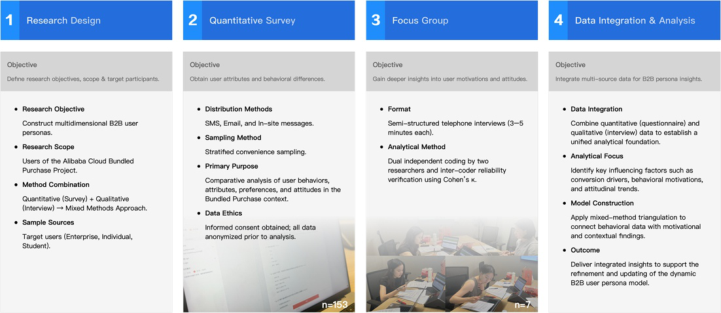
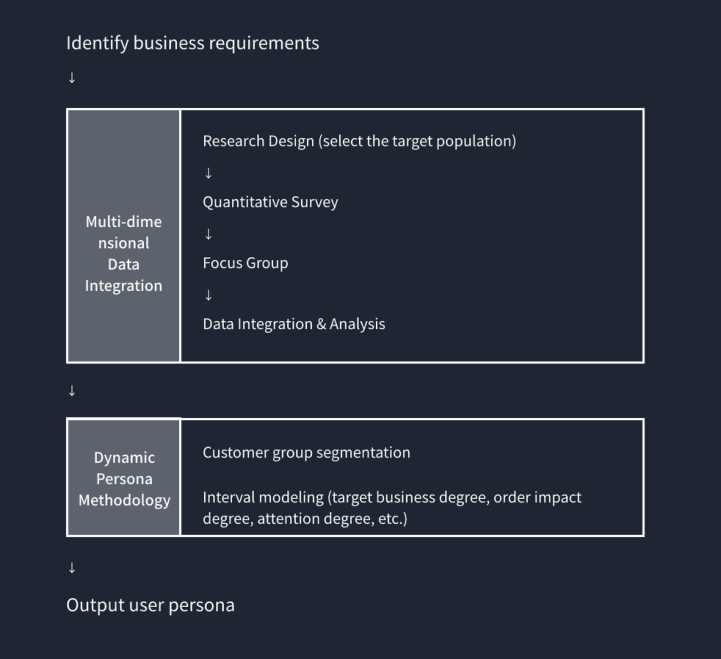
Research Framework Overview To illustrate the methodological structure, Figure 2 outlines the research framework comprising four key phases: (1) Research Design, (2) Quantitative Questionnaire Survey, (3) Focus Group Interviews, and (4) Data Integration & Analysis. Each phase contributes to building and refining multidimensional B2B user personas by integrating quantitative and qualitative findings.
Questionnaire and Focus Group Analysis. To identify user attributes and behavioral differences, a stratified convenience sample was collected through SMS, email, and in-site notifications, yielding 153 valid responses: 66 enterprise clients (43%), 59 individual users (39%), and 25 students
Multi-Dimensional B2B User Persona: Results From a Systematic Review 535
(16%). Among enterprise respondents, 23 were decision-makers and 43 were executors. The questionnaire provided quantitative insights into behavioral and attitudinal variations across user types within the Combined Purchase context.
Figure 1: User research flowchart.
Seven participants from the survey pool joined semi-structured telephone interviews (3–5 minutes each) to enrich qualitative understanding. Discussions focused on (1) purchase guidance and procedural clarity, (2) configuration flexibility, and (3) promotional benefits. Interview data were thematically analyzed by two coders with verified reliability (Cohen’s κ). The integrated quantitative and qualitative findings revealed key conversion drivers, behavioral motivations, and attitudinal trends, forming the analytical basis for the subsequent Data Integration & Analysis phase.
Data Integration & Analysis. This study integrated quantitative and qualitative data to develop a comprehensive understanding of enterprise user behavior. Questionnaire results were cross-analyzed with interview insights through a mixed-methods triangulation framework, combining behavioral statistics (e.g., conversion rates, order values, activity timestamps) with users’ cognitive and emotional drivers. The analysis identified three key dimensions—conversion drivers, behavioral motivations, and attitudinal trends—revealing how short-term transactional behaviors are linked to deeper motivational and perceptual patterns. A dynamic persona modeling framework was then developed, connecting behavioral, motivational, and attitudinal variables to enable continuous persona updates and provide actionable insights for product, marketing, and customer relationship optimization.
Limitations. Given the complexity of B2B contexts, this study focuses on the cross-selling scenario in the cloud-computing domain, and findings should be interpreted within this scope. Data collection followed standardized, objective protocols. Rather than pursuing exhaustive analysis, we examined the limitations of existing methods in capturing the dynamic nature of enterprise customers. Emphasizing methodological innovation, we
536 Shen and Jin
propose replicable and standardized approaches while acknowledging data constraints and interpreting results with caution.
FINDINGS Multi-Dimensional Data Integration
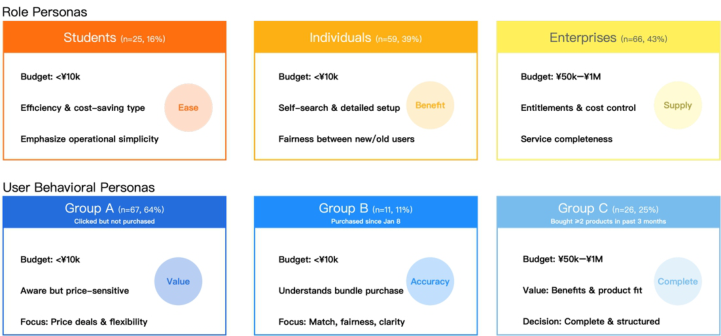
User Role Analysis. Based on identity attributes from the questionnaire, user groups differed in budget, purchasing power, and satisfaction. Student users (16%) had limited budgets (5k–10k RMB) and the lowest satisfaction (7.14). Individual users (39%) showed moderate engagement with relatively high satisfaction (7.83) despite lower spending. Enterprise users (43%) demonstrated diverse budgets, high purchasing depth, and strong payment capacity with moderate satisfaction (7.78). Overall, students followed a “low purchasing power–low satisfaction” pattern, while enterprises formed a stable high-value segment with stronger behavioral and attitudinal depth.
Behavioral Perspective Analysis. Based on online identity tags, users were divided into behavioral groups. Group A (64%) browsed without purchase, showing low budgets, high price sensitivity, and limited awareness (satisfaction 7.43). Group B (11%) purchased and showed the highest satisfaction (8.18) with stronger loyalty potential. Group C (25%) consisted mostly of enterprise users with higher budgets and frequent purchases (attitude 7.92), indicating strong conversion potential. Cross-analysis revealed that non-purchasers were mainly students or individuals, while high-value prospects were primarily enterprises, highlighting both conversion barriers and growth opportunities.
Static User Persona. Integrating identity and behavioral data provides a more holistic understanding of B2B users beyond single-dimension analysis. Questionnaire-based segmentation revealed that student users prioritize simplicity, individual users value fairness and accessibility, and enterprise users emphasize cost efficiency and service completeness. Behaviorally, Group A is price-sensitive, Group B focuses on functional fit, and Group C exhibits complex, multi-factor decision-making. Together, these insights form the foundation for multi-dimensional persona modeling, linking identity and behavior to reveal diverse needs and value perceptions among B2B users.
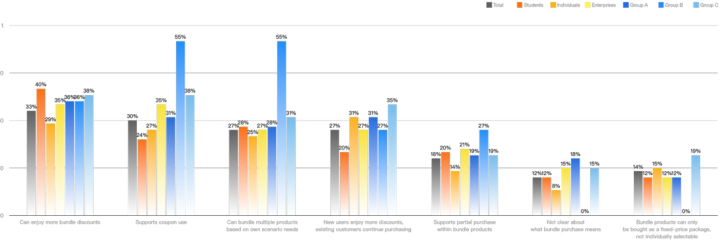
Figure 2: Perception of combined purchase features across different user roles and behavioral groups.
Multi-Dimensional B2B User Persona: Results From a Systematic Review 537
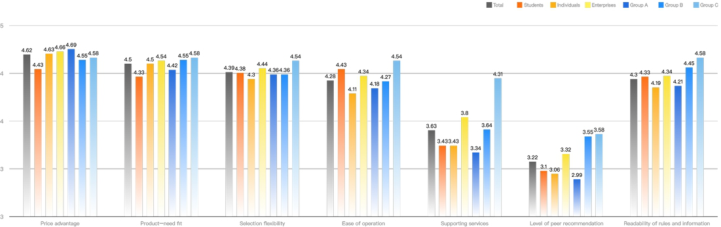
Figure 3: Comparative evaluation of key satisfaction factors among different user roles and behavioral groups.
A multi-dimensional analysis of identity and behavior enables us to move from “labeling user groups” to actionable customer segmentation, making the personas more aligned with business needs. It not only uncovers conversion bottlenecks (e.g., budget constraints among student users) but also pinpoints growth opportunities (e.g., the high-value potential of enterprise customers). To visualize these findings, Figure 4 presents the integrated segmentation framework derived from questionnaire and behavioral data, featuring three role personas (Students, Individuals, Enterprises) and three behavioral personas (Groups A–C). Each segment highlights characteristic attributes—such as budget range, purchasing behavior, and decision preferences—demonstrating how identity and behavioral dimensions intersect to reveal actionable insights. This integration illustrates how static cross-dimensional segmentation can guide collaboration across marketing, product, and customer success teams.
Figure 4: Multi-dimensional segmentation of B2B users based on identity and behavioral personas.
Dynamic Persona Methodology and Visualization Framework A complete user research analysis report does not merely stop at the analysis level; it also needs to pay attention to whether the report presentation can enable the audience or collaborators to quickly and easily obtain the core information (Mell and Grance, 2011). Compared with the more common
538 Shen and Jin
ordinary data presentation forms on the market (such as bar charts, line charts, pie charts, etc.), in the case of multi-dimensional user stratification and dynamic data, compared with the one-time analysis of the ordinary analysis process, based on the new circle selection population data and data cleaning steps added in the mixed research method integration, in the data preparation stage, preprocessing of the collected data is added according to the time series and business model. Multi-source data collection requires the final user portrait to provide a more efficient and flexible way to digest and display the corresponding analysis results. Traditional single-point research cannot meet the dynamic data user portrait, and we adopt a visual chart to display the B2B customer decision heat map.
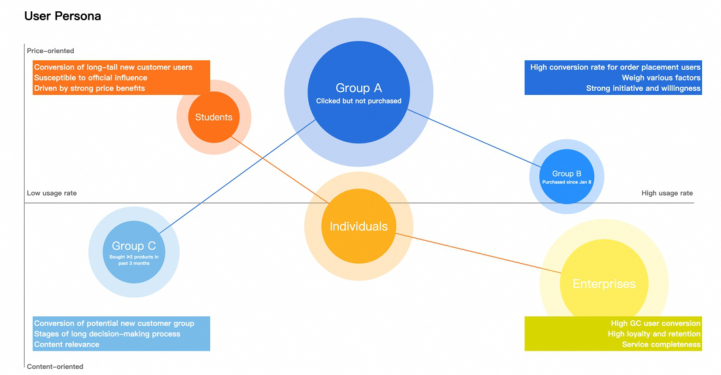
Taking the Alibaba Cloud group purchase scenario as an example, the core behavioral attributes and identity attributes in the overview chart are the two underlying dimensions of the core dynamic portrait. Among them, the behavioral attribute groups “A, B, C” and the identity attribute groups “student, individual, enterprise” are the pre-processed user groups after combining multi-source data collection; the size of the user group range is related to the actual user volume. The target business level is a fixed analysis dimension. The guiding dimension can be changed in different scenarios; in the cross-selling scenario of combination purchase, price and content are the key dimensions that both business and users pay attention to. Detailed user portrait information, such as basic attributes, behavioral data, customer value, etc., is not displayed on this overview chart. The presenter can obtain multi-dimensional information processing results such as core user stratification dimensions, data volume, tag trends, and market conditions on one chart.
Figure 5: Modelling of user dynamic persona for group purchase users.
Compared with the traditional text analysis method, the most essential difference of this dynamic portrait visual chart is the shift from “data language” to “business language”, replacing data reports with natural
Multi-Dimensional B2B User Persona: Results From a Systematic Review 539
business scenario stories and lowering the understanding threshold with visual charts. Besides the analysis within groups, it can visually display the similarities and differences of multiple groups (≥2 groups) of users under the same analysis dimension, helping the business team to better understand user behavior patterns and demand preferences, and also providing qualitative and quantitative analysis support for formulating precise marketing strategies. Due to the complex data interface and the confidentiality mechanism of various enterprise data, we have not yet fully connected this dynamic portrait to all data sources for online operation. However, it is obvious that from the conclusion of this research analysis, apart from implementing a dynamic B2B customer portrait that is operable, verifiable and iterative, it has also explored an upgraded “dynamic decision support” that innovatively supports the cooperation of product design, sales strategy, customer success and cross-selling among various stakeholders.
CONCLUSION
This article mainly introduces a multi-dimensional user profiling analysis research method in the B2B scenario. This research conducts in-depth analysis from the perspective of the commercialization of cloud computing, explores targeted methods based on the current deficiencies in B2B user research, and consolidates the possibility of this method for user profiling research and analysis in other B2B scenarios. The core breakthrough lies in comparing with traditional user research (see Figure 6): 1) In the early stage, through a mixed research method integration, combined with various data such as identity, behavior, attitude, as well as quantitative online data and qualitative offline questionnaires and focus groups, static data is transformed into a dynamic acquisition data approach; 2) In the analysis stage, through dynamic persona methodology and visualization framework, the single- dimensional analysis methods that cannot meet the complex scenarios of B2B can be explained through dynamic visual data presentation forms, also promoting the future development possibilities of user research and business commercialization. Our research findings show that this method can provide higher timeliness and accuracy in profiling construction and update, enabling enterprises to more accurately understand changes in customer behavior, identify leverage points for decision-making, and thereby optimize product and market strategies. Compared with traditional B2B user research techniques, this study provides a sustainable evolving and implementable dynamic user profiling solution for the cloud computing scenario. “This solution enables us to clearly see the core demands of our multi-layer target customer groups, more clearly,” one stakeholder explicitly stated. For the business, whether it is user research data analysis or conclusion export, this method is more instructive.
In the future, our research will focus more on the application of this method in other scenarios, not just in the commercialization of cloud computing, but in more B2B user research scenarios. For the standardization of the plan and the development of data, such as attempts to explain using AI models, these are all areas where we can continuously progress by combining
540 Shen and Jin
data with traditional user research methods. We hope to provide a replicable innovative path.
Figure 6: A multi-dimensional user profiling analysis research method model in the B2B scenario.
REFERENCES
Alibaba Cloud. (2024). Global Infrastructure Overview. Retrieved from https://ww w.aliyun.com/?spm=5176.19720258.~J_8058803260.1.54212c4amcxFK5. Bharadwaj, A., El Sawy, O. A., Pavlou, P. A., & Venkatraman, N. (2013). Digital
Business Strategy: Toward a Next Generation of Insights. MIS Quarterly, 37(2), 471–482. Brusilovsky, P., & Millán, E. (2007). User Models for Adaptive Hypermedia and Adaptive Educational Systems. In P. Brusilovsky, A. Kobsa, & W. Nejdl (Eds.), The Adaptive Web: Methods and Strategies of Web Personalization (LNCS 4321, pp. 3–53). Springer. Bryman, A. (2016). Social Research Methods. Oxford University Press. CAICT. (2023). White Paper on Cloud Computing (2023). China Academy of
Information and Communications Technology, Beijing. (In Chinese).
Multi-Dimensional B2B User Persona: Results From a Systematic Review 541
Chen, H., Chiang, R. H. L., & Storey, V. C. (2012). Business Intelligence and Analytics: From Big Data to Big Impact. MIS Quarterly, 36(4), 1165–1188. Cooper, A. (1999). The inmates are running the asylum. In Software-ergonomie’99:
design von informationswelten (pp. 17–17). Wiesbaden: Vieweg+ Teubner Verlag. Cooper, A. (1999). The Inmates Are Running the Asylum. Indianapolis: Sams. Creswell, J. W., & Plano Clark, V. L. (2017). Designing and Conducting Mixed Methods Research (3rd ed.). SAGE. Flick, U. (2018). An Introduction to Qualitative Research. Sage. Gauch, S., Speretta, M., Chandramouli, A., & Micarelli, A. (2007). User Profiles
for Personalized Information Retrieval. In The Adaptive Web (LNCS 4321, pp. 54–89). Springer. Lilien, G. L. (2016). The B2B Knowledge Gap. International Journal of Research in Marketing, 33(3), 543–556. Marston, S., Li, Z., Bandyopadhyay, S., Zhang, J., & Ghalsasi, A. (2011).
Cloud Computing—The Business Perspective. Decision Support Systems, 51(1), 176–189. McAfee, A., & Brynjolfsson, E. (2012). Big Data: The Management Revolution.
Harvard Business Review, 90(10), 60–68. Mell, P., & Grance, T. (2011). The NIST Definition of Cloud Computing. NIST Special Publication 800–145. https://doi.org/10.6028/NIST. SP.800–145. Patton, M. Q. (2015). Qualitative Research & Evaluation Methods. Sage. Payne, A., & Frow, P. (2005). A Strategic Framework for Customer Relationship
Management. Journal of Marketing, 69(4), 167–176. Reichheld, F. F. (2003). The One Number You Need to Grow. Harvard Business Review, 81(12), 46–54. Ricci, F., Rokach, L., & Shapira, B. (Eds.). (2015). Recommender Systems Handbook
(2nd ed.). Springer. Sheth, J. N. (1973). A Model of Industrial Buyer Behavior. Journal of Marketing, 37(4), 50–56. Su, L. J. (2025). AI Cloud Market by Vendor. Omdia. Retrieved from https://omdia.
tech.informa.com/om138112/ai-cloud-market-china-1h25. Webster Jr., F. E., & Wind, Y. (1972). A general model for understanding organizational buying behavior. Journal of marketing, 36(2), 12–19. Wedel, M., & Kannan, P. K. (2016). Marketing Analytics for Data-Rich Environments. Journal of Marketing, 80(6), 97–121.
LISTED IN THE AHFE DIGITAL BOOKSTORE CATALOGUE
Explore the complete digital volume
Human Factors in Design, Engineering, and Computing
Read this individual research paper free through the original publisher, or explore the full digital proceedings book.
ISBN 978-1-964867-75-5
Explore this ISBN in the AHFE Bookstore ↗Listed in the July 2026 bookstore catalogue; search by ISBN to confirm current availability · Digital book purchase optional