Xinmiao Shen, Danlin Song (2025). LightBUY - Developing Cloud Sales Design Specifications from the Ground Up. In: Human Factors and Systems Interaction. AHFE Open Access, vol. 192, pp. 29–39. https://doi.org/10.54941/ahfe1006625
The sales service associated with cloud products represents a crucial component in the commercialization of the cloud computing sector. Although comprehensive analyses and clear definitions exist within the consumer-to-consumer (C2C) context, a standardized framework for the procurement of cloud computing solutions in the business-to-business (B2B) environment remains undeveloped. It is essential to address various user roles, accommodate intricate cloud computing scenarios, and enhance user efficiency in B2B contexts. This subject is inherently complex, and the substantial variations among cloud computing products necessitate rigorous requirements for high-level design architecture. Therefore, instead of focusing on a system design in its entirety, we are concentrating on the structural architecture with the goal of improving its executability, stability, and coherence. Additionally, we are aiming to provide an industry-standard reference for purchasing scenarios in the cloud computing domain.
Cloud computing users initiate their transition to the cloud by acquiring various cloud products, and the sales experience significantly influences their initial engagement with cloud services. This purchasing behaviour indicates that users are beginning to familiarize themselves with and utilize cloud products. However, the current sales experience for cloud products appears to be outdated when compared to the consumer-oriented e-commerce sector. Users are often required to navigate extensive and complex manuals or to acquire comprehensive knowledge of cloud products from the ground up. Consequently, the reading and sales experience have not kept pace with the rapid advancements in technology. Alibaba Cloud operates in over 200 countries and regions, serving more than 4 million customers and marking the advent of the era of 5 million servers in cloud computing. Cloud computing represents a business model characterized by network effects and economies of scale, with Alibaba Cloud offering millions of customers access to a reusable global cloud computing network and resource pool. To enhance the effectiveness of cloud computing in serving customers, it is imperative to address this fundamental issue and develop a sales experience that is more
aligned with the needs of the majority of users. LightBUY represents the design standard for cloud computing buying within this context.
CHALLENGES Background of Cloud Computing Purchase
One of the most prominent market trends is the adoption of hybrid and multi-cloud strategies, which integrate both public and private cloud services. This approach enables enterprises to capitalize on the benefits of each cloud type, thereby optimizing their IT infrastructure (Mali, 2024). According to Gartner, the global public cloud service revenue for Infrastructure as a Service (IaaS) is projected to grow at a faster rate than any other service, reaching $76.6 billion by 2022. Current breakthrough technologies, such as artificial intelligence (AI), can advance rapidly due to their ability to access and analyze vast amounts of data in real time. These innovations are increasingly challenging to support solely through traditional IT frameworks and are more likely to transition to public cloud services (Press Release, 2019). From a market segmentation perspective, public cloud services currently represent the predominant form of cloud computing in China, with their market share increasing annually. In 2022, the public cloud market in China accounted for the largest share, comprising 71.6%, while the private cloud market constituted only 28.4% (Chinabaogao, 2024). The overarching trend indicates that the public cloud market is poised to assume a dominant and foundational role within the cloud computing industry. The commercialization of public cloud services necessitates the establishment of a web portal, which serves as a critical interface for public cloud users. Currently, there exists a lack of standardized guidelines for the marketing and purchase of cloud computing products on websites. A comparative analysis of five leading cloud service providers reveals a notable absence of a unified standard definition for purchases practices within the market.
B2B User Groups: Significant Disparities In addition to the absence of standardized purchases scenarios within the cloud computing industry, another significant challenge is the extensive and diverse user base in the B2B sector. The disparity among various classifications of users is considerable. For instance, the number of developers within the ModelScope community affiliated with Alibaba Cloud has surpassed 5 million. Furthermore, enterprises in the service industry, such as Zeekr, Bosideng, Cainiao, and China Southern Power Grid, encounter varying roles across different operational links. These users typically progress through a phase of purchasing cloud products before initiating their usage. C2C users may be more influenced by price reductions, whereas B2B users are likely to prioritize product performance and suitability for specific applications. The distinct roles of these users imply that, when interacting with the same interface, they will focus on different content and services. Therefore, Consequently, to address the diverse requirements of various users within a unified interface, it is essential to customize the interaction design of comprehensive user experiences.
LightBUY - Developing Cloud Sales Design Specifications From the Ground Up 31
DEFINE THE USER PORTRAIT Through the implementation of online questionnaires on the purchase page of the Alibaba Cloud website, a total of 2,784 responses were collected. Following a thorough data cleaning process, the basic demographics of the users were categorized into three groups: enterprises (38.8%), individuals (31.0%), students (26.2%) and others (4.0%, most of them chose other identities but did not continue to fill in the specific details of their identities). In addition to identifying user demographics, respondents were also inquired about their current purchasing status and behavioural patterns, including page browsing habits and purchasing methods. Students and individual users exhibit similar characteristics regarding their purchasing status and behavioural habits. In contrast, enterprise users demonstrate a greater inclination towards making purchases with a focus on resource allocation and management.
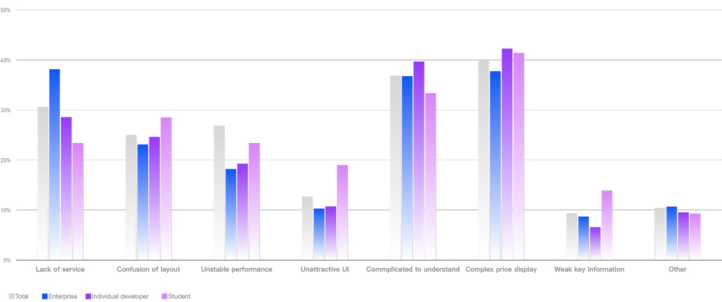
Furthermore, regarding the satisfaction scores associated with the current purchasing experience, the overall satisfaction score, following data cleaning, is 3.81 on a 5-point scale. This score is disaggregated as follows: 3.61 for enterprises, 4.00 for individuals, and 3.88 for students. Within the enterprise category, the satisfaction score for users who have made purchases is 3.82, while it is 3.40 for those who have not. Among purchased users, the score is 3.89 for those with unexpired subscriptions and 3.45 for those with expired subscriptions.In summary, enterprises exhibit the lowest satisfaction levels among all user categories, with even lower satisfaction reported by users who do not renew their subscriptions or make purchases. The enterprise user portrait is one of the primary focal points of analysis.At the same time, we asked users who scored 1–3 about the main reasons for their dissatisfaction. As shown in Figure 1, users expressed significant dissatisfaction primarily due to the complexity of the purchasing content and the lack of clarity in price presentation.
Figure 1: Reasons for dissatisfaction (1–3 point). The most dissatisfied problem is complicated and unreadable purchase content and the price display is not clear. (Data from Alibaba cloud website questionnaire delivery, 2022.5.10-2024.3.21).
32 Shen and Song
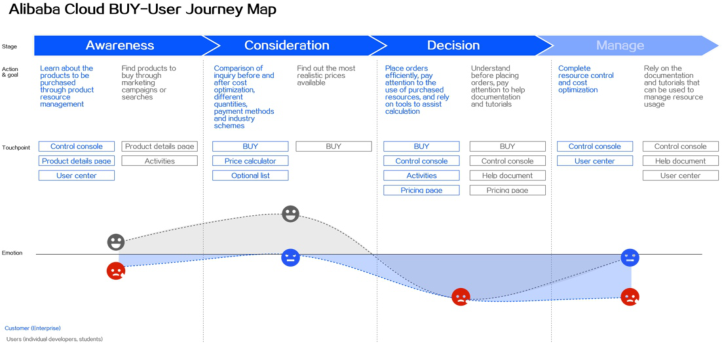
At this point, the user portrait in cloud computing can be broadly classified into two groups, as depicted in Figure 2: customers, primarily consisting of enterprises, and users, which include individual developers and students. Based on the analysis of user browsing patterns and behaviours at various stages, a classic BUY-User Journey Map can be developed. The primary challenges that require attention are predominantly located within the enterprise, particularly during the decision and management phases. This article will place greater emphasis on the decision phase, which represents the moment when users actively participate in purchasing activities.
Figure 2: Alibaba cloud BUY-user journey map.
“FROM COMPONENTS TO AUTOMOBILES”: STRUCTURE DESIGN OF CLOUD COMPUTING PURCHASE SCENARIOS The challenges currently faced in cloud computing purchases can be attributed to the absence of standardized guidelines or white papers within the industry. A promising approach to address this issue is through analogy. By examining the industrial design sector, particularly the automotive industry, we can identify significant parallels with cloud computing. Since the inception of the modern automobile in 1885, when German engineer Carl Benz developed a 0.85 horsepower gasoline engine mounted on a three- wheeled chassis, the automotive industry has established effective purchases methodologies and standards. Contemporary consumers are not required to possess an in-depth understanding of intricate automotive components, such as radiators, rotating shafts, transmissions, and fuel tanks. Instead, they can comprehend the vehicle’s functionality through a simplified concept— the “car chassis”. The automotive industry disaggregates intricate product structures into manageable components to address the requirements of both novice and expert users. Consequently, consumers can select vehicles that align with their varying degrees of knowledge and expertise. A similar structural approach is necessary for cloud computing products. It is essential to conceptualize and present these offerings in a manner that facilitates user comprehension and engagement, thereby enhancing the purchases.
LightBUY - Developing Cloud Sales Design Specifications From the Ground Up 33
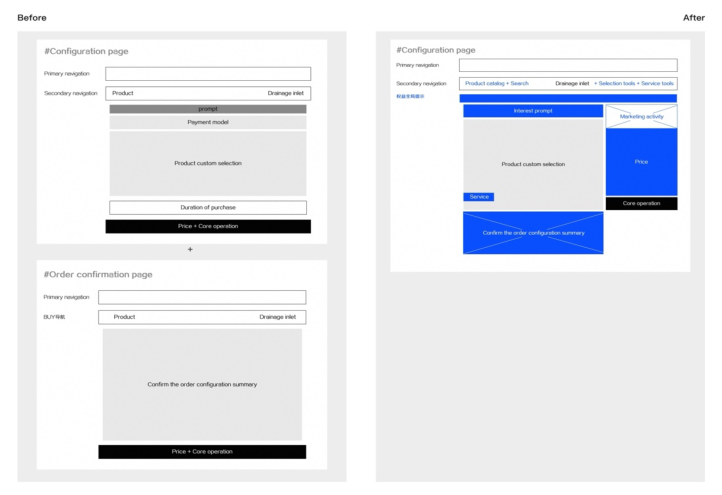
Basics: Start With the Interface The structural organization typically follows a hierarchical pattern, progressing from larger components to smaller ones, and from external elements to internal ones. In the context of a web portal, we commence with the interface. In contrast to the existing waterfall structure for browsing information, our analysis of user research indicates a significant demand for simultaneous operation and reading in cloud computing purchases. Therefore, it is essential to consider the spatial segmentation of various operations within the interface. The core operation of the cloud product purchase page is centered around pricing, which serves as a critical module and main action point. To align with the user’s natural reading pattern, which typically follows a top-down and left-to-right orientation, we have positioned the pricing and operational elements as a fixed module on the right side of the page. The layout is structured with a 8:2 ratio, featuring optional elements on the left side and pricing operations on the right side, thereby adjusting the overall structure of the page, Figure 3. An effective page layout not only enhances user experience but also positively impacts operational efficiency at the data layer. Consequently, we have validated this left-right structural approach for the Elastic Compute Service (ECS) product. In a grayscale test involving 1,553 users, we observed a 10% reduction in average order time, with no alterations made to other control variables. This indicates that the structural modification has led to a 10% increase in user operational efficiency on the same screen.
Figure 3: According to the ratio of the left option 7: the right price operation 3, the large frame adjustment from the upper and lower structure to the left and right structure is carried out.
34 Shen and Song
Category: Module Layout Definition In light of the aforementioned left-right structural framework, it is essential to examine the core module layout of the interface. Drawing upon Alibaba Cloud’s business model established in 2009, we can initially identify the fundamental modules that comprise the cloud product purchase page: product description, configuration options, pricing, and the primary action point. Additionally, given the operational nature of a commercial page, it is imperative to consider the inclusion of Instant Feedback, Confirmation of Configurations, and Marketing Activities as significant modules in this context. The primary distinction between cloud products and other consumer-end products lies in the user experience, which is characterized by a clear three-step process: reading, understanding, and operation. Given the constraints of page content display, it is imperative that the information presented to users is both readable and comprehensible. Upon establishing the core operational area for the left options and the right sequence, the layout for the left options is organized vertically, encompassing product description, payment mode (configuration option), primary option (configuration option), secondary option (configuration option), and configuration summary. This sequential and transparent method of information transmission facilitates the user’s journey from understanding to the purchase of a new cloud product. Simultaneously, we have rephrased the professional terminology associated with each module to ensure that the technical foundation can accurately identify and standardize the semantics of individual modules within the context of combined construction scenarios. This rewording facilitates feedback to the user interface presentation layer and allows for categorization on the purchases interface of various cloud products. Consequently, this approach aims to maintain a consistent purchases experience across Alibaba Cloud products.
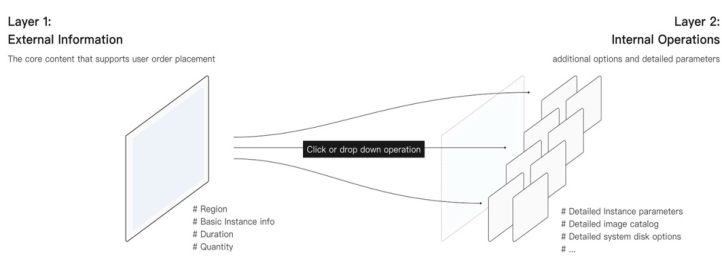
Operation: Split Into an Inner and Outer 2-Layer Component Structure The most direct and effective method for optimizing the structure of tiled content involves the layering of information. Concurrently, to ensure the operational efficiency of cloud product purchases, it is essential to consider the control and limitation of a specific number of user operational steps. Using the ECS as a case study, it can be observed that an ECS comprises several modules, including instance, storage, network, and essential optional modules such as region and login credentials. Initially, we will conduct a normative standard analysis of these modules. It becomes evident that the fundamental elements facilitating user order placement can be uniformly categorized into module titles, option titles, option selections, parameter details, and the interplay between option selections and parameter details. This redundancy in numerous atomic components is a significant contributing factor to the current inefficiencies. To address this issue, we can decompose the components into two distinct structures: 1st level, which encompasses external information—specifically, the core content
LightBUY - Developing Cloud Sales Design Specifications From the Ground Up 35
that supports user order placement; 2nd level, which pertains to internal operations, including additional options and detailed parameters, Figure 4.
Figure 4: A certain number of user operation steps can be controlled and limited through the interactive structure of components divided into 2 layers.
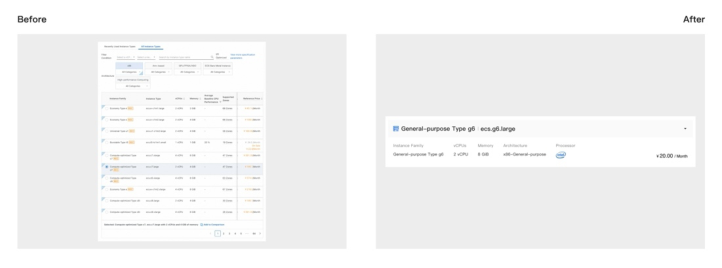
UI: Visual Sense of Quantitative Stratification Visual quantity perception pertains to the sensory aspects of visual elements within a user’s field of view, which are typically influenced by various multi- dimensional visual factors. For instance, the application of a highly saturated color to a small element can enhance its visual prominence, whereas the use of a lighter color on a larger element may render it “invisible” from the user’s perspective. This phenomenon is akin to the manual techniques frequently employed in UI design to modulate visual prominence. The significance of layering visual quantity and sensory elements in purchases scenarios cannot be overstated. This aspect is crucial for enhancing conversion rates and overall customer satisfaction. A purchases environment must address not only the display and transmission of specification information for cloud products on the front page but also the users’ requirements for efficiency on the backend. In previous iterations, greater emphasis was placed on the former, specifically the presentation of specifications and purchases parameters, often utilizing information tiling to showcase purchase parameters from this perspective. However, as the version evolved, an increase in displayed information without adequate layering led to user feedback indicating that the interface had become overly complex and difficult to navigate. Consequently, in the latest version of the specifications, we have introduced a novel layout design approach—visual layering— to better accommodate users’ demands for efficiency, convenience, and simplicity. The visual sensory layer of the purchase environment encompasses three dimensions: Layout, Color, and Size. Layout layering pertains to the modification of the visual hierarchy of elements through alterations in the order, positioning, relationships, and forms of interaction among the information presented. The essence of layout layering is manifested in the enhancement of purchased components. The specifications associated with B2B purchase scenarios are inherently complex. For instance, when purchasing a cloud server, such as an ECS, users must evaluate over ten
36 Shen and Song
parameters to identify the appropriate specifications. The aggregation of these specifications necessitates that users comprehend the significance of more than ten parameters within a single interactive context. The newly designed component consolidates this information into two layers (refer to Figure 5). The first layer is displayed in a fixed format comprising specification title + specification details. The second layer can be expanded through user interaction to incorporate a complex filtering function. This design aims to minimize the visual prominence of detailed information, thereby enhancing the visual hierarchy of the core information.
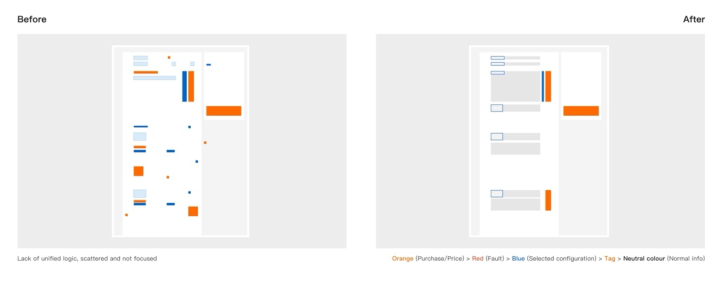
Color layering involves the manipulation of visual elements by adjusting saturation, brightness, and other color channels to enhance the presentation of information. In our analysis, we have restructured the visual hierarchy of the page as follows: a) Orange is designated as the primary level, utilized to convey critical action points and pricing information, such as purchasing and order placement; b) Red serves as the secondary level, employed to indicate prompts such as error notifications and incomplete submissions, thereby mitigating user confusion that may arise from a lack of feedback after clicking on the order, which could adversely affect the purchase conversion rate; c) Blue, representing the brand color of Alibaba Cloud, is assigned as the tertiary level, utilized to communicate essential information such as selection status, focus state, and operational entry points. This level is designed to assist users in quickly identifying the core specifications relevant to their selections; d) Finally, neutral colors are employed to present general information on the page, including detailed parameters, function descriptions, auxiliary information, and section segmentation.
Dimensional layering is employed to modify the visual hierarchy by varying the size and area of elements. In the newly designed purchase component, the primary level of information—comprising the specifications currently selected by the user—utilizes a larger font size and weight. Conversely, the secondary level of information, which includes parameters and prompts for auxiliary selection, is presented in a standard 12px body size. Furthermore, the core purchase component is designed to occupy the full width of the designated area, while the secondary options utilize a
LightBUY - Developing Cloud Sales Design Specifications From the Ground Up 37
standard option component that frequently appears on the page as individual elements. Consequently, the area allocated to the core component is visually more substantial than that of the secondary options, thereby enhancing the perceived visual hierarchy of the information presented.
Figure 6: Color layering specification.
Summary: Define Design Principles - Lightweight, Structured, Ecological The aforementioned definition, which encompasses various layers of interface, classification, operation and vision, aims to address the challenge of user comprehension regarding the complexities associated with purchase content. The simplification of content and its expression necessitate a more advanced and professional technological architecture for product development. Nevertheless, from the standpoint of experience design, it remains feasible to deconstruct and stratify information, thereby facilitating a more accessible reception of information for users. As illustrated in the preceding User Journey Map, the purchase scenario extends beyond the BUY page. The user’s interactions with the portal are extensive and encompass numerous scenarios. However, the design principles of “lightweight, structured” can be effectively applied throughout the entire process, thereby enhancing the overall “ecosystem” of cloud product purchases and optimizing the user experience. This methodology is referred to as LightBUY.
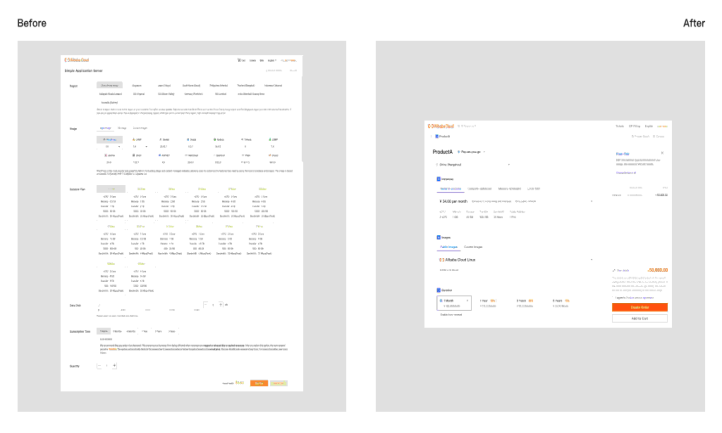
EVALUATION According to LightBUY’s design principles—Lightweight, Structured, and Ecological—it is crucial to secure recognition from stakeholders. The roles of stakeholders primarily involve product development, technology, and operations, with a particular emphasis on the efficiency and optimization of standardized cloud product purchases. Furthermore, it is imperative to demonstrate the feasibility of this set of standards from a quantitative standpoint. Figure 7 illustrates a significant product offered online by Alibaba Cloud. Upon accessing the original page, users are required to
38 Shen and Song
comprehend a substantial amount of product-specific information and confirm over 40 optional operational items. By adhering to the LightBUY guidelines that we have established, the overall purchasing process has been streamlined from two steps to one step, resulting in an increase in screen efficiency from three screens to one screen. Consequently, users are now only required to confirm a minimum of six options to advance to the next stage. Stakeholder 1 remarked, “This is precisely what we aim to achieve: enabling users to perform lightweight operations and purchase products directly based on our recommendations.” Stakeholder 2 noted, that the reading burden on the page has been alleviated, as users are not required to process an excessive amount of information all at once. We will continue to refine and enhance the interface by leveraging user research and data analysis capabilities.
Figure 7: Optimization effect after LightBUY is applied to a cloud computing product.
CONCLUSION
In this study, we present a framework for establishing a standard from inception to implementation within the cloud computing purchase sector, referred to as LightBUY. We acknowledge that the current set of standard specifications remains relatively rudimentary and that numerous details require further elaboration. However, we wish to underscore our approach, which draws upon Jesse James Garrett’s user experience elements to analyse problem definition at an abstract level, prioritize the core needs of users, and align with the initial stages of business strategy. The fundamental principles of this design standard are derived from the structural, framework, and presentation layers, characterized by being lightweight, structured, and ecologically comprehensive. Through the implementation of this framework, we aim to significantly address user pain points and foster greater innovation
LightBUY - Developing Cloud Sales Design Specifications From the Ground Up 39
opportunities for the business. Following extensive discussions within Alibaba Cloud, we have assessed the feasibility, scalability, and commercial viability of LightBUY. Our preliminary findings indicate that LightBUY possesses greater commercialization potential than its predecessor while simultaneously enhancing the user experience. Moving forward, our efforts will initially concentrate on refining the completeness of the standard specifications, particularly at the component level. This is essential due to the hierarchical structure’s inner and outer layers, which will introduce a new component style to effectively support this evident interactive transformation. Additionally, we plan to apply these standard specifications to a broader range of cloud products, encompassing hundreds of offerings to enhance the extensibility of the standards. Finally, we propose a novel concept termed the purchase scenario, a design approach associated with purchases processes. We aspire to establish a set of design principles that facilitate a streamlined operation and clear logic for users, from comprehension to deployment. Concurrently, we intend to engage in more detailed user research and data analysis to further enhance and refine the integrity of LightBUY within the cloud computing purchase industry.
REFERENCES
Alexander R. Galloway, (October 8, 2012). The Interface Effect, Polity, pp. 25–54. Bernd Fritzsch, (September 30, 2020). The Senses: A Comprehensive Reference, Elsevier Science, pp. 488–491. Chinabaogao, (2024). Production of web Insight and info, In-depth analysis and
future prospects of China’s cloud computing industry development report (2024– 2031). The Report Website: https://www.chinabaogao.com/detail/715752.html#r _data. Kanika, (Jully 29, 2024). Collecting Feedback Using 1 to 5 Rating Scale Surveys. The Report Website: https://www.zonkafeedback.com/blog/collecting-feedback-with- 1-to-5-rating-scale-survey. Press Release, (April 2, 2019). Gartner Forecats Wolrdwide Public Cloud Revenue
to Grow 17.5 Percent in. The Gartner Website: https://www.gartner.com/en/new sroom/press-releases/2019-07-29-gartner-says-worldwide-iaas-public-cloud-ser vices-market-grew-31point3-percent-in-2018. Press Release, (January 19, 2024). Alibaba Cloud’s 5 million servers: The super engine of the cloud computing era. The Press Website: https://startup.aliyun.com /info/1075316.html. Press Release, (May 2 2024). Alibaba Cloud accelerates AI application implementation. The Wallstreetcn Website: https://wallstreetcn.com/articles/ 3714694. Sayali Mali, (2024). Cloud Computing Market Size, Share and Growth Forecast
by Service (Laundry Care, Dry Clean, Duvet Clean), by Application (Residential, Commercial), and by Region for 2024–2031. The Report Website: https://www. persistencemarketresearch.com/market-research/cloud-computing-market.asp.
LISTED IN THE AHFE DIGITAL BOOKSTORE CATALOGUE
Explore the complete digital volume
Human Factors and Systems Interaction
Read this individual research paper free through the original publisher, or explore the full digital proceedings book.
ISBN 978-1-964867-68-7
Explore this ISBN in the AHFE Bookstore ↗Listed in the July 2026 bookstore catalogue; search by ISBN to confirm current availability · Digital book purchase optional