Xin Huang, Jianrun Zhang (2025). Optimised human-computer interaction for intelligent business seats in high-speed trains. In: Usability and User Experience. AHFE Open Access, vol. 194, pp. 228–234. https://doi.org/10.54941/ahfe1006685
The purpose of this paper is to explore the enhancement of the level of high-speed train business cockpit intelligence and intelligent functions of the user human-computer interaction satisfaction, on the basis of existing research, the use of questionnaire method and interview method on the business seat of the target population demand research analysis summary, and further use of the hierarchical analysis method to construct the cockpit intelligent functions applicable to different business travel scenarios of the comfort evaluation model, and then on the relevant intelligent functions for the assignment of the weight of the calculation, so as to obtain the priority ranking of the relevant intelligent functions to provide the experimental basis for the subsequent business seat intelligent cockpit research design.
In the document “Design Code for High-Speed Railway”, the State Railway Administration of China (SARA) defines high-speed railway as a passenger dedicated railway using standard gauge and running at a speed of 250km to 350km per hour. As the level of China’s socio-economic development and the quality of life of the residents continue to improve, the public has put forward higher requirements for the optimisation of the service quality of high-speed railways as an important intercity transport carrier, especially in terms of meeting the diversified travel needs of the passengers, which has shown significant demands. Among them, business seats, as a high-end product of railway passenger service, aim to provide a more comfortable and private travelling experience to meet the needs of passengers pursuing high-quality travel services. Preference heterogeneity plays a critical role in shaping high-speed rail passengers’ choice behavior (Chen et al., 2024). As a kind of differentiated service, business seat attracts passengers who pay attention to travelling experience, but nowadays there are only some differences between business seat and first/second class seat in terms of crew service and seat comfort (Jou, Chien & Wu, 2011).The design and service optimisation of business seats play an important role in improving passengers’ satisfaction and selection tendency. With the advancement of
Optimised Human-Computer Interaction for Intelligent Business Seats in High-Speed Trains 229
high-speed train technology and the improvement of the intelligence level of contemporary technology, business seats should also integrate the emerging technology, keep up with the technological development of the times, improve the level of intelligence, and provide personalised services, thus improving the core competitiveness of business seats.
Research Target The purpose of this paper is to explore the enhancement of the level of high-speed train business cockpit intelligence as well as the user human- computer interaction satisfaction of intelligent functions, with reference to the development status of automotive intelligent cockpit, and the collection of existing cockpit intelligent functions.
This study firstly collates and summarises the current development status of business seat cockpits at home and abroad, as well as the R&D direction of automotive intelligent cockpits in adjacent fields and the advantages and disadvantages of existing designs, and points out the limitations of the existing intelligent functions in the context of high-speed trains. On the basis of the existing research, the questionnaire method and interview method are used to analyse the demand of the target group of business seats, and the hierarchical analysis method is used to construct a comfort evaluation model of the intelligent functions of the cockpit applicable to different business travel scenarios, and then the weights of the relevant intelligent functions are assigned to calculate the weights, so as to get the priority ranking of the relevant intelligent functions, and to provide the basis for the experimental design of subsequent research and development of the intelligent cockpits in the business seats.
Research Methodology Interview method refers to a research method in which the researcher collects information in the form of oral questions and answers through face- to-face conversations with the research subjects. The researcher interacts with the interviewees according to the research purpose and the preset question framework, guiding the interviewees to express their opinions, attitudes, experiences, behaviours, and other information on the relevant topics or phenomena, so as to gain an in-depth understanding of the inner thoughts of the research subjects and the reasons behind their behaviours.
The researchers selected a total of 15 people, aged between 23 and 60 (10 men and 5 women), all of whom had multiple high-speed train business class travelling experiences, with the aim of exploring passengers’ perceptions of various aspects of the existing business class feature design and their potential need for future business class intelligence, and to derive a preliminary collection of business class intelligence features as shown in the figure below.
230 Huang and Zhang
Table 1: Business cockpit intelligent function collection.
Table available in the original PDF paper.
Functional Comfortableness Convenience Safety Personalised Entertainment Properties Intelligent
Voice assistant Fatigue
Seat memory Entertainment monitoring system
temperature Control Seat Adjustment Wireless
Privacy mode APP linkage Audiovisual charging system Lighting Sleep mode One-button Volume control Film mode
Adjustment
alarm Seat ventilation Getting on the Burst detection Operating mode Game mode bus
Seat Heating Arrival Luggage
Preference Screen sharing
announcement position
A questionnaire is an empirical research method that systematically obtains information about the attitudes, behaviours, opinions or backgrounds of research subjects through a standardised and structured data collection tool.
Interviews were conducted with users, and the questionnaire included the collection of demand for travelling in business seats, and the summary of scenario analysis of travelling by high-speed rail. According to the questionnaire, the smart features that users need the most when travelling in the business seat include wireless charging, entertainment, temperature and light adaption, and adjustable privacy space. The questionnaire is shown in the figure below. Combined with the function ensemble derived from the previous interview method, the resulting intelligent function ensemble of the business cockpit is preliminarily filtered and sorted by function priority.
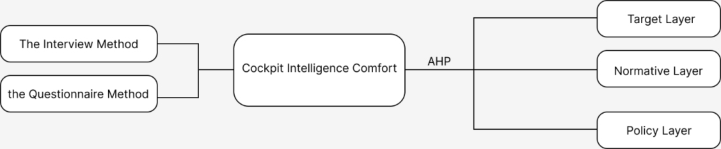
Evaluation Modelling Comprehensive evaluation model of business seat cockpit comfort is established by combining the research data derived from three research methods: interview method and questionnaire method. The sitting comfort prediction model developed by Bian et al. (2022) (89.5% accuracy) significantly improves the scenario adaptability of seat adaptive adjustment algorithms and provides a cross-modal data validation framework for quantifying smart function weights in business-class cabins through the Analytic Hierarchy Process (AHP) in this study. The interview method provides feedback on users’ expectations of the cockpit functions from the perspective of the intelligent functions of the cockpit and classifies them according to the different functional attributes. The questionnaire method explores the user’s experience in business seat travelling from different angles, and argues and screens the intelligent cockpit collection derived from the interview method.
Optimised Human-Computer Interaction for Intelligent Business Seats in High-Speed Trains 231
ESTABLISHMENT OF BUSINESS INTELLIGENT COCKPIT COMFORT EVALUATION Indicator System
The Analytic Hierarchy Process (AHP) is a classic multi-criteria decision- making tool that helps decision-makers balance complex factors by quantifying subjective judgments (Podvezko, 2009). Using the hierarchical analysis method, the user research smart cockpit functions obtained in the previous section were classified as: comfort, convenience, safety, personalisation, and entertainment. According to the functional classification, the objectives are decomposed into the objective layer, criterion layer, and programme layer. The target layer is the weighting analysis of the intelligent functions of the business seat; the criterion layer is the five functional categories; and the programme layer is the specific functions (e.g., intelligent temperature control, seat memory, etc.).
Constructing a Judgement Matrix Based on the data derived from the 1–9 scale method, a two-by-two comparison matrix for the guideline layer was constructed as follows:
Consistency Indicator (CI) and Consistency Ratio (CR) were calculated, requiring CR < 0.1.
The formula: CR=CI/RI. CI=λmax-n/n-1 CI ----- Consistency Indicators CR----- Consistency ratio RI ----- Stochastic consistency index, n is the matrix order.
Calculation of Guideline Layer Weights Weights were calculated using the eigenvector method and passed the consistency test (CR < 0.1).
232 Huang and Zhang
Table 3: Hierarchical analysis result.
Table available in the original PDF paper.
CI Value
Term Eigenvector Weighting Maximum Eigenvalue Comfortableness 2.689 53.771 per cent 5.174 0.043 Convenience 0.711 14.210 per cent Safety 1.055 21.093 per cent Personalised 0.329 6.571 per cent Entertainment 0.218 4.355 per cent
Consistency Indicator Testing In this study, a 5th order judgement matrix was constructed, corresponding to the above table can be queried to obtain the random consistency RI value of 1.120, RI value for the following consistency test calculation use.
Table 4: Summary of consistency test results.
Table available in the original PDF paper.
Maximum Characteristic Root
CI Value RI Value CR Value Consistency Test Results 5.174 0.043 1.120 0.039 pass (a bill or inspection
etc)
Normally, the smaller the CR value is, the better the consistency of the judgement matrix is, if the CR value is less than 0.1, the judgement matrix satisfies the consistency test; if the CR value is greater than 0.1, it means that there is no consistency, and it should be adjusted appropriately after the judgement matrix is analysed again. This time, the CI value is 0.043 for the 5th order judgement matrix, and the RI value is 1.120, so the CR value is 0.039<0.1, which means that the judgement matrix satisfies the consistency test, and the weights obtained from the calculation are consistent.
Calculation of Programme Layer Weights Repeat steps for two-by-two comparisons of programme layer functions under each criterion layer. Weights were calculated using the eigenvector method and passed the consistency test (CR < 0.1)
Global Weighting Global weight = criterion level weight × programme level weight Global weight = criterion level weight × programme level weight
Based on the Analytical Hierarchy Process (AHP) model, combining the guideline level weights with the programme level weights, the following results were obtained by global weighting:
Optimised Human-Computer Interaction for Intelligent Business Seats in High-Speed Trains 233
Table 5: Summary of consistency test results.
Table available in the original PDF paper.
Rankings Functionality Normative
Global Weight
Layer
Guideline Layer Weights
Programme Level Weights
1 Intelligent
Comfortableness 53.77 per cent 52.1% 28.02 per cent temperature control
2 Health
Safety 21.09 per cent 54.2 per cent 11.42 per cent monitoring
3 Seat
Comfortableness 53.77 per cent 21.6 per cent 11.62 per cent Adjustment 4 Voice assistant Convenience 14.21 per cent 44.8 per cent 6.37 per cent 5 Privacy Mode Safety 21.09 per cent 23.1% 4.87 per cent 6 Wireless
Convenience 14.21 per cent 27.3 per cent 3.88 per cent charging
7 Lighting
Comfortableness 53.77 per cent 11.7 per cent 6.29 per cent Adjustment 8 Seat memory Personalised 6.57 per cent 48.3 per cent 3.17 per cent 9 One-button
Safety 21.09 per cent 10.8 per cent 2.28 per cent alarm 10 APP Linkage Personalised 6.57 per cent 25.6 per cent 1.68 per cent
Data Validation and Sensitivity Analysis Consistency test: all judgement matrices with CR values < 0.1 pass the test.
User feedback: actual satisfaction with the high-weighted features was consistent with the weighting ordering as tested by 10 users (Pearson correlation coefficient r = 0.82, r= 0.82, p<0.05, p< 0.05).
CONCLUSION
This study aims to provide a scientific basis for the design optimization of high-speed rail business-class cabins through priority analysis of their intelligent functions. The main conclusions are summarized as follows: In the priority analysis of intelligent functions for business-class cabins, the comfort dimension holds the highest weight, significantly surpassing other functional categories. This result fully demonstrates users’ strong reliance on dynamic physical environment adjustment capabilities during travel.
However, during the optimization process, lightweight interaction design should be explored to avoid user experience degradation caused by feature redundancy. A/B testing reduces experimentation costs and supports data-driven refinement of interface variables. Studies show its adoption correlates with significant efficiency gains in iterative design processes (Koning, Hasan & Chatterji, 2022), offering a scalable framework for adaptive human-machine interaction optimization. User acceptance can be validated through A/B testing to ensure rational resource allocation.
The prioritized intelligent functions and collected core user data can guide subsequent optimization designs for business-class cabins. This approach will enhance satisfaction among target users and strengthen the core competitiveness of high-speed rail business-class services.
234 Huang and Zhang
Theoretical Contribution: Quantify the priority of intelligent functions in high-speed trains through AHP model, and provide methodological support for the mapping of “user requirements-engineering design”. It reveals the correlation mechanism between intelligent functions and user experience, which complements the research at the intersection of traffic engineering and human factors engineering.
Practical value: Guide the allocation of R&D resources to avoid cost wastage due to over-design. Provide priority reference for train manufacturers to optimise cockpit design, and reduce R&D trial and error costs. The results of the study provide theoretical support systematisation for future intelligent cockpit optimisation, and have important academic value and application prospects.
ACKNOWLEDGMENT
I am deeply grateful to Prof. Jianrun Zhang for his academic guidance and persistent support during my studies. Additionally, I extend sincere appreciation to Ms. Wenqian Zhu for her indispensable companionship and collaborative spirit in navigating both life and research challenges.
REFERENCES
Chen, P., Zhang, X. and Gao, D., 2024. Preference heterogeneity analysis on train choice behaviour of high-speed railway passengers: A case study in China. Transportation Research Part A: Policy and Practice, 188, p. 104198. Jou, R.-C., Chien, J.-Y. and Wu, Y.-C. (2011) ‘A study of passengers’ willingness
to pay for business class seats of high-speed rail in Taiwan’, Transportmetrica A: Transport Science, 9(3), pp. 223–238. doi: 10.1080/18128602.2011.565816. Koning, R., Hasan, S. and Chatterji, A., 2022. Experimentation and startup performance: Evidence from A/B testing. Management Science, 68(9), pp. 6434–6453. Podvezko, V., 2009. Application of AHP technique. Journal of Business Economics
and management, (2), pp. 181–189. Yuxue, B., Bingchen, G., Jianjie, C., Wenzhe, C., Hang, Z. and Chen, C., 2022. Sitting comfort analysis and prediction for high-speed rail passengers based on statistical analysis and machine learning. Building and Environment, 225, p. 109589.
LISTED IN THE AHFE DIGITAL BOOKSTORE CATALOGUE
Explore the complete digital volume
Usability and User Experience
Read this individual research paper free through the original publisher, or explore the full digital proceedings book.
ISBN 978-1-964867-70-0
Explore this ISBN in the AHFE Bookstore ↗Listed in the July 2026 bookstore catalogue; search by ISBN to confirm current availability · Digital book purchase optional