Xianzhao Fang, Jianrun Zhang (2023). An objective aesthetic evaluation method of CNC machine tool based on aesthetic degree calculation. In: Intelligent Human Systems Integration (IHSI 2023): Integrating People and Intelligent Systems. AHFE Open Access, vol. 69, pp. 657–666. https://doi.org/10.54941/ahfe1002888
According to the method for beauty degree calculation proposed by Ngo (2003), beauty degree calculation has been widely used in designing the shape of various objects and the aesthetics of various interfaces. He quantified the interface by dividing the interface into 14 indicators such as balance, symmetry, cohesion, and simplicity to achieve the objectification of beauty evaluation. This paper mainly studies the relationship between the interface aesthetic and the CNC machine tool evaluation by comparing the results of the machine tool's beauty degree calculation results and the participants' subjective evaluation scores, to verify the application of the beauty degree calculation on the evaluation of machine tool design, providing an idea for future machine tool design. First, 6 classic machine tool schemes were selected, and 8 related indicators were pre-processed through a questionnaire survey to obtain the 6 participating elements that the participants thought were most relevant to the appearance evaluation of the machine tool, to avoid subsequent elements interfering with the subjects' scoring. Then, 4 different types of machine tool were selected which can mainly represent the mainstream machine tool design, and the scores of 6 interface elements were calculated by MATLAB software to obtain the ranking. (https://www.mathworks.com/products/matlab.html) In the second step, the questionnaire was used to ask the subjects to rank the beauty of each machine tool design. Finally, the experimental beauty degree calculation results are compared with the subjective evaluation result. Compared subjective questionnaire result with the calculation results, the ranking of the calculation results is consistent. This shows that the beauty degree calculation results of the beauty of the machine tool are consistent with the subjective evaluation. The application of the beauty degree calculation in the evaluation of the CNC machine tool design scheme is scientific and accurate, which can realize the objective evaluation of the appearance of the machine tool and help the designers to improve the design scheme and design layout.
With the development of the times, in the 21st century, the manufacturing industry has increasingly become the pillar industry of a country’s econo- mic development, and machine tools are called industrial machines. The strength of the machine tool industry is one of the important indicators to measure the development level of a country’s manufacturing industry.
The machine tool has the characteristics of high technology and high com- plexity, and has the characteristics of multidisciplinary and multi process parallel in manufacturing design. However, in addition to the internal tech- nical requirements of the machine tool, people also have higher requirements for the appearance of the machine tool, because the appearance of the mach- ine tool reflects the internal function of the machine tool to a certain extent. The machine tool products with low industrial design level cannot meet the aesthetic needs of general users, and have weak competitiveness in the mar- ket, which is not conducive to the overall development of the machine tool industry.
However, designers themselves cannot quantify and accurately evaluate the appearance of the machine tools they design, which leads to high trial and error costs of the machine tools. Ngo (2003) proposed an objective evalua- tion method for interface beauty that can be used for reference by combining design elements and user visual aesthetics. This method uses 13 different eva- luation feature elements, and makes an objective evaluation on the beauty of the interface through the scores obtained from the algorithm, which provides a theoretical basis for the appearance evaluation of machine tool design. This paper mainly studies the possibility of the application of Ngo’s beauty evaluation method in the objective evaluation method of machine tool appearance, which has guiding significance for the design of CNC machine tools.
Beauty Degree Calculation Ngo (2003) described a quantitative method to evaluate the beauty of the interface in his paper. By dividing the interface into 14 indicators such as balance, symmetry, cohesion, Ration, and simplicity, the interface is quanti- tatively evaluated. The method to quantify these indicators for evaluation is a way to transform long-term perceptual knowledge into rational knowledge. However, the paper only shows that the interface is meaningful, and there is no deeper exploration in other fields. Therefore, this article selects some evaluation indicators for the layout of the building, and uses the method to analyse the significance of interface beauty for design of CNC machine tool. This article selects the following indicators as the final design of CNC machine tool evaluation factor.
Symmetry: Symmetry is axial repetition: a component on one side of the centreline and the other side of the centreline are strictly equal. Vertical sym- metry refers to the balanced arrangement of the same elements with respect to the vertical axis, while horizontal symmetry refers to the equal arran- gement with respect to the horizontal axis. Radial symmetry refers to the balance of equal elements with respect to the axis direction passing the cen- tre point. Symmetry can be used to ensure a balanced machine interface. “It has absolute aesthetic appeal” (Mullet and Sano, 1995). Motif promotes the development of the symmetrical order of windows and dialogs. Figure 2 represents an example of “good”and “bad”interfaces in the symmetry study. In Figure 2a, symmetry is achieved by equal elements on the left and right sides of the screen centreline. Figure 2b is an asymmetric design.
An Objective Aesthetic Evaluation Method of CNC Machine Tool Based 659
Symmetry refers to the degree of symmetry of the screen along the vertical, horizontal, and diagonal directions, expressed by the following formula:
Svertical
+|Shorizontal| + |Sradial|
Equations and mathematical formulas are available in the original paper PDF.
3 (1)
X′UL −X′UR
X′LL −X′LR
Y′UL −Y′UR
+ Y′LL −Y′LR
H′UL −H′UR
H′LL −H′LR
+ B′UL −B′UR
B′LL −B′LR
θ′UL −θ′UR
+ θ′LL −θ′LR
R′UL −R′UR
R′LL −R′LR
X′UL −X′LL
X′UR −X′LR
Y′UL −Y′LL
+ Y′UR −Y′LR
H′UL −H′LL
H′UR −H′LR
+ B′UL −B′LL
B′UR −B′LR
θ′UL −θ′LL
+ θ′UR −θ′LR
R′UL −R′LL
R′UR −R′LR
Y′UL−Y′LR
X′UR−X′LL
X′UL−X′LR
+ Y′UR−Y′LL
H′UL−H′LR
H′UR−H′LL + θ′UL−θ′LR
B′UR−B′LL
+ B′UL−B′LR
+ θ′UR−θ′LL
R′UL−R′LR
R′UR−R′LL
) 12 (4) X′j, Y′j, H′j, B′j, θ′j and R′j, respectively is the dimensionless value after standardized processed of Xj, Yj, Hj, Bj, θj and Rj, there are:
nj X
nj X
nj X
yij−yc xij−xc
i i
i q
min 1≤j≤n {oj}−min 1≤j≤n {oj}, O = X, Y, H, B, O, R (9) Among them, UL, UR, LL and LR represent upper left, upper right, lower left, and lower right respectively; (xij, yij) and (xc, yc) are the coordinates of the centre of the quarter part j and the frame centre of the object i respectively; Bij and hij are the width and height of the object; at the same time, nj is the total number of objects in a quarter.
Rhythm: It refers to the regular repetition of objective things in the process of movement, with a strong sense of order. Rhythm degree is obtained by
660 Fang and Zhang
calculating the rhythm degree of product form through the size, quantity, arrangement and form of product elements.
Balance: Balance can be understood as the overall feeling of the layout of each space in the building. Different planes represent different architectural spaces. People will have an overall impression when they pass through all the spaces. This is necessary for CNC machine tool. People who visit the building need to ensure that the building as a whole does not give people the feeling of top-heavy. The degree of balance is to calculate the overall perceived difference of the space on both sides of the horizontal and vertical axis, expressed by the following formula: WT−WB max(|WT|,|WB|)
WL−WR max(|WL|,|WR|)
2 (10)
Among them, L, R, T and B represent left, right, top and bottom respecti- vely; wj represents the total weight of part j; aij represents the area of object i in part j; dij represents the distance between the centre line of the object and the centre line of the frame; At the same time, nij represents the number of objects contained in a certain part.
Simplicity: Simplicity is to determine the simplicity of the overall layout of the interface by calculating the alignment or composition of interface elements.
Ds,t = 1 −(nvertical−nhorizontal)/4n (12) nvertical indicates the number of aligned points in the vertical direction and nhorizontal indicates the number of aligned points in the horizontal direction, n is the number of elements in the interface.
Ration: As early as a long time ago, people pursued beauty with some Rations. The pursuit of beauty is not the same between different cultures, but in thousands of years of evolution, some Rations are recognized as beauty and widely used in various designs. Square (1:1), Radix 2 square (1:1.414), Golden section rectangle (1:1.618), Square number 3 (1:1.732), Double the square (1:2) In design of CNC machine tool, the beautiful Rations should consider the composition of each space, including the combination of entrances, windows, and depth. The ratio is defined as the contrast relationship between the screen components and the ratio shape, expressed.
2 (13)
pobject is the difference between element proportions, playout is the difference between layout proportions, where,
An Objective Aesthetic Evaluation Method of CNC Machine Tool Based 661
n X
1 −min(|tj−ti|) 0.5
0.5 (15)
hlayout blayout
1 ri , ri> 1 , ri = hi bi and hj are the width and height of the interface element i; blayout and hlayout are the width and height of the layout respectively. tj is five commonly used ratios, which can be expressed as:
1
Cohesion: In screen design, similar aspect ratios can improve cohesion. The aspect ratio explained in terms refers to the relationship between length and width. The typical paper size is taller than wide, but the video screen quietly reverses. “Changing the aspect ratio of the visual area can effectively affect the eye movement pattern and facilitate the description of some of his different performances” (Dillon, 1992). When scanning what is in front of you, the visual aspect ratio needs to remain unchanged. Figure 5 shows examples of “good” and “bad” interfaces in cohesion research. In Figure 5a, cohesion is achieved by maintaining the aspect ratio of the visual area. The use of the screen in Figure 5b may be affected by the non-continuous aspect ratio of the screen elements.
Cohesion refers to a measure of the degree of screen association, expressed by the following formula:
2 (18)
Respectively, Cfl is the measurement of the Ration relationship between the layout and interface framework, and Clo is the measurement of the Ration relationship between interface elements and the layout, expressed as:
hlayout/blayout
hframe/bframe
1 ci , ci > 1 ci = hi/bi hlayout/blayout bi and hi are the width and height of the interface element i; n is the num- ber of elements in the interface frame. b layout, hlayout, b frame, and hframe indicate the width and height of the layout and interface frame respectively.
Unity: In design of CNC machine tool, the integrity of the entire plane space means that the spaces appear to be gathered, like a whole rather than a combination. Integrity means that even if two spaces have similar dimensions,
662 Fang and Zhang
the whole space will be integrated at the centre than at the edges, and the spaces are tightly gathered together.
The measure of integrity is the degree of aggregation of each space, expressed by the following formula:
UMform is the degree of association of objects in terms of size, expressed as:
n (22) At the same time, UMspace refers to the spatial correlation between combination and edge.
alayout−Pn
i ai aframe−Pn
i ai
Among them, ai, alayout, and aframe represent object i, typesetting and frame respectively; nsize refers to the number of sizes used; and n refers to the number of objects in the frame.
Sequence: Sequence in design refers to the arrangement of objects in typo- graphy in a way that facilitates eye movement to browse the information displayed in front of you. Usually, the eyes form the habit of reading from left to right and from top to bottom because of reading. Cognitive psycho- logists have found that certain objects attract the eye. Eye movement shifts from large objects to small objects.
EXPERIMENTAL STUDY A. Subjects
Experiment 1&2 have different 100 online participants with correct visual acuity from different professions were recruited. The mean age of the parti- cipants were 30 years old, ranging from 20–40 years old. In experiment 1, they were asked to select at least 3 important indicators in a questionnaire. In experiment 2, they were asked to score 6 indicators in another questionnaire.
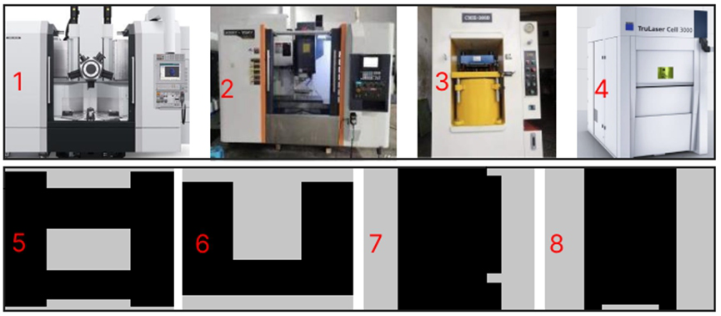
B. Materials The questionnaire of experiment 1 includes 6 images and 8 indicators (Fig. 1). The 6 images were chosen which can mainly represent the main- stream machine tool design. The 8 interpretable indicators that can be selected are as follows. Subjects need to select at least 3, and then obtain several important indicators. In experiment 2, 4 simple geometry images come from 4 machine tools designed by different companies which repre- sent different design level are processed into simple geometry (Fig. 2). And questionnaire 2 includes 4 simple geometry images, each image has 6 indica- tors obtained in experiment 1 to score (Fig. 3). Then subjects were asked to score.
An Objective Aesthetic Evaluation Method of CNC Machine Tool Based 663
Figure 1: Images of machine tools (1-6) and indicators of beauty evaluation (7-14).Figure 2: Images of machine tools (1-4) and processed machine tools layout presenta- tion (5-8).
C. Procedure Experiment 1 was conducted by online questionnaire survey. Parti- cipants were asked to look at 6 machine tool image and the explai- ned 8 indicators, then fill in the questionnaire. In experiment 2, sub- jects need to look at the images of 4 machine tools, and rank them. And the 4 machine tools were also calculated by MATLAB software (https://www.mathworks.com/products/matlab.html) to obtain the ranking. Then the experimental beauty degree calculation results were compared with the subjective evaluation result.
D. Results During the two-day questionnaire survey, the specific number of votes of the participants for each page was obtained (each person casts a minimum
664 Fang and Zhang
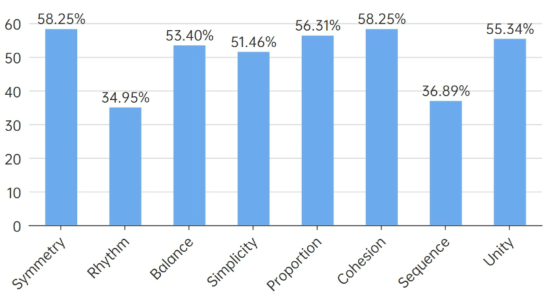
Figure 3: Ration of votes that participants consider important for each indicator.Table 1. Machine tool layout sample subjective ranking evaluation results.
of three votes). The indicators voted by the subjects represent the degree to which people visually value the indicators that determine the appearance of the machine tool. The purpose of this experiment is to exclude the fact that too many indicators were selected in Experiment 2, which would have an impact on the excessive data that needs to be processed when scoring subjects. A total of 130 questionnaires were distributed, 120 were returned, and 103 were valid questionnaires. The results obtained are shown in Figure 3.
According to the results of the questionnaire, among the 8 selected para- meters, two parameters are lower than 40%, and the selection probability of 6 parameters is more than 50%, so most people think that it has a great influence on the appearance of the machine tool 6 indicators. Make sure that these six indicators are selected for the scoring and calculation of Experiment 2.
In Experiment 2, 20 subjects were selected, and 20 subjects were asked to watch pictures of machine tools (fig. 1, 1-4), and rank each index of the four machine tools, and the obtained data are shown in Table 1.
According to the calculation formula of the quantitative index of interface element layout evaluation, the symmetry, rhythm, balance, simplicity, Ration, Cohesion, and completeness of the four machine tool layout schemes are calculated respectively. Images 1–4 is the picture of the machine tool, and Images 5–8 is the shape of the machine tool after processing. The calculation results are shown in Table 2.
An Objective Aesthetic Evaluation Method of CNC Machine Tool Based 665
Table 2. Calculated value of machine tool sample beauty.
It can be concluded that according to the data calculated by MATLAB software, the rankings of Experiment 1 and Experiment 2 are consistent, so the results calculated by Beauty calculation can be used in the aesthetics of machine tools.
According to the data obtained from the experiment, in terms of symmetry indicators, machine tool 1 has the highest degree of symmetry. Compared with other machine tools, machine tool 1 has the most uniform distribution in the horizontal and vertical directions. For the aesthetics of the machine tool, the most uniform layout distribution is, the visual feeling is the most beautiful. Symmetry can be used to ensure a balanced machine interface. “It has an absolute aesthetic appeal” (Mullet and Sano, 1995). The design of the machine tool can be borrowed from this, and the distribution of the structures is even in the design.
In terms of balance and cohesion, the rankings of the four machine tools are the same, and the score of the 4-machine tool is the lowest. The more the body deviates from the centre, people will have a sense of imbalance visually, which will greatly affect people’s perception of the machine tool. “Lack of balance or imbalance will interfere with our vision” (Lauer, 1979). In the design of machine tools, the principle of cantering the structure should be followed, which will make the overall structure more comfortable.
In terms of ratio, the 3-machine tool has the highest score, and several blo- cks of this machine tool are more inclined to 1:2. In the design of the machine tool, the ratio of each block should use or be close to several standard ratios. Advanced machine tools are more in line with human visual aesthetic chara- cteristics. While many instruction manuals suggest the use of these rectangles in both horizontal and vertical directions, most exhibits do not express this, and this should be considered in machine tool design.
For the index of simplicity, 4 has the highest score, and 2 and 3 have the same score. The more element alignment points in the machine tool design, the higher the simplicity, which makes the overall machine tool more aesth- etically pleasing, and people don’t like too simple shape ratio. In the design of machine tools, it should be considered how to achieve the most align- ment points when combining different elements, but not uniform and rigid, to achieve the optimal design.
In terms of overall degree, the 4-machine tool has the highest score, and the blocks formed by several 4 machine tools are the closest. By using similar sizes, a better visual experience can be brought. When designing a machine tool, it is necessary not only to consider whether the Rations of different blocks are close to the standard Rations, but also to consider whether the
666 Fang and Zhang
Rations of each structure of the machine tool are close to create a good visual experience.
CONCLUSION
According to the above analysis, beauty calculation is feasible for the calcula- tion of machine tool Beauty calculation. Interface Beauty calculation calcula- tions can help designers improve the structural layout and shape of machine tools to a certain extent. The calculation results have considerable refere- nce significance and can help designers Grasp the direction of machine tool design, and have an evaluation effect on the design of machine tools. In the actual design process, the designer should consider the combination of bala- nce, simplicity, symmetry and other indicators, and find a balance between simplicity and non-monotonous, uniform but not rigid, so as to design a better machine tool shape.
Design is generally the product of designer inspiration, but lacks an obje- ctive evaluation standard and an objective optimization process. This paper explores the objective evaluation and design points of machine tool design, and provides guidance for future machine tool design and evaluation. How- ever, this article is still lacking in the detailed design of the specific machine tool, which needs to be further explored by others.
REFERENCES
Bauerly M, Liu Y L. Effects of symmetry and number of compositional elements on interface and design aesthetics [J]. International Journal of Human-Computer Studies, 2010, 68(1-2); 1–21. Ben-Bassat T, Meyer J, Tractinsky N. Economic and subjective measures of the percei-
ved value of aesthetics and usability [J]. ACM Transactions on Computer-Human Interaction, 2006, 13(2); 210–234. Huang Yuexiang, Chen C H, LIPK. Kansei clustering for emotional design using a combined design structure matrix [J]. International Journal of Industrial Ergono- mics, 2012, 42(5): 416–427. Lai G Y, Chen P H, Shih S W, et al. Computational Models and experimental investi-
gations of effects of balance and symmetry on the aesthetics of text-overlaid image [J]. International Journal of Human-Computer Studies, 2010, 68(1-2); 1–21. Lei Zhou, Chengqi Xue, Wencheng Tang. 2013. Beauty evaluation method of interface element layout design. Journal of Computer Aided Design and Graphics, 2013, 25(05):758–766. Moshagena M, Thielsch M T, Facets of visual aesthetics [J]. International Journal of
Human-Computer Studies, 2010, 68(10); 689–709. Ngo D C L, Teo L s, Byrne J G. Modelling interface aesthetics [J]. Information Science, 2003, 152(8):25–46. Xue Chengqi, Zhang Ping, Zhou Lei. Computer-aided style design based on feature
construction [J]. Journal of Southeast University; Natural Science Edition, 2011, 41(4):734–738.
LISTED IN THE AHFE DIGITAL BOOKSTORE CATALOGUE
Explore the complete digital volume
Intelligent Human Systems Integration (IHSI 2023): Integrating People and Intelligent Systems
Read this individual research paper free through the original publisher, or explore the full digital proceedings book.
ISBN 978-1-958651-45-2
Explore this ISBN in the AHFE Bookstore ↗Listed in the July 2026 bookstore catalogue; search by ISBN to confirm current availability · Digital book purchase optional