Sugiyama Soichi, Noriyuki Kida (2025). Individual characteristics using pen writing behavior: intra- and inter-individual variability perspectives. In: Human Factors and Systems Interaction. AHFE Open Access, vol. 192, pp. 167–173. https://doi.org/10.54941/ahfe1006639
Several personal authentication technologies are currently available. Writing movements are consistent among individuals, and each person has unique writing habits. Therefore, this study aims to evaluate the intra and inter-individual variability in pen angles to determine whether writing motions can be used for personal authentication. Sixteen right-handed adults participated in this study. Each participant was asked to write a Japanese name consisting of four kanji characters while seated on a chair. This task was repeated five times. Three-dimensional coordinate data were recorded from both ends of the pen using a motion-capture system. Four pen angles were calculated from the collected data: the horizontal plane angle, sagittal plane angle, frontal plane angle, and three-dimensional tilt angle. The angles were analyzed at the beginning of the first stroke of each character and at characteristic movements specific to Japanese kanji writing, such as "tome (stop)", "hane (upward brushstroke)", and "harai (sweeping stroke)". The standard deviation of the five trials was used as an index of intra-individual variability, while the standard deviation of the mean across the participants was used as an index of inter-individual variability. At all analyzed sites, the sagittal angle exhibited smaller intra-individual variability (1.16-1.63°) and larger inter-individual variability (7.46-9.18°) than the other angles. These results suggest that the sagittal plane may be effective for personal identification. At characteristic moments of movement, the horizontal plane angle was larger than the angle at the beginning of writing for both intra variability (2.90-4.29°) and inter-individual variability (11.10-18.92°). This trend was also observed for the other three pen angles. The conditions of small intra-individual variability and large inter-individual variability are ideal for individual identification. However, these findings suggest that the characteristic movements may not be suitable for personal authentication. Further investigation is required to identify the optimal writing motions for authentication purposes.
In today’s society, various authentication technologies, such as face recognition, fingerprint recognition, image recognition, and motion recognition, including gait recognition, are used in critical applications. However, despite the increasing number of authentication methods, movement based authentication is not yet widely adopted in society. The hand
contains several muscles, bones, and joints that can move freely within the human body. Therefore, the hand enables precise control. Writing is one of the most common hand movements and is closely related to daily life. Writing movements exhibit individual consistency. It is believed that pen movement during writing reflects habitual motor patterns developed through individual experiences. In Japan, handwriting analysis is widely used in various fields. However, few studies (Yoko, 2018) have examined individual characteristics based on writing behaviors. This study, focused on pen movements during writing. We used 3D motion capture to collect pen movement data (such as coordinates and angles), verify whether writing motion is a viable method for personal authentication, and identify conditions that contribute to improving authentication accuracy. To this end, the study analyzed intra- and inter- individual variation in writing motions, as inter-individual variation must be sufficiently large and intra-individual variation must be small for personal authentication to be effective. We investigated whether pen angle evaluation criteria and movement characteristics at the beginning and end of writing are effective for authentication.
METHOD
Sixteen right-handed adults participated in this study. Each participant was asked to write a Japanese name consisting of four kanji characters (Yoko, 2021) while seated in a chair. This task was repeated five times.
A standard ballpoint pen was used. Motion-capture markers were affixed to both the tip and top of the pen. Three-dimensional motion capture equipment (OptiTrack V120 DUO) recorded pen movements.
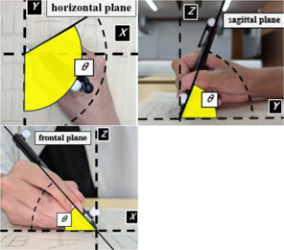
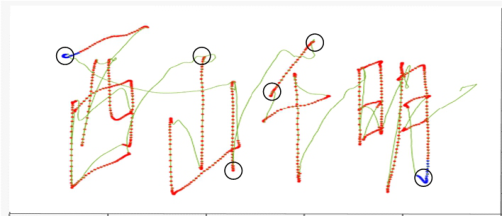
From the recorded coordinates of the pen’s tip and top, four angles were obtained: the horizontal plane, sagittal plane, frontal plane (Figure 1), and three-dimensional tilt angle of the pen. Six evaluation points were identified. The pen angles were investigated at three moments at the beginning of the first stroke of each of the characters “西,” “山,” and “千” and at three moments corresponding to characteristic movements at the end of the stroke: “tome” (stop), “hane” (upward brushstroke), and “harai” (sweeping stroke) (Figure 2). The evaluation points were extracted from a spherical region with a radius of 5 mm.
The mean and standard deviation of the four pen angles were obtained from five trials at the six evaluation points: the horizontal plane, sagittal plane, frontal plane, and three-dimensional tilt angle of the pen.
For intra-individual variability, the standard deviation of each participant’s five trials was calculated, and the mean of these standard deviations across all participants was used as an index of intra-individual variability.
For inter-individual variability, the mean angle for each participant was determined from five trials, and the standard deviation of these mean values across all participants was used as an index of inter-individual variability.
Individual Characteristics Using Pen Writing Behavior 169
Figure 1: Horizontal plane, sagittal plane, and frontal plane.Figure 2: Six evaluation points.
RESULTS
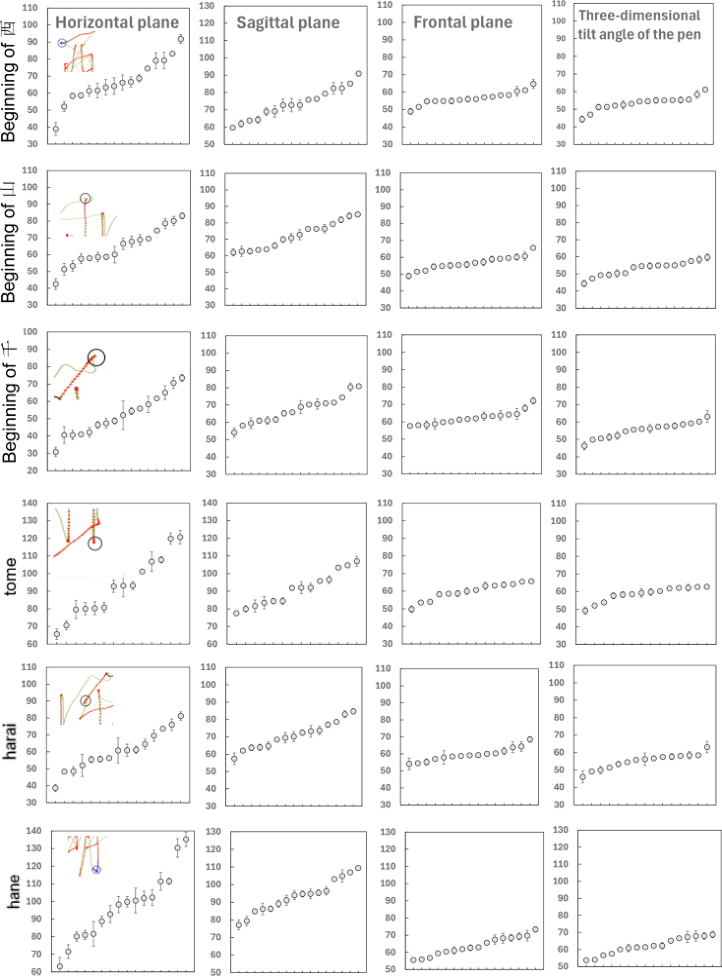
The results for the four pen angles at the six evaluation points are shown in Figure 3, which presents data for the horizontal plane, sagittal plane, frontal plane, and three-dimensional tilt angle of the pen. In Figure 3, the mean value across five trials for each participant is represented by a circle, and the standard deviation across five trials is depicted as SD bars. The participants’ results are ranked from left to right in descending order of mean values. The six evaluation points are labeled as “Beginning of 西,” “Beginning of 山,” “Beginning of 千,” “tome,” “harai,” and “hane” from top to bottom.
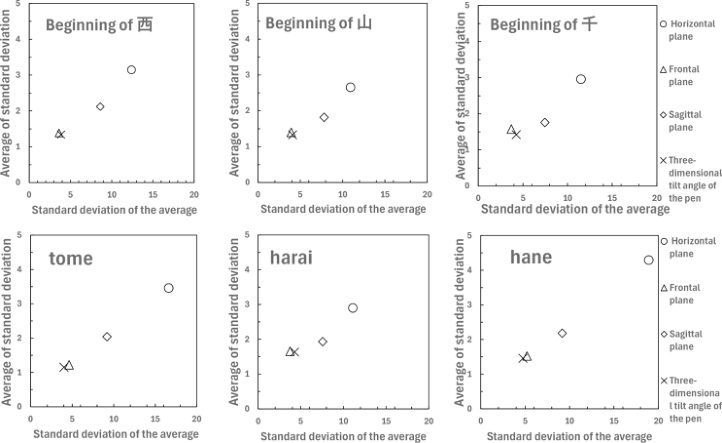
A graph showing the standard deviation of participants’ overall standard deviation of the within-individual mean of the five trials on the horizontal axis and the mean of all participants’ within-individual standard deviations of the five trials on the vertical axis is shown in Figure 4. Four pen angles were used for the six evaluation points: horizontal, sagittal, frontal, and three- dimensional tilt angles.
The horizontal (3.14
) and sagittal (2.12
) planes were larger than the frontal (1.39
) and three-dimensional tilt angle (1.34
) planes in the index of intra-individual variability at the beginning of writing “西.” The horizontal (12.41
) and sagittal (8.62
) planes showed larger values than those of the frontal (3.61
) and three-dimensional tilt angle (3.86
) planes for the index of inter-individual variability.
The horizontal (2.66
) and sagittal (1.82
) planes showed larger values than those of the frontal (1.40
) and three-dimensional tilt angle (1.33
)
170 Sugiyama and Kida
planes in the index of intra-individual variability at the beginning of writing “山.” The horizontal (10.92
) and sagittal (7.80
) planes showed larger values than those of the frontal (3.93
) and three-dimensional tilt angle (4.09
) planes for the index of inter-individual variability.
Figure 3: Measurements of each surface at six evaluation points.
The horizontal (2.96
) and sagittal (1.76
) planes showed larger values than those of the frontal (1.58
) and three-dimensional tilt angle (1.42
)
Individual Characteristics Using Pen Writing Behavior 171
planes for the index of intra-individual variability at the beginning of the “千” stroke. The horizontal (11.51
) and sagittal (7.46
) planes exhibited greater values than those of the frontal (3.70
) and three-dimensional tilt angle (4.25
) for the index of inter-individual variability.
The horizontal (3.46
) and sagittal (2.04
) planes were larger than the frontal (1.22
) and three-dimensional tilt angle (1.16
) planes in the intra- individual variability index of “tome.” The horizontal (16.63
) and sagittal (9.18
) planes showed larger values than those of the frontal (4.62
) and three-dimensional tilt angle (4.01
) planes for the index of inter-individual variability.
The horizontal plane (2.90
) showed greater values than those of the sagittal plane (1.93
), frontal plane (1.66
), and three-dimensional tilt angle (1.63
) in the index of intra-individual variability of the “harai.” The horizontal (11.10
) and sagittal (7.56
) planes showed larger values than those of the frontal (3.74
) and three-dimensional tilt angle (4.27
) planes for the index of inter-individual variability.
The horizontal (4.29
) and sagittal (2.18
) planes were larger than the frontal (1.52
) and three-dimensional tilt angle (1.46
) for the “hane” intra- individual variability index. The horizontal (18.92
) and sagittal (9.17
) planes showed larger values than those of the frontal (5.21
) and three- dimensional tilt angle (4.75
) planes for the index of inter-individual variability.
Figure 4: Intra-individual and inter-individual variation at the six evaluation points.
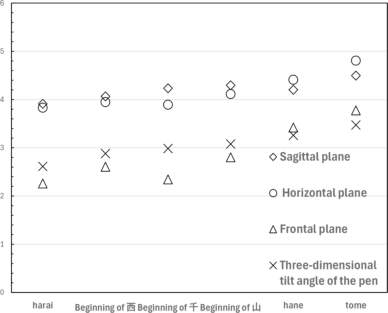
Figure 5 shows the inter-individual variability/intra-individual variability of the four pen angles (horizontal, sagittal, frontal, and three-dimensional tilt angles) for the six evaluation points. The maximum inter-individual
172 Sugiyama and Kida
variability/intra-individual variability values were arranged from right to left in descending order.
At the moment of the beginning of writing “西,” the horizontal and sagittal planes were 3.95 and 4.06, respectively, which were larger than those of the frontal plane (2.61) and three-dimensional tilt angle (2.88). At the beginning of the writing of “山,” the horizontal and sagittal planes were 4.11 and 4.29, respectively, which were larger than those of the frontal plane (2.80) and three-dimensional tilt angle (3.08). At the moment of the beginning of “千,” the horizontal and sagittal planes were 3.89 and 4.23, respectively, which were larger than those of the frontal plane (2.34) and three-dimensional tilt angle (2.98). At the “tome” moment, the horizontal and sagittal planes were 4.81 and 4.50, respectively, which were larger than those of the frontal plane (3.78) and three-dimensional tilt angle (3.47). At the “harai” moment, the horizontal and sagittal values were 3.83 and 3.91, respectively, which were larger than the values for the frontal plane (2.26) and three-dimensional tilt angle (2.61). At the “hane” moment, the horizontal and sagittal surfaces had values of 4.41 and 4.20, respectively, which were larger than those of the frontal plane (3.42) and three-dimensional tilt angle (3.26).
When comparing the six evaluation points, “tome” (3.47–4.81) and “hane” (3.26–4.41) showed larger values than those of “西” (2.61–4.06), “山” (2.80–4.29), “千” (2.34–4.23), and “harai” (2.26–3.91).
Figure 5: Indicators of inter-individual variability/intra-individual variability.
DISCUSSION
The horizontal and sagittal planes are considered more suitable for personal authentication than the frontal plane and three-dimensional tilt angle because of their greater inter-individual/intra-individual variability. Therefore, among the four pen angles, the present results suggest that the sagittal and horizontal planes are the most suitable for individual authentication.
The horizontal and sagittal planes are thought to be the main contributors to the larger index of inter-individual authentication because of the greater inter-individual variability of the horizontal and sagittal planes. In the frontal plane, writing beyond 90
is generally difficult because of finger constraints,
Individual Characteristics Using Pen Writing Behavior 173
and inter-individual variation is limited within this range. However, in the horizontal and sagittal planes, writing beyond 90
is more likely to occur, which is thought to be the reason for the wide range of values and large inter-individual variation.
A comparison of writing movements confirmed that “tome” and “hane” movements had larger inter-individual and intra-individual variability values than those of the three beginnings of writing and “harai.” This suggests that among the six points investigated in this study, the “tome” and “hane” movements may be appropriate for personal identification.
The results of the current study show that “hane” and “tome” have larger indices of personal identification than those of the three writing starts and “harai.” The writing motion of the “hane” is the moment when the pen moves sideways and downward, which is a characteristic movement. This complex movement may have influenced the high value of the personal identification index for the “hane” stroke. The “tome” writing motion is a characteristic movement used to stop the pen, and the hand movement must be controlled so that the pen movement gradually ceases. This movement may have influenced the high value of personal identification for the “tome.”
The “harai” is a characteristic end-of-writing movement confirmed by handwriting analysis, as well as the “tome” and “hane” movements, but the index for personal identification was smaller. In terms of the writing motion of the “harai,” which is a continuous stroke that keeps the pen flowing in the same direction, it is considered a more uniform writing motion, similar to the beginning of writing the first stroke. Therefore, in this experiment, the index of personal authentication for the “harai” may have been smaller than that for characteristic movements, such as the “tome” and “hane.”
In the future, it will be necessary to study character size, writing posture, and character differences to put this technology to practical use as a personal authentication method. In addition, when authenticating individuals, we believe that the reliability of authentication will be enhanced and the possibility of practical applications will increase by associating the combination of movements of each part with the individual, rather than using only one pattern of movement for authentication, and by incorporating changes in writing pressure, as in Seki’s research (Yoko, 2021).
To put this system into practical use for personal authentication, it is necessary to investigate the False Rejection Rate and the False Acceptance Rate (Yasushi, Naohisa, 2000), which will be investigated in the future.
REFERENCES
Yasushi, Nakayama. Naohisa, Komatu. (2000). “Current Status and Challenges of Biometric Personal Authentication Technology “Potential Application to Financial Services””, Institute for Monetary and Economic Studies Bank of Japan Discussion Paper. No. 99. J-43. Yoko, Seki. (2018). “Intra-individual variation and individual differences in writing
exercises”, The Japanese Associational Psychology, Vol. 60, pp. 560. Yoko, Seki. (2021). “Individuality in writing pressure change patterns”, The Japanese Associational Psychology, Vol.63, p. 493.
LISTED IN THE AHFE DIGITAL BOOKSTORE CATALOGUE
Explore the complete digital volume
Human Factors and Systems Interaction
Read this individual research paper free through the original publisher, or explore the full digital proceedings book.
ISBN 978-1-964867-68-7
Explore this ISBN in the AHFE Bookstore ↗Listed in the July 2026 bookstore catalogue; search by ISBN to confirm current availability · Digital book purchase optional