Kyosuke Oku, Yoshihiro Kai, Hitoshi Koda, Megumi Gonno, Maki Tanaka, Tomoyuki Matsui, Yuya Watanabe, Toru Morihara, Noriyuki Kida (2025). A method to measure direction change ability at irregular times in juniors. In: Human Factors in Sports, Preventive Medicine and Innovative Agonology. AHFE Open Access, vol. 188, pp. 22–30. https://doi.org/10.54941/ahfe1006478
The ability to change direction is important in everyday life for avoiding walking and sports. In actual sporting situations, the ability to change directions at irregular times is required. Previous studies have investigated this using analyses in three-dimensional space and force plate data, but it is preferable to measure it more easily. Furthermore, there is limited understanding of the ability to change direction at irregular times in the junior period. Therefore, the aim of this study was to develop a simple method of measuring the ability to change direction at irregular times in the junior period. The subjects were 44 junior high school students (11.43 ± 1.57 years old, 24 males and 20 females) who were asked to chase a target moving sideways along a 4 m straight line for 6 seconds without being caught. The target was played by two adult males, and the target characteristics were evaluated using approximate entropy (ApEn) to assess the number of turns, maximum speed, and unpredictability. Participants' pursuit accuracy was assessed using the mean and maximum differences, and response latency was assessed using the tau value at which the correlation coefficient was greatest in the cross-correlation analysis. First, to examine the reliability of the measurement method, the intraclass correlation coefficients (ICC1 and ICC1k) were calculated for the characteristics of the experimenter's movements, and significant reliability was confirmed for each variable. When the degree of pursuit was compared between the experimenters, no significant differences were found in the mean difference, maximum difference, or response delay for each variable. These results confirmed that the measurement method developed in this study was reliable, and that there was no effect due to difference between the experimenters. The simple method developed in this study for measuring the ability to change direction at irregular times is expected to be useful in sports and education.
The ability to change direction is important in everyday life, avoiding people when walking, and in sports. If you are unable to change direction at the right
A Method to Measure Direction Change Ability at Irregular Times in Juniors 23
time, you are at risk of collision, and you will not be able to perform sports maneuvers well. Previous studies have investigated the ability to run quickly in a straight line (Oku et al., 2024; Washif and Kok, 2021; Frost et al., 2008; Cronin et al., 2007), and turn (Young et al., 2002; Suarez-Arrones et al., 2020), with the ability to turn 180
, which is the costliest of all turns (Fernandez-Fernandez et al., 2023; Forster et al., 2022). While these studies focused on how fast one could run on a given course, they also used a reaction task in which the course was revealed when the subject passed through a gate (Sugiyama et al., 2021). However, in actual movement situations, the ability to change direction irregularly is required, and not just in the direction of the movement.
For this irregular timing of direction changes, a direction change ‘maneuver’ task is used. Previous studies have investigated how pedestrians choose their direction of travel in a crowd to avoid collisions (Murakami et al., 2021; Murakami et al., 2022). In sports, one-on-one maneuvers have been studied, with researchers using three-dimensional spatial coordinates and force plate data to investigate how defenders respond to irregular directional changes in the attacker (Tsutsui et al., 2020; Fujii et al., 2015; Fujii, Shinya, Yamashita, Kouzaki et al., 2014; Fujii, Shinya, Yamashita, Oda et al., 2014). In particular, the peak lateral velocity has been reported to contribute significantly to defense outcomes of the defence (Fujii et al., 2014). Based on these previous studies, focusing only on the lateral movement as a reaction task for irregular direction changes may be a simpler way to measure it.
In addition, there is limited knowledge regarding the directional changes in irregular timing ability during the junior period. The maximum speed, stride length, and ground contact time increase with age when running a 30 m straight line in the junior period (Meyers et al., 2015). It has also been reported that the time for a 5m sprint can be predicted using four factors: age, height, lower limb explosive strength (LLES), and level of competition (Kramer et al., 2021). Research has also examined the relationship between the level of competition and the ability to change direction in adolescent handball players (Matthys et al., 2013). However, research on the ability of junior athletes to pursue irregular targets is limited.
In this study, we designed a lateral-only maneuver task to measure the ability to change direction at irregular times during the junior period more easily. In real movement situations, it is necessary to respond not only to irregular movement directions but also to irregular timing. By assessing the ability to pursue a target moving in a lateral direction at irregular times, it is thought that the ability to change direction can be measured more easily than the force plate data and movement in three-dimensional space coordinates investigated in previous studies. Additionally, the ability to change direction at irregular times is lacking in the junior period, and the potential for its application in education and sports instruction will increase by making it easier to measure. Therefore, we aimed to measure the ability to change direction more easily at irregular times by using a lateral maneuver targeting the junior period. By clarifying this aim, it will be possible to more easily measure the ability to change direction at irregular intervals, which
is required in daily life and sports. We expect this to be applied in sports teaching and educational settings.
METHOD
Participants The participants were 43 junior high school students (11.43±1.57 years old, 24 males, 20 females) with regular exercise habits. Two adult males served as targets to be pursued. The purpose and content of the study were explained to the participants and their parents and written informed consent was obtained from all participants. This study was approved by the Research Ethics Committee of Kyoto Institute of Technology.
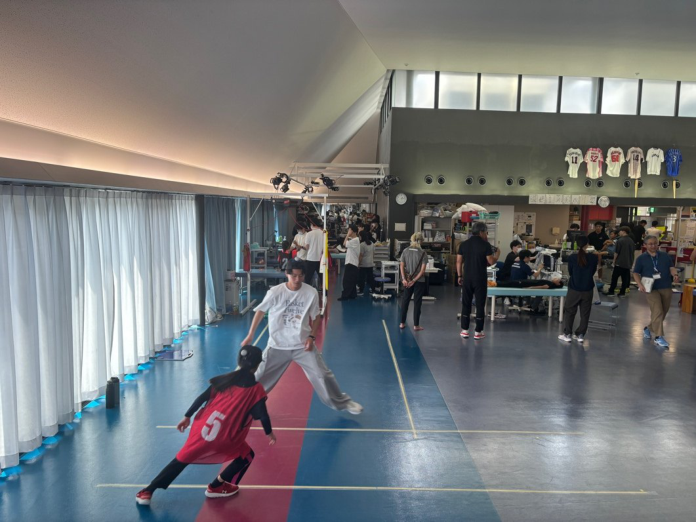
Experimental Set Up The experimental procedure is illustrated in Figure 1. Participants were asked to follow a target that moved irregularly along a 4 m wide straight line for 6 s. Two researchers played the targets. The distance between them is 1 m. The experimenters and participants wore a cap with a 40 mm diameter infrared marker attached to the top of their heads. The infrared markers were filmed using two infrared cameras (Opti Track Duo), and 3D spatial coordinates were obtained at a temporal resolution of 120 Hz.
Figure 1: Schematic of the experiment. The participants performed the maneuver task in front of the experimenter, 1 meter away. The experiment field was 4 m wide. Infrared markers attached to their heads were filmed using two infrared cameras to obtain the 3D spatial coordinates.
A Method to Measure Direction Change Ability at Irregular Times in Juniors 25
Procedure The experimenter continued to move sideways at irregular times to maintain as much distance as possible from each participant. The participants were instructed to keep up with the experimenter’s movements as much as possible by keeping the experimenter in front of their bodies. The same experimenter assessed each participant three times. Two experimenters took turns conducting the experiment; therefore, each participant performed six trials. As each of the 44 participants completed six trials, 264 trials were analyzed. If any measurement errors were detected at the spot (for example, if the infrared marker disappeared from the field of view of the camera), the trial was repeated.
Data Organisation The 5 s period from 1 s after the start of the measurement to 6 s after the end of the trial (720 frames) was the target for analysis. If there were any frames in which the acquired 3D spatial coordinates were interrupted, linear interpolation was performed. Smoothing was then performed using a 10 Hz low pass filter. In this study, we focused on lateral pursuit movements; therefore, we only analyzed the lateral movements (x-coordinates) of the target and follower.
To evaluate the participant’s movements as target stimuli, we calculated the maximum speed of the participant’s movements in a trial. The peak extraction function in Python was used to calculate the number of turns per trial. In addition, to calculate the unpredictability of the target stimulus, we calculated the approximate entropy (ApEn) (Duarte et al., 2012). This approximate entropy assumes a value between 0 and 2, with a higher value indicating a higher degree of unpredictability. Next, to assess how well the participants were able to pursue, we calculated the horizontal spatial difference in the horizontal direction for each trial and determined the average and maximum values for each trial. A small mean and maximum difference indicated good pursuit accuracy. To assess the lag in the pursuit response, we calculated the time lag τ when the cross-correlation analysis r was highest. A small time lag also indicated good tracking accuracy.
Statistical Analysis To examine the reliability of the measurement method, an intraclass correlation analysis (ICC1 and ICC1k) was performed on the experimenter’s movements to examine the reliability of the target stimulus. In addition, a correlation analysis was performed on the characteristics of the experimenter’s movements and the number of trials to examine the changes in the target role due to the number of trials. The tracking accuracies of the two experimenters were examined using a paired t-test.
RESULTS
Reliability Analysis To investigate the reliability of the visual stimulus used as the target in the measurement method, the intraclass correlation coefficient (ICC1k)
was calculated for the experimenter’s movements with respect to a single participant. As a result, significant reliability was confirmed for the number of times the experimenter changed direction (ICC1k = 0.98, p = 7.17×10⁻¹²). The intraclass correlation coefficient for maximum velocity was also analyzed and significant reliability was confirmed (ICC1k = 0.82, p = 0.020). The intraclass correlation coefficient, which expresses unpredictability, was also calculated for ApEn, and significant reliability was confirmed (ICC1k = 0.95, p = 0.000007).
To examine the reliability of the visual stimuli used as targets, we calculated the intraclass correlation coefficient (ICC1) to assess the consistency of movements within the experimenter. As a result, significant reliability was confirmed for the number of times the experimenter changed direction (ICC1 = 0.58, p = 7.17 × 10⁻¹²). The intraclass correlation coefficient for maximum velocity was also analyzed and significant reliability was confirmed (ICC1 = 0.10, p = 0.020). To examine reliability, the intraclass correlation coefficient for ApEn, which expresses unpredictability, was calculated and significant reliability was confirmed (ICC1 = 0.33, p = 0.000007).
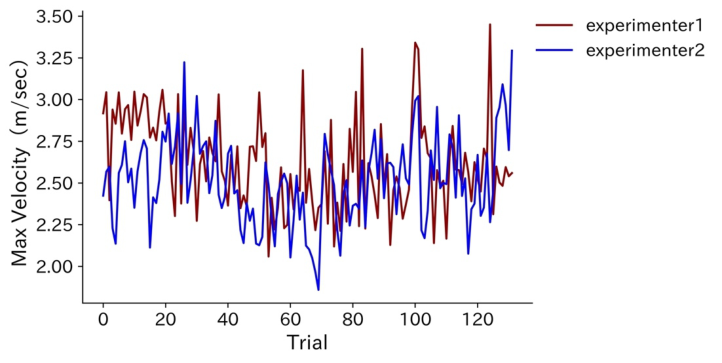
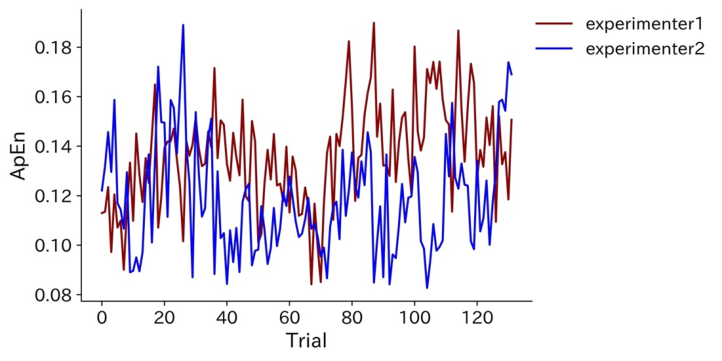
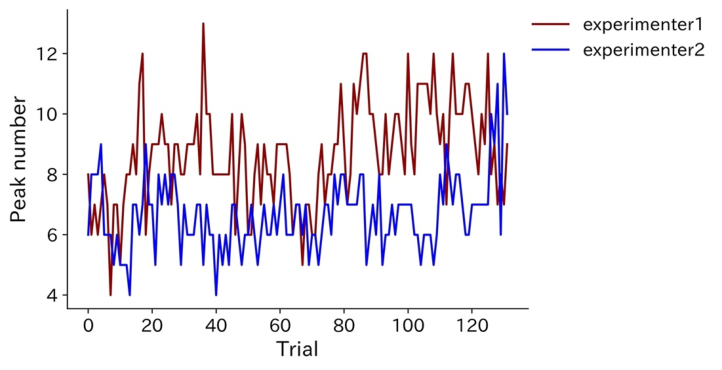
To examine whether there were any changes in movement as the number of trials increased, we analyzed the correlation between the number of trials and each characteristic of the two experimenters. When the two experimenters were combined, there was no significant correlation between the number of trials and the maximum velocity in a single trial (r = −0.09, p = 0.13) (Figure 2). For ApEn, which expresses unpredictability, it was confirmed that ApEn increased significantly with increasing number of trials (r = 0.17, p = 0.005) (Figure 3). A correlation was confirmed with the number of turnovers, suggesting that the number of turnovers increased as the number of trials increased (r = 0.27, p = 5.72×10⁻⁶) (Figure 4).
Figure 2: Changes in the number of trials at maximum velocity.
A Method to Measure Direction Change Ability at Irregular Times in Juniors 27
Figure 3: Change in number of trials at ApEn indicating unpredictability.Figure 4: The number of direction changes over the course of the trials.
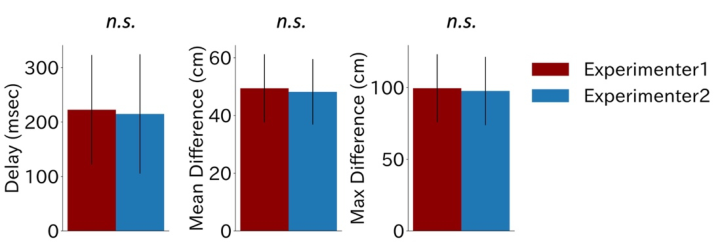
Comparing Performance Between Experimenters A paired t-test was performed on the mean difference, maximum difference, and delay in response between the two experimenters. As a result, the mean difference was 49.39 ± 11.81 cm for experimenter 1 and 48.17 ± 11.35 cm for experimenter 2, and no significant difference was found (t = 1.29, p = 0.20). The maximum difference was 99.51 ± 23.73 cm for experimenter 1 and 97.61 ± 23.82 cm for experimenter 2, no significant differences were found (t = 0.84, p = 0.40). Regarding response time, it was 222.51 ± 100.54 msec for subject 1 and 214.90 ± 109.62 msec for subject 2, and no significant difference was found (t = 0.95, p = 0.35).
Figure 5: Comparison of tracking accuracy between experimenters. The left panel shows the delay in the temporal response (cross-correlation τ), the middle panel shows the average difference in a trial, and the right panel shows the comparison of the maximum difference between experimenters.
DISCUSSION
This study aimed to develop a simple method for measuring the ability to change direction at irregular times in the junior period. The results of this study confirm the reliability of the measurement method, with significant intraclass correlations observed between the movement characteristics of the two experimenters acting as targets. Furthermore, when analyzing the number of trials and each characteristic of the movements of these two experimenters, no correlation was found for maximum speed, whereas a significant correlation was found for unpredictability and the number of direction changes; however, the effect size was small. For characteristics for which a significant relationship was found, it is possible that a significant difference was detected owing to the large number of trials. When we compared how closely the two experimenters pursued, we found no significant differences in the average, maximum, or temporal response delay. This suggests that the differences between the experimenters did not affect the followers’ performance. This is probably because the followers were juniors, whereas the two experimenters were both adult males, and the difference in motor ability between adults and children was large, making it difficult to observe the effect of the experimenter difference.
CONCLUSION
This study aims to develop a simple method for measuring juniors’ ability to change direction at irregular times. The intraclass correlation coefficients (ICC1 and ICC1k) for the characteristics of the movements of the experimenter were calculated, and the reliability was confirmed. When the degree of pursuit was compared between experimenters, no significant differences were found in the mean difference, maximum difference, or temporal response delay. These results confirmed that the measurement method developed in this study was reliable, and that there was no effect of experimenter differences. The method developed in this study can be used in sports and education to measure the ability to change direction at irregular times.
A Method to Measure Direction Change Ability at Irregular Times in Juniors 29
ACKNOWLEDGMENT
We express our gratitude to the Kyoto Board of Education for their cooperation in this research.
REFERENCES
Cronin, J. B., J. P. Green, G. T. Levin, M. E. Brughelli, and D. M. Frost. 2007. ‘Effect of starting stance on initial sprint performance’, J Strength Cond Res, 21: 990–2. Fernandez-Fernandez, J., J. Canos-Portales, R. Martinez-Gallego, F. Corbi, and
E. Baiget. 2023. ‘Effects of different maturity status on change of direction performance of youth tennis players’, Biol Sport, 40: 867–76. Forster, J. W. D., A. M. Uthoff, M. C. Rumpf, and J. B. Cronin. 2022. ‘Training to Improve Pro-Agility Performance: A Systematic Review’, J Hum Kinet, 85: 35–51. Frost, D. M., J. B. Cronin, and G. Levin. 2008. ‘Stepping backward can improve
sprint performance over short distances’, J Strength Cond Res, 22: 918–22. Fujii, K., M. Shinya, D. Yamashita, M. Kouzaki, and S. Oda. 2014. ‘Anticipation by basketball defenders: An explanation based on the three-dimensional inverted pendulum model’, Eur J Sport Sci, 14: 538–46. Fujii, K., M. Shinya, D. Yamashita, S. Oda, and M. Kouzaki. 2014. ‘Superior
reaction to changing directions for skilled basketball defenders but not linked with specialised anticipation’, Eur J Sport Sci, 14: 209–16. Fujii, K., D. Yamashita, S. Yoshioka, T. Isaka, and M. Kouzaki. 2014. ‘Strategies for defending a dribbler: Categorisation of three defensive patterns in 1-on-1 basketball’, Sports Biomech, 13: 204–14. Fujii, K., S. Yoshioka, T. Isaka, and M. Kouzaki. 2015. ‘The preparatory state of
ground reaction forces in defending against a dribbler in a basketball 1-on-1 dribble subphase’, Sports Biomech, 14: 28–44. Kramer, T., J. Valente-Dos-Santos, C. Visscher, E. Silva M. Coelho, B. C. H.
Huijgen, and M. T. Elferink-Gemser. 2021. ‘Longitudinal development of 5m sprint performance in young female tennis players’, J Sports Sci, 39: 296–303. Matthys, S. P., R. Vaeyens, J. Fransen, D. Deprez, J. Pion, J. Vandendriessche, B. Vandorpe, M. Lenoir, and R. Philippaerts. 2013. ‘A longitudinal study of multidimensional performance characteristics related to physical capacities in youth handball’, J Sports Sci, 31: 325–34. Meyers, R. W., J. L. Oliver, M. G. Hughes, J. B. Cronin, and R. S. Lloyd. 2015.
‘Maximal sprint speed in boys of increasing maturity’, Pediatr Exerc Sci, 27: 85–94. Murakami, H., C. Feliciani, Y. Nishiyama, and K. Nishinari. 2021. ‘Mutual anticipation can contribute to self-organization in human crowds’, Sci Adv, 7. Murakami, H., T. Tomaru, C. Feliciani, and Y. Nishiyama. 2022. ‘Spontaneous
behavioral coordination between avoiding pedestrians requires mutual anticipation rather than mutual gaze’, iScience, 25: 105474. Oku, K., Y. Kai, H. Koda, M. Gonno, M. Tanaka, T. Matsui, Y. Watanabe, T.
Morihara, and N. Kida. 2024. ‘Evolution of Key Factors Influencing Performance Across Phases in Junior Short Sprints’, Sports (Basel), 12. Suarez-Arrones, L., O. Gonzalo-Skok, I. Carrasquilla, J. Asian-Clemente, A. Santalla, P. Lara-Lopez, and F. J. Nunez. 2020. ‘Relationships between Change of Direction, Sprint, Jump, and Squat Power Performance’, Sports (Basel), 8. Sugiyama, T., S. Maeo, T. Kurihara, H. Kanehisa, and T. Isaka. 2021. ‘Change of
Direction Speed Tests in Basketball Players: A Brief Review of Test Varieties and Recent Trends’, Front Sports Act Living, 3: 645350.
Tsutsui, K., M. Shinya, and K. Kudo. 2020. ‘Human Navigational Strategy for Intercepting an Erratically Moving Target in Chase and Escape Interactions’, J Mot Behav, 52: 750–60. Washif, Jad Adrian, and Lian-Yee Kok. 2021. ‘Relationships Between Vertical Jump
Metrics and Sprint Performance, and Qualities that Distinguish Between Faster and Slower Sprinters’, Journal of Science in Sport and Exercise, 4: 135–44. Young, W. B., R. James, and I. Montgomery. 2002. ‘Is muscle power related to running speed with changes of direction?’, J Sports Med Phys Fitness, 42: 282–8.
LISTED IN THE AHFE DIGITAL BOOKSTORE CATALOGUE
Explore the complete digital volume
Human Factors in Sports, Preventive Medicine and Innovative Agonology
Read this individual research paper free through the original publisher, or explore the full digital proceedings book.
ISBN 978-1-964867-64-9
Explore this ISBN in the AHFE Bookstore ↗Listed in the July 2026 bookstore catalogue; search by ISBN to confirm current availability · Digital book purchase optional